Page 2 of 326
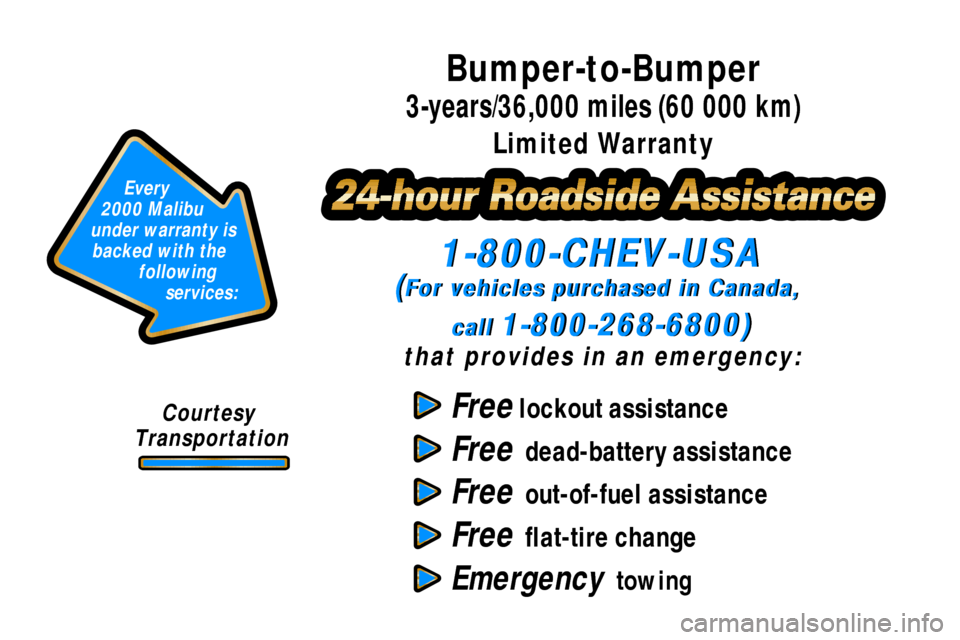
Free lockout assistance
Free dead-battery assistance
Free out-of-fuel assistance
Free flat-tire change
Emergency towing
1-800-CHEV-USA
(For vehicles purchased in Canada,
call
1-800-268-6800)
that provides in an emergency:
1-800-CHEV-USA
(For vehicles purchased in Canada,
call
1-800-268-6800)
Bumper-to-Bumper
3-years/36,000 miles (60 000 km)
Limited Warranty
Courtesy
Transportation
Every
2000 Malibu
under warranty is
backed with the
following
services:
Page 6 of 326
iv
Fuel
Checking Fluids and Lubricants
Bulb Replacement
Windshield Wiper Blade Replacement
Tires and WheelsAppearance Care
Electrical System/Fuses and Circuit Breakers
Capacities and Specifications
Normal Maintenance Replacement Parts
Table of Contents (cont'd)
Maintenance Schedule Service and Appearance Care
Section
7
Section
6
Scheduled Maintenance
Periodic Maintenance InspectionsRecommended Fluids and Lubricants
Maintenance Records
Page 11 of 326
ix
For example,
these symbols
are used on an
original battery:
CAUTION
POSSIBLE
INJURY
PROTECT
EYES BY
SHIELDING
CAUSTIC
BATTERY
ACID COULD
CAUSE
BURNS
AVOID
SPARKS OR
FLAMES
SPARK OR
FLAME
COULD
EXPLODE
BATTERY
These symbols
are important
for you and
your passengers
whenever your
vehicle is
driven:
DOOR LOCK
UNLOCK
FASTEN
SEAT
BELTS
POWER
WINDOW
AIR BAG
These symbols
have to do with
your lamps:
MASTER
LIGHTING
SWITCH
TURN
SIGNALS
PARKING
LAMPS
HAZARD
WARNING
FLASHER
DAYTIME
RUNNING
LAMPS
FOG LAMPS
These symbols
are on some of
your controls:
WINDSHIELD
WIPER
WINDSHIELD
WASHER
WINDSHIELD
DEFROSTER
REAR
WINDOW
DEFOGGER
VENTILATING
FAN
These symbols
are used on
warning and
indicator lights:
ENGINE
COOLANT
TEMP
BATTERY
CHARGING
SYSTEM
BRAKE
COOLANT
ENGINE OIL
PRESSURE
ANTI-LOCK
BRAKES
Here are some
other symbols
you may see:
FUSE
LIGHTER
HORN
SPEAKER
FUEL
Vehicle Symbols
These are some of the symbols you may find on your vehicle.
Page 76 of 326
2-13
Passlock�
Your vehicle is equipped with the Passlock
theft
-deterrent system.
Passlock is a passive theft
-deterrent system. Passlock
enables fuel if the ignition lock cylinder has not been
tampered with.
During normal operation, the THEFT SYSTEM light
will go off approximately five seconds after the key is
turned to the ON and the engine started.
If the THEFT SYSTEM light flashes with the key to
ON, wait 10 minutes until the light goes off. Then turn
the ignition key to OFF before attempting to start
the engine.
In an emergency, call the Chevrolet Roadside Assistance
Center at 1
-800-CHEV-USA� (1-800-243-8872).
(In Canada, call 1
-800-268-6800.)
New Vehicle ªBreak-Inº
NOTICE:
Your vehicle doesn't need an elaborate
ªbreak
-in.º But it will perform better in the
long run if you follow these guidelines:
�Don't drive at any one speed -- fast or
slow
-- for the first 500 miles (805 km).
Don't make full
-throttle starts.
�Avoid making hard stops for the first
200 miles (322 km) or so. During this time
your new brake linings aren't yet broken
in. Hard stops with new linings can mean
premature wear and earlier replacement.
Follow this breaking
-in guideline every
time you get new brake linings.
�Don't tow a trailer during break
-in.
See ªTowing a Trailerº in the Index for
more information.
Page 79 of 326
2-16
NOTICE:
Your engine is designed to work with the
electronics in your vehicle. If you add electrical
parts or accessories, you could change the way
the engine operates. Before adding electrical
equipment, check with your dealer. If you don't,
your engine might not perform properly.
If you ever have to have your vehicle towed,
see the part of this manual that tells how to do
it without damaging your vehicle. See ªTowing
Your Vehicleº in the Index.
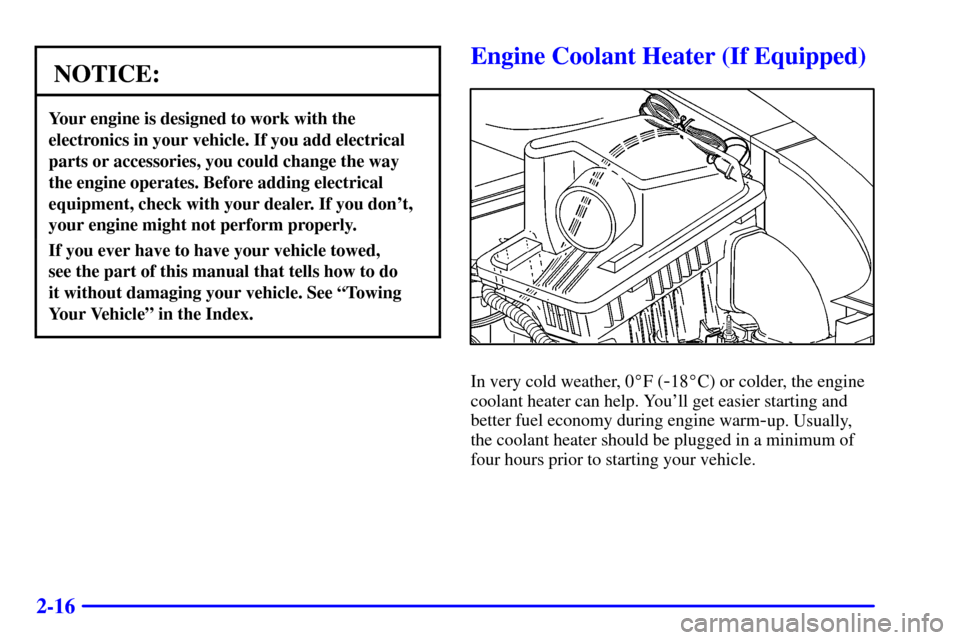
Engine Coolant Heater (If Equipped)
In very cold weather, 0�F (-18�C) or colder, the engine
coolant heater can help. You'll get easier starting and
better fuel economy during engine warm
-up. Usually,
the coolant heater should be plugged in a minimum of
four hours prior to starting your vehicle.
Page 83 of 326
2-20
AUTOMATIC OVERDRIVE (D): This position is
for normal driving. If you need more power for passing,
and you're:
�Going less than 35 mph (56 km/h), push your
accelerator pedal about halfway down.
�Going about 35 mph (56 km/h) or more, push the
accelerator all the way down. You'll shift down to
the next gear and have more power.
NOTICE:
If your vehicle seems to start up rather slowly,
or if it seems not to shift gears as you go faster,
something may be wrong with a transaxle
system sensor. If you drive very far that way,
your vehicle can be damaged. So, if this happens,
have your vehicle serviced right away. Until then,
you can use SECOND (2) when you are driving
less than 35 mph (56 km/h) and AUTOMATIC
OVERDRIVE (D) for higher speeds.
THIRD (3): This position is also used for normal
driving, however, it offers more power and lower fuel
economy than AUTOMATIC OVERDRIVE (D).
Here are some times you might choose THIRD (3)
instead of AUTOMATIC OVERDRIVE (D):
�When driving on hilly, winding roads.
�When towing a trailer, so there is less shifting
between gears.
�When going down a steep hill.
SECOND (2): This position gives you more power but
lower fuel economy. You can use SECOND (2) on hills.
It can help control your speed as you go down steep
mountain roads, but then you would also want to use
your brakes off and on.
NOTICE:
Don't drive in SECOND (2) for more than 25 miles
(41 km), or at speeds over 55 mph (88 km/h), or
you can damage your transaxle. Use AUTOMATIC
OVERDRIVE (D) or THIRD (3) as much as
possible. Don't shift into SECOND (2) unless you
are going slower than 65 mph (105 km/h) or you can
damage your engine.
Page 84 of 326
2-21
FIRST (1): This position gives you even more power
(but lower fuel economy) than SECOND (2). You can
use it on very steep hills, or in deep snow or mud.
If the selector lever is put in FIRST (1), the transaxle
won't shift into first gear until the vehicle is going
slowly enough.
NOTICE:
If your front wheels can't rotate, don't try to
drive. This might happen if you were stuck in
very deep sand or mud or were up against a
solid object. You can damage your transaxle.
Also, if you stop when going uphill, don't hold
your vehicle there with only the accelerator
pedal. This could overheat and damage the
transaxle. Use your brakes or shift into PARK (P)
to hold your vehicle in position on a hill.
Second-Gear Start
Your vehicle is equipped with a second-gear start
feature. Place the shift lever in SECOND (2) gear to
provide more traction when you are starting on ice
or other slippery surfaces. The transaxle will be in
SECOND (2) gear when the vehicle begins to move.
After starting in SECOND (2) gear, place the shift lever
in THIRD (3) or AUTOMATIC OVERDRIVE (D).
This feature is only for improved traction only when
the road surface is slippery and in not intended for
continuous use or when the vehicle is stuck in sand,
mud, ice, snow or gravel.
Page 116 of 326
2-53 Low Coolant Warning Light
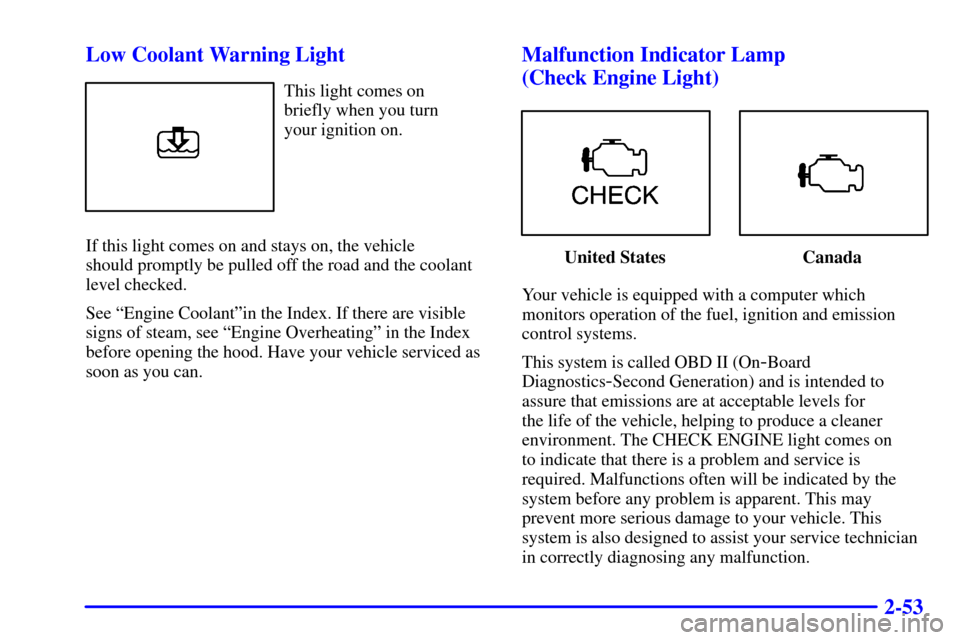
This light comes on
briefly when you turn
your ignition on.
If this light comes on and stays on, the vehicle
should promptly be pulled off the road and the coolant
level checked.
See ªEngine Coolantºin the Index. If there are visible
signs of steam, see ªEngine Overheatingº in the Index
before opening the hood. Have your vehicle serviced as
soon as you can.
Malfunction Indicator Lamp
(Check Engine Light)
United States Canada
Your vehicle is equipped with a computer which
monitors operation of the fuel, ignition and emission
control systems.
This system is called OBD II (On
-Board
Diagnostics
-Second Generation) and is intended to
assure that emissions are at acceptable levels for
the life of the vehicle, helping to produce a cleaner
environment. The CHECK ENGINE light comes on
to indicate that there is a problem and service is
required. Malfunctions often will be indicated by the
system before any problem is apparent. This may
prevent more serious damage to your vehicle. This
system is also designed to assist your service technician
in correctly diagnosing any malfunction.