Page 76 of 326
2-13
Passlock�
Your vehicle is equipped with the Passlock
theft
-deterrent system.
Passlock is a passive theft
-deterrent system. Passlock
enables fuel if the ignition lock cylinder has not been
tampered with.
During normal operation, the THEFT SYSTEM light
will go off approximately five seconds after the key is
turned to the ON and the engine started.
If the THEFT SYSTEM light flashes with the key to
ON, wait 10 minutes until the light goes off. Then turn
the ignition key to OFF before attempting to start
the engine.
In an emergency, call the Chevrolet Roadside Assistance
Center at 1
-800-CHEV-USA� (1-800-243-8872).
(In Canada, call 1
-800-268-6800.)
New Vehicle ªBreak-Inº
NOTICE:
Your vehicle doesn't need an elaborate
ªbreak
-in.º But it will perform better in the
long run if you follow these guidelines:
�Don't drive at any one speed -- fast or
slow
-- for the first 500 miles (805 km).
Don't make full
-throttle starts.
�Avoid making hard stops for the first
200 miles (322 km) or so. During this time
your new brake linings aren't yet broken
in. Hard stops with new linings can mean
premature wear and earlier replacement.
Follow this breaking
-in guideline every
time you get new brake linings.
�Don't tow a trailer during break
-in.
See ªTowing a Trailerº in the Index for
more information.
Page 77 of 326
2-14
Ignition Positions
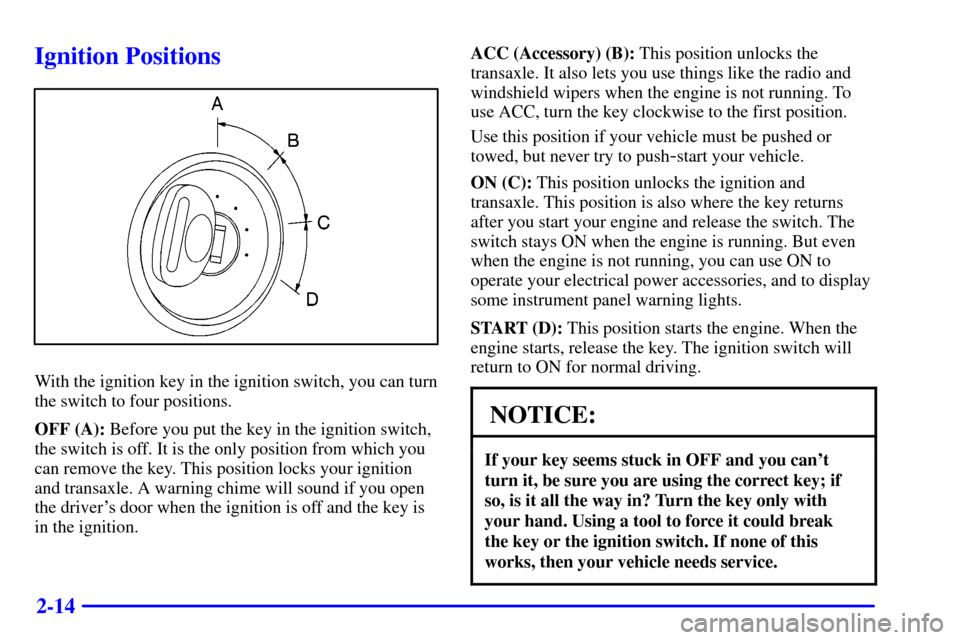
With the ignition key in the ignition switch, you can turn
the switch to four positions.
OFF (A): Before you put the key in the ignition switch,
the switch is off. It is the only position from which you
can remove the key. This position locks your ignition
and transaxle. A warning chime will sound if you open
the driver's door when the ignition is off and the key is
in the ignition.ACC (Accessory) (B): This position unlocks the
transaxle. It also lets you use things like the radio and
windshield wipers when the engine is not running. To
use ACC, turn the key clockwise to the first position.
Use this position if your vehicle must be pushed or
towed, but never try to push
-start your vehicle.
ON (C): This position unlocks the ignition and
transaxle. This position is also where the key returns
after you start your engine and release the switch. The
switch stays ON when the engine is running. But even
when the engine is not running, you can use ON to
operate your electrical power accessories, and to display
some instrument panel warning lights.
START (D): This position starts the engine. When the
engine starts, release the key. The ignition switch will
return to ON for normal driving.
NOTICE:
If your key seems stuck in OFF and you can't
turn it, be sure you are using the correct key; if
so, is it all the way in? Turn the key only with
your hand. Using a tool to force it could break
the key or the ignition switch. If none of this
works, then your vehicle needs service.
Page 78 of 326
2-15
Starting Your Engine
Move your shift lever to PARK (P) or NEUTRAL (N).
Your engine won't start in any other position
-- that's a
safety feature. To restart when you're already moving,
use NEUTRAL (N) only.
NOTICE:
Don't try to shift to PARK (P) if your vehicle
is moving. If you do, you could damage the
transaxle. Shift to PARK (P) only when your
vehicle is stopped.
1. Without pushing the accelerator pedal, turn your
ignition key to START. When the engine starts, let
go of the key. The idle speed will go down as your
engine gets warm.
NOTICE:
Holding your key in START for longer than
15 seconds at a time will cause your battery to
be drained much sooner. And the excessive heat
can damage your starter motor. Wait about
15 seconds between each try to help avoid
draining your battery or damaging your starter.
2. If your engine won't start (or starts but then stops),
it could be flooded with too much gasoline. Try
pushing your accelerator pedal all the way to the
floor and holding it there as you hold the key in
START for up to 15 seconds. This clears the extra
gasoline from the engine.
Page 82 of 326
2-19
Ensure the shift lever is fully in PARK (P) before
starting the engine. Your vehicle has an automatic
transaxle shift lock control. You have to apply your
regular brake before you can shift from PARK (P) when
the ignition key is to ON. If you cannot shift out of
PARK (P), ease pressure on the shift lever
-- push
the shift lever all the way into PARK (P)
-- as you
maintain brake application. Then move the shift lever
into the gear you wish. (Press the shift lever button
before moving the shift lever.) See ªShifting Out of
PARK (P)º later in this section.
REVERSE (R): Use this gear to back up.
NOTICE:
Shifting to REVERSE (R) while your vehicle is
moving forward could damage your transaxle.
Shift to REVERSE (R) only after your vehicle
is stopped.
To rock your vehicle back and forth to get out of snow,
ice or sand without damaging your transaxle, see ªStuck
In Sand, Mud, Ice or Snowº in the Index.NEUTRAL (N): In this position, your engine doesn't
connect with the wheels. To restart when you're
already moving, use NEUTRAL (N) only. Also, use
NEUTRAL (N) when your vehicle is being towed.
CAUTION:
Shifting out of PARK (P) or NEUTRAL (N) while
your engine is ªracingº (running at high speed)
is dangerous. Unless your foot is firmly on the
brake pedal, your vehicle could move very
rapidly. You could lose control and hit people
or objects. Don't shift out of PARK (P) or
NEUTRAL (N) while your engine is racing.
NOTICE:
Damage to your transaxle caused by shifting out
of PARK (P) or NEUTRAL (N) with the engine
racing isn't covered by your warranty.
Page 85 of 326
2-22
Parking Brake
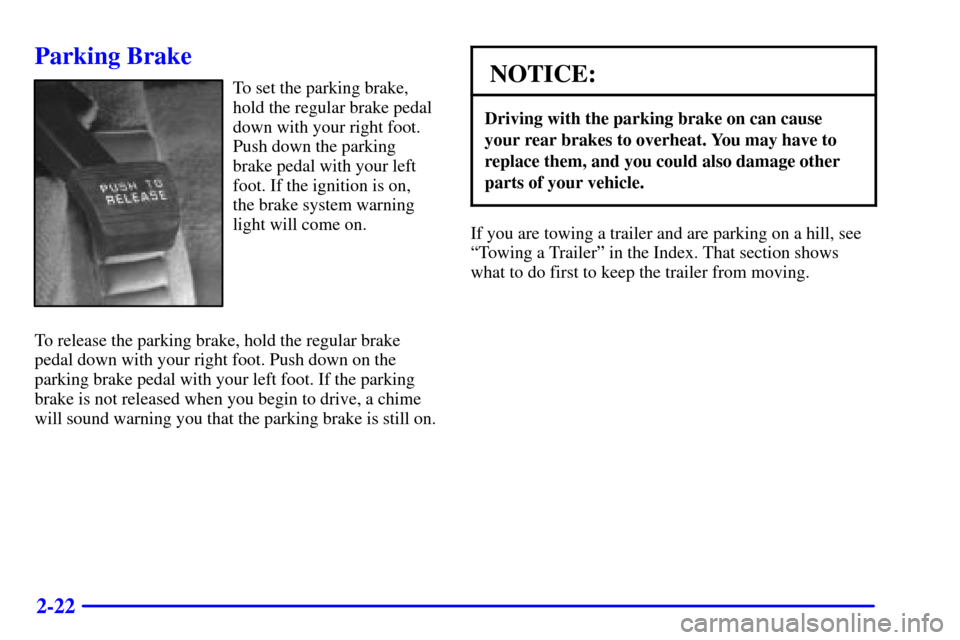
To set the parking brake,
hold the regular brake pedal
down with your right foot.
Push down the parking
brake pedal with your left
foot. If the ignition is on,
the brake system warning
light will come on.
To release the parking brake, hold the regular brake
pedal down with your right foot. Push down on the
parking brake pedal with your left foot. If the parking
brake is not released when you begin to drive, a chime
will sound warning you that the parking brake is still on.NOTICE:
Driving with the parking brake on can cause
your rear brakes to overheat. You may have to
replace them, and you could also damage other
parts of your vehicle.
If you are towing a trailer and are parking on a hill, see
ªTowing a Trailerº in the Index. That section shows
what to do first to keep the trailer from moving.
Page 86 of 326
2-23
Shifting Into PARK (P)
CAUTION:
It can be dangerous to get out of your vehicle if
the shift lever is not fully in PARK (P) with the
parking brake firmly set. Your vehicle can roll. If
you have left the engine running, the vehicle can
move suddenly. You or others could be injured.
To be sure your vehicle won't move, even when
you're on fairly level ground, use the steps that
follow. If you're pulling a trailer, see ªTowing a
Trailerº in the Index.
1. Hold the brake pedal down with your right foot and
set the parking brake.
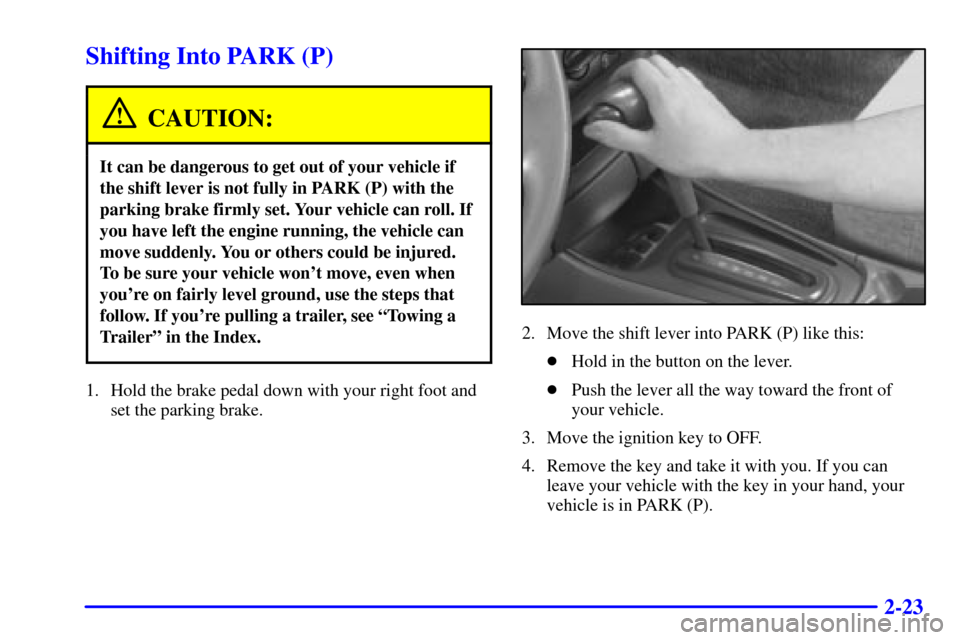
2. Move the shift lever into PARK (P) like this:
�Hold in the button on the lever.
�Push the lever all the way toward the front of
your vehicle.
3. Move the ignition key to OFF.
4. Remove the key and take it with you. If you can
leave your vehicle with the key in your hand, your
vehicle is in PARK (P).
Page 88 of 326
2-25
Shifting Out of PARK (P)
Your vehicle has an automatic transaxle shift lock
control. You have to apply your regular brake before
you can shift from PARK (P) when the ignition is in
ON. See ªAutomatic Transaxleº in the Index.
If you cannot shift out of PARK (P), ease pressure on
the shift lever
-- push the shift lever all the way into
PARK (P)
-- as you maintain brake application. Then
move the shift into the gear you wish. (Press the shift
lever button before moving the shift lever.)
If you ever hold the brake pedal down but still can't
shift out of PARK (P), try this:
1. Turn the key to ACC.
2. Apply and hold the regular brake until the end
of step 5.
3. Shift to NEUTRAL (N).
4. Turn the key to START, to start the vehicle.
5. Shift to the drive gear you want.
6. Have the vehicle fixed as soon as you can.
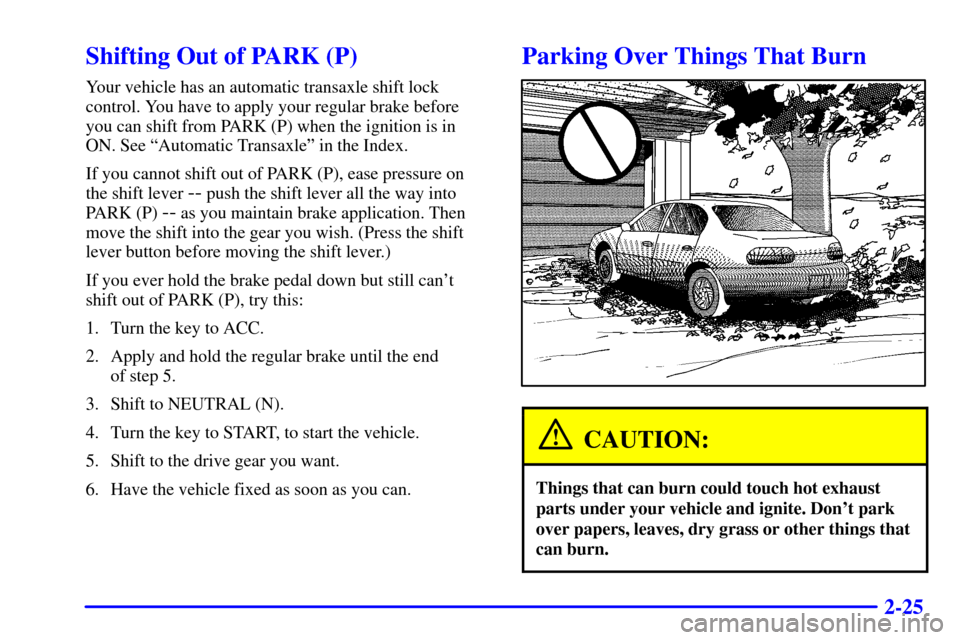
Parking Over Things That Burn
CAUTION:
Things that can burn could touch hot exhaust
parts under your vehicle and ignite. Don't park
over papers, leaves, dry grass or other things that
can burn.
Page 93 of 326
2-30
As you signal a turn or a lane change, if the arrows
flash rapidly, a signal bulb may be burned out and
other drivers won't see your turn signal.
If a bulb is burned out, replace it to help avoid an
accident. If the arrows don't go on at all when you
signal a turn, check for burned
-out bulbs and then check
the fuse (see ªFuses and Circuit Breakersº in the Index).
Headlamp High/Low Beam Changer
To change the headlamps
from low beam to
high beam, push
forward on the turn
signal/multifunction lever.
To change the headlamps from high beam to low beam,
pull the turn signal lever toward you. When the high
beams are on, a light on the instrument panel cluster
also will be on if the ignition is to ON.
Flash-to-Pass
This feature lets you use your high-beam headlamps to
signal a driver in front of you that you want to pass.
To use it, pull the turn signal/multifunction lever toward
you until the high
-beam headlamps come on, then
release the lever to turn them off.
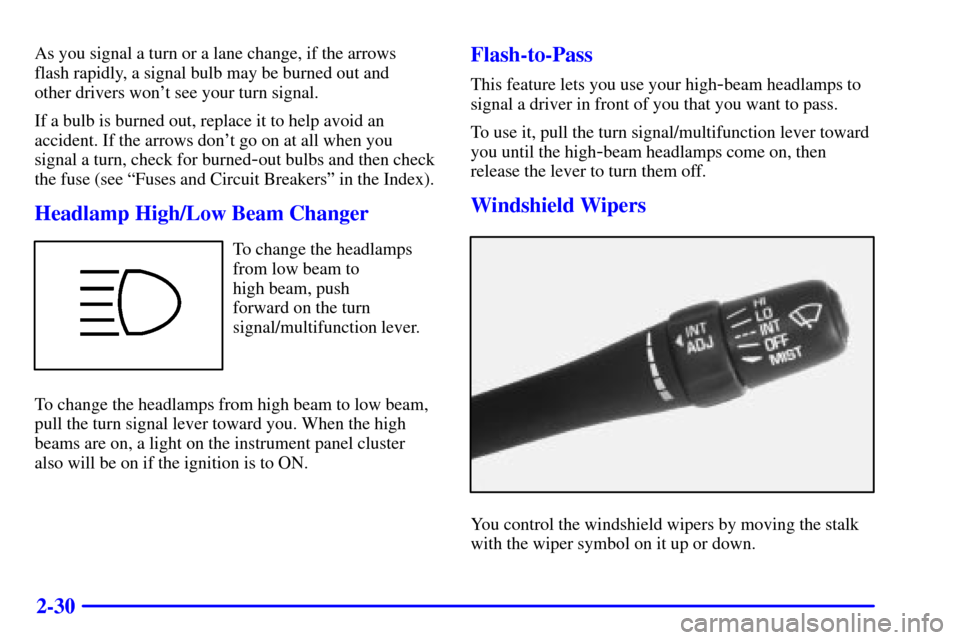
Windshield Wipers
You control the windshield wipers by moving the stalk
with the wiper symbol on it up or down.