Page 77 of 398

2-
yellowblue
2-1
Section 2 Features and Controls
Here you can learn about the many standard and optional features on your vehicle, and information on starting,
shifting and braking. Also explained are the instrument panel and the warning systems that tell you if everything is
working properly
-- and what to do if you have a problem.
2
-2 Keys
2
-3 Door Locks
2
-6 Keyless Entry System (If Equipped)
2
-14 Rear Doors
2
-15 Theft
2
-16 Passlock�
2-17 New Vehicle ªBreak-Inº
2
-17 Ignition Positions
2
-18 Starting Your Gasoline Engine
2
-20 Engine Coolant Heater (If Equipped)
2
-21 Automatic Transmission Operation
2
-24 Parking Brake
2
-25 Shifting Into PARK (P)
2
-28 Shifting Out of PARK (P)
2
-28 Parking Over Things That Burn
2
-29 Engine Exhaust2
-29 Running Your Engine While You're Parked
2
-30 Locking Rear Axle
2
-30 Windows
2
-33 Horn
2
-33 Tilt Wheel (Option)
2
-33 Turn Signal/Multifunction Lever
2
-39 Exterior Lamps
2
-41 Interior Lamps
2
-43 Mirrors
2
-46 Storage Compartments
2
-46 Cigarette Lighter/Ashtray
2
-47 Sun Visors
2
-48 The Instrument Panel - Your
Information System
2
-49 Instrument Panel Cluster
2
-51 Warning Lights, Gages and Indicators
Page 90 of 398
yellowblue
2-14
Rear Doors
CAUTION:
It can be dangerous to drive with the rear doors
open because carbon monoxide (CO) gas can
come into your vehicle. You can't see or smell
CO. It can cause unconsciousness and even death.
If you must drive with the rear doors open or if
electrical wiring or other cable connections must
pass through the seal between the body and the
rear doors:
�Make sure all other windows are shut.
�Turn the fan on your heating or cooling
system to its highest speed with the setting
on VENT, HEAT, BLEND or DEF.
Additionally, on vehicles with heating/air
conditioning systems, NORM A/C or
BI
-LEVEL A/C can be used. That will
force outside air into your vehicle. See
ªComfort Controlsº in the Index.
�If you have air outlets on or under the
instrument panel, open them all the way.
See ªEngine Exhaustº in the Index.
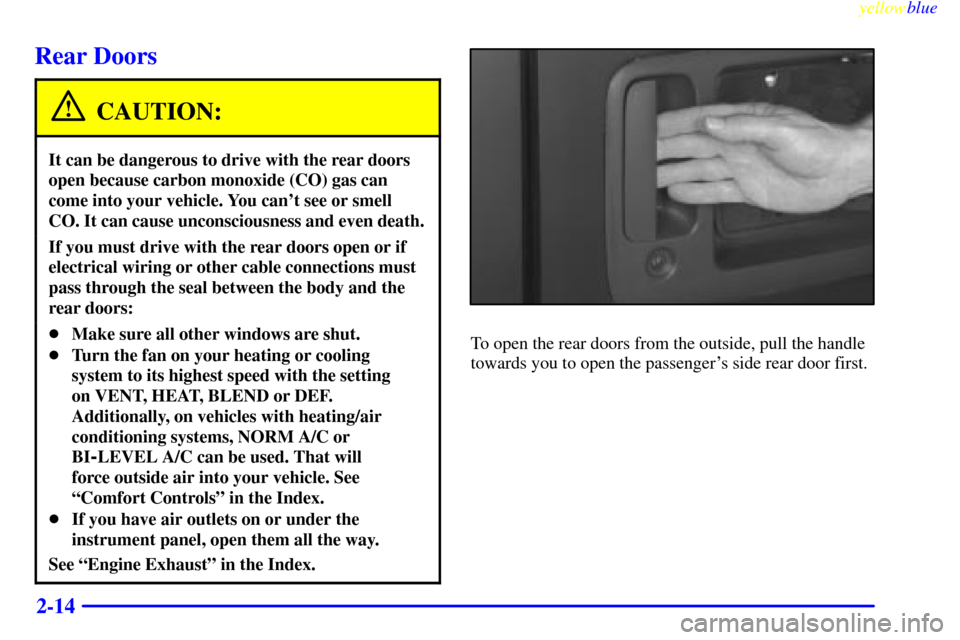
To open the rear doors from the outside, pull the handle
towards you to open the passenger's side rear door first.
Page 108 of 398
yellowblue
2-32
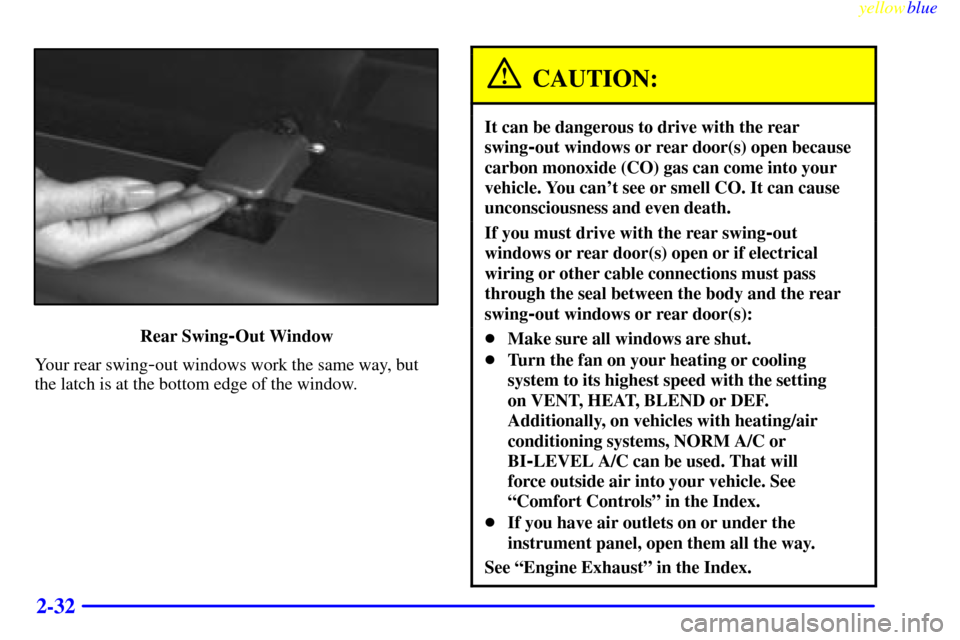
Rear Swing-Out Window
Your rear swing
-out windows work the same way, but
the latch is at the bottom edge of the window.
CAUTION:
It can be dangerous to drive with the rear
swing
-out windows or rear door(s) open because
carbon monoxide (CO) gas can come into your
vehicle. You can't see or smell CO. It can cause
unconsciousness and even death.
If you must drive with the rear swing-out
windows or rear door(s) open or if electrical
wiring or other cable connections must pass
through the seal between the body and the rear
swing
-out windows or rear door(s):
�Make sure all windows are shut.
�Turn the fan on your heating or cooling
system to its highest speed with the setting
on VENT, HEAT, BLEND or DEF.
Additionally, on vehicles with heating/air
conditioning systems, NORM A/C or
BI
-LEVEL A/C can be used. That will
force outside air into your vehicle. See
ªComfort Controlsº in the Index.
�If you have air outlets on or under the
instrument panel, open them all the way.
See ªEngine Exhaustº in the Index.
Page 110 of 398
yellowblue
2-34 Turn Signal and Lane Change Signals
The turn signal has two upward (for right) and two
downward (for left) positions. These positions allow you
to signal a turn or a lane change.
To signal a turn, move the lever all the way up
or down. When the turn is finished, the lever will
return automatically.
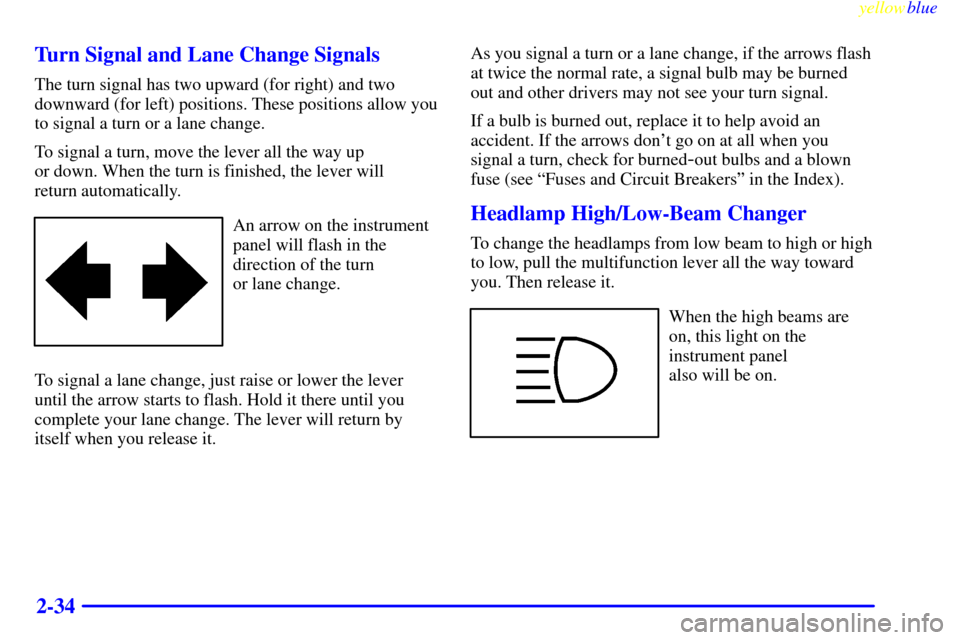
An arrow on the instrument
panel will flash in the
direction of the turn
or lane change.
To signal a lane change, just raise or lower the lever
until the arrow starts to flash. Hold it there until you
complete your lane change. The lever will return by
itself when you release it.As you signal a turn or a lane change, if the arrows flash
at twice the normal rate, a signal bulb may be burned
out and other drivers may not see your turn signal.
If a bulb is burned out, replace it to help avoid an
accident. If the arrows don't go on at all when you
signal a turn, check for burned
-out bulbs and a blown
fuse (see ªFuses and Circuit Breakersº in the Index).
Headlamp High/Low-Beam Changer
To change the headlamps from low beam to high or high
to low, pull the multifunction lever all the way toward
you. Then release it.
When the high beams are
on, this light on the
instrument panel
also will be on.
Page 115 of 398
yellowblue
2-39
Exterior Lamps
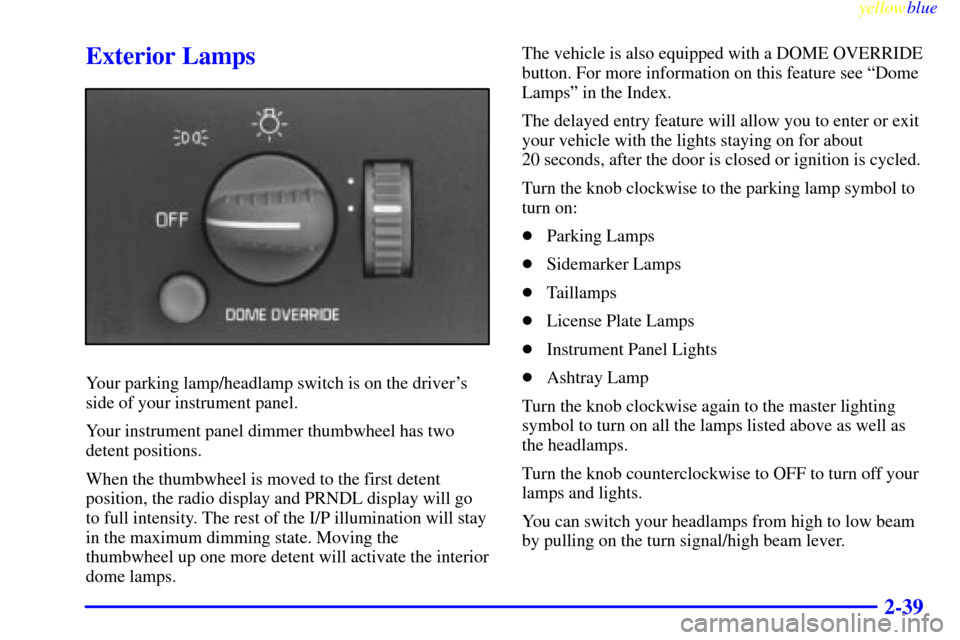
Your parking lamp/headlamp switch is on the driver's
side of your instrument panel.
Your instrument panel dimmer thumbwheel has two
detent positions.
When the thumbwheel is moved to the first detent
position, the radio display and PRNDL display will go
to full intensity. The rest of the I/P illumination will stay
in the maximum dimming state. Moving the
thumbwheel up one more detent will activate the interior
dome lamps.The vehicle is also equipped with a DOME OVERRIDE
button. For more information on this feature see ªDome
Lampsº in the Index.
The delayed entry feature will allow you to enter or exit
your vehicle with the lights staying on for about
20 seconds, after the door is closed or ignition is cycled.
Turn the knob clockwise to the parking lamp symbol to
turn on:
�Parking Lamps
�Sidemarker Lamps
�Taillamps
�License Plate Lamps
�Instrument Panel Lights
�Ashtray Lamp
Turn the knob clockwise again to the master lighting
symbol to turn on all the lamps listed above as well as
the headlamps.
Turn the knob counterclockwise to OFF to turn off your
lamps and lights.
You can switch your headlamps from high to low beam
by pulling on the turn signal/high beam lever.
Page 116 of 398

yellowblue
2-40
A circuit breaker protects your headlamps. If you have
an electrical overload, your headlamps will flicker on
and off. Have your headlamp wiring checked right away
if this happens.
Headlamps On Reminder
A tone will sound when your headlamps are turned on
and your ignition is in OFF, LOCK or ACCESSORY.
If you need to use your headlamps when the ignition
switch is in OFF, LOCK or ACCESSORY, the tone can
be turned off by moving the thumbwheel next to the
parking lamp/headlamp switch all the way down.
Daytime Running Lamps
Daytime Running Lamps (DRL) can make it easier for
others to see the front of your vehicle during the day.
DRL can be helpful in many different driving
conditions, but they can be especially helpful in the
short periods after dawn and before sunset.The DRL system will make your headlamps come on at
a reduced brightness when:
�The ignition is on,
�The headlamp switch is off, and
�The parking brake is released.
When the DRL are on, only your headlamps will be on.
The taillamps, sidemarker and other lamps won't be on.
Your instrument panel won't be lit up either.
When it begins to get dark, your DRL indicator light is a
reminder to turn your headlamp switch on. The other
lamps that come on with your headlamps will also
come on.
When you turn off the headlamp switch, the regular
lamps will go off, and your headlamps will change to
the reduced brightness of DRL.
To idle your vehicle with the engine on and the DRL off,
set the parking brake. The DRL will stay off until you
release the parking brake.
As with any vehicle, you should turn on the regular
headlamp system when you need it.
Page 122 of 398
yellowblue
2-46
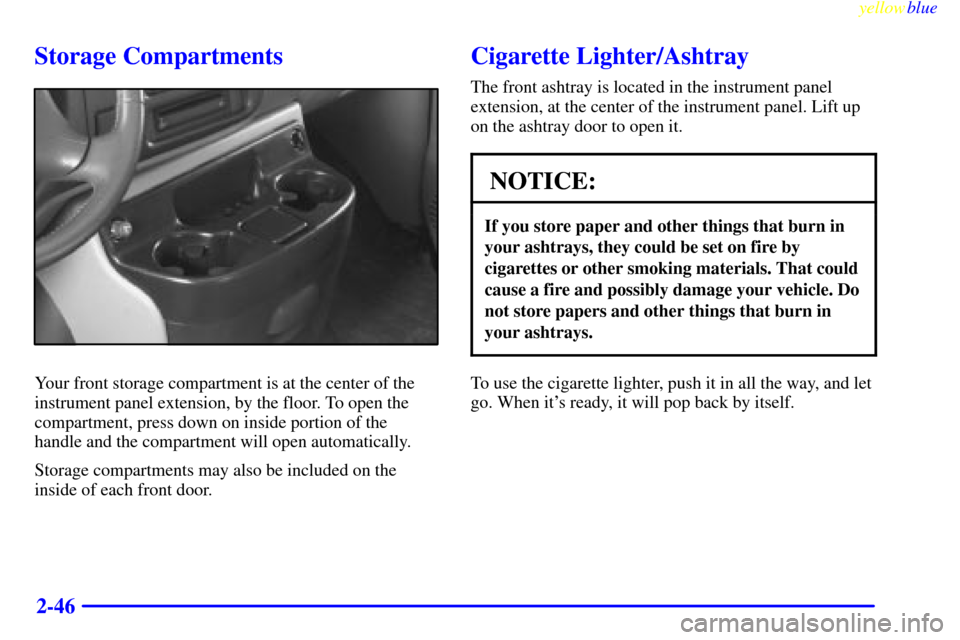
Storage Compartments
Your front storage compartment is at the center of the
instrument panel extension, by the floor. To open the
compartment, press down on inside portion of the
handle and the compartment will open automatically.
Storage compartments may also be included on the
inside of each front door.
Cigarette Lighter/Ashtray
The front ashtray is located in the instrument panel
extension, at the center of the instrument panel. Lift up
on the ashtray door to open it.
NOTICE:
If you store paper and other things that burn in
your ashtrays, they could be set on fire by
cigarettes or other smoking materials. That could
cause a fire and possibly damage your vehicle. Do
not store papers and other things that burn in
your ashtrays.
To use the cigarette lighter, push it in all the way, and let
go. When it's ready, it will pop back by itself.
Page 124 of 398
yellowblue
2-48
The Instrument Panel - Your Information System
A. Lamp Controls
B. Air Vents
C. Instrument Panel Cluster
D. Comfort Controls System
E. Audio SystemF. Auxiliary Power Outlet
G. Cupholder
H. Ashtray
I. Cigarette LighterJ. Convenience Tray
K. Horn
L. Turn Signal/Multifunction
Lever