Page 298 of 361
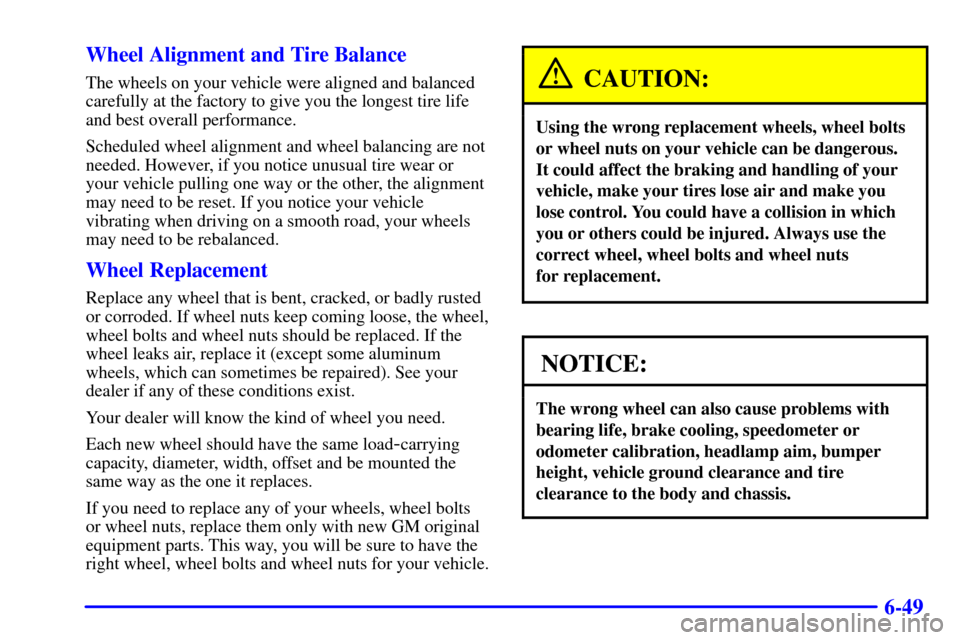
6-49 Wheel Alignment and Tire Balance
The wheels on your vehicle were aligned and balanced
carefully at the factory to give you the longest tire life
and best overall performance.
Scheduled wheel alignment and wheel balancing are not
needed. However, if you notice unusual tire wear or
your vehicle pulling one way or the other, the alignment
may need to be reset. If you notice your vehicle
vibrating when driving on a smooth road, your wheels
may need to be rebalanced.
Wheel Replacement
Replace any wheel that is bent, cracked, or badly rusted
or corroded. If wheel nuts keep coming loose, the wheel,
wheel bolts and wheel nuts should be replaced. If the
wheel leaks air, replace it (except some aluminum
wheels, which can sometimes be repaired). See your
dealer if any of these conditions exist.
Your dealer will know the kind of wheel you need.
Each new wheel should have the same load
-carrying
capacity, diameter, width, offset and be mounted the
same way as the one it replaces.
If you need to replace any of your wheels, wheel bolts
or wheel nuts, replace them only with new GM original
equipment parts. This way, you will be sure to have the
right wheel, wheel bolts and wheel nuts for your vehicle.
CAUTION:
Using the wrong replacement wheels, wheel bolts
or wheel nuts on your vehicle can be dangerous.
It could affect the braking and handling of your
vehicle, make your tires lose air and make you
lose control. You could have a collision in which
you or others could be injured. Always use the
correct wheel, wheel bolts and wheel nuts
for replacement.
NOTICE:
The wrong wheel can also cause problems with
bearing life, brake cooling, speedometer or
odometer calibration, headlamp aim, bumper
height, vehicle ground clearance and tire
clearance to the body and chassis.
Page 321 of 361
6-72
Minifuse Usage
7 Selective Real Time Damping
(SRTD) Relay
8 Headlamp Low
-Beam Right
9 Headlamp High
-Beam Right
10 Headlamp Low
-Beam Left
11 Horn
12 Headlamp High
-Beam Left
13 Fuel Pump
14 Cooling Fan
- Ignition 3
15 Oxygen Sensor
16 Powertrain Control Module
17 Throttle Control
18 Injector 2
19 Engine Ignition
20 Blank
21 Blank
22 Injector 1
23 Powertrain Control Module
24 Air ConditioningMinifuse Usage
25 Blank
26 Blank
27 Spare
28 Spare
29 Spare
30 Spare
31 Spare
32 Spare
Micro Relay Usage
33 Air Pump
34 Air Conditioner and Clutch
35 Fuel Pump
36 Horn
37 Rear Fog Lamp
38 Back
-Up Lamps
39 Fog Lamp
40 Blank
41 Selective Real Time
Damping (SRTD)
Page 322 of 361
6-73
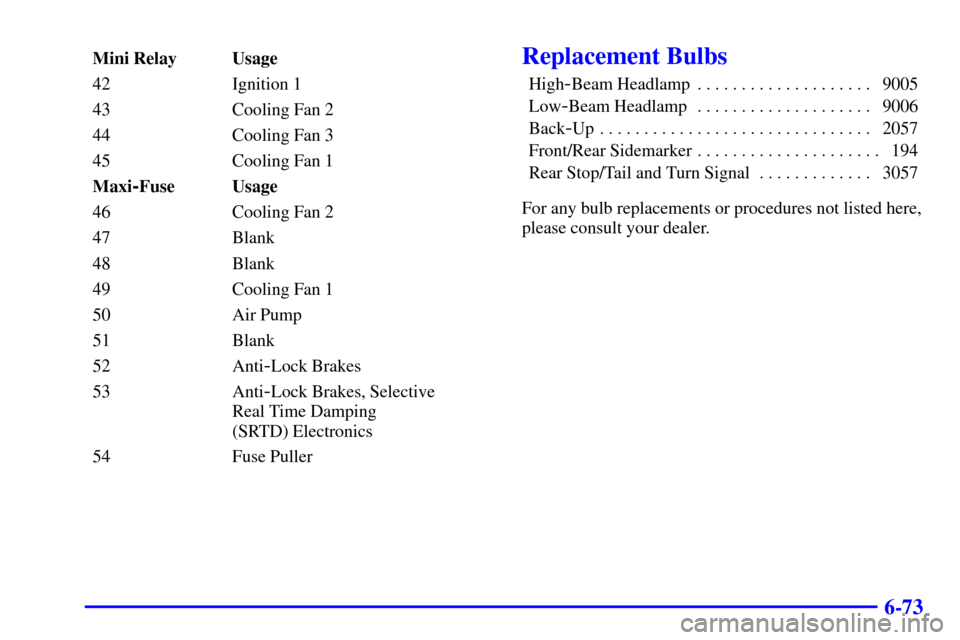
Mini Relay Usage
42 Ignition 1
43 Cooling Fan 2
44 Cooling Fan 3
45 Cooling Fan 1
Maxi
-Fuse Usage
46 Cooling Fan 2
47 Blank
48 Blank
49 Cooling Fan 1
50 Air Pump
51 Blank
52 Anti
-Lock Brakes
53 Anti
-Lock Brakes, Selective
Real Time Damping
(SRTD) Electronics
54 Fuse Puller
Replacement Bulbs
High-Beam Headlamp 9005. . . . . . . . . . . . . . . . . . . .
Low
-Beam Headlamp 9006. . . . . . . . . . . . . . . . . . . .
Back
-Up 2057. . . . . . . . . . . . . . . . . . . . . . . . . . . . . . .
Front/Rear Sidemarker 194. . . . . . . . . . . . . . . . . . . . .
Rear Stop/Tail and Turn Signal 3057. . . . . . . . . . . . .
For any bulb replacements or procedures not listed here,
please consult your dealer.
Page 323 of 361

6-74
Capacities and Specifications
The following approximate capacities are given in
English and metric conversions.
Please refer to ªRecommended Fluids and Lubricantsº
in the Index for more information.
Air ConditioningSee the refrigerant information . . .
label under the hood.
Automatic Transmission
Drain and Refill 5.0 quarts (4.7 L). . . . . . . . . . . . . .
Overhaul 10.8 quarts (10.2 L). . . . . . . . . . . . . . . . .
Cooling System12.6 quarts (11.9 L) . . . . . . . . . . . . . .
Crankcase
With Filter Change 6.5 quarts (6.1 L). . . . . . . . . . .
Fuel Tank18.5 gallons (70.0 L) . . . . . . . . . . . . . . . . .
Manual Transmission
(Overhaul)4.1 quarts (3.8 L) . . . . . . . . . . . . . . . . .
Rear Axle
Lubricant 1.69 quarts (1.6 L). . . . . . . . . . . . . . . . . .
Limited Slip Additive 4 ounces (118 ml). . . . . . . . .
Tire PressuresSee Tire
-Loading Information . . . . . .
label on rear edge of driver's door.
Wheel Nut Torque100 lb
-ft (140 N´m) . . . . . . . . . . All capacities are approximate. When adding, be sure to
fill to the appropriate level, as recommended in this
manual. Recheck fluid level after filling.
Engine Specifications
Type5.7L V8 . . . . . . . . . . . . . . . . . . . . . . . . . . . . . . . .
VIN Engine CodeG . . . . . . . . . . . . . . . . . . . . . . . . . .
Displacement346 cubic inches (5665 cc) . . . . . . . . .
Fuel DeliverySequential Multi
-Port . . . . . . . . . . . . .
Fuel Injection (SFI)
Valve ArrangementOverhead Valve . . . . . . . . . . . . .
Piston Displacement5.7L . . . . . . . . . . . . . . . . . . . . . .
Bore3.90 inches (9.9 cm) . . . . . . . . . . . . . . . . . . . . . .
Stroke3.62 inches (9.2 cm) . . . . . . . . . . . . . . . . . . . .
Compression Ratio10.1:1 . . . . . . . . . . . . . . . . . . . .
Horsepower345 @ 5600 . . . . . . . . . . . . . . . . . . . . . . .
Torque350 @ 4400 . . . . . . . . . . . . . . . . . . . . . . . . . . .
Firing Order1
-8-7-2-6-5-4-3 . . . . . . . . . . . . . . . . . .
Thermostat Starts to Open187�F (86�C) . . . . . . . .
Page 337 of 361
Scheduled Maintenance
7-12
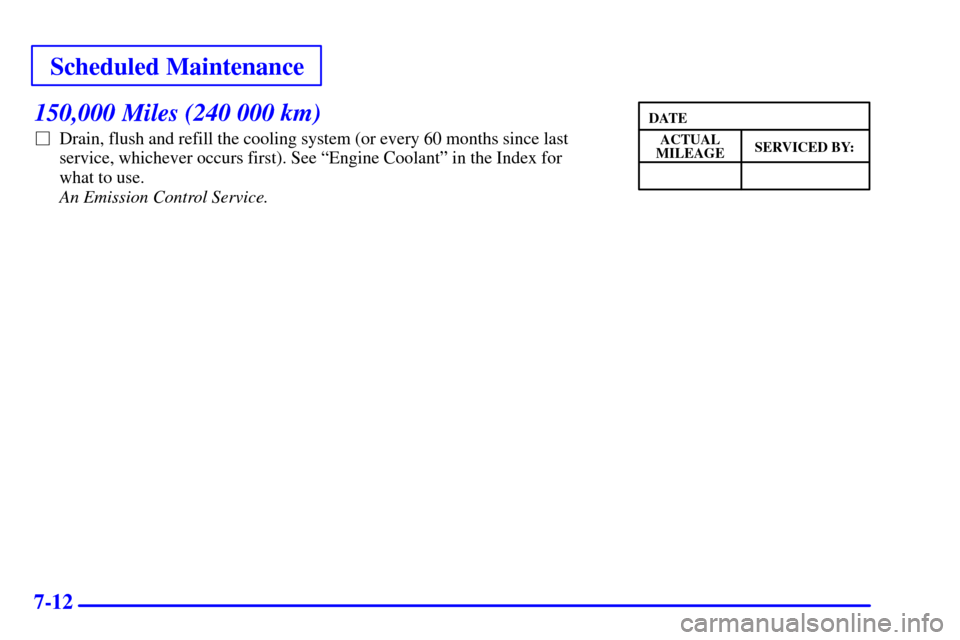
150,000 Miles (240 000 km)
�Drain, flush and refill the cooling system (or every 60 months since last
service, whichever occurs first). See ªEngine Coolantº in the Index for
what to use.
An Emission Control Service. ACTUAL
SERVICED BY:MILEAGE
DATE
Page 343 of 361
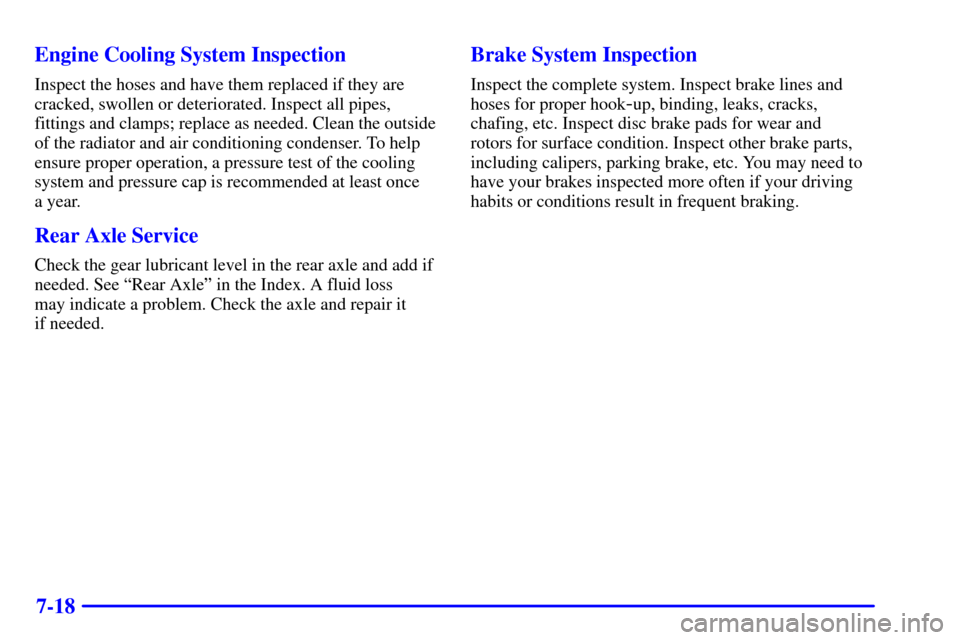
7-18 Engine Cooling System Inspection
Inspect the hoses and have them replaced if they are
cracked, swollen or deteriorated. Inspect all pipes,
fittings and clamps; replace as needed. Clean the outside
of the radiator and air conditioning condenser. To help
ensure proper operation, a pressure test of the cooling
system and pressure cap is recommended at least once
a year.
Rear Axle Service
Check the gear lubricant level in the rear axle and add if
needed. See ªRear Axleº in the Index. A fluid loss
may indicate a problem. Check the axle and repair it
if needed.
Brake System Inspection
Inspect the complete system. Inspect brake lines and
hoses for proper hook
-up, binding, leaks, cracks,
chafing, etc. Inspect disc brake pads for wear and
rotors for surface condition. Inspect other brake parts,
including calipers, parking brake, etc. You may need to
have your brakes inspected more often if your driving
habits or conditions result in frequent braking.
Page:
< prev 1-8 9-16 17-24