Page 123 of 364
2-59
8. Raise the top until it is all the way up. Line up the
top so the pins are even with the holes.9. Pull down on the top and rotate the latch handle
up to lock the convertible top. Be sure the top is
latched securely on both sides.
10. Press the bypass switch up to the NORMAL
OPERATION position.
11. Close the trunk.
Page 200 of 364
4-26
Winter Driving
Here are some tips for winter driving:
�Have your vehicle in good shape for winter.
�You may want to put winter emergency supplies in
your trunk.
Include an ice scraper, a small brush or broom, a supply
of windshield washer fluid, a rag, some winter outer
clothing, a small shovel, a flashlight, a red cloth and a
couple of reflective warning triangles. And, if you will
be driving under severe conditions, include a small bag
of sand, a piece of old carpet or a couple of burlap bags
to help provide traction. Be sure you properly secure
these items in your vehicle.
Page 207 of 364

4-33
The other label is the Certification label, found on
the rear edge of the driver's door. It tells you the
gross weight capacity of your vehicle, called the Gross
Vehicle Weight Rating (GVWR). The GVWR includes
the weight of the vehicle, all occupants, fuel and cargo.
Never exceed the GVWR for your vehicle, or the Gross
Axle Weight Rating (GAWR) for either the front or
rear axle.
And, if you do have a heavy load, you should spread it
out. Don't carry more than 132 lbs. (60 kg) in your trunk.
CAUTION:
Do not load your vehicle any heavier than the
GVWR, or either the maximum front or rear
GAWR. If you do, parts on your vehicle can
break, and it can change the way your vehicle
handles. These could cause you to lose control
and crash. Also, overloading can shorten the life
of your vehicle.
If you put things inside your vehicle -- like suitcases,
tools, packages, or anything else
-- they will go as fast
as the vehicle goes. If you have to stop or turn quickly,
or if there is a crash, they'll keep going.
Page 208 of 364
4-34
CAUTION:
Things you put inside your vehicle can strike
and injure people in a sudden stop or turn, or
in a crash.
�Put things in the trunk or rear area of your
vehicle. In a trunk, put them as far forward
as you can. Try to spread the weight evenly.
If you have fold
-down rear seats, you'll find
four anchors on the back wall of your trunk.
You can use these anchors to tie down lighter
loads. They're not strong enough for heavy
things, however, so put them as far forward
as you can in the trunk or rear area.
�Never stack heavier things, like suitcases,
inside the vehicle so that some of them are
above the tops of the seats.
�Don't leave an unsecured child restraint in
your vehicle.
�When you carry something inside the vehicle,
secure it whenever you can.
�Don't leave a seat folded down unless you
need to.
Towing a Trailer (Models with
2.4L L4 Engine and 4
-Speed
Automatic Transaxle)
CAUTION:
If you don't use the correct equipment and drive
properly, you can lose control when you pull a
trailer. For example, if the trailer is too heavy,
the brakes may not work well
-- or even at all.
You and your passengers could be seriously
injured. You may also damage your vehicle; the
resulting repairs would not be covered by your
warranty. Pull a trailer only if you have followed
all the steps in this section. Ask your dealer for
advice and information about towing a trailer
with your vehicle.
If your vehicle is not a convertible, your vehicle can
tow a trailer if it is equipped with a 2.4L L4 engine
and 4 speed automatic transaxle and the proper trailer
towing equipment. If your vehicle is a convertible or
is not equipped as stated above, do not tow a trailer.
Page 235 of 364
5-20 Removing the Spare Tire and Tools
The equipment you'll need
is in the trunk. Turn the
center retainer nut on the
compact spare cover
counterclockwise to
remove it.
Lift and remove the cover. See ªCompact Spare Tireº
later in this section for more information about the
compact spare.
Page 236 of 364
5-21
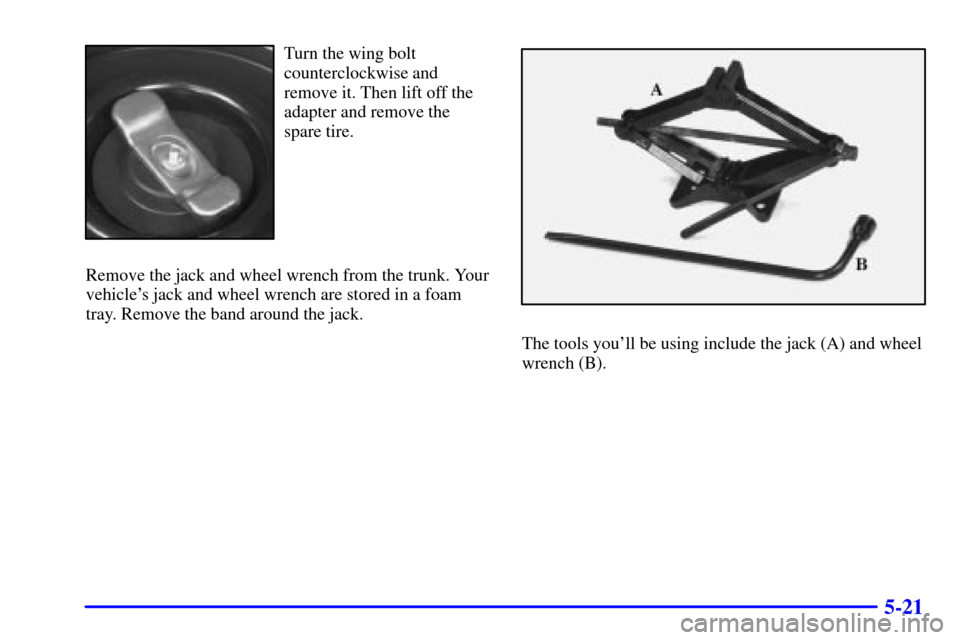
Turn the wing bolt
counterclockwise and
remove it. Then lift off the
adapter and remove the
spare tire.
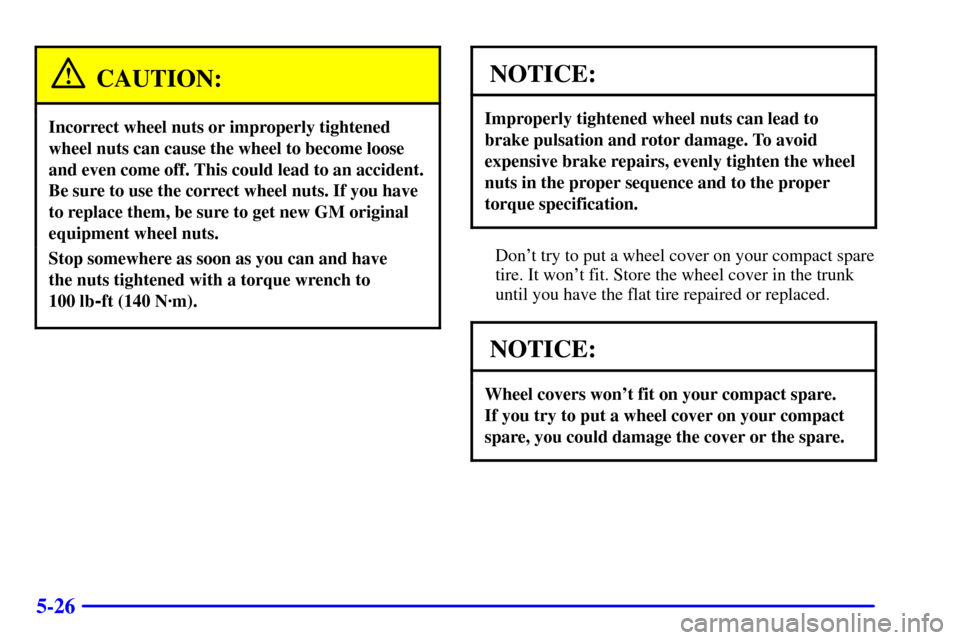
Remove the jack and wheel wrench from the trunk. Your
vehicle's jack and wheel wrench are stored in a foam
tray. Remove the band around the jack.
The tools you'll be using include the jack (A) and wheel
wrench (B).
Page 241 of 364
5-26
CAUTION:
Incorrect wheel nuts or improperly tightened
wheel nuts can cause the wheel to become loose
and even come off. This could lead to an accident.
Be sure to use the correct wheel nuts. If you have
to replace them, be sure to get new GM original
equipment wheel nuts.
Stop somewhere as soon as you can and have
the nuts tightened with a torque wrench to
100 lb
-ft (140 N´m).
NOTICE:
Improperly tightened wheel nuts can lead to
brake pulsation and rotor damage. To avoid
expensive brake repairs, evenly tighten the wheel
nuts in the proper sequence and to the proper
torque specification.
Don't try to put a wheel cover on your compact spare
tire. It won't fit. Store the wheel cover in the trunk
until you have the flat tire repaired or replaced.
NOTICE:
Wheel covers won't fit on your compact spare.
If you try to put a wheel cover on your compact
spare, you could damage the cover or the spare.
Page 243 of 364
5-28 Storing the Spare Tire and Tools
CAUTION:
Storing a jack, a tire or other equipment in the
passenger compartment of the vehicle could
cause injury. In a sudden stop or collision, loose
equipment could strike someone. Store all these
in the proper place.
The compact spare is for temporary use only. Replace
the compact spare tire with a full
-size tire as soon as you
can. See ªCompact Spare Tireº in the Index. See the
storage instructions label to replace your compact spare
into your trunk properly.
A. Wrench
B. Jack
C. Spare Tire
D. AdapterE. Wing Bolt
F. Cover
G. Nut