Page 196 of 364
4-22
Freeway Driving
Mile for mile, freeways (also called thruways, parkways,
expressways, turnpikes or superhighways) are the safest
of all roads. But they have their own special rules.
The most important advice on freeway driving is: Keep
up with traffic and keep to the right. Drive at the same
speed most of the other drivers are driving. Too
-fast or
too
-slow driving breaks a smooth traffic flow. Treat the
left lane on a freeway as a passing lane.At the entrance, there is usually a ramp that leads to the
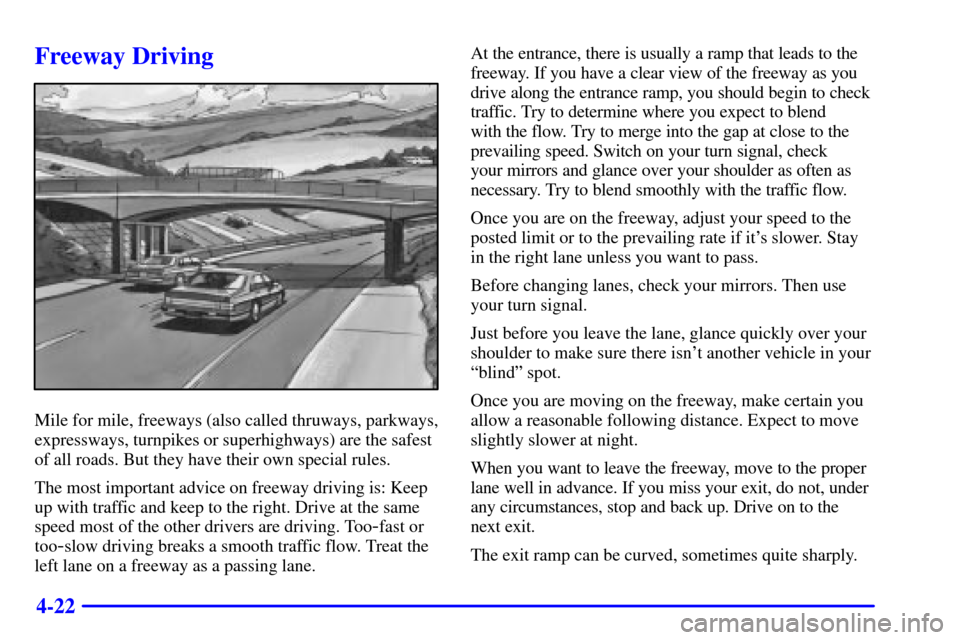
freeway. If you have a clear view of the freeway as you
drive along the entrance ramp, you should begin to check
traffic. Try to determine where you expect to blend
with the flow. Try to merge into the gap at close to the
prevailing speed. Switch on your turn signal, check
your mirrors and glance over your shoulder as often as
necessary. Try to blend smoothly with the traffic flow.
Once you are on the freeway, adjust your speed to the
posted limit or to the prevailing rate if it's slower. Stay
in the right lane unless you want to pass.
Before changing lanes, check your mirrors. Then use
your turn signal.
Just before you leave the lane, glance quickly over your
shoulder to make sure there isn't another vehicle in your
ªblindº spot.
Once you are moving on the freeway, make certain you
allow a reasonable following distance. Expect to move
slightly slower at night.
When you want to leave the freeway, move to the proper
lane well in advance. If you miss your exit, do not, under
any circumstances, stop and back up. Drive on to the
next exit.
The exit ramp can be curved, sometimes quite sharply.
Page 198 of 364

4-24
Highway Hypnosis
Is there actually such a condition as ªhighway hypnosisº?
Or is it just plain falling asleep at the wheel? Call it
highway hypnosis, lack of awareness, or whatever.
There is something about an easy stretch of road with the
same scenery, along with the hum of the tires on the road,
the drone of the engine, and the rush of the wind against
the vehicle that can make you sleepy. Don't let it happen
to you! If it does, your vehicle can leave the road in less
than a second, and you could crash and be injured.
What can you do about highway hypnosis? First, be aware
that it can happen.
Then here are some tips:
�Make sure your vehicle is well ventilated, with a
comfortably cool interior.
�Keep your eyes moving. Scan the road ahead and to
the sides. Check your rearview mirrors and your
instruments frequently.
�If you get sleepy, pull off the road into a rest, service
or parking area and take a nap, get some exercise, or
both. For safety, treat drowsiness on the highway as
an emergency.
Hill and Mountain Roads
Driving on steep hills or mountains is different from
driving in flat or rolling terrain.
Page 212 of 364

4-38 Safety Chains
You should always attach chains between your vehicle
and your trailer. Cross the safety chains under the tongue
of the trailer so that the tongue will not drop to the road
if it becomes separated from the hitch. Instructions
about safety chains may be provided by the hitch
manufacturer or by the trailer manufacturer. Follow the
manufacturer's recommendation for attaching safety
chains and do not attach them to the bumper. Always
leave just enough slack so you can turn with your rig.
And, never allow safety chains to drag on the ground.
Trailer Brakes
Does your trailer have its own brakes? Be sure to read
and follow the instructions for the trailer brakes so
you'll be able to install, adjust and maintain them
properly. Because you have anti
-lock brakes, do not
try to tap into your vehicle's brake system. If you do,
both brake systems won't work well, or at all.
Driving with a Trailer
Towing a trailer requires a certain amount of experience.
Before setting out for the open road, you'll want to
get to know your rig. Acquaint yourself with the feel
of handling and braking with the added weight of the
trailer. And always keep in mind that the vehicle you
are driving is now a good deal longer and not nearly as
responsive as your vehicle is by itself.
Before you start, check the trailer hitch and platform
(and attachments), safety chains, electrical connector,
lamps, tires and mirror adjustment. If the trailer has
electric brakes, start your vehicle and trailer moving and
then apply the trailer brake controller by hand to be sure
the brakes are working. This lets you check your
electrical connection at the same time.
During your trip, check occasionally to be sure that the
load is secure, and that the lamps and any trailer brakes
are still working.
Following Distance
Stay at least twice as far behind the vehicle ahead as
you would when driving your vehicle without a trailer.
This can help you avoid situations that require heavy
braking and sudden turns.
Page 307 of 364
6-61
Fuse Usage
TURN
-B/U Turn Signals, Back-Up Lamps
ERLS Engine Relays
BCM/CLU Body Control Module,
Instrument Panel Cluster
PCM Powertrain Control Module
IGN MDL Ignition Module
F/P
-INJ Fuel Pump, Fuel Injectors
AIR BG Air BagFuse Usage
CRUISE Cruise Control Switch
ABS Anti
-Lock Brake (Ignition)
Blank Not Used
RFA BATT Remote Keyless Entry System
MIRROR Power Mirror
LT HDLP Left Headlamp
RDO/INTLP Radio, Interior Lamps
RT HDLP Right Headlamp
CLSTR Instrument Panel Cluster
EXT LP Exterior Lamps
CIG Cigarette Lighter,
Diagnostic Link Connector
FOG Fog Lamps
HORN Horn
Blank Not Used
Blank Not Used
STOP/HZD Stop Lamps, Hazard Lamps
Page 309 of 364

6-63
Fuse Usage
IGN Ignition Switch Circuits
BATT 1 Power ACC/Stoplamp Circuits
BATT 2 Lighting Circuits
ABS Anti
-Lock Brake System
COOLING FAN Engine Cooling Fan
PCM/HVAC Powertrain Control Module,
Heater and A/C Blower
BLO Heater and A/C Blower
PCM Powertrain Control Module
A/C A/C Compressor
Replacement Bulbs
Lamps Bulb Number
Back
-Up Lamps 912. . . . . . . . . . . . . . . . . . . . . . . . . .
Front Parking/Turn Signal Lamps 3157. . . . . . . . . . .
Halogen Headlamps, High/Low Beam 9007. . . . . . .
Tail/Turn Signal Lamps 3057. . . . . . . . . . . . . . . . . . .
Turn Signal Lamps (Rear Sedan) 3057. . . . . . . . . . . .
Dome/Reading Lamp (If Equipped)
Base Model 912. . . . . . . . . . . . . . . . . . . . . . . . . . . .
Up
-Level Model 168 & 906. . . . . . . . . . . . . . . . . . .
Sunroof Model 912 (Dome). . . . . . . . . . . . . . . . . . .
212
-2 (Mirror)
Convertible Model 212
-2 . . . . . . . . . . . . . . . . . . . . .
Capacities and Specifications
The following approximate capacities are given in
English and metric conversions. Please refer to
ªRecommended Fluids and Lubricantsº in the Index
for more information.
Engine Crankcase4.0 quarts (3.8 L) . . . . . . . . . . . .
Automatic Transaxle (3
-Speed)
Pan Removal and Replacement 4.0 quarts (3.8 L). . .
After Complete Overhaul 6.9 quarts (6.5 L). . . . . . . .