Page 100 of 357

2-43
If you cannot shift out of PARK (P), ease pressure on
the shift lever
-- push the shift lever all the way into
PARK (P) and release the shift lever button as you
maintain brake application. Then press the shift lever
button and move the shift lever into the gear you wish.
If you ever hold the brake pedal down but still can't
shift out of PARK (P), try this:
1. Turn the ignition key to the OFF position.
2. Apply and hold the brake until the end of Step 4.
3. Shift to NEUTRAL (N).
4. Start the engine and then shift to the drive gear
you want.
5. Have the vehicle fixed as soon as you can.
Parking Your Vehicle
(Manual Transmission)
Before you get out of your vehicle, put your manual
transmission in REVERSE (R) and firmly apply the
parking brake.
If your vehicle is equipped to tow a trailer, see
ªTowing a Trailerº in the Index.
Parking Over Things That Burn
CAUTION:
Things that can burn could touch hot exhaust
parts under your vehicle and ignite. Don't park
over papers, leaves, dry grass or other things that
can burn.
Page 102 of 357
2-45
CAUTION:
It can be dangerous to get out of your vehicle if
the shift lever is not fully in PARK (P) with the
parking brake firmly set. Your vehicle can roll.
Don't leave your vehicle when the engine is
running unless you have to. If you've left the
engine running, the vehicle can move suddenly.
You or others could be injured. To be sure your
vehicle won't move, even when you're on fairly
level ground, always set your parking brake and
move the shift lever to PARK (P).
Follow the proper steps to be sure your vehicle won't move.
See ªShifting Into PARK (P)º in the Index.
If you are parking on a hill and if you're pulling a trailer,
also see ªTowing a Trailerº in the Index.
Limited-Slip Rear Axle
If your vehicle has this feature, your limited-slip rear
axle can give you additional traction on snow, mud, ice,
sand or gravel. It works like a standard axle most of the
time, but when one of the rear wheels has no traction
and the other does, this feature will allow the wheel with
traction to move the vehicle.
Windows
Manual Windows
Turn the window crank handle to open and close each
door window.
Page 105 of 357

2-48 Turn Signal and Lane Change Indicator
The turn signal has two upward (for right) and two
downward (for left) positions. These positions allow
you to signal a turn or a lane change.
To signal a turn, move the lever all the way up
or down. When the turn is finished, the lever will
return automatically.
An arrow on the instrument
panel cluster will flash in
the direction of the turn
or lane change.
To signal a lane change, just raise or lower the lever
until the arrow starts to flash. Hold it there until you
complete your lane change. The lever will return by
itself when you release it.As you signal a turn or a lane change, if the arrows don't
flash but just stay on as you signal a turn or lane change,
a signal bulb may be burned out and other drivers won't
see your turn signal.
If a bulb is burned out, replace it to help avoid an
accident. If the arrows don't go on at all when you
signal a turn, check the fuse (see ªFuses and Circuit
Breakersº in the Index).Headlamp High/Low-Beam Changer
When the high beams
are on, this light located
on the instrument panel
cluster also will be on.
To change the headlamps from low beam to high or
high beam to low, pull the turn signal lever all the way
toward you. Then release it.
Page 116 of 357
2-59 Cargo Cover
Using the Cargo Cover
The cargo cover can be closed for hidden storage in the
rear area of your vehicle. It can also help reduce noise in
the vehicle when placed in the upright position, closing
out the rear
-end area.
When carrying large or heavy items, it is a good idea
to open the cover and place the items in the rear area of
the vehicle.Removing the Cargo Cover
1. Close the cover. If the cargo cover is not closed and
resting on the trim panel, it cannot be removed.
2. Pull the cover toward you to unsnap it. Then slide
the cargo cover along the groove in the trim panel.
Reverse the steps to install the cover.
Page 120 of 357
2-63
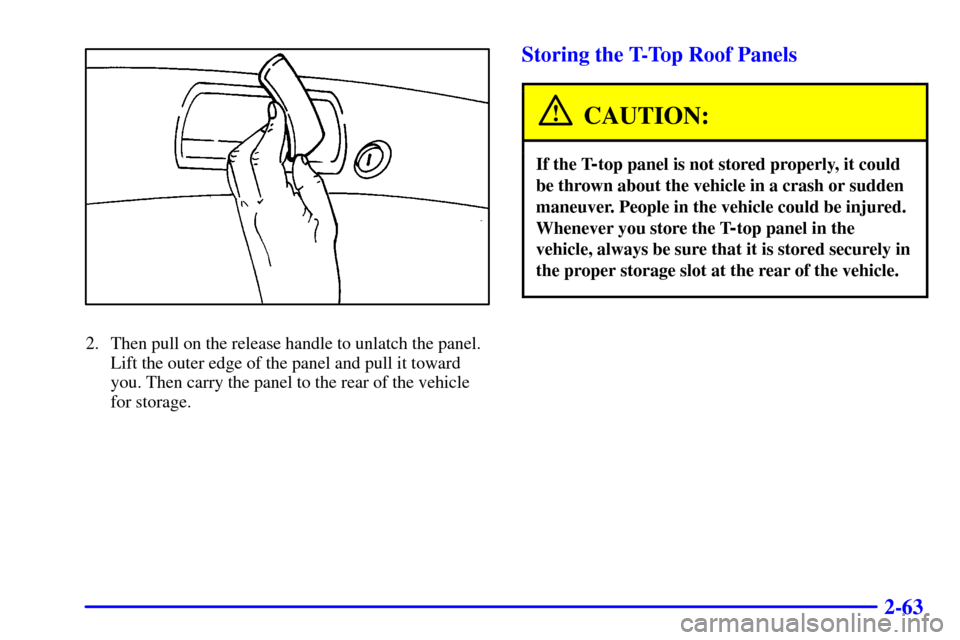
2. Then pull on the release handle to unlatch the panel.
Lift the outer edge of the panel and pull it toward
you. Then carry the panel to the rear of the vehicle
for storage.
Storing the T-Top Roof Panels
CAUTION:
If the T-top panel is not stored properly, it could
be thrown about the vehicle in a crash or sudden
maneuver. People in the vehicle could be injured.
Whenever you store the T
-top panel in the
vehicle, always be sure that it is stored securely in
the proper storage slot at the rear of the vehicle.
Page 123 of 357
2-66
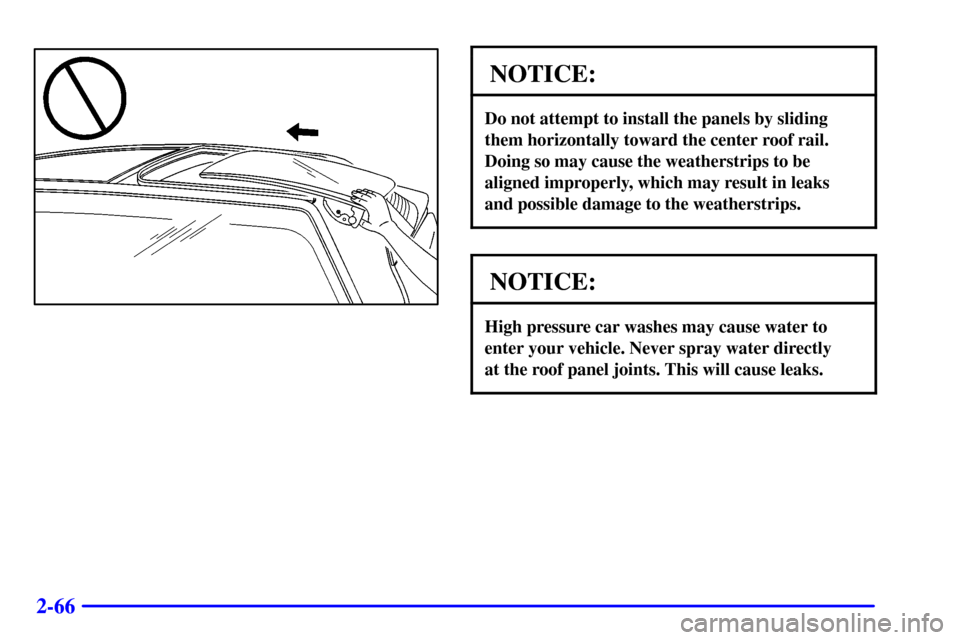
NOTICE:
Do not attempt to install the panels by sliding
them horizontally toward the center roof rail.
Doing so may cause the weatherstrips to be
aligned improperly, which may result in leaks
and possible damage to the weatherstrips.
NOTICE:
High pressure car washes may cause water to
enter your vehicle. Never spray water directly
at the roof panel joints. This will cause leaks.
Page 140 of 357
2-83
If the light comes on while you are driving, pull off the
road and stop carefully. You may notice that the pedal is
harder to push. Or, the pedal may go closer to the floor.
It may take longer to stop. If the light is still on, have the
vehicle towed for service. (See ªTowing Your Vehicleº
in the Index.)
CAUTION:
Your brake system may not be working properly
if the brake system warning light is on. Driving
with the brake system warning light on can lead
to an accident. If the light is still on after you've
pulled off the road and stopped carefully, have
the vehicle towed for service.
When the ignition is on, the brake system warning light
will also come on when you set your parking brake. The
light will stay on if your parking brake doesn't release
fully. If it stays on after your parking brake is fully
released, it means you have a brake problem.
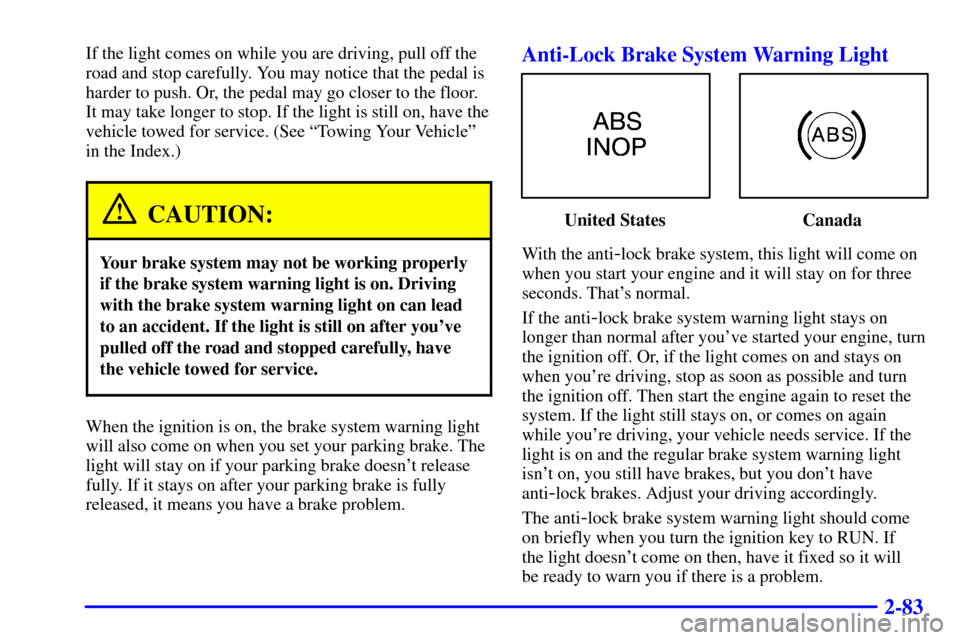
Anti-Lock Brake System Warning Light
United States Canada
With the anti
-lock brake system, this light will come on
when you start your engine and it will stay on for three
seconds. That's normal.
If the anti
-lock brake system warning light stays on
longer than normal after you've started your engine, turn
the ignition off. Or, if the light comes on and stays on
when you're driving, stop as soon as possible and turn
the ignition off. Then start the engine again to reset the
system. If the light still stays on, or comes on again
while you're driving, your vehicle needs service. If the
light is on and the regular brake system warning light
isn't on, you still have brakes, but you don't have
anti
-lock brakes. Adjust your driving accordingly.
The anti
-lock brake system warning light should come
on briefly when you turn the ignition key to RUN. If
the light doesn't come on then, have it fixed so it will
be ready to warn you if there is a problem.
Page 143 of 357

2-86
NOTICE:
If you keep driving your vehicle with this light
on, after a while, your emission controls may not
work as well, your fuel economy may not be as
good and your engine may not run as smoothly.
This could lead to costly repairs that may not be
covered by your warranty.
NOTICE:
Modifications made to the engine, transmission,
exhaust or fuel system of your vehicle or the
replacement of the original tires with other than
those of the same Tire Performance Criteria
(TPC) can affect your vehicle's emission
controls and may cause the SERVICE ENGINE
SOON or CHECK ENGINE light to come on.
Modifications to these systems could lead to
costly repairs not covered by your warranty.
This may also result in a failure to pass a
required Emission Inspection/Maintenance test.
This light should come on, as a check to show you it is
working, when the ignition is on and the engine is not
running. If the light doesn't come on, have it repaired.
This light will also come on during a malfunction in one
of two ways:
�Light Flashing
-- A misfire condition has been
detected. A misfire increases vehicle emissions and
may damage the emission control system on your
vehicle. Dealer or qualified service center diagnosis
and service may be required.
�Light On Steady
-- An emission control system
malfunction has been detected on your vehicle.
Dealer or qualified service center diagnosis and
service may be required.
If the Light Is Flashing
The following may prevent more serious damage to
your vehicle:
�Reducing vehicle speed.
�Avoiding hard accelerations.
�Avoiding steep uphill grades.
�If you are towing a trailer, reduce the amount of
cargo being hauled as soon as it is possible.