Page 249 of 359
5-
5-1
Section 5 Problems on the Road
Here you'll find what to do about some problems that can occur on the road.
5
-2 Hazard Warning Flashers
5
-3 Other Warning Devices
5
-3 Jump Starting
5
-8 Towing Your Vehicle
5
-9 Engine Overheating5
-12 Cooling System
5
-17 If a Tire Goes Flat
5
-18 Changing a Flat Tire
5
-27 Compact Spare Tire
5
-28 If You're Stuck: In Sand, Mud, Ice or Snow
Page 256 of 359

5-8
13. Try to start the vehicle with the dead battery. If it
won't start after a few tries, it probably needs service.
14. Remove the cables in reverse order to prevent electrical
shorting. Take care that they don't touch each other
or any other metal. Replace the red positive (+) remote
terminal cover to its original position.
A. Remote Positive (+) Terminal
B. Good Battery
C. Windshield Washer Bottle Stud
(not shown in picture
--located on the passenger's
side corner of the engine compartment)
Towing Your Vehicle
CAUTION:
To help avoid serious personal injury to you
or others:
�Never let passengers ride in a vehicle that is
being towed.
�Never tow faster than safe or posted speeds.
�Never tow with damaged parts not
fully secured.
�Never get under your vehicle after it has
been lifted by the tow truck.
�Always secure the vehicle on each side with
separate safety chains when towing it.
�Use only the correct hooks.
NOTICE:
Use the proper towing equipment to avoid
damage to the bumper, fascia or fog lamp areas
of the vehicle.
Page 257 of 359
5-9
With current trends in automotive styles and design, it
is essential that the correct towing equipment is used to
tow a vehicle. Your vehicle can be towed with wheel
-lift
or car
-carrier equipment.
Consult your dealer or a professional towing service if
you need to have your vehicle towed. See ªRoadside
Assistanceº in the Index.
Engine Overheating
You will find an ENGINE COOLANT HOT, IDLE
ENGINE message or an ENGINE OVERHEATED,
STOP ENGINE message on the Driver Information
Center (DIC). There is also an engine temperature
warning light and/or gage on the instrument panel.
See ªEngine Coolant Temperature Warning Lightº or
ªEngine Coolant Temperature Gageº in the Index.
Overheated Engine Protection
Operating Mode
Should an overheated engine condition exist and the
message ENGINE OVERHEATED, STOP ENGINE is
displayed, an overheat protection mode which alternates
firing groups of cylinders helps prevent engine damage.
In this mode, you will notice a loss in power and engine
performance. This operating mode allows your vehicle
to be driven to a safe place in an emergency; you may
drive up to 50 miles (80 km). Towing a trailer in the
overheat protection mode should be avoided.
NOTICE:
After driving in the overheated engine protection
operating mode, to avoid engine damage, allow the
engine to cool before attempting any repair. The
engine oil will be severely degraded. Repair the
cause of coolant loss, change the oil and reset the
oil life indicator. See ªEngine Oilº in the Index.
Page 259 of 359

5-11 If No Steam Is Coming From Your Engine
If you get an engine overheat warning but see or hear no
steam, the problem may not be too serious. Sometimes
the engine can get a little too hot when you:
�Climb a long hill on a hot day.
�Stop after high
-speed driving.
�Idle for long periods in traffic.
�Tow a trailer.
If you get the overheat warning with no sign of steam,
try this for a minute or so:
1. Dial temperature control to the highest heat setting
and open the windows, as necessary.
2. If you're in a traffic jam, shift to NEUTRAL (N);
otherwise, shift to the highest gear while
driving
-- AUTOMATIC OVERDRIVE (�)
or DRIVE (D).If you no longer have the overheat warning, you
can drive. Just to be safe, drive slower for about
10 minutes. If the warning doesn't come back on,
you can drive normally.
If the warning continues, pull over, stop, and park
your vehicle right away.
If there's still no sign of steam, idle the engine for
three minutes while you're parked. If you still have the
warning, turn off the engine and get everyone out of
the vehicle until it cools down. Also, see ªOverheated
Engine Protection Operating Modeº listed previously in
this section.
You may decide not to lift the hood but to get service
help right away.
Page 265 of 359

5-17
4. With the coolant surge tank pressure cap off, start
the engine and let it run until you can feel the upper
radiator hose getting hot. Watch out for the engine
cooling fans.
By this time, the coolant level inside the coolant
surge tank may be lower. If the level is lower, add
more of the proper mixture to the coolant surge tank
until the level reaches at or above the fill mark at the
forward edge of the surge tank.
5. Then replace the pressure cap. Be sure the pressure
cap is hand
-tight.Start the engine and allow it to warm up. If the CHECK
COOLANT LEVEL message does not appear on the
Driver Information Center, coolant is at the proper fill
level. If a CHECK COOLANT LEVEL message does
appear, repeat Steps 1 to 3 and reinstall the pressure cap
or see your dealer.
If a Tire Goes Flat
It's unusual for a tire to ªblow outº while you're driving,
especially if you maintain your tires properly. If air goes
out of a tire, it's much more likely to leak out slowly.
But if you should ever have a ªblowout,º here are a
few tips about what to expect and what to do:
If a front tire fails, the flat tire will create a drag that
pulls the vehicle toward that side. Take your foot off
the accelerator pedal and grip the steering wheel firmly.
Steer to maintain lane position, and then gently brake to
a stop well out of the traffic lane.
A rear blowout, particularly on a curve, acts much like
a skid and may require the same correction you'd use
in a skid. In any rear blowout, remove your foot from
the accelerator pedal. Get the vehicle under control by
steering the way you want the vehicle to go. It may be
very bumpy and noisy, but you can still steer. Gently
brake to a stop
-- well off the road if possible.
If a tire goes flat, the next part shows how to use your
jacking equipment to change a flat tire safely.
Page 271 of 359
5-23
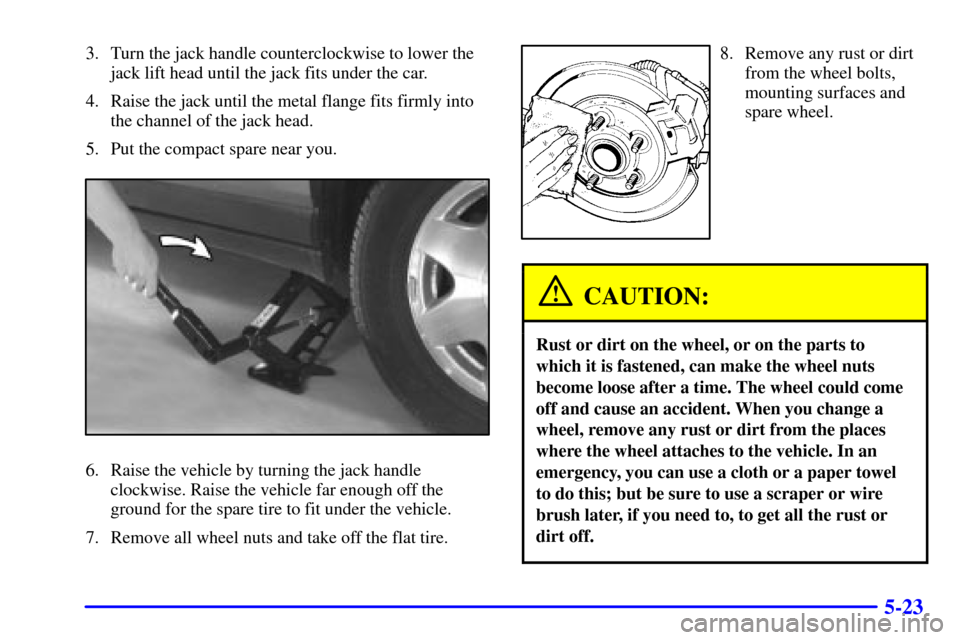
3. Turn the jack handle counterclockwise to lower the
jack lift head until the jack fits under the car.
4. Raise the jack until the metal flange fits firmly into
the channel of the jack head.
5. Put the compact spare near you.
6. Raise the vehicle by turning the jack handle
clockwise. Raise the vehicle far enough off the
ground for the spare tire to fit under the vehicle.
7. Remove all wheel nuts and take off the flat tire.
8. Remove any rust or dirt
from the wheel bolts,
mounting surfaces and
spare wheel.
CAUTION:
Rust or dirt on the wheel, or on the parts to
which it is fastened, can make the wheel nuts
become loose after a time. The wheel could come
off and cause an accident. When you change a
wheel, remove any rust or dirt from the places
where the wheel attaches to the vehicle. In an
emergency, you can use a cloth or a paper towel
to do this; but be sure to use a scraper or wire
brush later, if you need to, to get all the rust or
dirt off.
Page 272 of 359
5-24
CAUTION:
Never use oil or grease on studs or nuts. If you
do, the nuts might come loose. Your wheel could
fall off, causing a serious accident.
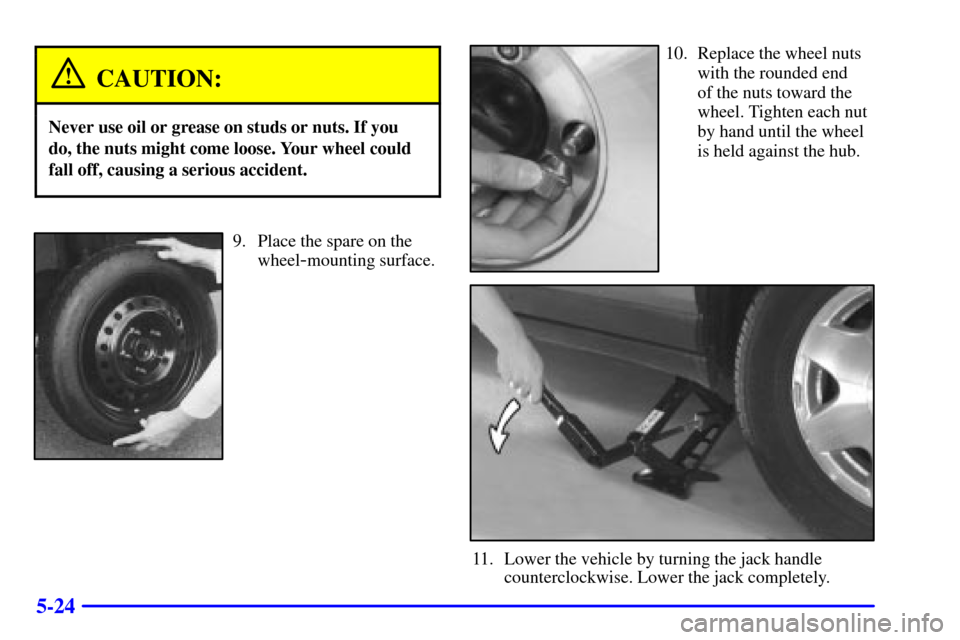
9. Place the spare on the
wheel
-mounting surface.
10. Replace the wheel nuts
with the rounded end
of the nuts toward the
wheel. Tighten each nut
by hand until the wheel
is held against the hub.
11. Lower the vehicle by turning the jack handle
counterclockwise. Lower the jack completely.
Page 276 of 359

5-28
If You're Stuck: In Sand, Mud,
Ice or Snow
In order to free your vehicle when it is stuck, you will
need to spin the wheels, but you don't want to spin
your wheels too fast. The method known as ªrockingº
can help you get out when you're stuck, but you must
use caution.
CAUTION:
If you let your tires spin at high speed, they
can explode, and you or others could be injured.
And, the transaxle or other parts of the vehicle
can overheat. That could cause an engine
compartment fire or other damage. When
you're stuck, spin the wheels as little as possible.
Don't spin the wheels above 35 mph (55 km/h) as
shown on the speedometer.
NOTICE:
Spinning your wheels can destroy parts of your
vehicle as well as the tires. If you spin the wheels
too fast while shifting your transaxle back and
forth, you can destroy your transaxle.
For information about using tire chains on your vehicle,
see ªTire Chainsº in the Index.
Rocking Your Vehicle To Get It Out
First, turn your steering wheel left and right. That will
clear the area around your front wheels. You should turn
your traction control system off. (See ªTraction Control
Systemº in the Index.) Then shift back and forth
between REVERSE (R) and a forward gear, spinning the
wheels as little as possible. Release the accelerator pedal
while you shift, and press lightly on the accelerator
pedal when the transaxle is in gear. By slowly spinning
your wheels in the forward and reverse directions, you
will cause a rocking motion that may free your vehicle.
If that doesn't get you out after a few tries, you may
need to be towed out. If you do need to be towed out,
see ªTowing Your Vehicleº in the Index.