Page 11 of 359
ix
For example,
these symbols
are used on an
original battery:
CAUTION
POSSIBLE
INJURY
PROTECT
EYES BY
SHIELDING
CAUSTIC
BATTERY
ACID COULD
CAUSE
BURNS
AVOID
SPARKS OR
FLAMES
SPARK OR
FLAME
COULD
EXPLODE
BATTERY
These symbols
are important
for you and
your passengers
whenever your
vehicle is
driven:
DOOR LOCK
UNLOCK
FASTEN
SEAT
BELTS
POWER
WINDOW
AIR BAG
These symbols
have to do with
your lamps:
MASTER
LIGHTING
SWITCH
TURN
SIGNALS
PARKING
LAMPS
HAZARD
WARNING
FLASHER
DAYTIME
RUNNING
LAMPS
FOG LAMPS
These symbols
are on some of
your controls:
WINDSHIELD
WIPER
WINDSHIELD
WASHER
WINDSHIELD
DEFROSTER
REAR
WINDOW
DEFOGGER
VENTILATING
FAN
These symbols
are used on
warning and
indicator lights:
ENGINE
COOLANT
TEMP
BATTERY
CHARGING
SYSTEM
BRAKE
COOLANT
ENGINE OIL
PRESSURE
ANTI-LOCK
BRAKES
Here are some
other symbols
you may see:
FUSE
LIGHTER
HORN
SPEAKER
FUEL
Vehicle Symbols
These are some of the symbols you may find on your vehicle.
Page 12 of 359
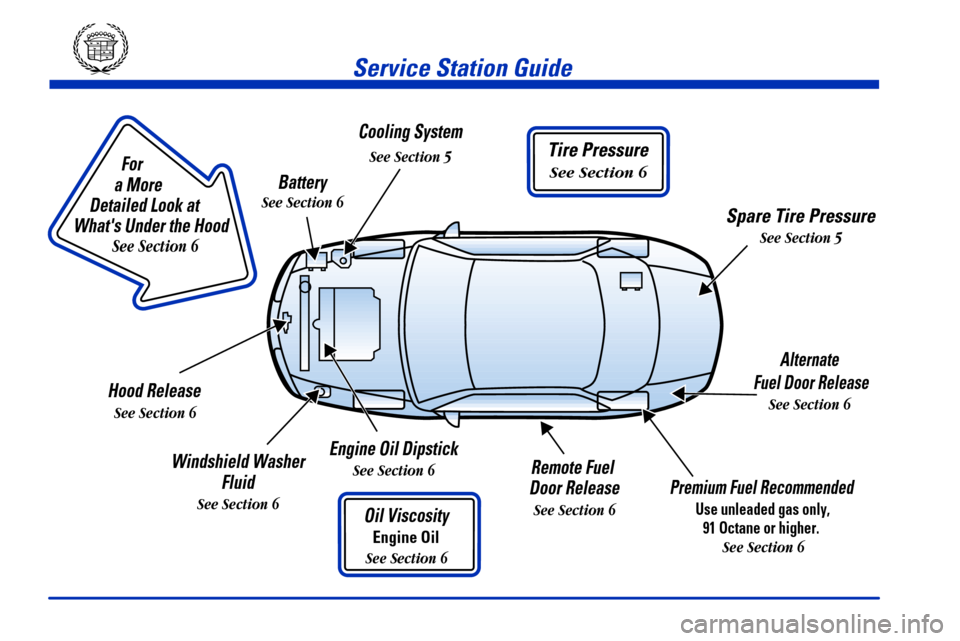
For
a More
Detailed Look at
What's Under the Hood
See Section 6
Tire Pressure
See Section 6
Service Station Guide
Oil Viscosity
Engine Oil
See Section 6
Engine Oil Dipstick
See Section 6Remote Fuel
Door Release
See Section 6
Premium Fuel Recommended
Use unleaded gas only,
91 Octane or higher.
See Section 6
Cooling System
See Section 5
Hood Release
See Section 6
Windshield Washer
Fluid
See Section 6
Spare Tire Pressure
See Section 5
Alternate
Fuel Door Release
See Section 6
Battery
See Section 6
Page 232 of 359
4-22
Once you are moving on the freeway, make certain you
allow a reasonable following distance. Expect to move
slightly slower at night.
When you want to leave the freeway, move to the
proper lane well in advance. If you miss your exit,
do not, under any circumstances, stop and back up.
Drive on to the next exit.
The exit ramp can be curved, sometimes quite sharply.
The exit speed is usually posted.
Reduce your speed according to your speedometer, not
to your sense of motion. After driving for any distance
at higher speeds, you may tend to think you are going
slower than you actually are.
Before Leaving on a Long Trip
Make sure you're ready. Try to be well rested. If you
must start when you're not fresh
-- such as after a
day's work
-- don't plan to make too many miles that
first part of the journey. Wear comfortable clothing and
shoes you can easily drive in.Is your vehicle ready for a long trip? If you keep it
serviced and maintained, it's ready to go. If it needs
service, have it done before starting out. Of course,
you'll find experienced and able service experts in
Cadillac dealerships all across North America.
They'll be ready and willing to help if you need it.
Here are some things you can check before a trip:
�Windshield Washer Fluid: Is the reservoir full?
Are all windows clean inside and outside?
�Wiper Blades: Are they in good shape?
�Fuel, Engine Oil, Other Fluids: Have you checked
all levels?
�Lamps: Are they all working? Are the lenses clean?
�Tires: They are vitally important to a safe,
trouble
-free trip. Is the tread good enough for
long
-distance driving? Are the tires all inflated to
the recommended pressure?
�Weather Forecasts: What's the weather outlook
along your route? Should you delay your trip a short
time to avoid a major storm system?
�Maps: Do you have up
-to-date maps?
Page 239 of 359

4-29
Then, shut the engine off and close the window almost
all the way to preserve the heat. Start the engine again
and repeat this only when you feel really uncomfortable
from the cold. But do it as little as possible. Preserve the
fuel as long as you can. To help keep warm, you can get
out of the vehicle and do some fairly vigorous exercises
every half hour or so until help comes.
Recreational Vehicle Towing
Your vehicle was not designed to be towed with all four
wheels on the ground. If your vehicle must be towed,
see ªTowing Your Vehicleº in the Index.
NOTICE:
Towing your vehicle with all four wheels on the
ground will damage drivetrain components.
Loading Your Vehicle
Two labels on your vehicle show how much weight it
may properly carry. The Tire
-Loading Information label
found on the rear edge of the driver's door tells you the
proper size, speed rating and recommended inflation
pressures for the tires on your vehicle. It also gives you
important information about the number of people that
can be in your vehicle and the total weight that you can
carry. This weight is called the Vehicle Capacity Weight
and includes the weight of all occupants, cargo and all
options not installed in the factory.
Page 277 of 359

6-
6-1
Section 6 Service and Appearance Care
Here you will find information about the care of your vehicle. This section begins with service and fuel information,
and then it shows how to check important fluid and lubricant levels. There is also technical information about your
vehicle, and a part devoted to its appearance care.
6
- 2 Service
6
- 3 Fuel
6
- 5 Filling Your Tank
6
- 8 Filling a Portable Fuel Container
6
- 8 Checking Things Under the Hood
6
- 11 Engine Oil
6
- 16 Engine Air Cleaner/Filter
6
- 19 Automatic Transaxle Fluid
6
- 22 Engine Coolant
6
- 25 Surge Tank Pressure Cap
6
- 26 Power Steering Fluid
6
- 27 Windshield Washer Fluid
6
- 28 Brakes
6
- 32 Battery
6
- 34 Bulb Replacement6
- 43 Windshield Wiper Blade Replacement
6
- 44 Tires
6
- 52 Appearance Care
6
- 53 Cleaning the Inside of Your Vehicle
6
- 54 Care of Safety Belts
6
- 55 Cleaning the Outside of Your Vehicle
6
- 57 Cleaning Tires
6
- 59 GM Vehicle Care/Appearance Materials
6
- 60 Vehicle Identification Number (VIN)
6
- 60 Service Parts Identification Label
6
- 61 Electrical System
6
- 68 Removing the Rear Seat Cushion
6
- 69 Replacement Bulbs
6
- 69 Capacities and Specifications
6
- 70 Normal Maintenance Replacement Parts
Page 321 of 359
6-45 Inflation -- Tire Pressure
The Tire-Loading Information label, which is located
on the rear edge of the driver's door, shows the correct
inflation pressures for your tires when they're cold.
ªColdº means your vehicle has been sitting for at least
three hours or driven no more than 1 mile (1.6 km).
If you'll be driving at high speeds (e.g., speeds of
100 mph (160 km/h) or higher), where it is legal,
set the cold inflation pressure to the maximum
inflation pressure shown on the tire sidewall, or to
38 psi (265 kPa), whichever is lower. See the example
below. When you end this high
-speed driving, return to
the cold inflation pressure shown on the Tire
-Loading
Information label.
Example:
You'll find maximum load and inflation pressure
molded on the tire's sidewall, in small letters, near the
rim flange. It will read something like this: Maximum
load 690 kg (1521 lbs.) @ 300 kPa (44 psi) Max. Press.
For this example, you would set the inflation pressure
for high
-speed driving at 38 psi (265 kPa).
NOTICE:
Don't let anyone tell you that underinflation or
overinflation is all right. It's not. If your tires
don't have enough air (underinflation), you can
get the following:
�Too much flexing
�Too much heat
�Tire overloading
�Bad wear
�Bad handling
�Bad fuel economy.
If your tires have too much air (overinflation),
you can get the following:
�Unusual wear
�Bad handling
�Rough ride
�Needless damage from road hazards.