Page 295 of 359

6-19
Automatic Transaxle Fluid
When to Check and Change
A good time to check your automatic transaxle fluid
level is when the engine oil is changed.
Change both the fluid and filter every 50,000 miles
(83 000 km) if the vehicle is mainly driven under one
or more of these conditions:
�In heavy city traffic where the outside temperature
regularly reaches 90�F (32�C) or higher.
�In hilly or mountainous terrain.
�When doing frequent trailer towing.
�Uses such as found in taxi, police or delivery service.
If you do not use your vehicle under any of these
conditions, the fluid and filter do not require change
until the message CHANGE TRANS FLUID appears
on the Driver Information Center.
See ªScheduled Maintenance Servicesº in the
Maintenance Schedule booklet.
How to Check
Because this operation can be a little difficult, you
may choose to have this done at the dealership
service department.
If you do it yourself, be sure to follow all the instructions
here, or you could get a false reading on the dipstick.
NOTICE:
Too much or too little fluid can damage your
transaxle. Too much can mean that some of the
fluid could come out and fall on hot engine parts
or exhaust system parts, starting a fire. Be sure
to get an accurate reading if you check your
transaxle fluid.
Wait at least 30 minutes before checking the transaxle
fluid level if you have been driving:
�When outside temperatures are above 90�F (32�C).
�At high speed for quite a while.
�In heavy traffic
-- especially in hot weather.
�While pulling a trailer.
Page 307 of 359
6-31
CAUTION:
The CHANGE BRAKE PADS message or the
high
-pitched warning sound means that soon
your brakes won't work well. That could lead
to an accident. When the CHANGE BRAKE
PADS message comes on and stays on, have
your vehicle serviced.
NOTICE:
Continuing to drive with worn-out brake pads
could result in costly brake repair.
Some driving conditions or climates may cause a brake
squeal when the brakes are first applied or lightly
applied. This does not mean something is wrong with
your brakes.Properly torqued wheel nuts are necessary to help
prevent brake pulsation. When tires are rotated,
inspect brake pads for wear and evenly torque wheel
nuts in the proper sequence to GM specifications.
Brake linings should always be replaced as complete
axle sets.
See ªBrake System Inspectionº in the Maintenance
Schedule booklet under Part C ªPeriodic
Maintenance Inspections.º
Brake Pedal Travel
See your dealer if the brake pedal does not return to
normal height, or if there is a rapid increase in pedal
travel. This could be a sign of brake trouble.
Brake Adjustment
Every time you apply the brakes, with or without the
vehicle moving, your brakes adjust for wear.
Page 319 of 359
6-43
Windshield Wiper Blade Replacement
Windshield wiper blades should be inspected at least
twice a year for wear or cracking. See ªWiper Blade
Checkº in your Maintenance Schedule booklet
under Part B ªOwner Checks and Servicesº for
more information.
It's a good idea to clean or replace the wiper blade
assembly on a regular basis or when worn. For proper
windshield wiper blade length and type, see ªNormal
Maintenance Replacement Partsº in the Index.
To replace the wiper blade assembly:
1. Lift the wiper up from the windshield and set into
the vertically
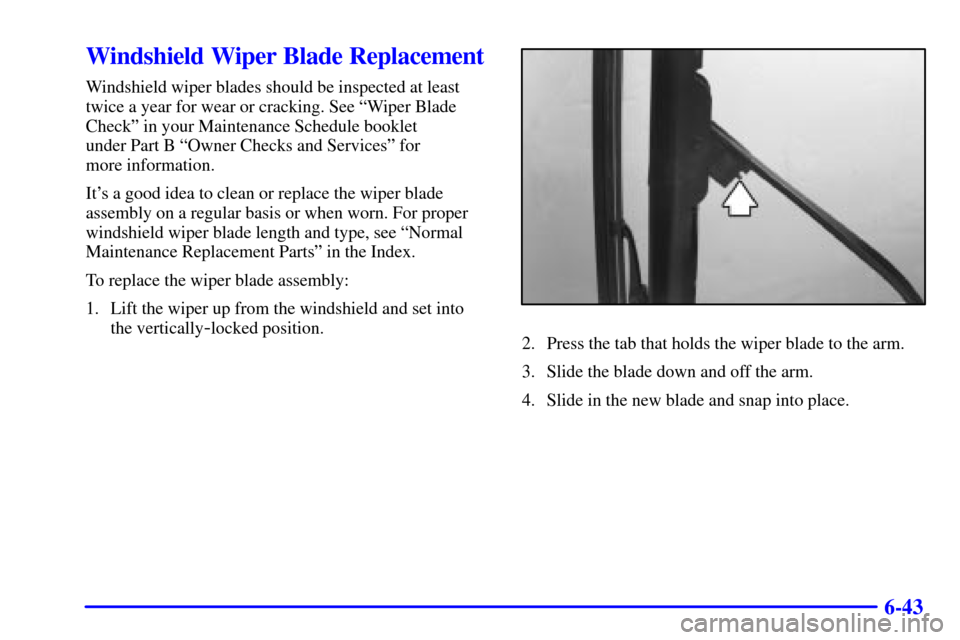
-locked position.2. Press the tab that holds the wiper blade to the arm.
3. Slide the blade down and off the arm.
4. Slide in the new blade and snap into place.
Page 322 of 359

6-46
When to Check
Check your tires once a month or more.
Don't forget your compact spare tire. It should be at
60 psi (420 kPa).
How to Check
Use a good quality pocket
-type gage to check tire
pressure. You can't tell if your tires are properly
inflated simply by looking at them. Radial tires may
look properly inflated even when they're underinflated.
Be sure to put the valve caps back on the valve stems.
They help prevent leaks by keeping out dirt and moisture.
Tire Inspection and Rotation
Tires should be rotated every 6,000 to 8,000 miles
(10 000 to 13 000 km). Any time you notice unusual
wear, rotate your tires as soon as possible and check
wheel alignment. Also check for damaged tires or
wheels. See ªWhen It's Time for New Tiresº and
ªWheel Replacementº later in this section for
more information.The purpose of regular rotation is to achieve more
uniform wear for all tires on the vehicle. The first
rotation is the most important. See ªScheduled
Maintenance Servicesº in the Maintenance Schedule
booklet for scheduled rotation intervals.
When rotating your tires, always use the correct rotation
pattern shown here.
Don't include the compact spare tire in your tire rotation.
Page 354 of 359

7-8
Courtesy Transportation
Cadillac has always exemplified quality and value in its
offering of motor vehicles. To enhance your ownership
experience, we and our participating dealers are proud
to offer Courtesy Transportation, a customer support
program for new vehicles.
The Courtesy Transportation program is offered to
retail purchase/lease customers in conjunction with the
Bumper
-to-Bumper coverage provided by the New
Vehicle Limited Warranty. Several transportation options
are available when warranty repairs are required. This will
reduce your inconvenience during warranty repairs.
Plan Ahead When Possible
When your vehicle requires warranty service, you
should contact your dealer and request an appointment.
By scheduling a service appointment and advising your
service consultant of your transportation needs, your
dealer can help minimize your inconvenience. If your
vehicle cannot be scheduled into the service department
immediately, keep driving it until it can be scheduled for
service, unless, of course, the problem is safety
-related.
If it is, please call your dealership, let them know this,
and ask for instructions.If the dealer requests that you simply drop the vehicle
off for service, you are urged to do so as early in the
work day as possible to allow for same day repair.
Transportation Options
Warranty service can generally be completed while you
wait. However, if you are unable to wait Cadillac helps
minimize your inconvenience by providing several
transportation options. Depending on the circumstances,
your dealer can offer you one of the following:
Shuttle Service
Participating dealers can provide you with shuttle service to
get you to your destination with minimal interruption of
your daily schedule. This includes a one way shuttle ride to a
destination up to 10 miles from the dealership.
Public Transportation or Fuel Reimbursement
If your vehicle requires overnight warranty repairs,
reimbursement up to $30 per day (five days maximum)
may be available for the use of public transportation
such as taxi or bus. In addition, should you arrange
transportation through a friend or relative,
reimbursement for reasonable fuel expenses up to
$10 per day (five day maximum) may be available.
Claim amounts should reflect actual costs and be
supported by original receipts.