Page 71 of 359
2-11 Trunk Lock Release
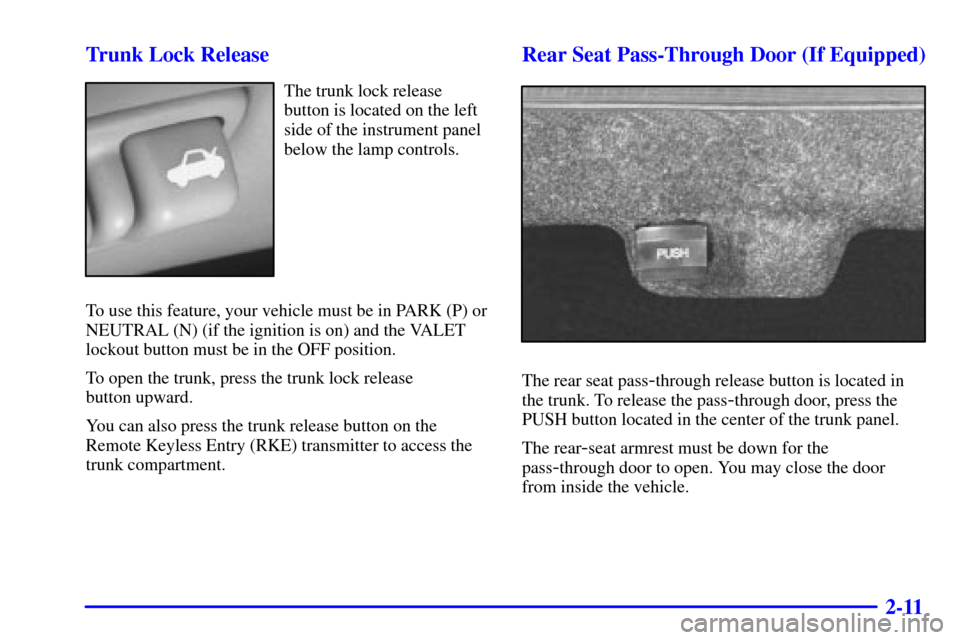
The trunk lock release
button is located on the left
side of the instrument panel
below the lamp controls.
To use this feature, your vehicle must be in PARK (P) or
NEUTRAL (N) (if the ignition is on) and the VALET
lockout button must be in the OFF position.
To open the trunk, press the trunk lock release
button upward.
You can also press the trunk release button on the
Remote Keyless Entry (RKE) transmitter to access the
trunk compartment.
Rear Seat Pass-Through Door (If Equipped)
The rear seat pass-through release button is located in
the trunk. To release the pass
-through door, press the
PUSH button located in the center of the trunk panel.
The rear
-seat armrest must be down for the
pass
-through door to open. You may close the door
from inside the vehicle.
Page 72 of 359

2-12 Trunk Lid Tie Down (If Equipped)
CAUTION:
Driving with the trunk lid open can allow
dangerous CO (carbon monoxide) gas to come
into your vehicle. You can't see or smell CO.
It can cause unconsciousness and even death.
If you ever need to drive with your trunk lid
open, then:
�Make sure all windows, the rear seat
pass
-through and sunroof are closed.
�Turn the fan on your heating and cooling
system to its highest speed, with the setting
on VENT. This forces fresh outside air into
your vehicle.
�Open all air ducts on the instrument panel.
Don't use the trunk lid tie down if you are towing
a trailer because of the danger of CO.
This feature is used to secure the trunk lid if it will not
close completely, such as when carrying large packages
in the trunk.
1. Attach the end loop of the tie down to the retainer
located at the center of the trunk sill (see view B).
2. Attach the clip end of the tie down to the D
-ring on
the trunk lid (see view A).
3. Tighten the tie down by pulling the free end of the
cord until secure.
4. To remove the tie down, press the clip end to release
and loosen the cord.
Page 86 of 359
2-26 Performance Shift Display (STS Only)
When your vehicle detects a change in driving
conditions, it will automatically initiate the appropriate
performance shift mode. When this occurs, the gear
display on the instrument panel cluster will change to
indicate that the transmission has shifted to a different
gear. For example, the gear display on the cluster may
indicate D, 3, 2, or 1 even though the gearshift lever is
still in OVERDRIVE (D). Once the performance shift
mode ends, the gear display on the cluster will return to
matching the gearshift lever indication.
Parking Brake
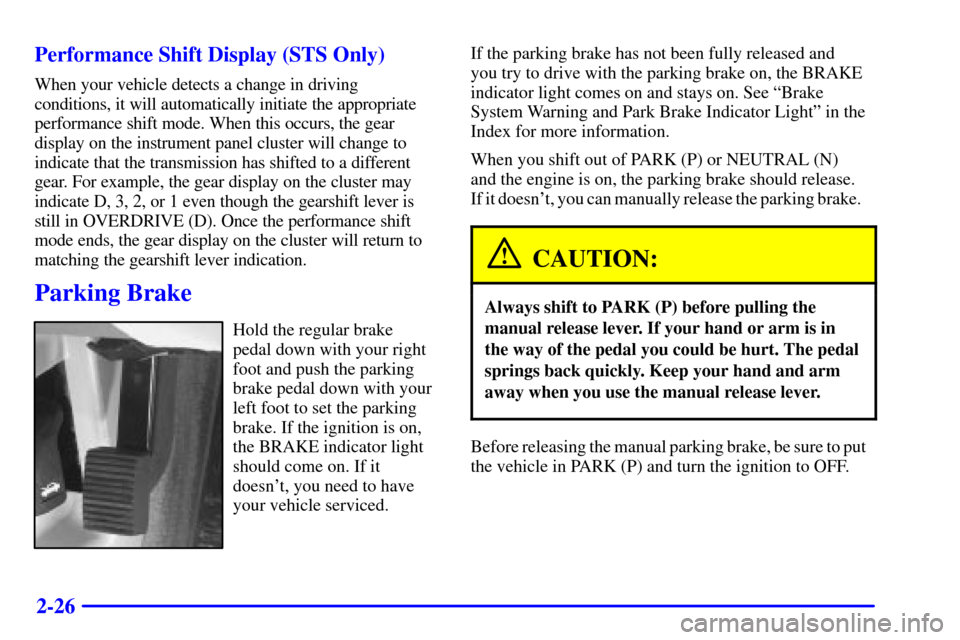
Hold the regular brake
pedal down with your right
foot and push the parking
brake pedal down with your
left foot to set the parking
brake. If the ignition is on,
the BRAKE indicator light
should come on. If it
doesn't, you need to have
your vehicle serviced.If the parking brake has not been fully released and
you try to drive with the parking brake on, the BRAKE
indicator light comes on and stays on. See ªBrake
System Warning and Park Brake Indicator Lightº in the
Index for more information.
When you shift out of PARK (P) or NEUTRAL (N)
and the engine is on, the parking brake should release.
If it doesn't, you can manually release the parking brake.
CAUTION:
Always shift to PARK (P) before pulling the
manual release lever. If your hand or arm is in
the way of the pedal you could be hurt. The pedal
springs back quickly. Keep your hand and arm
away when you use the manual release lever.
Before releasing the manual parking brake, be sure to put
the vehicle in PARK (P) and turn the ignition to OFF.
Page 87 of 359
2-27
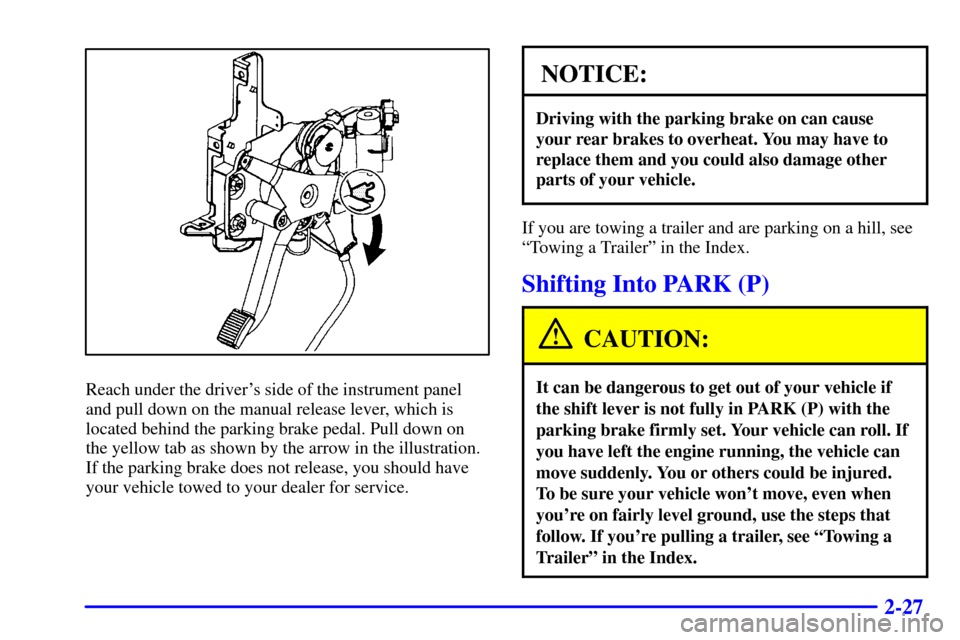
Reach under the driver's side of the instrument panel
and pull down on the manual release lever, which is
located behind the parking brake pedal. Pull down on
the yellow tab as shown by the arrow in the illustration.
If the parking brake does not release, you should have
your vehicle towed to your dealer for service.
NOTICE:
Driving with the parking brake on can cause
your rear brakes to overheat. You may have to
replace them and you could also damage other
parts of your vehicle.
If you are towing a trailer and are parking on a hill, see
ªTowing a Trailerº in the Index.
Shifting Into PARK (P)
CAUTION:
It can be dangerous to get out of your vehicle if
the shift lever is not fully in PARK (P) with the
parking brake firmly set. Your vehicle can roll. If
you have left the engine running, the vehicle can
move suddenly. You or others could be injured.
To be sure your vehicle won't move, even when
you're on fairly level ground, use the steps that
follow. If you're pulling a trailer, see ªTowing a
Trailerº in the Index.
Page 96 of 359

2-36
Turn Signal/Multifunction Lever
Turn and Lane Change Signals
To signal a turn, move the lever on the left side of the
steering wheel all the way up or down. The lever returns
automatically when the turn is complete.
An arrow located on the
instrument panel cluster
will flash in the direction
of the turn or lane change.
Raise or lower the lever until the arrow starts to flash to
signal a lane change. Hold it there until the lane change
is complete. The lever returns when it is released.
If the turn signal is left on, a warning chime will sound
and the Driver Information Center (DIC) will display
TURN SIGNAL ON (after driving about a mile) to
remind you to turn it off.Arrows that flash rapidly when signaling for a turn or
lane change may be caused by a burned
-out signal bulb.
Other drivers won't see the turn signal.
Replace burned
-out bulbs to help avoid possible
accidents. Check the fuse (see ªFuses and Circuit
Breakersº in the Index) and check for burned
-out
bulbs if the arrow fails to work when signaling a turn.
Headlamp High/Low Beam
When the low-beam headlamps are on, push the turn
signal lever away from you to change the headlamps to
high beam.
This light on the
instrument panel cluster
will be on, indicating
high
-beam usage.
Pull the turn signal lever toward you to return to
low
-beam headlamps.
Page 100 of 359
2-40 Cruise Control
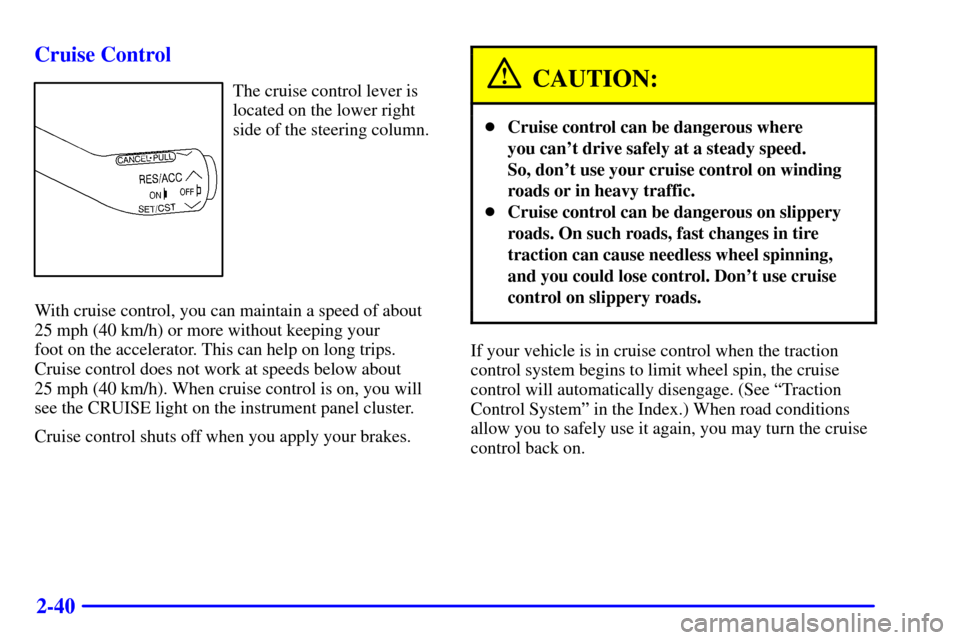
The cruise control lever is
located on the lower right
side of the steering column.
With cruise control, you can maintain a speed of about
25 mph (40 km/h) or more without keeping your
foot on the accelerator. This can help on long trips.
Cruise control does not work at speeds below about
25 mph (40 km/h). When cruise control is on, you will
see the CRUISE light on the instrument panel cluster.
Cruise control shuts off when you apply your brakes.CAUTION:
�Cruise control can be dangerous where
you can't drive safely at a steady speed.
So, don't use your cruise control on winding
roads or in heavy traffic.
�Cruise control can be dangerous on slippery
roads. On such roads, fast changes in tire
traction can cause needless wheel spinning,
and you could lose control. Don't use cruise
control on slippery roads.
If your vehicle is in cruise control when the traction
control system begins to limit wheel spin, the cruise
control will automatically disengage. (See ªTraction
Control Systemº in the Index.) When road conditions
allow you to safely use it again, you may turn the cruise
control back on.
Page 103 of 359
2-43
Exterior Lamps
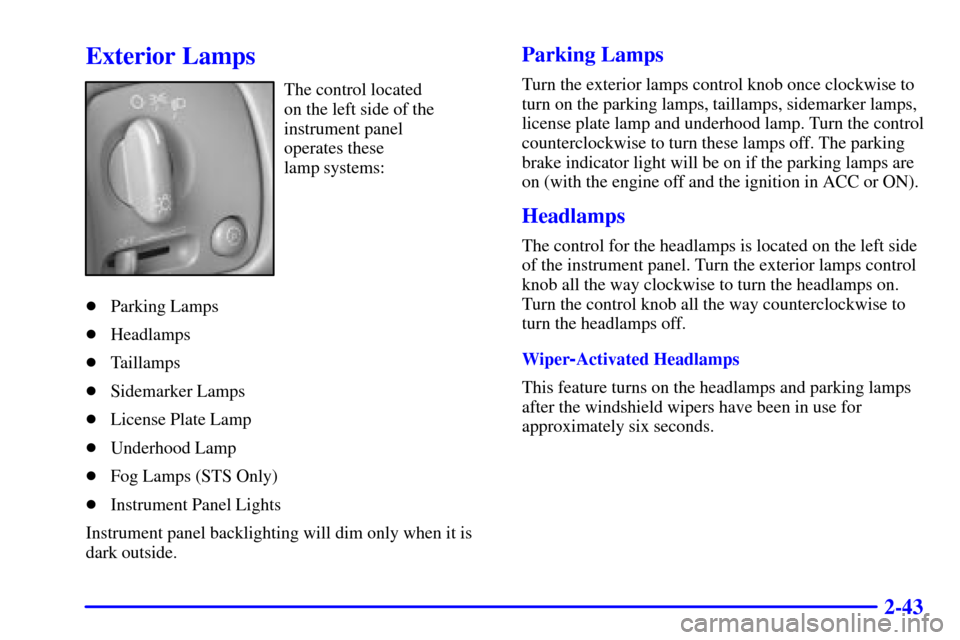
The control located
on the left side of the
instrument panel
operates these
lamp systems:
�Parking Lamps
�Headlamps
�Taillamps
�Sidemarker Lamps
�License Plate Lamp
�Underhood Lamp
�Fog Lamps (STS Only)
�Instrument Panel Lights
Instrument panel backlighting will dim only when it is
dark outside.
Parking Lamps
Turn the exterior lamps control knob once clockwise to
turn on the parking lamps, taillamps, sidemarker lamps,
license plate lamp and underhood lamp. Turn the control
counterclockwise to turn these lamps off. The parking
brake indicator light will be on if the parking lamps are
on (with the engine off and the ignition in ACC or ON).
Headlamps
The control for the headlamps is located on the left side
of the instrument panel. Turn the exterior lamps control
knob all the way clockwise to turn the headlamps on.
Turn the control knob all the way counterclockwise to
turn the headlamps off.
Wiper
-Activated Headlamps
This feature turns on the headlamps and parking lamps
after the windshield wipers have been in use for
approximately six seconds.
Page 104 of 359

2-44
To operate the wiper-activated headlamps, the Twilight
Sentinel� must be on. If the wiper-activated headlamps
are on and the ignition key is turned to ACC, the
wiper
-activated headlamps will continue. When you
turn the key to OFF or ACC, the wiper
-activated
headlamps will immediately turn off.
The wiper
-activated headlamps will turn off if you
turn off the Twilight Sentinel or the windshield wipers.
If turned off by deactivating the Twilight Sentinel,
a HEADLAMPS SUGGESTED message will be
displayed on the Driver's Information Center (DIC).
Lamps On Reminder
You will hear a warning chime if you open the driver's
door while leaving the lamps on and the exterior lamps
control is activated. An exception to this is when you're
using Twilight Sentinel or if the ignition is on.
Daytime Running Lamps
Daytime Running Lamps (DRL) can make it easier
for others to see the front of your vehicle during the
day. DRL can be helpful in many different driving
conditions, but they can be especially helpful in the
short periods after dawn and before sunset.
The DRL system will make the high
-beam headlamps
come on at reduced brightness when:
�The ignition is on,
�the headlamp switch is off and
�the transaxle is not in PARK (P).
When DRL are on, only your high
-beam headlamps
(at reduced brightness) will be on. No other exterior
lamps such as the parking lamps, taillamps, etc. will be
on when the DRL are being used. Your instrument
panel won't be lit up either.