Page 250 of 359
5-2
Hazard Warning Flashers
Your hazard warning flashers let you warn others. They
also let police know you have a problem. Your front and
rear turn signal lamps will flash on and off.
The hazard warning button
is located in the center of
the instrument panel,
between the two air vents.
Press the button in to make
the front and rear turn signal
lamps flash on and off.
This light located on the
instrument panel cluster
will flash, indicating that
the hazard warning
flashers are on.
Your hazard warning flashers work no matter what
position the key is in, and even if the key isn't in.
Press the button again to turn your hazard warning
flashers off. When the hazard warning flashers are on,
the turn signals won't work.
Page 251 of 359
5-3
Other Warning Devices
If you carry reflective triangles, you can set one up at
the side of the road about 300 feet (100 m) behind
your vehicle.
Jump Starting
If your battery has run down, you may want to use
another vehicle and some jumper cables to start your
vehicle. Please follow the steps below to do it safely.
CAUTION:
Batteries can hurt you. They can be
dangerous because:
�They contain acid that can burn you.
�They contain gas that can explode or ignite.
�They contain enough electricity to burn you.
If you don't follow these steps exactly, some or
all of these things can hurt you.
NOTICE:
Ignoring these steps could result in costly damage
to your vehicle that wouldn't be covered by
your warranty.
The ACDelco� battery in your vehicle has a
built
-in hydrometer. Do not charge, test or jump
start the battery if the hydrometer looks clear
or light yellow. Replace the battery when there
is a clear or light yellow hydrometer and a
cranking complaint.
Trying to start your vehicle by pushing or pulling
it won't work, and it could damage your vehicle.
Page 252 of 359
5-4
1. Check the other vehicle. It must have a 12-volt
battery with a negative ground system.
NOTICE:
If the other system isn't a 12-volt system with a
negative ground, both vehicles can be damaged.
2. Get the vehicles close enough so the jumper cables
can reach, but be sure the vehicles aren't touching
each other. If they are, it could cause a ground
connection you don't want. You wouldn't be able
to start your vehicle and the bad grounding could
damage the electrical systems.
3. To avoid the possibility of the vehicles rolling, set
the parking brake firmly on both vehicles involved
in the jump starting procedure. Put the transaxle
in PARK (P).4. Turn off the ignition on both vehicles. Unplug
unnecessary accessories plugged into the cigarette
lighter. Turn off all lamps that aren't needed as well
as radios. This will avoid sparks and help save both
batteries. In addition, it could save your radio!
NOTICE:
If you leave your radio on, it could be badly
damaged. The repairs wouldn't be covered by
your warranty.
5. Open the hoods and locate the battery on the
other vehicle and the remote positive (+) terminal,
located on the passenger's side of the engine, on
your vehicle. (You will not see the battery under
the hood of your vehicle, since it is located under
the rear seat on the passenger's side.) Find the
positive (+) and negative (
-) terminals on the
battery in the other vehicle.
Page 253 of 359
5-5
CAUTION:
An electric fan can start up even when the engine
is not running and can injure you. Keep hands,
clothing and tools away from any underhood
electric fan.
6. Start by lifting and
moving the red
positive (+)
remote terminal
cover away from
the relay center.
CAUTION:
Using a match near a battery can cause battery
gas to explode. People have been hurt doing this,
and some have been blinded. Use a flashlight if
you need more light.
Be sure the battery has enough water. You
don't need to add water to the ACDelco�
battery installed in every new GM vehicle.
But if a battery has filler caps, be sure the right
amount of fluid is there. If it is low, add water to
take care of that first. If you don't, explosive gas
could be present.
Battery fluid contains acid that can burn you.
Don't get it on you. If you accidentally get it in
your eyes or on your skin, flush the place with
water and get medical help immediately.
Page 255 of 359
5-7
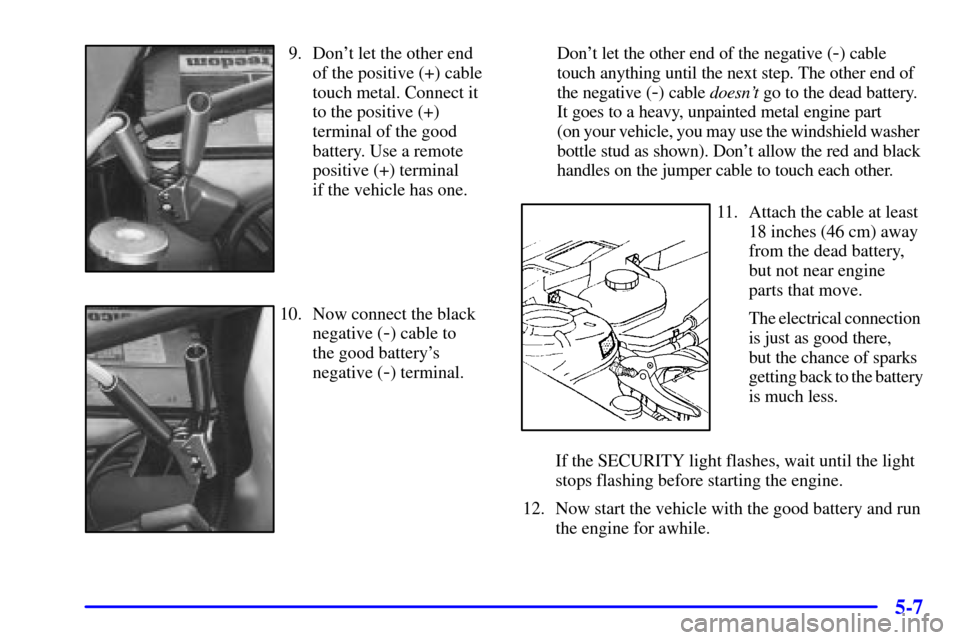
9. Don't let the other end
of the positive (+) cable
touch metal. Connect it
to the positive (+)
terminal of the good
battery. Use a remote
positive (+) terminal
if the vehicle has one.
10. Now connect the black
negative (
-) cable to
the good battery's
negative (
-) terminal.Don't let the other end of the negative (
-) cable
touch anything until the next step. The other end of
the negative (
-) cable doesn't go to the dead battery.
It goes to a heavy, unpainted metal engine part
(on your vehicle, you may use the windshield washer
bottle stud as shown). Don't allow the red and black
handles on the jumper cable to touch each other.
11. Attach the cable at least
18 inches (46 cm) away
from the dead battery,
but not near engine
parts that move.
The electrical connection
is just as good there,
but the chance of sparks
getting back to the battery
is much less.
If the SECURITY light flashes, wait until the light
stops flashing before starting the engine.
12. Now start the vehicle with the good battery and run
the engine for awhile.
Page 257 of 359
5-9
With current trends in automotive styles and design, it
is essential that the correct towing equipment is used to
tow a vehicle. Your vehicle can be towed with wheel
-lift
or car
-carrier equipment.
Consult your dealer or a professional towing service if
you need to have your vehicle towed. See ªRoadside
Assistanceº in the Index.
Engine Overheating
You will find an ENGINE COOLANT HOT, IDLE
ENGINE message or an ENGINE OVERHEATED,
STOP ENGINE message on the Driver Information
Center (DIC). There is also an engine temperature
warning light and/or gage on the instrument panel.
See ªEngine Coolant Temperature Warning Lightº or
ªEngine Coolant Temperature Gageº in the Index.
Overheated Engine Protection
Operating Mode
Should an overheated engine condition exist and the
message ENGINE OVERHEATED, STOP ENGINE is
displayed, an overheat protection mode which alternates
firing groups of cylinders helps prevent engine damage.
In this mode, you will notice a loss in power and engine
performance. This operating mode allows your vehicle
to be driven to a safe place in an emergency; you may
drive up to 50 miles (80 km). Towing a trailer in the
overheat protection mode should be avoided.
NOTICE:
After driving in the overheated engine protection
operating mode, to avoid engine damage, allow the
engine to cool before attempting any repair. The
engine oil will be severely degraded. Repair the
cause of coolant loss, change the oil and reset the
oil life indicator. See ªEngine Oilº in the Index.
Page 276 of 359

5-28
If You're Stuck: In Sand, Mud,
Ice or Snow
In order to free your vehicle when it is stuck, you will
need to spin the wheels, but you don't want to spin
your wheels too fast. The method known as ªrockingº
can help you get out when you're stuck, but you must
use caution.
CAUTION:
If you let your tires spin at high speed, they
can explode, and you or others could be injured.
And, the transaxle or other parts of the vehicle
can overheat. That could cause an engine
compartment fire or other damage. When
you're stuck, spin the wheels as little as possible.
Don't spin the wheels above 35 mph (55 km/h) as
shown on the speedometer.
NOTICE:
Spinning your wheels can destroy parts of your
vehicle as well as the tires. If you spin the wheels
too fast while shifting your transaxle back and
forth, you can destroy your transaxle.
For information about using tire chains on your vehicle,
see ªTire Chainsº in the Index.
Rocking Your Vehicle To Get It Out
First, turn your steering wheel left and right. That will
clear the area around your front wheels. You should turn
your traction control system off. (See ªTraction Control
Systemº in the Index.) Then shift back and forth
between REVERSE (R) and a forward gear, spinning the
wheels as little as possible. Release the accelerator pedal
while you shift, and press lightly on the accelerator
pedal when the transaxle is in gear. By slowly spinning
your wheels in the forward and reverse directions, you
will cause a rocking motion that may free your vehicle.
If that doesn't get you out after a few tries, you may
need to be towed out. If you do need to be towed out,
see ªTowing Your Vehicleº in the Index.
Page 279 of 359

6-3
CAUTION:
You can be injured and your vehicle could be
damaged if you try to do service work on a
vehicle without knowing enough about it.
�Be sure you have sufficient knowledge,
experience, the proper replacement parts
and tools before you attempt any vehicle
maintenance task.
�Be sure to use the proper nuts, bolts and
other fasteners. ªEnglishº and ªmetricº
fasteners can be easily confused. If you use
the wrong fasteners, parts can later break
or fall off. You could be hurt.
Adding Equipment to the Outside of
Your Vehicle
Things you might add to the outside of your vehicle can
affect the airflow around it. This may cause wind noise
and affect windshield washer performance. Check with
your dealer before adding equipment to the outside of
your vehicle.
Fuel
Use premium unleaded gasoline rated at 91 octane or
higher for best performance. You may use middle
grade or regular unleaded gasolines, but your vehicle's
acceleration may be slightly reduced.
It is recommended that the gasoline meet specifications
which have been developed by the American Automobile
Manufacturers Association (AAMA) and endorsed by
the Canadian Motor Vehicle Manufacturers Association
for better vehicle performance and engine protection.
Gasolines meeting the AAMA specification could
provide improved driveability and emission control
system performance compared to other gasolines.
Be sure the posted octane for premium is at least 91
(at least 87 for regular). If the octane is less than 87,
you may get a heavy knocking noise when you drive.
If it's bad enough, it can damage your engine.
If you're using fuel rated at the recommended octane
or higher and you hear heavy knocking, your engine
needs service. But don't worry if you hear a little
pinging noise when you're accelerating or driving up a
hill. That's normal, and you don't have to buy a higher
octane fuel to get rid of pinging. It's the heavy, constant
knock that means you have a problem.