Page 278 of 339
6-16
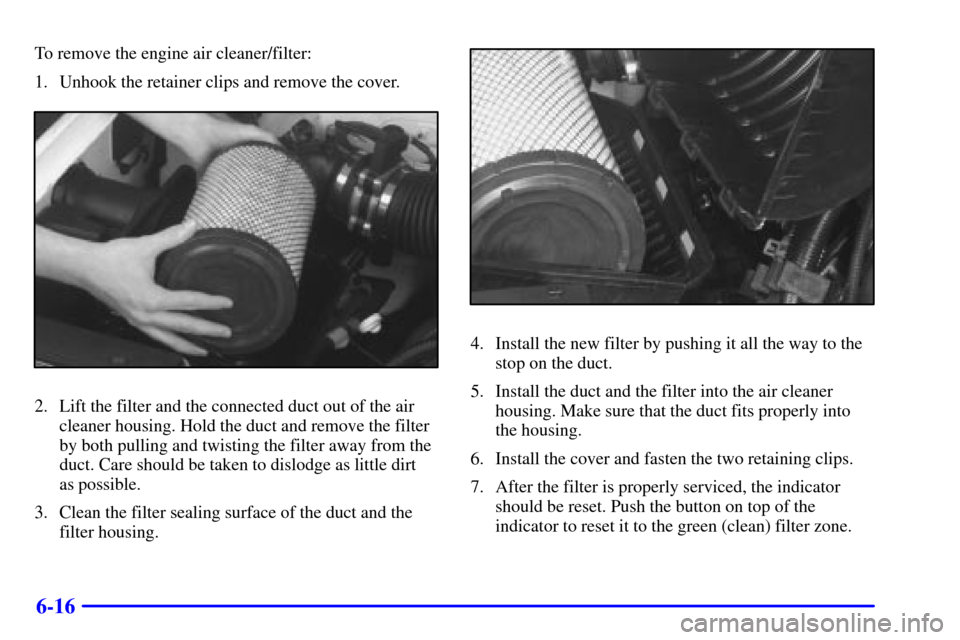
To remove the engine air cleaner/filter:
1. Unhook the retainer clips and remove the cover.
2. Lift the filter and the connected duct out of the air
cleaner housing. Hold the duct and remove the filter
by both pulling and twisting the filter away from the
duct. Care should be taken to dislodge as little dirt
as possible.
3. Clean the filter sealing surface of the duct and the
filter housing.
4. Install the new filter by pushing it all the way to the
stop on the duct.
5. Install the duct and the filter into the air cleaner
housing. Make sure that the duct fits properly into
the housing.
6. Install the cover and fasten the two retaining clips.
7. After the filter is properly serviced, the indicator
should be reset. Push the button on top of the
indicator to reset it to the green (clean) filter zone.
Page 279 of 339

6-17
Refer to the Maintenance Schedule to determine when to
replace the engine air cleaner/filter. See ªOwner Checks
and Servicesº in the Maintenance Schedule booklet.
CAUTION:
Operating the engine with the air cleaner/filter
off can cause you or others to be burned. The air
cleaner not only cleans the air, it stops flame if
the engine backfires. If it isn't there, and the
engine backfires, you could be burned. Don't
drive with it off, and be careful working on the
engine with the air cleaner/filter off.
NOTICE:
If the air cleaner/filter is off, a backfire can cause
a damaging engine fire. And, dirt can easily get
into your engine, which will damage it. Always
have the air cleaner/filter in place when
you're driving.
Automatic Transmission Fluid
When to Check and Change
A good time to check your automatic transmission fluid
level is when the engine oil is changed.
Change both the fluid and filter every 50,000 miles
(83 000 km) if the vehicle is mainly driven under one or
more of these conditions:
�In heavy city traffic where the outside temperature
regularly reaches 90�F (32�C) or higher.
�In hilly or mountainous terrain.
�When doing frequent trailer towing.
�Uses such as found in taxi, police or delivery service.
If you do not use your vehicle under any of these
conditions, change the fluid and filter every
100,000 miles (166 000 km).
See ªScheduled Maintenance Servicesº in the
Maintenance Schedule booklet.
Page 280 of 339

6-18 How to Check
Because this operation can be a little difficult, you
may choose to have this done at the dealership
service department.
If you do it yourself, be sure to follow all the
instructions here, or you could get a false reading on
the dipstick.
NOTICE:
Too much or too little fluid can damage your
transmission. Too much can mean that some of
the fluid could come out and fall on hot engine
parts or exhaust system parts, starting a fire. Be
sure to get an accurate reading if you check your
transmission fluid.
Wait at least 30 minutes before checking the
transmission fluid level if you have been driving:
�When outside temperatures are above 90�F (32�C).
�At high speed for quite a while.
�In heavy traffic
-- especially in hot weather.
�While pulling a trailer.
To get the right reading, the fluid should be at normal
operating temperature, which is 180�F to 200�F
(82�C to 93�C).
Get the vehicle warmed up by driving about 15 miles
(24 km) when outside temperatures are above 50�F
(10�C). If it's colder than 50�F (10�C), drive the
vehicle in THIRD (3) until the engine temperature gage
moves and then remains steady for 10 minutes. Then
follow the hot check procedures.
Page 283 of 339
6-21
Rear Axle
When to Check and Change Lubricant
Refer to the Maintenance Schedule to determine how
often to check the lubricant and when to change it. See
ªScheduled Maintenance Servicesº in the Maintenance
Schedule booklet.
How to Check Lubricant
If the level is below the bottom of the filler plug hole,
you'll need to add some lubricant. Add enough lubricant
to raise the level to the bottom of the filler plug hole.
What to Use
Refer to the Maintenance Schedule to determine what
kind of lubricant to use. See ªRecommended Fluids and
Lubricantsº in the Maintenance Schedule booklet.
Four-Wheel Drive
Transfer Case
When to Check Lubricant
Refer to the Maintenance Schedule to determine how
often to check the lubricant. See ªPeriodic Maintenance
Inspectionsº in the Maintenance Schedule booklet.
Page 284 of 339
6-22
How to Check Lubricant
If the level is below the bottom of the filler plug hole,
you'll need to add some lubricant. Add enough lubricant
to raise the level to the bottom of the filler plug hole.
Use care not to overtighten plug.
What to Use
Refer to the Maintenance Schedule to determine what
kind of lubricant to use. See ªRecommended Fluids and
Lubricantsº in the Maintenance Schedule booklet.
Front Axle
When to Check and Change Lubricant
Refer to the Maintenance Schedule to determine how
often to check the lubricant and when to change it. See
ªScheduled Maintenance Servicesº in the Maintenance
Schedule booklet.
How to Check Lubricant
If the level is below the bottom of the filler plug hole,
you may need to add some lubricant.
Page 293 of 339

6-31
CAUTION:
The brake wear warning sound means that soon
your brakes won't work well. That could lead to
an accident. When you hear the brake wear
warning sound, have your vehicle serviced.
NOTICE:
Continuing to drive with worn-out brake pads
could result in costly brake repair.
Some driving conditions or climates may cause a brake
squeal when the brakes are first applied or lightly
applied. This does not mean something is wrong with
your brakes.
Properly torqued wheel nuts are necessary to help
prevent brake pulsation. When tires are rotated, inspect
brake pads for wear and evenly torque wheel nuts in the
proper sequence to GM specifications.Your rear drum brakes don't have wear indicators, but if
you ever hear a rear brake rubbing noise, have the rear
brake linings inspected immediately. Also, the rear
brake drums should be removed and inspected each time
the tires are removed for rotation or changing. When
you have the front brake pads replaced, have the rear
brakes inspected, too.
Brake linings should always be replaced as complete
axle sets.
See ªBrake System Inspectionº in the Maintenance
Schedule booklet under Part C ªPeriodic
Maintenance Inspections.º
Brake Pedal Travel
See your dealer if the brake pedal does not return to
normal height, or if there is a rapid increase in pedal
travel. This could be a sign of brake trouble.
Brake Adjustment
Every time you make a brake stop, your disc brakes
adjust for wear.
If your brake pedal goes down farther than normal, your
rear drum brakes may need adjustment. Adjust them by
backing up and firmly applying the brakes a few times.
Page 295 of 339
6-33
Bulb Replacement
The following procedure tells you how to replace your
headlamp bulbs. For the type of bulb to use, see
ªReplacement Bulbsºin the Index. For any bulbs not
listed in this section, contact your service department.
Halogen Bulbs
CAUTION:
Halogen bulbs have pressurized gas inside and
can burst if you drop or scratch the bulb. You or
others could be injured. Be sure to read and
follow the instructions on the bulb package.
Headlamps
1. Remove the parking/turn signal assembly as
described under ªParking/Turn Signal Lamps,º
following this procedure. The parking/turn signal
assembly must be removed to provide clearance for
headlamp removal.2. Remove the two turn signal bulb sockets and the
sidemarker bulb socket from the parking/turn signal
assembly by turning counterclockwise.
3. Set the parking/turn signal assembly to the side.4. Remove the two bolts at the top of the radiator
support as shown.
5. Pull the headlamp assembly out.
Page 299 of 339
6-37
4. Remove the screws from
the bulb retainer and
take the bulb retainer off
of the lamp assembly.
5. Pull the old bulb straight out of the socket.
6. Put in a new bulb and push it straight in until it
is tight.
7. Replace the bulb retainer.
8. Replace the rear lamp assembly and tighten the
screws. You may want to use a magnetic screwdriver
when installing the screws.
9. Close the tailgate.Windshield Wiper Blade Replacement
Windshield wiper blades should be inspected at least
twice a year for wear and cracking. See ªWiper Blade
Checkº in the Maintenance Schedule booklet under
Part B, ªOwner Checks and Servicesº for
more information.
Replacement blades come in different types and are
removed in different ways. For proper type and length,
see ªNormal Maintenance Replacement Partsº in the
Index. Here's how to remove the Shephard's Hook type.