Page 229 of 323
5-18
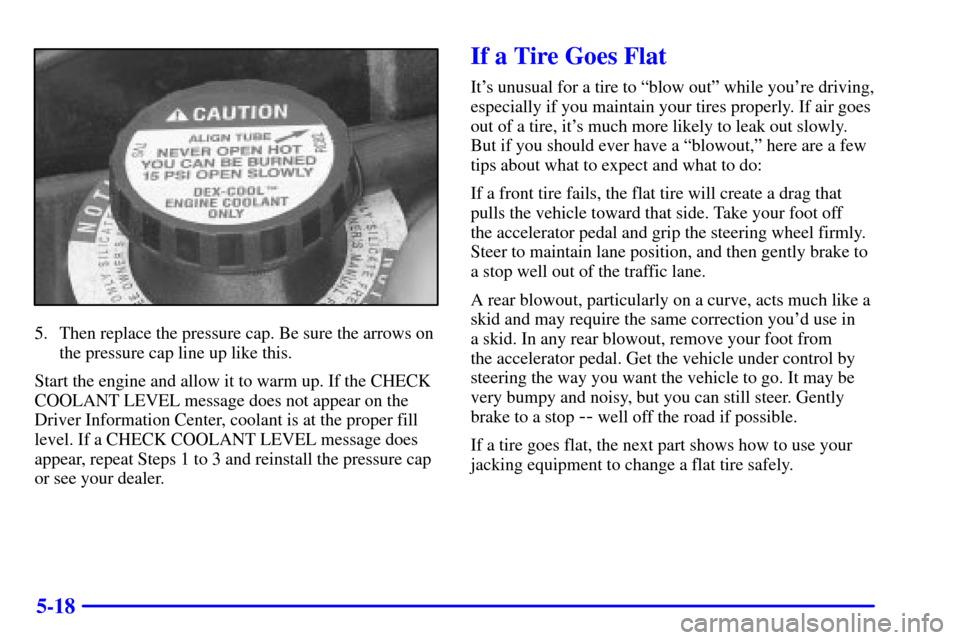
5. Then replace the pressure cap. Be sure the arrows on
the pressure cap line up like this.
Start the engine and allow it to warm up. If the CHECK
COOLANT LEVEL message does not appear on the
Driver Information Center, coolant is at the proper fill
level. If a CHECK COOLANT LEVEL message does
appear, repeat Steps 1 to 3 and reinstall the pressure cap
or see your dealer.
If a Tire Goes Flat
It's unusual for a tire to ªblow outº while you're driving,
especially if you maintain your tires properly. If air goes
out of a tire, it's much more likely to leak out slowly.
But if you should ever have a ªblowout,º here are a few
tips about what to expect and what to do:
If a front tire fails, the flat tire will create a drag that
pulls the vehicle toward that side. Take your foot off
the accelerator pedal and grip the steering wheel firmly.
Steer to maintain lane position, and then gently brake to
a stop well out of the traffic lane.
A rear blowout, particularly on a curve, acts much like a
skid and may require the same correction you'd use in
a skid. In any rear blowout, remove your foot from
the accelerator pedal. Get the vehicle under control by
steering the way you want the vehicle to go. It may be
very bumpy and noisy, but you can still steer. Gently
brake to a stop
-- well off the road if possible.
If a tire goes flat, the next part shows how to use your
jacking equipment to change a flat tire safely.
Page 242 of 323

5-31
If You're Stuck: In Sand, Mud,
Ice or Snow
In order to free your vehicle when it is stuck, you will
need to spin the wheels, but you don't want to spin your
wheels too fast. The method known as ªrockingº can
help you get out when you're stuck, but you must
use caution.
CAUTION:
If you let your tires spin at high speed, they can
explode, and you or others could be injured.
And, the transaxle or other parts of the vehicle
can overheat. That could cause an engine
compartment fire or other damage. When you're
stuck, spin the wheels as little as possible. Don't
spin the wheels above 35 mph (55 km/h) as shown
on the speedometer.
NOTICE:
Spinning your wheels can destroy parts of your
vehicle as well as the tires. If you spin the wheels
too fast while shifting your transaxle back and
forth, you can destroy your transaxle.
For information about using tire chains on your vehicle,
see ªTire Chainsº in the Index.
Rocking Your Vehicle To Get It Out
First, turn your steering wheel left and right. That will
clear the area around your front wheels. You should turn
your traction control system off. (See ªTraction Control
Systemº in the Index.) Then shift back and forth
between REVERSE (R) and a forward gear, spinning the
wheels as little as possible. Release the accelerator pedal
while you shift, and press lightly on the accelerator
pedal when the transaxle is in gear. By slowly spinning
your wheels in the forward and reverse directions, you
will cause a rocking motion that may free your vehicle.
If that doesn't get you out after a few tries, you may
need to be towed out. If you do need to be towed out,
see ªTowing Your Vehicleº in the Index.
Page 252 of 323
6-10
When you open the hood, you'll see:
A. Battery
B. Engine Coolant Fill Location
C. Power Steering Fluid
D. Engine Oil Fill LocationE. Engine Oil Dipstick
F. Brake Master Cylinder
G. Transaxle Dipstick/Fluid
Fill LocationH. Engine Air Cleaner/Filter
I. Windshield Washer Fluid
Reservoir
Before closing the hood, be sure all filler caps are on properly. Then pull the hood down and close it firmly.
Page 268 of 323
6-26
Surge Tank Pressure Cap
NOTICE:
The surge tank cap is a 15 psi (105 kPa)
pressure
-type cap and must be tightly installed to
prevent coolant loss and possible engine damage
from overheating. Be sure the arrows on the
cap line up.
If the surge tank pressure cap needs to be replaced, a
GM cap is recommended.
Power Steering Fluid
The power steering fluid
reservoir is located next
to the coolant surge tank
on the passenger's side
of the engine.
When to Check Power Steering Fluid
It is not necessary to regularly check power steering
fluid unless you suspect there is a leak in the system or
you hear an unusual noise. A fluid loss in this system
could indicate a problem. Have the system inspected
and repaired.
Page 269 of 323

6-27 How to Check Power Steering Fluid
Turn the key off, let the engine compartment cool down,
wipe the cap and the top of the reservoir clean, then
unscrew the cap and wipe the dipstick with a clean rag.
Replace the cap and completely tighten it. Then remove
the cap again and look at the fluid level on the dipstick.
The level should be at the FULL COLD mark. If
necessary, add only enough fluid to bring the level up
to the mark.
What to Use
To determine what kind of fluid to use, see
ªRecommended Fluids and Lubricantsº in the
Maintenance Schedule booklet. Always use the proper
fluid. Failure to use the proper fluid can cause leaks and
damage hoses and seals.
Windshield Washer Fluid
What to Use
When you need windshield washer fluid, be sure to read
the manufacturer's instructions before use. If you will be
operating your vehicle in an area where the temperature
may fall below freezing, use a fluid that has sufficient
protection against freezing.
Adding Washer Fluid
The CHECK WASHER FLUID message will be
displayed on the Driver Information Center (DIC)
when the fluid is low.
Page 302 of 323

6-60
MaxiFuse
(8
-Way)Usage
INADVERT Inadvertent Power Relay, Interior
Lamps Fuse, Cigarette Lighter
-1 Fuse,
Courtesy Lamp Relay
LAMPS Headlamps Fuse/Relay, High/Low
Beam Control Relay, Fog Lamp Fuse,
DRL Fuse, Hazard Fuse, Mirror Fuse,
Inadvertent Power Relay, Right and
Left High
-Beam Fuse, Right and Left
Low
-Beam Fuse, Stoplamp Fuse,
Fog Lamp Relay, DRL Relay
IGN 1 Rear Ignition
-1 Relay, Wiper Fuse,
Relay Ignition
-1 Fuse, Supplemental
Inflatable Restraint (SIR) Fuse,
Accessory Relay
WINDOWS Retained Accessory
Power (RAP) Relay
SEATS Horn Relay, Driver and Passenger
Lumbar In/Out Relays, Driver and
Passenger Lumbar Up/Down RelaysMaxiFuse
(6
-Way)Usage
BATT 3 Steering Column Ignition Switch
BATT 2 Steering Column Ignition Switch
IGN 1 Front Ignition
-1 Relay, Oxygen
Sensor 1 and 2 Fuse, Fuel Fuse, Cruise
Fuse, Fuel Pump Relay
BATT 1 Starter Relay and Solenoid,
Park/Reverse Fuse, Park Relay,
Powertrain Control Module (PCM)
Fuse, AC Compressor Fuse and Relay,
Fan Relays, Reverse Relay
BRAKES Anti
-Lock Brake System (ABS)
Brake Modulator
COOL FNS Cooling Fan Relays 1 and 3
Page 308 of 323

6-66
Fuse Usage
RADIO/PHONE Radio Receiver, Radio Interface
Module (RIM) (Optional), Phone,
RAP Relay, Trunk Release Relay,
Fuel Door Release Relay,
High/Low
-Beam Relay
CLUSTER Steering Wheel Controls, Cluster
ACC PZM, Electrochromic Mirror,
Rain Sensor (Optional),
Accessory Relay
HTD MIR Right and Left Outside
Heated Mirror
HTD SEAT R Passenger Heated Seat
Relay (Optional)
HTD SEAT L Driver Heated Seat
Relay (Optional)
PULL DOWN Trunk Pull
-Down Motor
ANTENNA Power Mast Antenna
RSS Damper Relay (ETC Only)Fuse Usage
CONVENC Trunk Release Relay, Trunk
Release Solenoid, Fuel Door
Release Relay, Fuel Filler Door
Release Solenoid, Door Lock
Relay, Left and RIght Door
Motors, PZM, Door Unlock Relay
BATT Driver and Passenger Seat Lumbar
Switch (Optional), Driver and
Passenger Seat Belt Comfort
Solenoid, Memory Seat
Module (Optional)
RSS Road Sensing Suspension (RSS)
Module (ETC Only)
RT PARK Headlamp Switch, Right Front
Parking Lamp, Right Front and
Rear Sidemarker Lamps, Right
Turn/Stop/Tail Lamps
LT PARK Left Front and Rear Sidemarker
Lamps, Left Front Parking Lamp,
Left Turn/Stop/Tail Lamps, Right
and Left License Lamps,
Underhood Lamp
Page 322 of 323

7-12
CURRENT PUBLICATIONS FOR 2000 CADILLAC
SERVICE MANUALS
Service Manuals have the diagnosis and repair information
on engines, transmission, axle, suspension, brakes,
electrical, steering, body, etc.
RETAIL SELL PRICE: $120.00
TRANSMISSION, TRANSAXLE, TRANSFER CASE
UNIT REPAIR MANUAL
This manual provides information on unit repair service
procedures, adjustments and specifications for the
2000 GM transmissions, transaxles and transfer cases.
RETAIL SELL PRICE: $50.00
SERVICE BULLETINS
Service Bulletins give technical service information needed
to knowledgeably service General Motors cars and trucks.
Each bulletin contains instructions to assist in the
diagnosis and service of your vehicle.OWNER'S INFORMATION
Owner publications are written directly for Owners and
intended to provide basic operational information about
the vehicle.
Owner's Manual.
RETAIL SELL PRICE: $15.00
CURRENT & PAST MODEL ORDER FORMS
Service Publications are available for current and past
model GM vehicles. To request an order form, please
specify year and model name of the vehicle.
PLEASE COMPLETE THE ORDER FORM SHOWN ON
THE FOLLOWING PAGE AND MAIL TO:
Helm, Incorporated � P.O. Box 07130 � Detroit, MI 48207OR ORDER TOLL FREE: 1-800-551-4123
Monday-Friday 8:00 AM ± 6:00 PM Eastern Time
For Credit Card Orders Only (VISA±MasterCard±Discover)
2000 CADILLAC SERVICE PUBLICATIONS ORDERING INFORMATION
The following publications covering the operation and servicing of your vehicle can be purchased by filling out
the Service Publication Order Form in this book and mailing it in with your check, money order,
or credit card information to Helm, Incorporated (address below.)

