Page 262 of 321
6-18
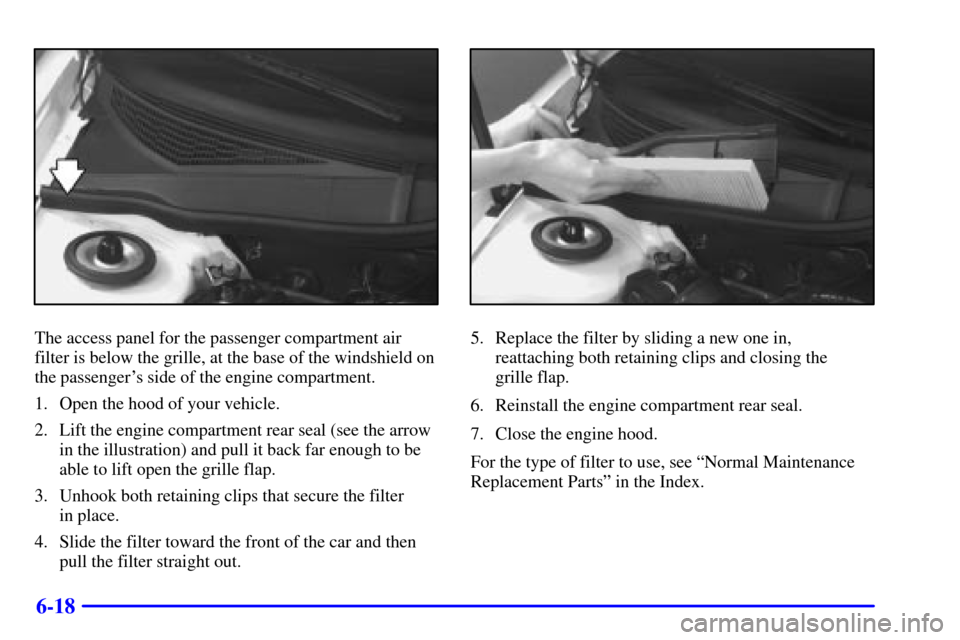
The access panel for the passenger compartment air
filter is below the grille, at the base of the windshield on
the passenger's side of the engine compartment.
1. Open the hood of your vehicle.
2. Lift the engine compartment rear seal (see the arrow
in the illustration) and pull it back far enough to be
able to lift open the grille flap.
3. Unhook both retaining clips that secure the filter
in place.
4. Slide the filter toward the front of the car and then
pull the filter straight out.5. Replace the filter by sliding a new one in,
reattaching both retaining clips and closing the
grille flap.
6. Reinstall the engine compartment rear seal.
7. Close the engine hood.
For the type of filter to use, see ªNormal Maintenance
Replacement Partsº in the Index.
Page 263 of 321
6-19
Automatic Transmission Fluid
It is not necessary to check the transmission fluid level.
A transmission fluid leak is the only reason for fluid
loss. If a leak occurs, take your vehicle to the dealership
service department and have it repaired as soon as
possible. You may also have your fluid level checked
by your dealer or service center when you have your
oil changed.
Change both the fluid and filter every 50,000 miles
(83 000 km) if the vehicle is mainly driven under one
or more of these conditions:
�In heavy city traffic where the outside temperature
regularly reaches 90�F (32�C) or higher.
�In hilly or mountainous terrain.
�When doing frequent trailer towing.
�Uses such as found in taxi, police or delivery service.
If you do not use your vehicle under any of these
conditions, the fluid and filter do not require changing.NOTICE:
We recommend you use only fluid labeled
DEXRON�-III, because fluid with that label is
made especially for your automatic transmission.
Damage caused by fluid other than DEXRON
�-III
is not covered by your new vehicle warranty.
Rear Axle
When to Check Lubricant
Refer to the Maintenance Schedule to determine how
often to check the lubricant. See ªPeriodic Maintenance
Inspectionsº and ªScheduled Maintenance Servicesº in
the Maintenance Schedule booklet.
Page 285 of 321
6-41
CAUTION:
Rust or dirt on a wheel, or on the parts to which
it is fastened, can make wheel studs become loose
after a time. The wheel could come off and cause
an accident. When you change a wheel, remove
any rust or dirt from places where the wheel
attaches to the vehicle. In an emergency, you
can use a cloth or a paper towel to do this;
but be sure to use a scraper or wire brush later,
if you need to, to get all the rust or dirt off.
(See ªChanging a Flat Tireº in the Index.)
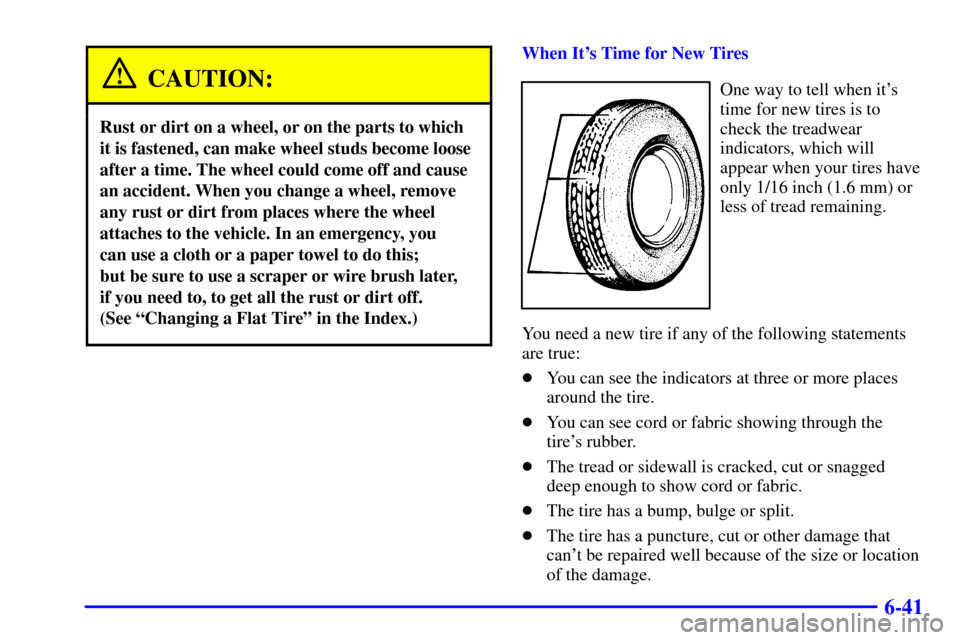
When It's Time for New Tires
One way to tell when it's
time for new tires is to
check the treadwear
indicators, which will
appear when your tires have
only 1/16 inch (1.6 mm) or
less of tread remaining.
You need a new tire if any of the following statements
are true:
�You can see the indicators at three or more places
around the tire.
�You can see cord or fabric showing through the
tire's rubber.
�The tread or sidewall is cracked, cut or snagged
deep enough to show cord or fabric.
�The tire has a bump, bulge or split.
�The tire has a puncture, cut or other damage that
can't be repaired well because of the size or location
of the damage.
Page 295 of 321
6-51
Cleaning the Outside of Your Vehicle
The paint finish on your vehicle provides beauty, depth
of color, gloss retention and durability.
Washing Your Vehicle
The best way to preserve your vehicle's finish is to
keep it clean by washing it often with lukewarm or
cold water.
Don't wash your vehicle in the direct rays of the sun.
Use a car washing soap. Don't use strong soaps or
chemical detergents. Be sure to rinse the vehicle well,
removing all soap residue completely. You can get
GM
-approved cleaning products from your dealer.
(See ªAppearance Care and Materialsº in the Index.)
Don't use cleaning agents that are petroleum based,
or that contain acid or abrasives. All cleaning agents
should be flushed promptly and not allowed to dry on
the surface, or they could stain. Dry the finish with a
soft, clean chamois or an all
-cotton towel to avoid
surface scratches and water spotting.
High pressure car washes may cause water to enter
your vehicle.
Cleaning Exterior Lamps/Lenses
Use lukewarm or cold water, a soft cloth and a car
washing soap to clean exterior lamps and lenses.
Follow instructions under ªWashing Your Vehicle.º
Finish Care
Occasional waxing or mild polishing of your vehicle by
hand may be necessary to remove residue from the paint
finish. You can get GM
-approved cleaning products
from your dealer. (See ªAppearance Care and Materialsº
in the Index.)
Your vehicle has a ªbasecoat/clearcoatº paint finish.
The clearcoat gives more depth and gloss to the
colored basecoat. Always use waxes and polishes that
are non
-abrasive and made for a basecoat/clearcoat
paint finish.
NOTICE:
Machine compounding or aggressive polishing
on a basecoat/clearcoat paint finish may dull the
finish or leave swirl marks.
Page 296 of 321
6-52
Foreign materials such as calcium chloride and other
salts, ice melting agents, road oil and tar, tree sap, bird
droppings, chemicals from industrial chimneys, etc.,
can damage your vehicle's finish if they remain on
painted surfaces. Wash the vehicle as soon as possible.
If necessary, use non
-abrasive cleaners that are marked
safe for painted surfaces to remove foreign matter.
Exterior painted surfaces are subject to aging, weather
and chemical fallout that can take their toll over a period
of years. You can help to keep the paint finish looking
new by keeping your vehicle garaged or covered
whenever possible.
Cleaning Aluminum or
Chrome
-Plated Wheels (If Equipped)
Keep your wheels clean using a soft clean cloth
with mild soap and water. Rinse with clean water.
After rinsing thoroughly, dry with a soft clean towel.
A wax may then be applied.
The surface of these wheels is similar to the painted
surface of your vehicle. Don't use strong soaps,
chemicals, abrasive polishes, abrasive cleaners, cleaners
with acid or abrasive cleaning brushes on them because
you could damage the surface. Do not use chrome polish
on aluminum wheels.Use chrome polish only on chrome
-plated wheels,
but avoid any painted surface of the wheel, and buff
off immediately after application.
Don't take your vehicle through an automatic car wash
that has silicon carbide tire cleaning brushes. These
brushes can also damage the surface of these wheels.
Cleaning Tires
To clean your tires, use a stiff brush with a tire cleaner.
NOTICE:
When applying a tire dressing always take care
to wipe off any overspray or splash from all
painted surfaces on the body or wheels of the
vehicle. Petroleum
-based products may damage
the paint finish and tires.
Page 313 of 321
7-5
GM Mobility Program for Persons
with Disabilities
This program, available to
qualified applicants, can
reimburse you up to $1,000
toward aftermarket driver
or passenger adaptive
equipment you may require
for your vehicle (hand
controls, wheelchair/scooter
lifts, etc.).
This program can also provide you with free resource
information, such as area driver assessment centers and
mobility equipment installers. The program is available
for a limited period of time from the date of vehicle
purchase/lease. See your dealer for more details or call
the GM Mobility Assistance Center at 1
-800-323-9935.
Text telephone (TTY) users, call 1
-800-833-9935.
GM of Canada also has a Mobility Program. Call
1
-800-GM-DRIVE (463-7483) for details. When
calling from outside Canada, please dial 1
-905-644-3063.
All TTY users call 1
-800-263-3830.
Roadside Service
Cadillac's exceptional Roadside Service is more than an
auto club or towing service. It provides every Catera
owner with the advantage of contacting a Cadillac
advisor and, when appropriate, a Catera trained dealer
technician who can provide on
-site service.
Page 314 of 321

7-6
Each technician travels with a specially equipped
service vehicle complete with the necessary Catera parts
and tools required to handle most roadside repairs.
Cadillac Roadside Service� can be reached by dialing
1
-800-882-1112, 24 hours a day, 365 days a year.
This service is provided at no charge for any
warranty
-covered situation and for a nominal
charge if the Catera is no longer under warranty.
Roadside Service is available only in the United
States and Canada.
Cadillac Owner Privileges�
Roadside Service provides several Cadillac Owner
Privileges� at ªno charge,º throughout your 2000
Cadillac Warranty Period
-- 48 months/50,000 miles
(80 000 km).Emergency Road Service is performed on site for the
following situations:
�Towing Service
�Battery Jump Starting
�Lock Out Assistance
�Fuel Delivery
�Flat Tire Change (Covers change only)
�Trip Interruption
-- If your trip is interrupted due to a
warranty failure, incidental expenses may be reimbursed
during the 48 months/50,000 miles (80 000 km) warranty
period. Items covered are hotel, meals and rental car.
Page 315 of 321
7-7 Roadside Service Availability
Wherever you drive in the United States or Canada,
an advisor is available to assist you over the phone.
A dealer technician, if available, can travel to your
location within a 30 mile (50 km) radius of a
participating Catera dealership. If beyond this radius,
we will arrange to have your car towed to the nearest
Catera dealership.
Reaching Roadside Service
Dial the toll-free Roadside Service number:
1
-800-882-1112. An experienced Roadside
Service Advisor will assist you and request the
following information:
�A description of the problem
�Name, home address, home telephone number
�Location of your Catera and number you are
calling from
�The model year, Vehicle Identification Number (VIN),
mileage and date of deliveryRoadside Service for the Hearing or
Speech Impaired
Roadside Service is prepared to assist owners who have
hearing difficulties or are speech impaired. Cadillac has
installed special telecommunication devices called Text
Telephone (TTY) in the Roadside Service Center.
Any customer who has access to a (TTY) or a
conventional teletypewriter can communicate with
Cadillac by dialing from the United States or Canada
1
-800-833-CMCC (2622) -- daily, 24 hours.