Page 29 of 321
1-17
How to Wear Safety Belts Properly
Adults
This part is only for people of adult size.
Be aware that there are special things to know about
safety belts and children. And there are different rules
for smaller children and babies. If a child will be riding
in your vehicle, see the part of this manual called
ªChildren.º Follow those rules for everyone's protection.
First, you'll want to know which restraint systems your
vehicle has.
We'll start with the driver position.
Driver Position
This part describes the driver's restraint system.
Lap-Shoulder Belt
The driver has a lap-shoulder belt. Here's how to wear
it properly.
1. Close and lock the door.
2. Adjust the seat (to see how, see ªSeatsº in the Index)
so you can sit up straight.
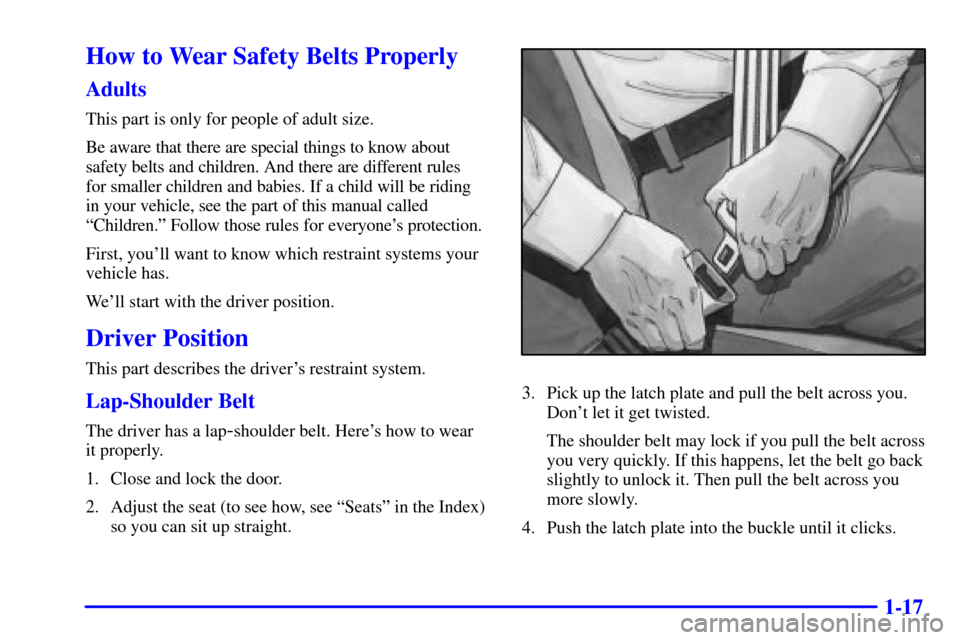
3. Pick up the latch plate and pull the belt across you.
Don't let it get twisted.
The shoulder belt may lock if you pull the belt across
you very quickly. If this happens, let the belt go back
slightly to unlock it. Then pull the belt across you
more slowly.
4. Push the latch plate into the buckle until it clicks.
Page 53 of 321
1-41
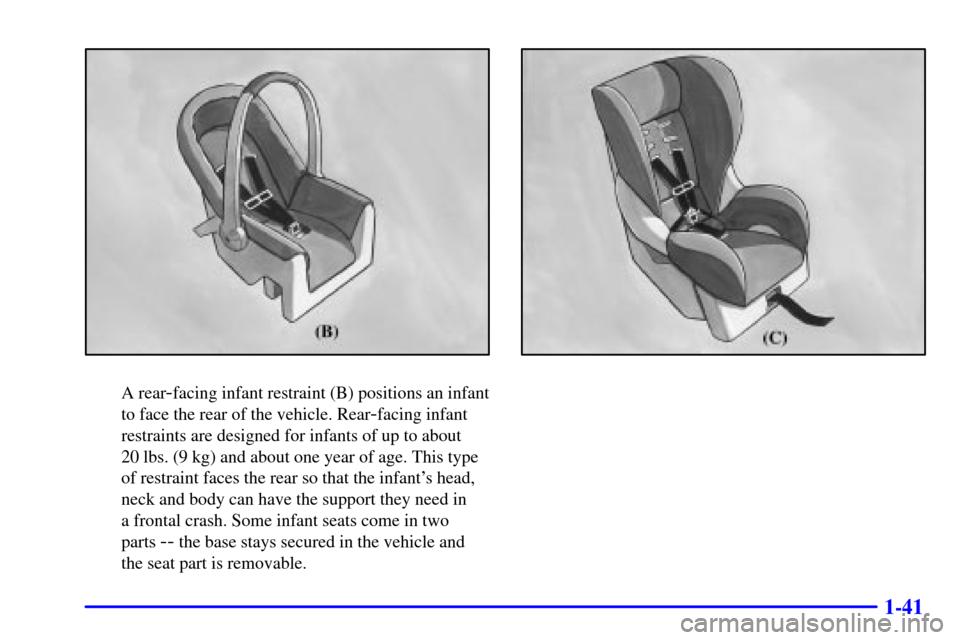
A rear-facing infant restraint (B) positions an infant
to face the rear of the vehicle. Rear
-facing infant
restraints are designed for infants of up to about
20 lbs. (9 kg) and about one year of age. This type
of restraint faces the rear so that the infant's head,
neck and body can have the support they need in
a frontal crash. Some infant seats come in two
parts
-- the base stays secured in the vehicle and
the seat part is removable.
Page 55 of 321
1-43
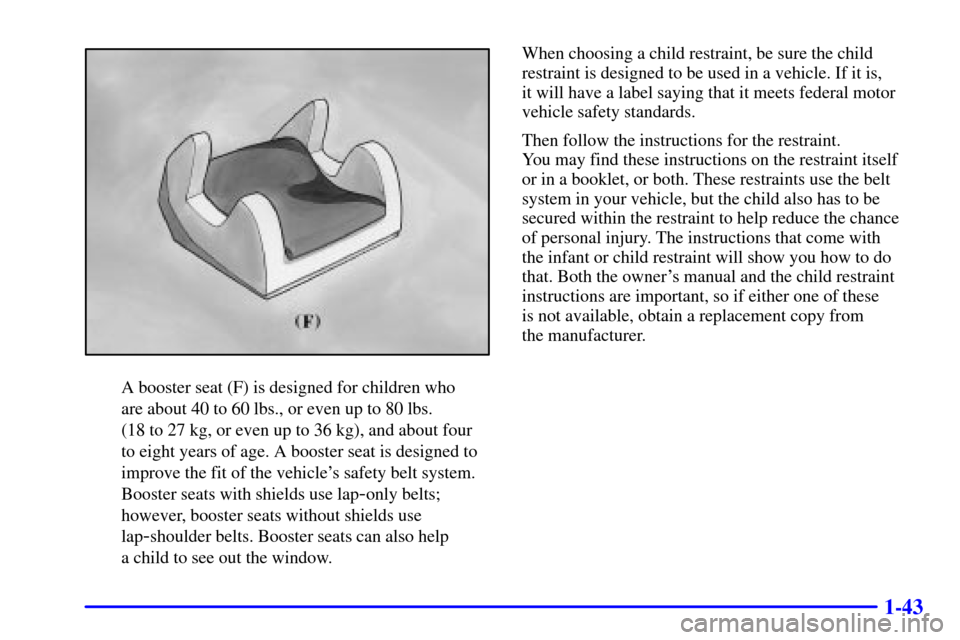
A booster seat (F) is designed for children who
are about 40 to 60 lbs., or even up to 80 lbs.
(18 to 27 kg, or even up to 36 kg), and about four
to eight years of age. A booster seat is designed to
improve the fit of the vehicle's safety belt system.
Booster seats with shields use lap
-only belts;
however, booster seats without shields use
lap
-shoulder belts. Booster seats can also help
a child to see out the window.When choosing a child restraint, be sure the child
restraint is designed to be used in a vehicle. If it is,
it will have a label saying that it meets federal motor
vehicle safety standards.
Then follow the instructions for the restraint.
You may find these instructions on the restraint itself
or in a booklet, or both. These restraints use the belt
system in your vehicle, but the child also has to be
secured within the restraint to help reduce the chance
of personal injury. The instructions that come with
the infant or child restraint will show you how to do
that. Both the owner's manual and the child restraint
instructions are important, so if either one of these
is not available, obtain a replacement copy from
the manufacturer.
Page 60 of 321
1-48
To remove the child restraint, just unbuckle the vehicle's
safety belt and let it go back all the way. The safety belt
will move freely again and be ready to work for an adult
or larger child passenger.
Securing a Child Restraint in the
Right Front Seat Position
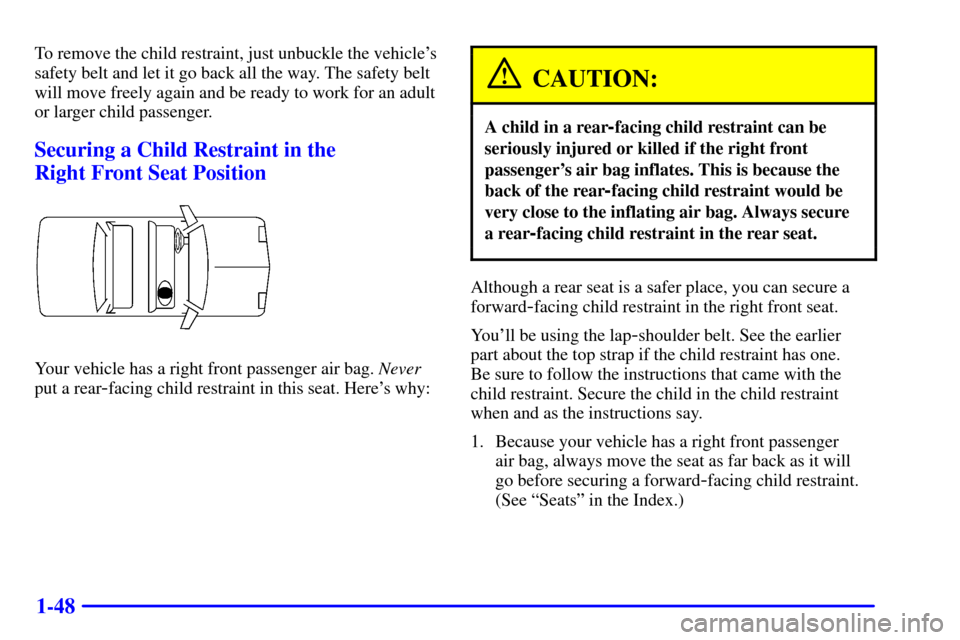
Your vehicle has a right front passenger air bag. Never
put a rear
-facing child restraint in this seat. Here's why:
CAUTION:
A child in a rear-facing child restraint can be
seriously injured or killed if the right front
passenger's air bag inflates. This is because the
back of the rear
-facing child restraint would be
very close to the inflating air bag. Always secure
a rear
-facing child restraint in the rear seat.
Although a rear seat is a safer place, you can secure a
forward
-facing child restraint in the right front seat.
You'll be using the lap
-shoulder belt. See the earlier
part about the top strap if the child restraint has one.
Be sure to follow the instructions that came with the
child restraint. Secure the child in the child restraint
when and as the instructions say.
1. Because your vehicle has a right front passenger
air bag, always move the seat as far back as it will
go before securing a forward
-facing child restraint.
(See ªSeatsº in the Index.)
Page 77 of 321

2-12
If your vehicle loses power
temporarily, you can
manually open the trunk
using the trunk release
handle. The handle is
located on the underside
of the trunk lid on the
driver's side and can be
accessed through the
fold
-down rear seats.
Fold down the driver's side rear seat and reach through to
the trunk compartment to find the release handle. Pulling
the handle opens the trunk. For more information on
how to fold the rear seats, see ªFolding the Rear Seatº
in the Index.
Theft
Vehicle theft is big business, especially in some cities.
Although your vehicle has a number of theft
-deterrent
features, we know that nothing we put on it can make
it impossible to steal. However, there are ways you
can help.
Key in the Ignition
If you leave your vehicle with the keys inside, it's an
easy target for joy riders or professional thieves
-- so
don't do it.
When you park your vehicle and open the driver's door,
you'll hear a tone reminding you to remove your key
from the ignition and take it with you. Always do this.
Your steering wheel will be locked, and so will your
ignition and transmission. And remember to lock
the doors.
Page 91 of 321
2-26
Parking Brake
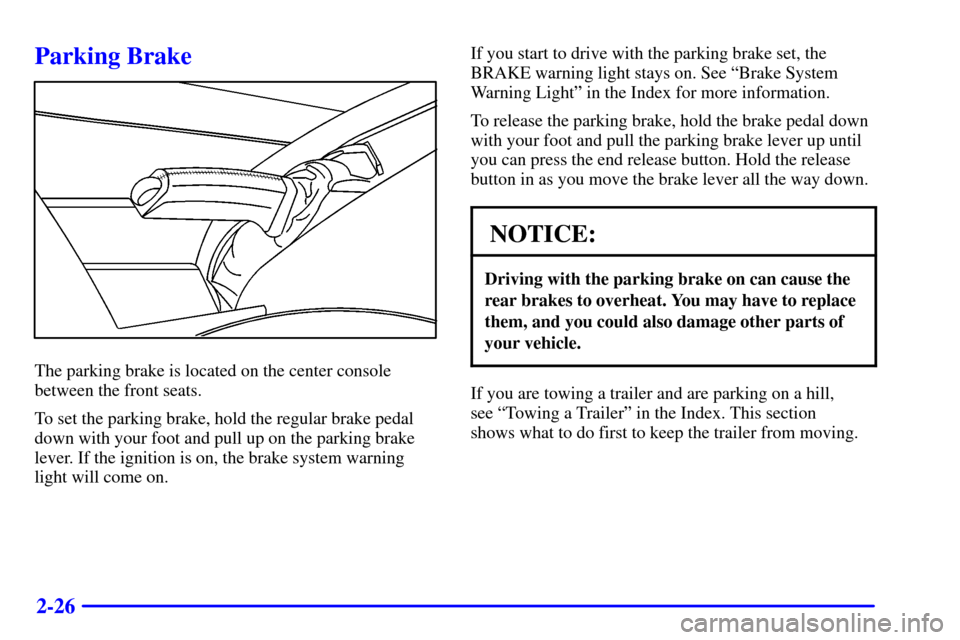
The parking brake is located on the center console
between the front seats.
To set the parking brake, hold the regular brake pedal
down with your foot and pull up on the parking brake
lever. If the ignition is on, the brake system warning
light will come on.If you start to drive with the parking brake set, the
BRAKE warning light stays on. See ªBrake System
Warning Lightº in the Index for more information.
To release the parking brake, hold the brake pedal down
with your foot and pull the parking brake lever up until
you can press the end release button. Hold the release
button in as you move the brake lever all the way down.
NOTICE:
Driving with the parking brake on can cause the
rear brakes to overheat. You may have to replace
them, and you could also damage other parts of
your vehicle.
If you are towing a trailer and are parking on a hill,
see ªTowing a Trailerº in the Index. This section
shows what to do first to keep the trailer from moving.
Page 152 of 321

3-8
The direction of airflow for the rear seats can also be
adjusted. Move the center control dial between each
vent up or down to adjust the airflow from low to high.
Turn the dial to the ªOº position to stop airflow.
Move the lever in the center of each vent to direct
airflow toward the upper or floor outlets.
The airflow temperature from the rear outlets is the
same as the driver's temperature setting.
Ventilation Tips
�Keep the hood and front air inlet free of ice, snow or
any other obstruction (such as leaves). The heater
and defroster will work far better, reducing the
chance of fogging the inside of the windows.
�When you enter a vehicle in cold weather, adjust the
fan to the highest speed for a few moments before
driving off. This helps clear the intake outlets of
snow and moisture, and reduces the chance of
fogging the inside of the windows.
�Keep the air path under the front seats clear of
objects. This helps circulate air throughout
your vehicle.Passenger Compartment Air Filter
This ventilation system includes a charcoal air filter that
helps to remove dust, pollen, etc. from air flowing into
your vehicle. A restriction in the airflow coming into
the passenger compartment could be the result of dirt
in the filter. For more information, see ªPassenger
Compartment Air Filterº in the Index. Also see the
Maintenance Schedule booklet for when to change
the filter.
Audio Systems
Your audio system has been designed to operate easily
and give years of listening pleasure. You will get the
most enjoyment out of it if you acquaint yourself with it
first. Find out what your audio system can do and how
to operate all its controls, to be sure you're getting the
most out of the advanced engineering that went into it.
Setting the Clock
Press and hold HR or MN until the time display begins
to change. Release the button as you get close to the
correct time. The time may be set anytime the clock is
displayed. There is a two
-second delay before the clock
goes into time
-set mode.
Page 206 of 321
4-31
CAUTION:
Do not load your vehicle any heavier than the
GVWR, or either the maximum front or rear
GAWR. If you do, parts on your vehicle can
break, and it can change the way your vehicle
handles. These could cause you to lose control
and crash. Also, overloading can shorten the life
of your vehicle.
NOTICE:
Your warranty does not cover parts or
components that fail because of overloading.
If you put things inside your vehicle -- like suitcases,
tools, packages or anything else
-- they will go as fast as
the vehicle goes. If you have to stop or turn quickly, or
if there is a crash, they'll keep going.
CAUTION:
Things you put inside your vehicle can strike and
injure people in a sudden stop or turn, or in
a crash.
�Put things in the trunk of your vehicle. In a
trunk, put them as far forward as you can.
Try to spread the weight evenly.
�Never stack heavier things, like suitcases,
inside the vehicle so that some of them are
above the tops of the seats.
�Don't leave an unsecured child restraint in
your vehicle.
�When you carry something inside the
vehicle, secure it whenever you can.
�Don't leave a seat folded down unless you
need to.
Electronic Level Control
This feature keeps the rear of your vehicle level as the
load changes. It's automatic
-- you don't need to
adjust anything.