Page 65 of 321

1-53
Checking Your Restraint Systems
Now and then, make sure the safety belt reminder light
and all your belts, buckles, latch plates, retractors and
anchorages are working properly. Look for any other
loose or damaged safety belt system parts. If you see
anything that might keep a safety belt system from
doing its job, have it repaired.
Torn or frayed safety belts may not protect you in
a crash. They can rip apart under impact forces.
If a belt is torn or frayed, get a new one right away.
Also look for any opened or broken air bag covers,
and have them repaired or replaced. (The air bag
system does not need regular maintenance.)
Replacing Restraint System Parts
After a Crash
If you've had a crash, do you need new belts?
After a very minor collision, nothing may be necessary.
But if the belts were stretched, as they would be if worn
during a more severe crash, then you need new belts.
If you ever see a yellow label on the driver's or the right front
passenger's safety belt buckle, that means to replace the
buckle assembly. Be sure to do so. Then the new buckle
assembly will be there to help protect you in a collision.
If belts are cut or damaged, replace them. Collision
damage also may mean you will need to have safety belt
or seat parts repaired or replaced. New parts and repairs
may be necessary even if the belt wasn't being used at
the time of the collision.
If an air bag inflates, you'll need to replace air bag
system parts. See the part on the air bag system
earlier in this section.
Page 66 of 321

2-
2-1
Section 2 Features and Controls
Here you can learn about the many standard and optional features on your vehicle, and information on starting,
shifting and braking. Also explained are the instrument panel and the warning systems that tell you if everything is
working properly
-- and what to do if you have a problem.
2
- 2 Keys
2
- 4 Door Locks
2
- 7 Remote Keyless Entry System (RKE)
2
- 11 Trunk
2
- 12 Theft
2
- 13 Theft-Deterrent System (Option)
2
- 15 Immobilizer
2
- 16 New VehicleªBreak-Inº
2
- 16 Ignition Positions
2
- 18 Starting Your Engine
2
- 19 Engine Coolant Heater (If Equipped)
2
- 21 Automatic Transmission Operation
2
- 26 Parking Brake
2
- 27 Shifting Into PARK (P)
2
- 29 Shifting Out of PARK (P)
2
- 30 Parking Over Things that Burn2
- 31 Engine Exhaust
2
- 31 Running Your Engine While You're Parked
2
- 32 Windows
2
- 34 Horn
2
- 34 Tilt Wheel
2
- 35 Turn Signal/Multifunction Lever
2
- 41 Exterior Lamps
2
- 47 Interior Lamps
2
- 48 Mirrors
2
- 50 Storage Compartments
2
- 53 OnStar� System (If Equipped)
2
- 54 Sunroof (Option)
2
- 58 HomeLink� Transmitter (If Equipped)
2
- 62 The Instrument Panel -- Your
Information System
2
- 66 Warning Lights, Gages and Indicators
Page 78 of 321

2-13 Parking at Night
Park in a lighted spot, close all windows and lock your
vehicle. Remember to keep your valuables out of sight.
Put them in a storage area, or take them with you.
Parking Lots
If you park in a lot where someone will be watching
your vehicle, it's best to lock it up and take your keys.
But what if you have to leave your key?
�If possible, park in a busy, well lit area.
�Put your valuables in a storage area, like your
trunk or glove box. Be sure to close and lock the
storage area.
�Close all windows.
�Lock the glove box.
�Lock all the doors except the driver's.
�Then take the door key and remote keyless entry
transmitter with you.
Theft-Deterrent System (Option)
If the ignition is off
and a door is open, the
SECURITY light will
flash to remind you to
activate the system.
To arm the system:
1. Open the door.
2. Lock the door using the power door lock or the
remote keyless entry transmitter. The SECURITY
light should come on and stay on.
3. Close all the doors. The SECURITY light should
go off within approximately 30 seconds.
The horn will sound and the headlamps will flash for
several minutes when the door or trunk is opened
without the key or remote keyless entry transmitter.
The horn also sounds if the locks are damaged.
Page 79 of 321

2-14
Remember, the theft-deterrent system won't activate if
you lock the doors with a key or use the manual door
lock. It activates only if you use a power door lock
switch or the remote keyless entry transmitter.
To avoid activating the alarm by accident:
�The vehicle should be locked with the key after the
doors are closed if you don't want to activate the
theft
-deterrent system.
�Always unlock a door with a key or use the remote
keyless entry transmitter. (Pressing the unlock button
on the remote keyless entry transmitter disables the
theft
-deterrent system.) Unlocking a door any other
way will activate the alarm. Cycling the ignition
without disarming the theft
-deterrent system will
also activate the alarm.
If you activate the alarm by accident, unlock the driver's
door with your key. You can also turn off the alarm by
using the remote keyless entry transmitter. The alarm
won't stop if you try to unlock a door in any other way.
Testing the Alarm
1. From inside the vehicle, roll down the window, then
get out of the vehicle, keeping the door open.
2. From outside the vehicle, with the door open, lock
the vehicle using the power door lock or the remote
keyless entry transmitter and close the door. Wait
30 seconds until the SECURITY light stops flashing.
3. Reach in and unlock the door using the manual
lock and open the door. The horn will sound and
the headlamps will flash.
If the alarm does not sound when it should, check to
see if the horn works. The horn fuse may be blown.
To replace the fuse, see ªFuses and Circuit Breakersº
in the Index. If the fuse does not need to be replaced,
you may need to have your vehicle serviced.
To reduce the possibility of theft, always activate
the optional theft
-deterrent system when leaving
your vehicle.
Page 89 of 321
2-24
Upshifting and downshifting of the transmission is
automatically modified to prevent undesired shifting
when your vehicle is towing a trailer or when you
are driving in hilly or mountainous terrain. This is
also normal.
Sport Mode Button
For a firmer shift and
increased performance,
you may choose the sport
mode. This button lets
you change from a normal
driving mode to a sport
driving mode. It is located
on the shift lever handle.
Press the ªSº button once to select the sport feature.
Press it again to return to the normal driving mode.When you start the engine, your vehicle will be in
normal mode. For general driving conditions, use the
normal mode. It will remain in normal unless you select
the sport feature.
This light on the instrument
panel cluster will come
on when the sport mode
is selected.
If this light begins flashing while you are driving, there
may be a fault in the automatic transmission. Have your
vehicle serviced.
Page 91 of 321
2-26
Parking Brake
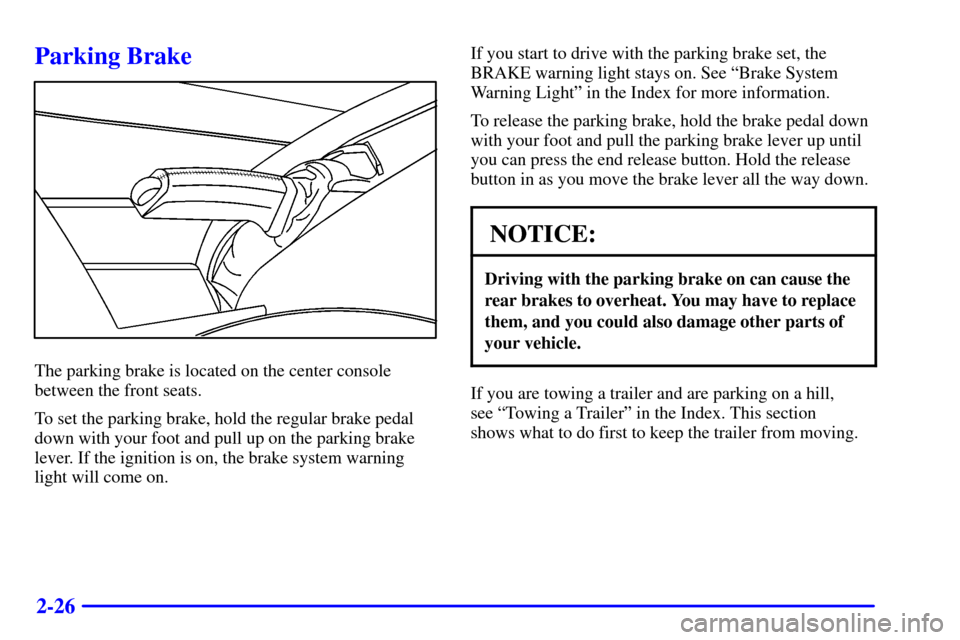
The parking brake is located on the center console
between the front seats.
To set the parking brake, hold the regular brake pedal
down with your foot and pull up on the parking brake
lever. If the ignition is on, the brake system warning
light will come on.If you start to drive with the parking brake set, the
BRAKE warning light stays on. See ªBrake System
Warning Lightº in the Index for more information.
To release the parking brake, hold the brake pedal down
with your foot and pull the parking brake lever up until
you can press the end release button. Hold the release
button in as you move the brake lever all the way down.
NOTICE:
Driving with the parking brake on can cause the
rear brakes to overheat. You may have to replace
them, and you could also damage other parts of
your vehicle.
If you are towing a trailer and are parking on a hill,
see ªTowing a Trailerº in the Index. This section
shows what to do first to keep the trailer from moving.
Page 99 of 321
2-34
Rear Window Lockout
Moving this switch to the
left will disable the rear
passenger window controls.
A red indicator light in
the control will illuminate
as a reminder the rear
passenger window
controls are disabled.
Move the switch to the right to enable the rear passenger
window controls again. A green indicator light in the
control will illuminate to indicate the rear passenger
window controls are active.
Horn
The horn can be sounded by pressing either horn symbol
on the steering wheel. The symbols are located at about
the 9 and 3 o'clock positions.
Tilt Wheel
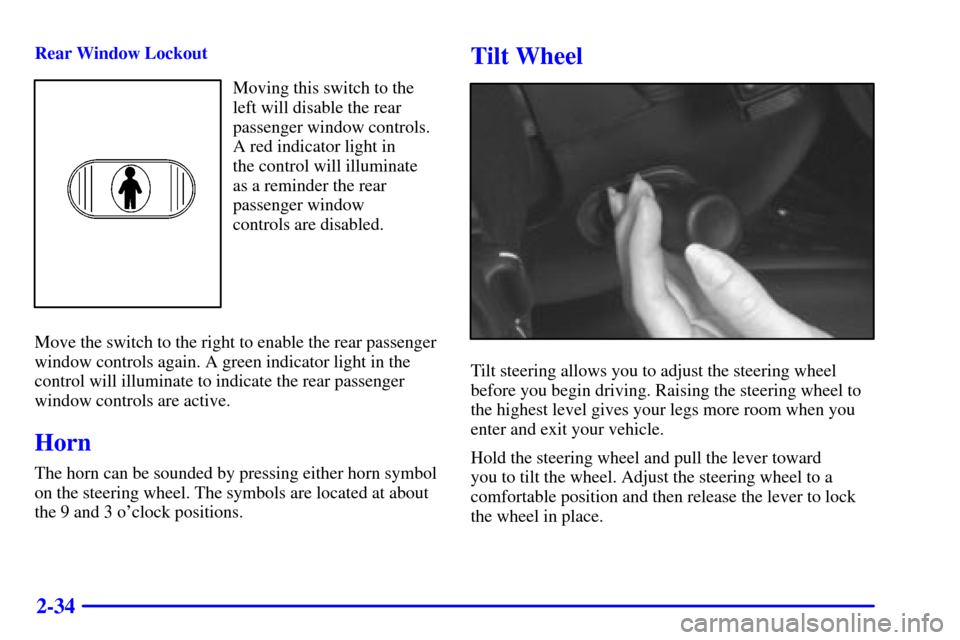
Tilt steering allows you to adjust the steering wheel
before you begin driving. Raising the steering wheel to
the highest level gives your legs more room when you
enter and exit your vehicle.
Hold the steering wheel and pull the lever toward
you to tilt the wheel. Adjust the steering wheel to a
comfortable position and then release the lever to lock
the wheel in place.
Page 101 of 321
2-36 Headlamp High/Low Beam
With the Twilight Sentinel� on or with the lamp control
dial turned to the headlamp position, push the turn
signal lever on the driver's side of the steering wheel
away from you to turn on the high
-beam headlamps.
This light on the
instrument panel cluster
will be on, indicating
high
-beam usage.
Pull the lever back to the original position to return
to low
-beam headlamps. For more information,
see ªHeadlampsº in the Index.
Flash-To-Pass
This feature uses the high-beam headlamps to signal the
driver in front of you that you want to pass. This feature
will work with either the headlamps on or off.
To use, pull the turn signal lever toward you and release.
Windshield Wipers
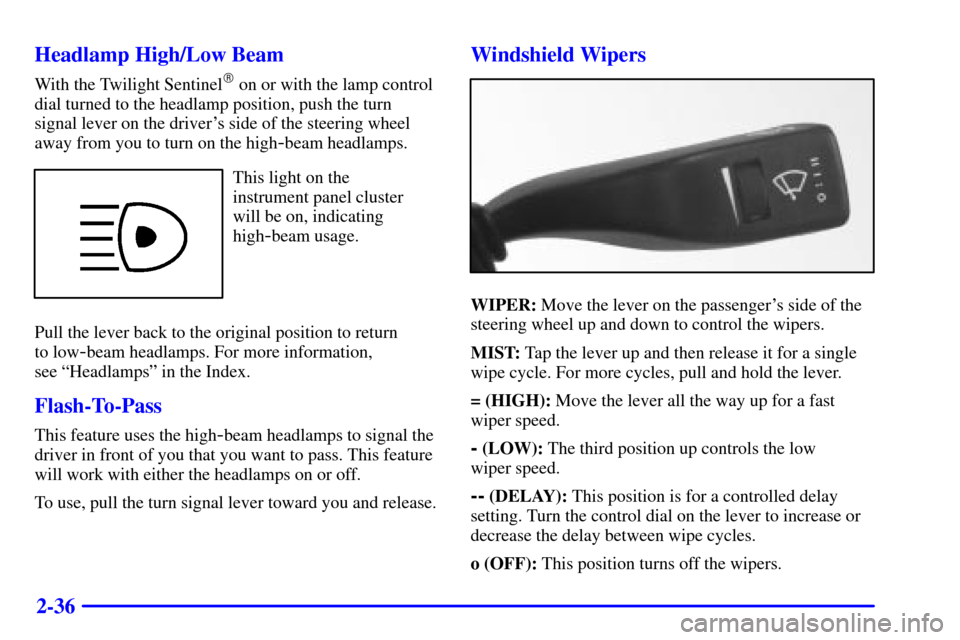
WIPER: Move the lever on the passenger's side of the
steering wheel up and down to control the wipers.
MIST: Tap the lever up and then release it for a single
wipe cycle. For more cycles, pull and hold the lever.
= (HIGH): Move the lever all the way up for a fast
wiper speed.
- (LOW): The third position up controls the low
wiper speed.
-- (DELAY): This position is for a controlled delay
setting. Turn the control dial on the lever to increase or
decrease the delay between wipe cycles.
o (OFF): This position turns off the wipers.