2000 BMW Z8 key
[x] Cancel search: keyPage 77 of 172

76n
To open Pull the handle. The lamp comes on.
A beverage can holder is stored in the
glove compartment.
For further information, refer to page 78.To closeFlip the door up.
To prevent injury in the event of a
crash, close the glove compart-
ment immediately after every use.<520de049
To lockUse one of the master keys. The glove
compartment, the storage shelf for the
cellular phone and the luggage compart-
ment lid are now locked.
A master key is also required for
unlocking.
If you turn over only your door and
ignition key for valet parking (refer
to page 28), for example, access to the
glove compartment,
the storage shelf
for the cellular phone or
the luggage
compartment
is not possible when the
vehicle has been locked.<
Manual operation(in the event of electrical malfunction)
With the key in the last key positions,
you can unlock or lock the glove com-
partment.
Refer to page 140 for operating
the
storage shelf for the cellular phone and
the luggage compartment lid
.
In the doorsTo open:
Pull into the cut-outs.
To close:
Push the cover back.520de051
Glove compartment Storage compartments
Page 78 of 172

77n
IndexDataTechnologyRepairsCar careControlsOverview
Storage compartmentsIn the center consoleTo open:
Flip the cover up (arrow 1) Ð access to
the ashtray and cigarette lighter.
When the glove compartment has been
unlocked, press the button (arrow 2) Ð storage shelf for
the cellular phone.
To close:
Flip the cover back into place.
Manual operation(in the event of electrical malfunction)
Refer to page 140 for operating
the
storage shelf for the cellular phone.
520de050
Behind the seatsBy way of example, the illustration
shows the storage compartment behind
the driver's seat.
To open:
Unlock by turning the master key all the
way to the left.
The cover will open slightly and can
then be flipped all the way up.
To close:
Press down until you hear it snap into
place. The cover has been locked
again.
If you turn over only your door and
ignition key for valet parking (refer
to page 28), access is impossible.<520de082
Rechargeable flashlight Located in the storage compartment
behind the driver's seat.
Because of overload-protection, the
flashlight can remain in its holder.
Be sure that the flashlight is
switched off when it is inserted
into its holder. Failure to do so could
lead to overcharging and damage.<520de070
Page 81 of 172

80n
Cigarette lighterPress the lighter in. Remove as soon as
the lighter jumps back out.
Hold or touch the hot cigarette
lighter by the knob only. Holding
or touching it in other areas could result
in burns.
The cigarette lighter remains opera-
tional when the ignition key has been
removed. Therefore do not leave unsu-
pervised children in the vehicle.<520de053
Cigarette lighter socketThis socket is suitable for attaching
power supplies for flashlights, car vac-
uum cleaners, or other appliances up to
a rating of approx. 200 watts at 12 volts.
Avoid damaging the socket by inserting
plugs of improper shapes or sizes.
Page 129 of 172

128n
The onboard tool kit is located under
the luggage compartment's floor panel.
520de059
1 To move the wipers to the fold-out
position:
Turn the ignition on. Set the wiper
lever in position 1 (intermittent set-
ting). Turn the ignition back off during
the wiper-delay pause. The wipers
will then be in a rather vertical position
2 Rotate the wiper arm completely out
from the windshield
3 Position the wiper blade at an angle
and pull the release spring (arrow)
4 Fold the wiper blade down and
unhook it toward the windshield
5 Pull the wiper blade past the wiper
arm toward the top
6 Insert a new wiper blade and press it
in until you hear it click into place. 520de060
Fold the wipers back onto the
windshield before turning the igni-
tion key to position 1 or 2. If you do not,
the wipers could be damaged.<
Use only wiper blades approved
by BMW.<
Onboard tool kit Windshield wiper blades
Page 137 of 172

136n
Battery
Battery posts, terminals, and re-
lated accessories contain lead
and lead compounds. Wash hands after
handling.<
Installation location The battery is located under the lug-
gage compartment's floor panel.Charge conditionYou can read the charge condition
of the battery with the "Magic Eye"
(hydrometer):
>Green: adequate charge
>Black: not charged adequately. The
battery must be recharged. Please
contact your BMW center for addi-
tional information
>Yellow: replace the battery.520de076
The service life specified for the
battery can be achieved only if it is
always kept adequately charged. If the
vehicle is primarily used for stop-and-
go traffic, be sure to check the charge
state often.<
MaintenanceThe battery is completely maintenance-
free. That means that the original bat-
tery acid will normally last for the ser-
vice life of the battery under moderate
climate conditions.
For all questions regarding the
battery, please consult your BMW
center. Since the battery is absolutely
maintenance-free, the following is for
your information only.<
SymbolsYou will find the following symbols on
your vehicle battery. To avoid injury,
please comply with the following pre-
cautions whenever you work with or
near the battery.
Before handling the battery,
please read the following infor-
mation.
Wear eye protection. Do not
allow particles containing bat-
tery acid or lead to come into
contact with eyes, skin, or clothing.
Battery acid is extremely corro-
sive. Wear eye protection and
protective gloves. Do not tip the
battery. Battery acid can leak from the
ventilation openings.
Be sure that children keep well
away from batteries and battery
acid.
Never allow sparks or open
flame near the battery. Do not
smoke in the vicinity of the bat-
tery. Avoid creating sparks when work-
ing around electrical cables or equip-
ment. Turn the key to position 0 in the
ignition when disconnecting or con-
necting the battery. Do not short-circuit
the battery terminals. This creates a risk
of injury from high-energy sparks.
Page 146 of 172
145n
IndexDataTechnologyRepairsCar careControlsOverview
Towing
Avoid "off-center" towing. Be sure
that the tow rope is pulled tightly
when the towing vehicle begins to
move.<
The towed vehicle should always
be the lighter of the two vehicles.
If this is not the case, it is no longer
possible to control vehicle response.<
Tow-startingFor instructions on jump starting, refer
to page 143.
Never attempt to use your vehicle to
push another vehicle, since damage to
the energy-absorbing bumpers could
result.
Towing a vehicle1 Put the manual-shift gear lever in
neutral
2 Towing speed:
Max. 45 mph (70 km/h)
3 Towing distance:
Max. 95 miles (150 km)
4 Leave the ignition key at position 1 to
ensure that the brake lamps, turn sig-
nals, horn and windshield wipers
remain operative, and to prevent the
steering lock detent from engaging
5 Switch on the hazard-warning system
(comply with country-specific regula-
tions).
Find some means of identifying the
vehicle in tow, e. g. place a sign or
warning triangle in the rear window.
Make sure that the ignition key re-
mains in position 1 even when the
electrical system has failed to prevent
the steering lock from engaging. The
steering and brakes are without power
assist when the engine is not running.
This means that increased effort is
required for steering and braking.<
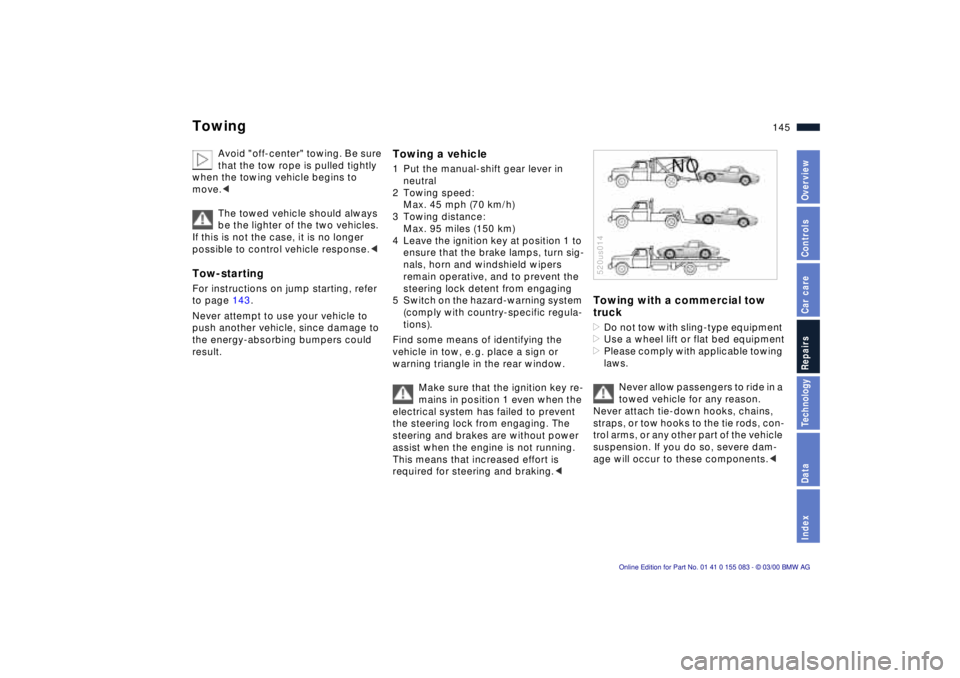
Towing with a commercial tow
truck>Do not tow with sling-type equipment
>Use a wheel lift or flat bed equipment
>Please comply with applicable towing
laws.
Never allow passengers to ride in a
towed vehicle for any reason.
Never attach tie-down hooks, chains,
straps, or tow hooks to the tie rods, con-
trol arms, or any other part of the vehicle
suspension. If you do so, severe dam-
age will occur to these components.<520us014
Page 163 of 172

Everything from A to ZA
ABS (Antilock Brake
System)19,86
Accessories4
Activated charcoal filter73
Adding engine oil109
Adding washer
fluid108,157
Adjusting the
temperature72
Adusting seats43
Air conditioner70
Air distribution72
Air nozzles70
Air outlets70
Air pressure96
Air supply72
Airbags19,49,121,148
Alarm system36
Antenna92
Antifreeze111
Antilock Brake System
(ABS)19,86
Anti-theft alarm system36
Anti-theft protection30
Aquaplaning85,97
Ashtray79
Attach vehicle vacuum
cleaner80
Automatic car washes115
Automatic speed control59 Automatic windshield
washer58
Avoiding unwanted
alarm37
Axle loads156
B
Backrest, unlock44
Backup lamps56
bulb replacement130
Battery136,158
charge137
discharged143
Battery capacity158
Battery charge current18
Belts48
Beverage can holder78
Blower72
BMW High Performance
Synthetic Oil110
Bore154
Brake fluid112
Brake hydraulic system18
Brake pads20
Brakes88
brake faults89
Breaking in the vehicle84
Bulb replacement129 C
California Proposition 65
Warning123 Can holder78
Car Memory46
Car radio62,92
refer also to the car radio
Owner's Manual
Car radio
reception92,148
Car telephone79
Car wash115
Care
exterior117
interior119
Caring for the vehicle
finish118
Catalytic converter85
CBC (Cornering Brake
Control)19
CD mode, refer to the radio
Owner's Manual
Cellular phone92
refer also to "Radio and
Information Systems
Owner's Manual"
Central locking system30
key34
Changing the oil filter157
Check air pressure24
Child restraint systems51
Child seat safety52
Child seats51
Cigarette lighter80
Clock62
Cockpit14 Code, refer to the radio
Owner's Manual
Combination switch56
Compartments76,77
Compartments for stowing
items76
Compression154
Configuring the settings46
Connector for On-Board-
Diagnostics124
Consumption display60
Controls14
Convertible top39
closing after an electrical
malfunction141
Coolant111,157
Coolant temperature
gauge61
Cornering Brake Control
(CBC)19
Cruise control59
Curb weight156
Current check indicator18
D
Dashboard14
Data
dimensions155
engine154
technical154
weights156
A-Z
Page 164 of 172

Everything from A to Z
163n
IndexDataTechnologyRepairsCar careControlsOverview
Daytime running lamps
switch67
Daytime-driving lamp
switch67
DBC (Dynamic Brake
Control)88
Defrost position73
Defroster, rear
window58,73
Defrosting the windows73
Dimensions155
Dipstick109
Disc brakes88
Displacement154
Display lighting67
Displays16
Door keys28
Door warning lamp
bulb replacement132
Doors
emergency actuation30
remote control31
unlocking and locking30
DOT Quality Grades98
Draft-free ventilation73
Drive belts158
Driving hints85
Driving lamps67
DSC (Dynamic Stability
Control)20,63,149
Dynamic Brake Control
(DBC)88 Dynamic Stability Control
(DSC)20,63,149
E
Electric power seat
adjustment43
Electric power windows38
Electrical defect
passenger-side door141
Electrical equipment
failure138
Electrical system158
Electronic vehicle
immobilizer29
Emergency actuation
doors30
Emergency operation
fuel filler door140
passenger-side door141
Engine compartment106
Engine coolant111
Engine cooling157
Engine data154
Engine oil109
consumption109
fill capacity157
quality110
specifications110
viscosity110
Engine oil level19
check109
Engine oil pressure18 Engine output154
Engine speed154
Engine, starting54
Exit lamps
bulb replacement132
Exterior mirrors45
F
Fault, ABS87
Fill capacities157
Filler cap cover23
Filling capacities157
Filling the washer
reservoir157
Filling the windshield washer
reservoir157
First aid22
First-aid kit22
Fittings, tow starting and
towing144
Flashlight77
Flat tire135
Foglamps
bulb replacement131
Follow-Me-Home lamps67
Footbrake88
Footwell lamps68
bulb replacement132
For car phones and
telephones, please refer to
the manufacturer's
Owner's Manual Front seat adjustment43
Frost protection,
radiator111
Fuel24
preparation154
Fuel filler door
release after an electrical
defect140
Fuel gauge60
Fuel indicator60
Fuel quality24
Fuel tank capacity157
Fuses138
G
Gasoline24
Glove compartment76
Glove compartment lamp
bulb replacement133
Gross vehicle weight156 H
Handbrake55
Handsfree system79
Hardtop94
Hazard warning flashers22
Hazard warning triangle22
Head restraint44
Headlamp covers,
care115,129
Headlamp flasher68