2000 BMW Z8 airbag
[x] Cancel search: airbagPage 51 of 172

50n
AirbagsSitting correctly with airbags
Comply with the following instruc-
tions for the airbags, otherwise,
the airbags may not be able to provide
their maximum protection, with result-
ing risks to personal safety. All passen-
gers in the vehicle should be aware of
and comply with this information:
The airbags are supplemental restraint
devices designed to provide extra pro-
tection; they are not a substitute for
safety belts. Wear your safety belt at all
times. The airbags will not be triggered
in the event of a minor accident, a vehi-
cle roll-over, or collisions from the rear.
In these instances, the safety belt pro-
vides optimal protection.
Airbags are located under cover panels
in the steering wheel, in the instrument
panel and in the door side trim panels.
Assume a seating position that is com-
fortable and provides the greatest-pos-
sible distance between you and the air-
bags in your seating area. Always hold
the steering wheel by the rim Ð hands in
the "9 o'clock" and "3 o'clock" posi-
tions Ð otherwise, your hands or arms
could be injured if the airbag is trig-
gered.
Do not allow any objects to obstruct the
area between the airbag and the driver/
passenger.
Do not use the cover panel above the
front passenger airbag as a storage
area.
Do not apply adhesive materials to the
cover panels of the airbags, or cover or
modify them in any other way.
Do not use a rear-facing child seat in the
front passenger seat. If you use a child
restraint system, read carefully and
comply with the instructions on page 51.
Be sure that child seats are installed
correctly and with the greatest possible
distance between them and the side air-
bag. Do not allow children to lean out of
the child's seat in the direction of the
side trim panels. If they do so, serious
injuries can occur if the airbag is trig-
gered.<
Even when all these guidelines are ob-
served, there is still a small residual risk
of injury to the face, hands and arms
occurring from airbag deployment in
isolated instances.
The ignition and inflation noise may
cause a mild temporary hearing loss in
extremely sensitive individuals.
For additional information concerning
the airbag system, refer to pages 121
and 148.The illustration shows the correct seat-
ing position for a child in a child restraint
system
* with sufficient distance be-
tween him and the side airbag (arrow).
520de115
Page 52 of 172

51n
IndexDataTechnologyRepairsCar careControlsOverview
Airbags Child restraints
*
The illustration shows the correct seat-
ing position for an older child wearing a
safety belt with sufficient distance be-
tween him and the side airbag (arrow).520de116
Before installing any child restraint
device or child seat, please read
the following:
Never install a rear-facing child restraint
system in the passenger seat of this
vehicle.
If the airbag deploys and hits the back-
rest of the rear-facing child seat, it is
likely that the child sitting in the rear-
facing child seat will be seriously
injured or killed.
Certain precautions should be taken if it
is necessary for a child (not an infant) to
ride in the vehicle. First, move the pas-
senger seat as far away from the instru-
ment panel as possible. This important
precaution is intended to maximize the
distance between the airbag and the
child. Older children should be tightly
secured with the safety belt. Younger
children should be secured in an appro-
priate forward-facing child-restraint
system that has first been secured with
a safety belt.
In the interest of the child's safety,
please read carefully and comply with
the instructions for installation and use
provided by the child restraint's manu-
facturer whenever you use such a de-
vice.
Do not allow children to lean out of a
child restraint system toward the door
or instrument panel, as otherwise seri-
ous injuries may result if the airbag
deploys. Always ensure that all occu-
pants (of all ages) remain properly and
securely restrained at all times.
Read carefully and comply with the
safety precautions regarding safety
belts on page 48, otherwise, the pro-
tective function of the safety belts will
be compromised.<
Page 84 of 172

Overview
Controls and features
Operation, care
and maintenance
Owner service procedures
Technical data
Index Advanced technology
83n
IndexDataTechnologyRepairsCar careControlsOverview
Car care Special operating instructions:
Break-in procedures84
Driving notes85
Catalytic converter85
Antilock Brake System (ABS)86
Dynamic Brake Control
(DBC)88
Disc brakes88
Brake system89
Winter operation90
Power steering92
Cellular phone92
Radio reception92
Wind protection93
Hardtop94
Wheels and tires:
Tire inflation pressure96
Tire condition97
Tire replacement98
Tire rotation100
Wheel and tire
combinations101
Winter tires102
Snow chains102
Approved wheel and tire
specifications103Under the hood:
Hood104
Engine compartment106
Washer fluids108
Washer nozzles108
Engine oil109
Coolant111
Brake fluid112
Vehicle Identification
Number113
Maintenance and care:
The BMW Maintenance
System114
Caring for your vehicle115
Airbags121
Storing your vehicle122
Laws and regulations:
Technical modifications123
California Proposition 65
Warning123
OBD interface socket124
Page 122 of 172
121n
IndexDataTechnologyRepairsCar careControlsOverview
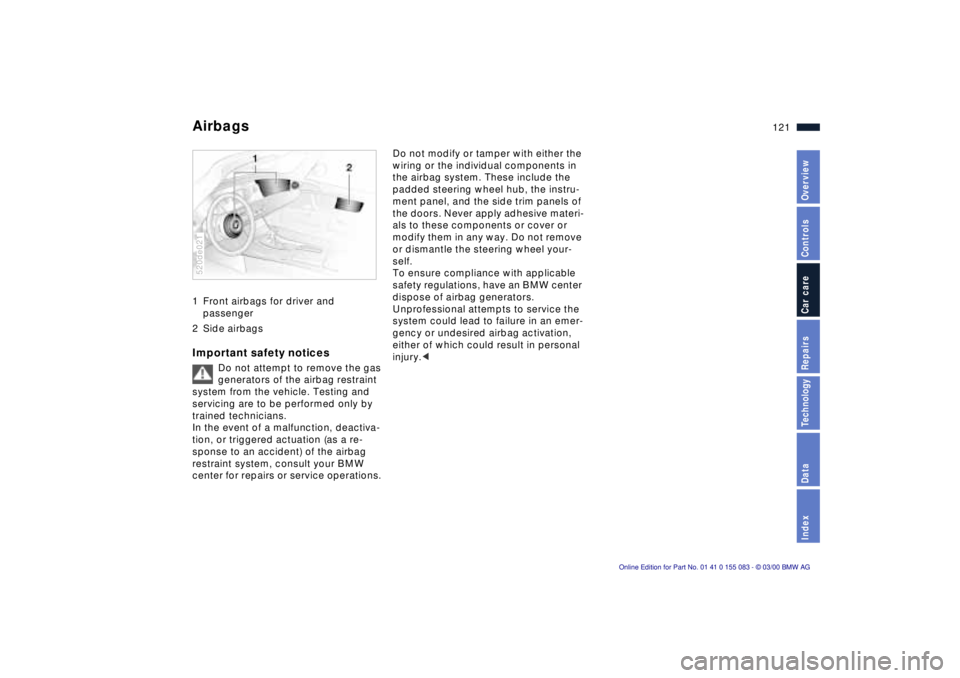
Airbags 1 Front airbags for driver and
passenger
2 Side airbags Important safety notices
Do not attempt to remove the gas
generators of the airbag restraint
system from the vehicle. Testing and
servicing are to be performed only by
trained technicians.
In the event of a malfunction, deactiva-
tion, or triggered actuation (as a re-
sponse to an accident) of the airbag
restraint system, consult your BMW
center for repairs or service operations.
520de021
Do not modify or tamper with either the
wiring or the individual components in
the airbag system. These include the
padded steering wheel hub, the instru-
ment panel, and the side trim panels of
the doors. Never apply adhesive materi-
als to these components or cover or
modify them in any way. Do not remove
or dismantle the steering wheel your-
self.
To ensure compliance with applicable
safety regulations, have an BMW center
dispose of airbag generators.
Unprofessional attempts to service the
system could lead to failure in an emer-
gency or undesired airbag activation,
either of which could result in personal
injury.<
Page 148 of 172

Overview
Controls and features
Operation, care
and maintenance
Owner service procedures
Technical data
Index Advanced technology
147n
IndexDataTechnologyRepairsCar careControlsOverview
Airbags148
Radio reception148
Dynamic Stability Control
(DSC)149
Safety belt tensioner149
Interior rearview mirror with
automatic dimmer150
Xenon lamps151
Technology
Page 149 of 172

148n
Deceleration sensors continuously
monitor the acceleration forces acting
upon the vehicle. If, as the result of a
frontal collision, a deceleration is
reached at which the protection of the
safety belts alone is no longer adequate,
the gas generators of the driver and
passenger airbags are ignited. However,
the passenger airbag is only triggered if
an additional sensor has recognized
that the passenger seat is occupied.
In the event of a side collision, only the
side airbags will be triggered if neces-
sary. And only that airbag for that side
of the vehicle where the collision
occurred will be triggered.
390de012
The airbags located under the marked
covers inflate and unfold in a matter of
a few milliseconds. In this process, they
tear through the designed separation
points of the covers or press them out.
Because the inflation process must be
virtually instantaneous, it is necessarily
accompanied by a certain amount of
ignition and inflation noise. The gas
required to inflate the airbags is not
dangerous, and the associated smoke
then dissipates.
The entire process is completed within
fractions of a second.The AM frequency bands (medium-
wave, long-wave and short-wave) make
it possible to receive stations from a
great distance, because the broadcast
signals travel not only along the ground
as surface waves, but also as atmo-
spheric waves that are reflected from
the ionosphere.
Frequency-modulation (FM) provides
substantially better sound quality than
the other frequency bands. However,
because FM transmissions rely on line-
of-sight broadcast waves, their effec-
tive reception range is limited.
The limitations inherent to radio recep-
tion in a moving vehicle have been min-
imized by a number of innovative sys-
tem designs.
360de084
Airbags Radio reception
Page 163 of 172

Everything from A to ZA
ABS (Antilock Brake
System)19,86
Accessories4
Activated charcoal filter73
Adding engine oil109
Adding washer
fluid108,157
Adjusting the
temperature72
Adusting seats43
Air conditioner70
Air distribution72
Air nozzles70
Air outlets70
Air pressure96
Air supply72
Airbags19,49,121,148
Alarm system36
Antenna92
Antifreeze111
Antilock Brake System
(ABS)19,86
Anti-theft alarm system36
Anti-theft protection30
Aquaplaning85,97
Ashtray79
Attach vehicle vacuum
cleaner80
Automatic car washes115
Automatic speed control59 Automatic windshield
washer58
Avoiding unwanted
alarm37
Axle loads156
B
Backrest, unlock44
Backup lamps56
bulb replacement130
Battery136,158
charge137
discharged143
Battery capacity158
Battery charge current18
Belts48
Beverage can holder78
Blower72
BMW High Performance
Synthetic Oil110
Bore154
Brake fluid112
Brake hydraulic system18
Brake pads20
Brakes88
brake faults89
Breaking in the vehicle84
Bulb replacement129 C
California Proposition 65
Warning123 Can holder78
Car Memory46
Car radio62,92
refer also to the car radio
Owner's Manual
Car radio
reception92,148
Car telephone79
Car wash115
Care
exterior117
interior119
Caring for the vehicle
finish118
Catalytic converter85
CBC (Cornering Brake
Control)19
CD mode, refer to the radio
Owner's Manual
Cellular phone92
refer also to "Radio and
Information Systems
Owner's Manual"
Central locking system30
key34
Changing the oil filter157
Check air pressure24
Child restraint systems51
Child seat safety52
Child seats51
Cigarette lighter80
Clock62
Cockpit14 Code, refer to the radio
Owner's Manual
Combination switch56
Compartments76,77
Compartments for stowing
items76
Compression154
Configuring the settings46
Connector for On-Board-
Diagnostics124
Consumption display60
Controls14
Convertible top39
closing after an electrical
malfunction141
Coolant111,157
Coolant temperature
gauge61
Cornering Brake Control
(CBC)19
Cruise control59
Curb weight156
Current check indicator18
D
Dashboard14
Data
dimensions155
engine154
technical154
weights156
A-Z
Page 166 of 172

Everything from A to Z
165n
IndexDataTechnologyRepairsCar careControlsOverview
Paintwork, minor
repairs118
Paintwork, waxing118
Parking brake55
Parking lamps68
Parking, winter91
Performance154
Pocket flashlight77
Pollen73
Power steering92
Power windows38
Pressure monitoring,
tires65
Pressure, tires24,96
Pre-warmed seats75 R
Radio62
refer also to the radio
Owner's Manual
Radio reception92,148
Radios92
RDW (Tire Pressure
Warning)65
Reading lamps69
Rear foglamps68
Rear lamp130
Rear window
defroster58,73
Rearview mirror45
Recirculated air mode72 Refueling23
Remaining fuel indicator60
Remote control31
Removing condensation
from the windows73
Removing the vehicle from
storage122
Replacement keys28
Reporting Safety Defects5
Restraint systems51
Reverse15,56
Roof load capacity156
Rotating the tires100
Rubber parts90
S
Safety belt tensioner149
Safety belts48
Safety buttons34
Seat heating75
Securing cargo81
Self-defrosting mirrors45
Service and Warranty
Information Booklet
(US models)114
Service Interval
Display61,114
Shelves76,77
Side airbags49
Side lamps67 Side marker lamps67
bulb
replacement129,130
Sliding91
Slippery roads91
Snow chains90,103
Socket80
Spare key28
Spark plugs158
Speaker79
Speed control59
Speedometer16
Starting54
Starting
problems85,143,144
Steel wheels103
Steering92
Steering wheel lock53
Stopping the vehicle54
Storage areas76,77
Storing your vehicle122
Stroke154
Summer tires101
Switching off the engine54
Symbols2,136
T
Tachometer60
Taillamps
bulb replacement130
Tank capacity157
Technical data154 Technical
modifications4,123
Telephone79
Temperature display
outside temperature62
Temperature gauge
engine coolant61
Temperature layering73
Tilt alarm32
Tilt sensor alarm sensor37
Tire codes101
Tire damage97
Tire inflation
pressure24,96
Tire pressure monitoring65
Tire Pressure Warning
(RDW)65
Tire replacement98,99
Tire rotation100
Tire specifications103
Tire tread97
Together19
Tools128
Torque154
Tow fittings144
Tow starting144
Towing144
Track155
Traction Control System
refer to DSC63
Transmission56
Transmitter key28
Tread depth, tires97