2000 BMW 540I SEDAN clock
[x] Cancel search: clockPage 61 of 217
61n
RepairsIndexOverview Controls Car care Technology Data
AirbagsIndicator lamp
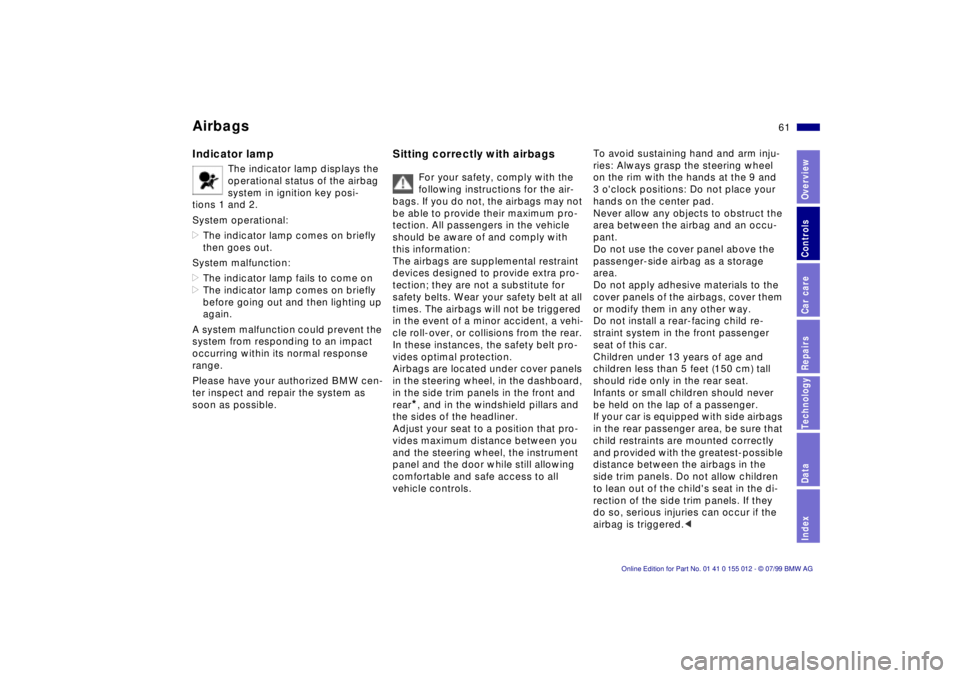
The indicator lamp displays the
operational status of the airbag
system in ignition key posi-
tions 1 and 2.
System operational:
>The indicator lamp comes on briefly
then goes out.
System malfunction:
>The indicator lamp fails to come on
>The indicator lamp comes on briefly
before going out and then lighting up
again.
A system malfunction could prevent the
system from responding to an impact
occurring within its normal response
range.
Please have your authorized BMW cen-
ter inspect and repair the system as
soon as possible.
Sitting correctly with airbags
For your safety, comply with the
following instructions for the air-
bags. If you do not, the airbags may not
be able to provide their maximum pro-
tection. All passengers in the vehicle
should be aware of and comply with
this information:
The airbags are supplemental restraint
devices designed to provide extra pro-
tection; they are not a substitute for
safety belts. Wear your safety belt at all
times. The airbags will not be triggered
in the event of a minor accident, a vehi-
cle roll-over, or collisions from the rear.
In these instances, the safety belt pro-
vides optimal protection.
Airbags are located under cover panels
in the steering wheel, in the dashboard,
in the side trim panels in the front and
rear*, and in the windshield pillars and
the sides of the headliner.
Adjust your seat to a position that pro-
vides maximum distance between you
and the steering wheel, the instrument
panel and the door while still allowing
comfortable and safe access to all
vehicle controls.
To avoid sustaining hand and arm inju-
ries: Always grasp the steering wheel
on the rim with the hands at the 9 and
3 o'clock positions: Do not place your
hands on the center pad.
Never allow any objects to obstruct the
area between the airbag and an occu-
pant.
Do not use the cover panel above the
passenger-side airbag as a storage
area.
Do not apply adhesive materials to the
cover panels of the airbags, cover them
or modify them in any other way.
Do not install a rear-facing child re-
straint system in the front passenger
seat of this car.
Children under 13 years of age and
children less than 5 feet (150 cm) tall
should ride only in the rear seat.
Infants or small children should never
be held on the lap of a passenger.
If your car is equipped with side airbags
in the rear passenger area, be sure that
child restraints are mounted correctly
and provided with the greatest-possible
distance between the airbags in the
side trim panels. Do not allow children
to lean out of the child's seat in the di-
rection of the side trim panels. If they
do so, serious injuries can occur if the
airbag is triggered.<
Page 152 of 217
152n
Coolant Brake fluidAdding coolantWait until the engine cools before re-
moving the cap from the expansion
tank. The needle of the coolant gauge
in the instrument cluster must be lo-
cated in the blue zone; otherwise, there
is a danger of scalding.
1 Start by turning the cap counter-
clockwise. Pause to allow any
accumulated pressure to escape,
then open.
2 If the coolant is low, slowly add
coolant until the correct level is
reached Ð do not overfill.
The coolant is a mixture of water and
extended-duty antifreeze with corrosion
inhibitor. Always maintain the pre-
scribed all-season 50:50 mixture ratio
for year-round protection against inter-
nal corrosion. No other additives are re-
quired.
Replace the coolant every four years.If the indicator lamp for the
brake hydraulic system appears
or if the "CHECK BRAKE FLUID"
warning appears in the Check
Control: The brake fluid level is
too low in the reservoir.
The brake fluid reservoir is located
under the microfilter housing on the
driver's side of the car. Should you de-
termine that the brake fluid is low, refer
the problem to your BMW center, who
can trace and rectify any sources of
leakage when refilling the reservoir.
Your BMW center is familiar with the
specifications for approved brake fluids
(DOT 4).
Brake fluid loss results in extended
pedal travel. For this situation, refer to
the notes on page 130.
Brake fluid is hygroscopic, that is,
it absorbs moisture from the air
over time.
In order to ensure the safety and
reliability of the brake system, have the
brake fluid changed every two years by
an authorized BMW center. Refer also
to the Service and Warranty Information
Booklet (US models) or to the Warranty
and Service Guide Booklet (Canadian
models).
Brake fluid is toxic and damages the
vehicle's paint. You should always store
it in its original container and in a loca-
tion which is out of reach of children.
Do not spill the fluid and do not fill the
brake fluid reservoir beyond the "MAX"
mark. The brake fluid could ignite upon
contact with hot engine parts and cause
serious burns.<
Comply with the applicable
environmental laws regulating the
disposal of brake fluid.<
Page 209 of 217
209n
RepairsIndexOverview Controls Car care Technology Data
Everything from A to Z
Clock, refer to the Radio
Owner's Manual
Cockpit16
Cold start68
Comfort seat51
Compartments108
Compression ratio198
Computer, refer to Onboard
computer88
Consumption display83
Convenience operating
mode of windows and
sliding/tilt sunroof36
Coolant130, 151
Antifreeze130
Capacity203
Temperature gauge84
Cover, sun blinds104
Cruise control80
Cruising range88
Cup holder109
Curb weight201
D
Dashboard16
Data link connector for
Onboard Diagnostics162
Daytime-driving lamp94
DBC (Dynamic Brake
Control)24, 129
Deep water125Defrost windshields101
Digital sound processor192
Dimensions199
Dipstick, engine oil149
Disc brakes124, 128
Disconnect the battery178
Displacement198
Display lighting94
Displays18
Distance warning90
Diversity Antenna
system190
Divided rear-seat
backrest112
Door keys35
Door locks, care130
Doors
Emergency release36
Manual operation36
Unlocking and locking36
Drive belts204
Driving notes125
Driving through water125
DSC (Dynamic Stability
Control)24, 91, 189
Dynamic Brake Control
(DBC)24, 129
Dynamic Stability Control
(DSC)24, 91, 189
E
Electric power seat50
Electric power windows47
Electrical defect
Fuel filler door180
Sliding/Tilt sunroof180
Tailgate181
Electrical heating exterior
mirror55
Electrical steering wheel
adjustment54
Elements of operation16
Emergency operation
Doors36
Fuel filler door180
Luggage compartment lid/
Tailgate41, 181
Sliding/Tilt sunroof180
Energy Control83
Engine
Compartment144
Coolant151
Specifications198
Engine oil
Capacity203
Consumption149
Grades150
Level23
Pressure23
Error indicators85
Exterior finish156
Exterior mirror54
Electrical heating55
F
Failure of an electrical
accessorry180
Failure warnings85
Filler cap cover28
Filling capacities203
First-aid kit27
Fittings, tow-starting and
towing183
Flashlight108
Flat tire134
Footbrake
Footwell lamps96
Forward/Back adjustment,
seat50, 52
Front fog lamps95, 169
bulb replacement169
Front seat adjustment50
Frost protection,
radiator151
Fuel29
Capacity203
Consumption indicator83
Gauge83
Quality29
Reserve203
Fuel filler door release after
electrical fault180
Fuel tank, capacity203
Fuses178