2000 BMW 540I SEDAN check engine
[x] Cancel search: check enginePage 129 of 217

129n
RepairsIndexOverview Controls Car care Technology Data
Disc brakesDriving notesWhen driving in wet conditions and in
heavy rain, it is a good idea to apply
light pressure to the brake pedal every
few miles (kilometers). Watch traffic
conditions to ensure that this maneuver
does not endanger other road users.
The heat which is generated by the
brake applications helps to dry the
brake pads and rotors.
Maximum braking force is obtained
while the wheels continue to rotate,
peaking when the wheels remain on the
verge of locking without actually doing
so. ABS maintains this state automati-
cally. If the ABS fails, you should revert
to the staggered braking technique de-
scribed below (refer to page 131).
Extended or steep mountain descents
do not necessarily have to lead to re-
duced braking efficiency. Shift down to
a gear in which only minimal periodic
brake applications are required or move
the selector lever to the appropriate
lower range with automatic transmis-
sion.
You can increase the engine's braking
effect by selecting progressively lower
gears, downshifting as far as 1st gear,
or the 1st or 2nd shift position, on steep
descents.Should engine braking prove inade-
quate, you should still avoid extended,
continuous braking. Instead of main-
taining low to moderate pressure over
an extended period of time, you should
decelerate by applying more substantial
pressure to the brake pedal (watch for
following traffic!), then releasing the
pedal, then repeating the application.
This staggered braking technique al-
lows the brakes to cool in the intervals
between active braking phases, pre-
venting overheating and ensuring that
full braking capacity remains available
at all times.
Do not coast with the clutch de-
pressed or with the transmission
or selector lever in neutral. Do not coast
with the engine shut off. The engine
provides no braking effect when the
clutch is depressed or the transmission
is in neutral, and there is no power-as-
sist for braking or steering when the
engine is not running.
Never allow floor mats, carpets or any
other objects to protrude into the area
around the accelerator, clutch and
brake pedals and obstruct their move-
ment.<
Dynamic Brake Control (DBC)
*
If you apply the brakes rapidly, this sys-
tem automatically produces the maxi-
mum braking force boost and thus
helps to achieve the shortest possible
braking distance during "panic stops."
All of the benefits of the ABS system
are exploited under these circum-
stances.
Do not reduce the pressure on the
brake pedal for the duration of the
brake application. When the brake
pedal is released, the DBC is deacti-
vated.
In the event of a malfunction, the yellow
warning lamp comes on. Conventional
braking efficiency is available without
limitations.
Have the system checked and repaired
at your BMW center as soon as possi-
ble.
For "Information for your safety"
covering the ABS system, refer to
page 128. This information also gener-
ally applies for DBC.<
Page 149 of 217
149n
RepairsIndexOverview Controls Car care Technology Data
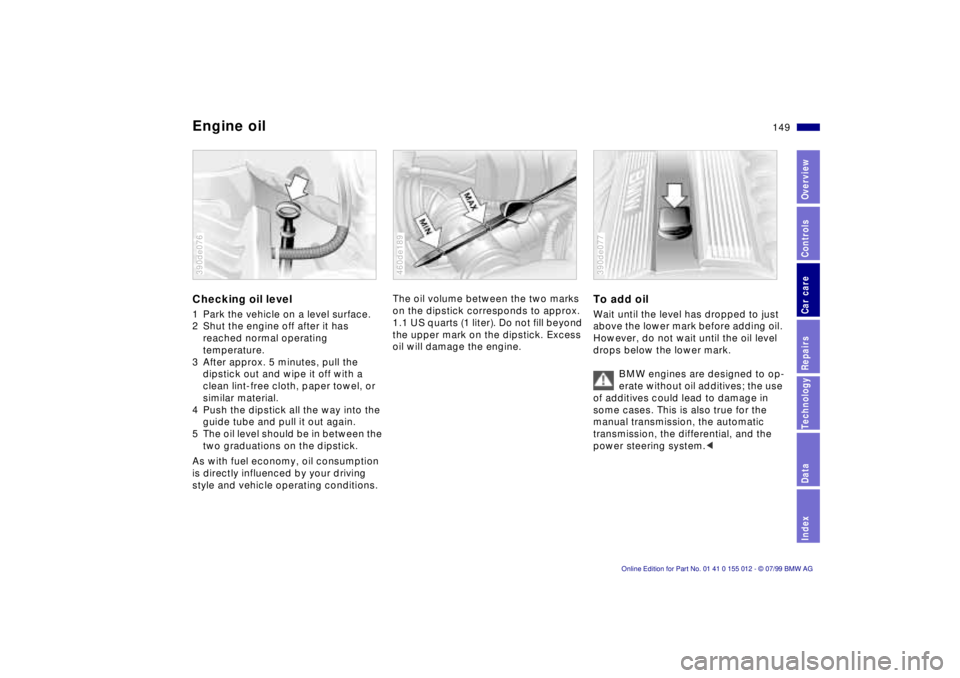
Engine oilChecking oil level1 Park the vehicle on a level surface.
2 Shut the engine off after it has
reached normal operating
temperature.
3 After approx. 5 minutes, pull the
dipstick out and wipe it off with a
clean lint-free cloth, paper towel, or
similar material.
4 Push the dipstick all the way into the
guide tube and pull it out again.
5 The oil level should be in between the
two graduations on the dipstick.
As with fuel economy, oil consumption
is directly influenced by your driving
style and vehicle operating conditions.390de076
The oil volume between the two marks
on the dipstick corresponds to approx.
1.1 US quarts (1 liter). Do not fill beyond
the upper mark on the dipstick. Excess
oil will damage the engine.460de189
To add oilWait until the level has dropped to just
above the lower mark before adding oil.
However, do not wait until the oil level
drops below the lower mark.
BMW engines are designed to op-
erate without oil additives; the use
of additives could lead to damage in
some cases. This is also true for the
manual transmission, the automatic
transmission, the differential, and the
power steering system.< 390de077
Page 151 of 217
151n
RepairsIndexOverview Controls Car care Technology Data
Engine oil Coolant
Comply with the applicable envi-
ronmental laws regulating the dis-
posal of used oil.<
Recommendation: Have the oil
changed by your BMW center.
Continuous exposure to used oil
has caused cancer in laboratory
testing. For this reason, any skin areas
that come into contact with oil should
be thoroughly washed with soap and
water.
Always store oil, grease, etc., out of
reach of children. Comply with all warn-
ing labels and information on lubricant
containers.<
Do not add coolant to the cooling
system when the engine is hot. If
you attempt to do so, escaping coolant
can cause burns.
To avoid the possibility of damage later
on, never use anything other than fac-
tory-approved, nitrite and amino-free
extended-duty antifreeze with corrosion
inhibitor. Your authorized BMW center
is familiar with the official specifica-
tions.
Antifreeze and anticorrosion agents are
hazardous to health. You should always
store them in their original container
and in a location which is inaccessible
to children.
Extended-duty antifreeze with corrosion
inhibitor contains the flammable sub-
stance ethylene glycol. For this reason,
do not spill antifreeze with corrosion in-
hibitor on hot engine parts. It could
catch fire and cause serious burns.<
Comply with the applicable envi-
ronmental laws regulating the dis-
posal of extended-duty antifreeze with
corrosion inhibitor.<
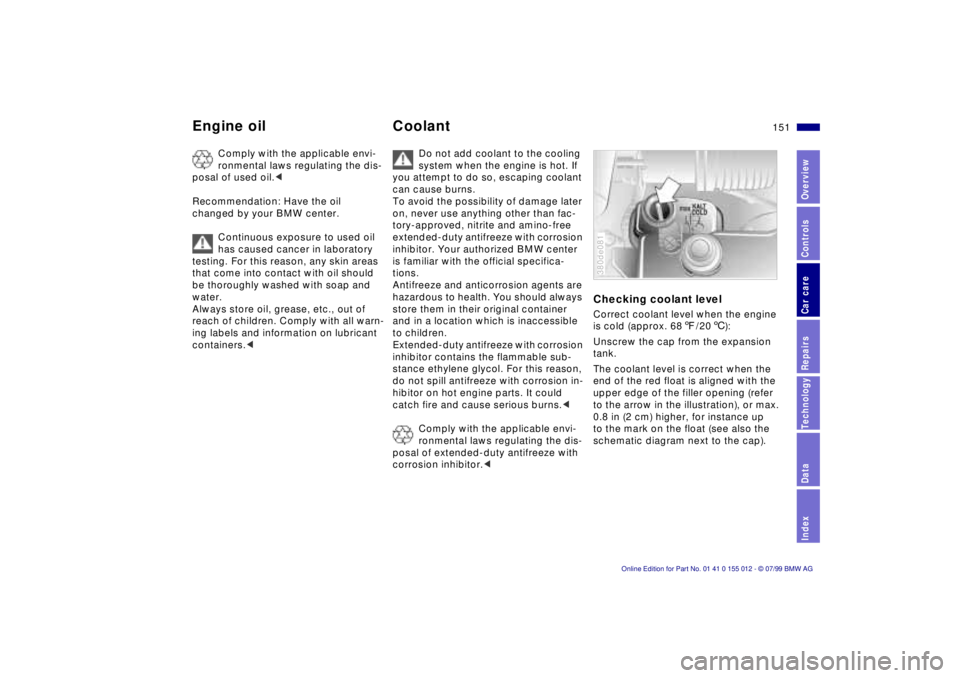
Checking coolant levelCorrect coolant level when the engine
is cold (approx. 687/206):
Unscrew the cap from the expansion
tank.
The coolant level is correct when the
end of the red float is aligned with the
upper edge of the filler opening (refer
to the arrow in the illustration), or max.
0.8 in (2 cm) higher, for instance up
to the mark on the float (see also the
schematic diagram next to the cap).380de081
Page 152 of 217

152n
Coolant Brake fluidAdding coolantWait until the engine cools before re-
moving the cap from the expansion
tank. The needle of the coolant gauge
in the instrument cluster must be lo-
cated in the blue zone; otherwise, there
is a danger of scalding.
1 Start by turning the cap counter-
clockwise. Pause to allow any
accumulated pressure to escape,
then open.
2 If the coolant is low, slowly add
coolant until the correct level is
reached Ð do not overfill.
The coolant is a mixture of water and
extended-duty antifreeze with corrosion
inhibitor. Always maintain the pre-
scribed all-season 50:50 mixture ratio
for year-round protection against inter-
nal corrosion. No other additives are re-
quired.
Replace the coolant every four years.If the indicator lamp for the
brake hydraulic system appears
or if the "CHECK BRAKE FLUID"
warning appears in the Check
Control: The brake fluid level is
too low in the reservoir.
The brake fluid reservoir is located
under the microfilter housing on the
driver's side of the car. Should you de-
termine that the brake fluid is low, refer
the problem to your BMW center, who
can trace and rectify any sources of
leakage when refilling the reservoir.
Your BMW center is familiar with the
specifications for approved brake fluids
(DOT 4).
Brake fluid loss results in extended
pedal travel. For this situation, refer to
the notes on page 130.
Brake fluid is hygroscopic, that is,
it absorbs moisture from the air
over time.
In order to ensure the safety and
reliability of the brake system, have the
brake fluid changed every two years by
an authorized BMW center. Refer also
to the Service and Warranty Information
Booklet (US models) or to the Warranty
and Service Guide Booklet (Canadian
models).
Brake fluid is toxic and damages the
vehicle's paint. You should always store
it in its original container and in a loca-
tion which is out of reach of children.
Do not spill the fluid and do not fill the
brake fluid reservoir beyond the "MAX"
mark. The brake fluid could ignite upon
contact with hot engine parts and cause
serious burns.<
Comply with the applicable
environmental laws regulating the
disposal of brake fluid.<
Page 154 of 217
154n
The BMW Maintenance System has
been designed as a reliable means of
providing maximum driving and operat-
ing safety Ð and as cost-effectively as
possible for you.
Please keep in mind that regular main-
tenance is not only necessary for the
safety of your vehicle, but also plays a
significant role in maintaining the resale
value of the vehicle.
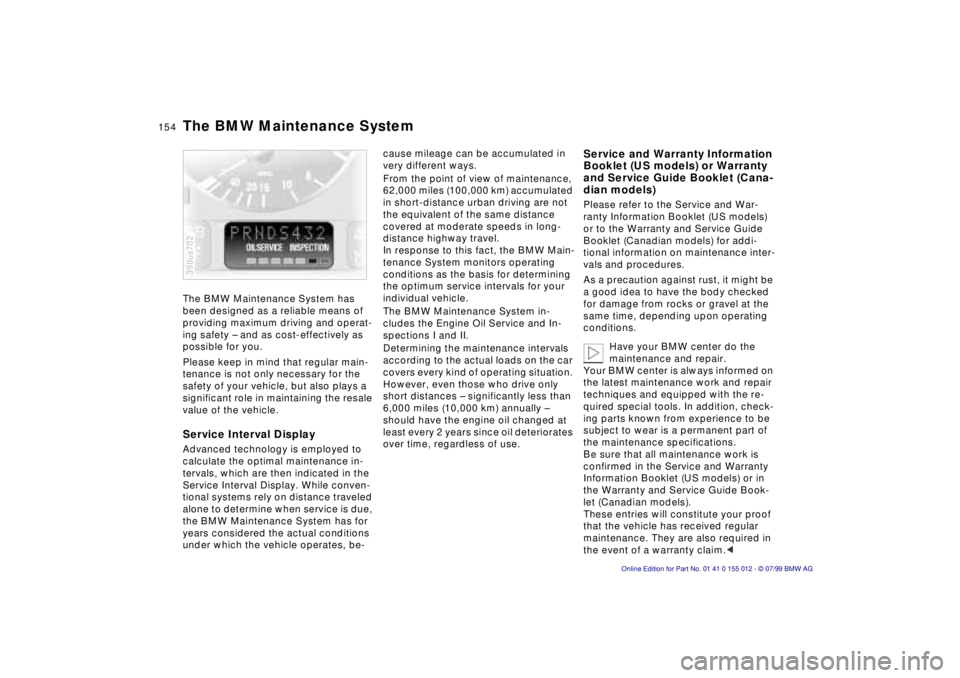
Service Interval DisplayAdvanced technology is employed to
calculate the optimal maintenance in-
tervals, which are then indicated in the
Service Interval Display. While conven-
tional systems rely on distance traveled
alone to determine when service is due,
the BMW Maintenance System has for
years considered the actual conditions
under which the vehicle operates, be-390us702
cause mileage can be accumulated in
very different ways.
From the point of view of maintenance,
62,000 miles (100,000 km) accumulated
in short-distance urban driving are not
the equivalent of the same distance
covered at moderate speeds in long-
distance highway travel.
In response to this fact, the BMW Main-
tenance System monitors operating
conditions as the basis for determining
the optimum service intervals for your
individual vehicle.
The BMW Maintenance System in-
cludes the Engine Oil Service and In-
spections I and II.
Determining the maintenance intervals
according to the actual loads on the car
covers every kind of operating situation.
However, even those who drive only
short distances Ð significantly less than
6,000 miles (10,000 km) annually Ð
should have the engine oil changed at
least every 2 years since oil deteriorates
over time, regardless of use.
Service and Warranty Information
Booklet (US models) or Warranty
and Service Guide Booklet (Cana-
dian models)Please refer to the Service and War-
ranty Information Booklet (US models)
or to the Warranty and Service Guide
Booklet (Canadian models) for addi-
tional information on maintenance inter-
vals and procedures.
As a precaution against rust, it might be
a good idea to have the body checked
for damage from rocks or gravel at the
same time, depending upon operating
conditions.
Have your BMW center do the
maintenance and repair.
Your BMW center is always informed on
the latest maintenance work and repair
techniques and equipped with the re-
quired special tools. In addition, check-
ing parts known from experience to be
subject to wear is a permanent part of
the maintenance specifications.
Be sure that all maintenance work is
confirmed in the Service and Warranty
Information Booklet (US models) or in
the Warranty and Service Guide Book-
let (Canadian models).
These entries will constitute your proof
that the vehicle has received regular
maintenance. They are also required in
the event of a warranty claim.<
The BMW Maintenance System
Page 162 of 217
162n
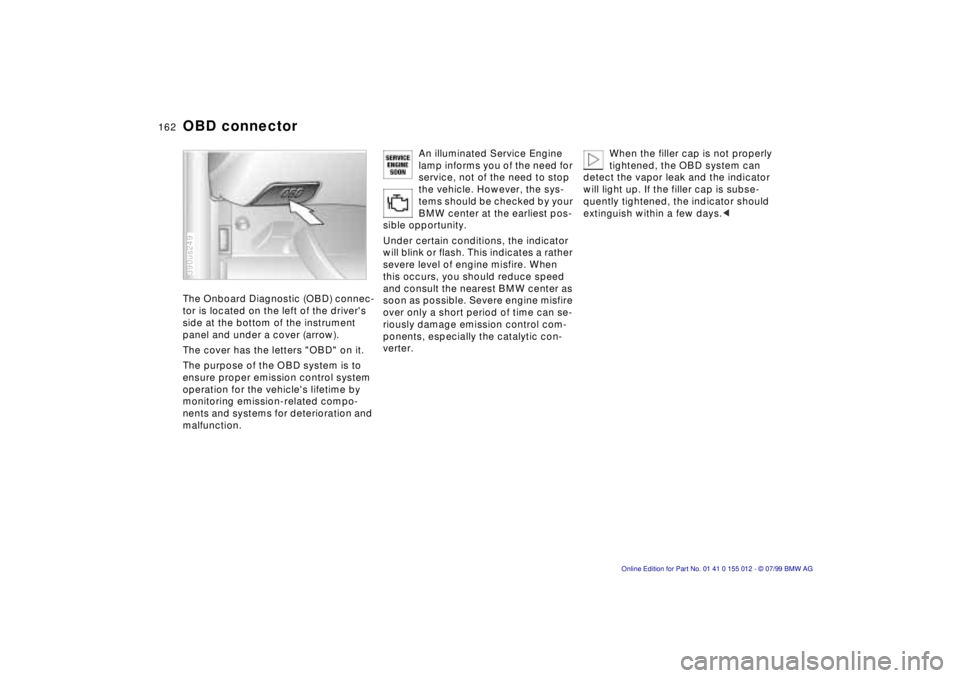
OBD connectorThe Onboard Diagnostic (OBD) connec-
tor is located on the left of the driver's
side at the bottom of the instrument
panel and under a cover (arrow).
The cover has the letters "OBD" on it.
The purpose of the OBD system is to
ensure proper emission control system
operation for the vehicle's lifetime by
monitoring emission-related compo-
nents and systems for deterioration and
malfunction.390us249
An illuminated Service Engine
lamp informs you of the need for
service, not of the need to stop
the vehicle. However, the sys-
tems should be checked by your
BMW center at the earliest pos-
sible opportunity.
Under certain conditions, the indicator
will blink or flash. This indicates a rather
severe level of engine misfire. When
this occurs, you should reduce speed
and consult the nearest BMW center as
soon as possible. Severe engine misfire
over only a short period of time can se-
riously damage emission control com-
ponents, especially the catalytic con-
verter.
When the filler cap is not properly
tightened, the OBD system can
detect the vapor leak and the indicator
will light up. If the filler cap is subse-
quently tightened, the indicator should
extinguish within a few days.<
Page 167 of 217
167n
RepairsIndexOverview Controls Car care Technology Data
Lamps and bulbsThe lamps and bulbs make essential
contributions to the safety of your vehi-
cle. For this reason, follow the instruc-
tions below carefully when replacing a
bulb. If you are not familiar with any of
the procedures, consult your authorized
BMW center.
Do not touch the glass portion of a
new bulb with your bare hands
since even small amounts of impurities
burn into the surface and reduce the
service life of the bulb. Use a clean
cloth, paper napkin, or a similar mate-
rial, or hold the bulb by its metallic
base.<
A replacement bulb set is available from
your BMW center.
Whenever working on the electri-
cal system, switch off the electri-
cal accessory you are working on or
disconnect the cable from the negative
terminal of the battery. Failure to do this
could result in short circuits.
To prevent injuries and damage, comply
with any instructions provided by the
bulb manufacturer.<
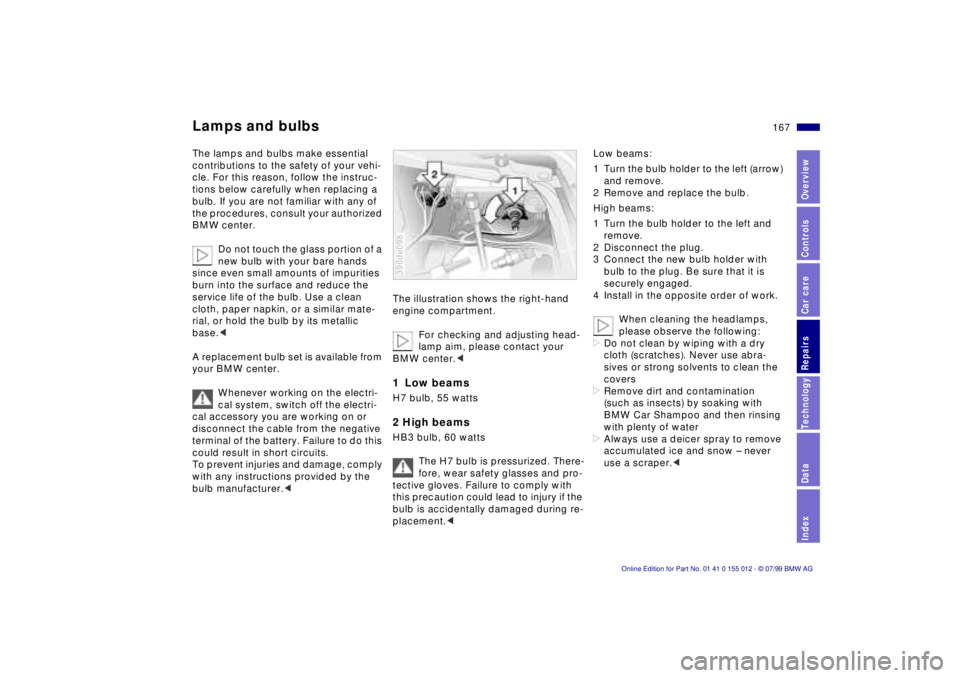
The illustration shows the right-hand
engine compartment.
For checking and adjusting head-
lamp aim, please contact your
BMW center.< 1 Low beams H7 bulb, 55 watts 2 High beamsHB3 bulb, 60 watts
The H7 bulb is pressurized. There-
fore, wear safety glasses and pro-
tective gloves. Failure to comply with
this precaution could lead to injury if the
bulb is accidentally damaged during re-
placement.< 390de098
Low beams:
1 Turn the bulb holder to the left (arrow)
and remove.
2 Remove and replace the bulb.
High beams:
1 Turn the bulb holder to the left and
remove.
2 Disconnect the plug.
3 Connect the new bulb holder with
bulb to the plug. Be sure that it is
securely engaged.
4 Install in the opposite order of work.
When cleaning the headlamps,
please observe the following:
>Do not clean by wiping with a dry
cloth (scratches). Never use abra-
sives or strong solvents to clean the
covers
>Remove dirt and contamination
(such as insects) by soaking with
BMW Car Shampoo and then rinsing
with plenty of water
>Always use a deicer spray to remove
accumulated ice and snow Ð never
use a scraper.<
Page 177 of 217
177n
RepairsIndexOverview Controls Car care Technology Data
Battery
A highly-explosive gas is
generated when the battery is
charged.
If you happen to get acid in your
eyes, rinse thoroughly for
15 minutes with clear water.
Following that, consult a physician
immediately. If you get acid spray on
your skin or clothing, rinse with plenty
of water. If electrolyte is accidentally
swallowed, consult a physician immedi-
ately.
In order to protect the battery
case from ultraviolet radiation,
do not place it in direct sunlight.
A discharged battery can freeze. Store
the battery in areas where temperature
remains above freezing.
MaintenanceThe battery is absolutely maintenance-
free, that is, the original electrolyte will
normally last for the service life of the
battery under moderate climatic condi-
tions.
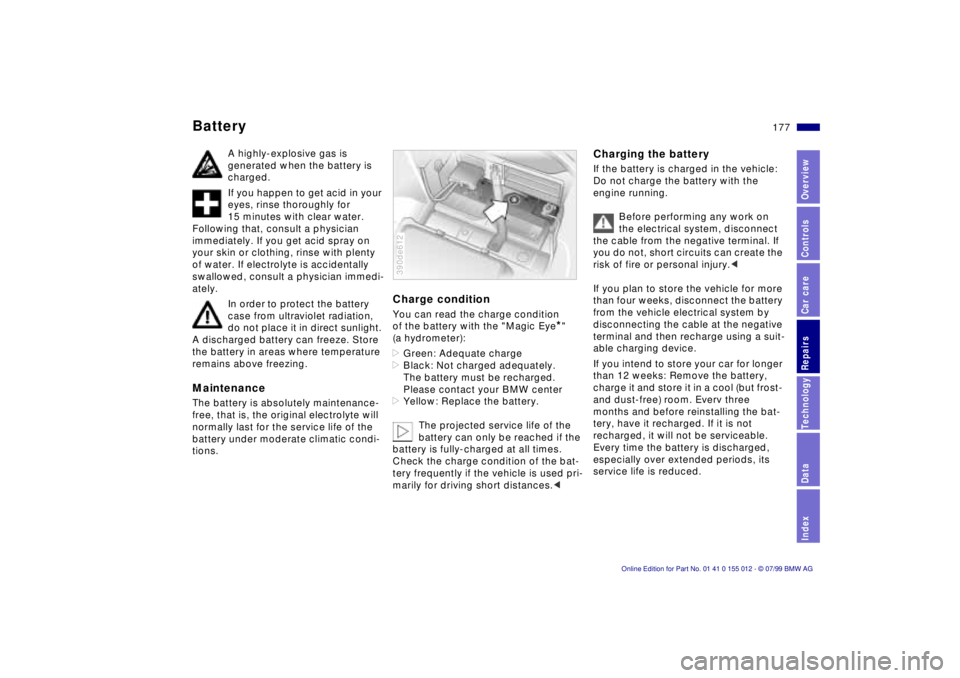
Charge conditionYou can read the charge condition
of the battery with the "Magic Eye
*"
(a hydrometer):
>Green: Adequate charge
>Black: Not charged adequately.
The battery must be recharged.
Please contact your BMW center
>Yellow: Replace the battery.
The projected service life of the
battery can only be reached if the
battery is fully-charged at all times.
Check the charge condition of the bat-
tery frequently if the vehicle is used pri-
marily for driving short distances.<
390de612
Charging the batteryIf the battery is charged in the vehicle:
Do not charge the battery with the
engine running.
Before performing any work on
the electrical system, disconnect
the cable from the negative terminal. If
you do not, short circuits can create the
risk of fire or personal injury.<
If you plan to store the vehicle for more
than four weeks, disconnect the battery
from the vehicle electrical system by
disconnecting the cable at the negative
terminal and then recharge using a suit-
able charging device.
If you intend to store your car for longer
than 12 weeks: Remove the battery,
charge it and store it in a cool (but frost-
and dust-free) room. Everv three
months and before reinstalling the bat-
tery, have it recharged. If it is not
recharged, it will not be serviceable.
Every time the battery is discharged,
especially over extended periods, its
service life is reduced.