2000 BMW 540I SEDAN sensor
[x] Cancel search: sensorPage 99 of 217

99n
RepairsIndexOverview Controls Car care Technology Data
Automatic climate control1 Air flow directed toward the
windshield and side windows
2 Air flow for the upper body
The side rotary dials provide
infinitely-variable regulation of
the air supply, while the levers
change the airflow direction.
The center rotary dial controls the
temperature of the air as it
flows out102
3 Front footwell ventilation
4 Rear footwell ventilation
5 Air flow for the upper body in the
rear seat102
6 Automatic air distribution100
7 Individual air distribution100
8 Temperature control Ð
left-hand side100
9 Display for temperature and
air supply100, 10110 Temperature control Ð
right-hand side100
11 To defrost windshield and door
windows101
12 Air conditioner101
13 Automatic recirculated air control
AUC101
14 Rear window defroster79, 102
15 Air supply101
16 Residual heat mode102
17 Air grill for interior temperature
sensor Ð please keep clear and
unobstructed
Page 126 of 217

126n
Catalytic converterThe catalytic converter reduces harmful
exhaust emissions, and is designed for
use with unleaded fuel only.
Even minute quantities of lead would be
enough to permanently damage both
the catalytic converter and the system
oxygen sensor.
To ensure efficient, trouble-free engine
operation and avoid potential damage:
>Be sure to comply with the scheduled
maintenance requirements
>Fill the fuel tank well before it is
empty
>Tow-start the vehicle only when the
engine is cold, since unburned fuel
may otherwise reach the catalytic
converter. It is better to start the vehi-
cle with an outside starting aid>Avoid other situations in which the
fuel is not burned, or burns incom-
pletely, such as engaging the starter
frequently or for extended periods, or
repeated start attempts in which the
engine does not start (stopping and
restarting an engine which is running
properly does not present a problem).
Never let the engine run with any of
the spark plug cables disconnected.Be sure to comply with the in-
structions above to prevent un-
burned fuel from reaching the catalytic
converter. Otherwise there is danger of
overheating and damage to the cata-
lytic converter.
Extreme temperatures occur at the cat-
alytic converter on this and every cata-
lyst-equipped vehicle. Heat shields are
installed adjacent to some sections of
the exhaust system. Never remove
these shields; do not apply undercoat-
ing to their surfaces. When driving,
standing at idle, and parking the vehi-
cle, take care to avoid contact between
the exhaust system and flammable ma-
terials (grass, hay, leaves, etc.). Such
contact could lead to a fire, resulting in
personal injury and property damage.<
Page 155 of 217

155n
RepairsIndexOverview Controls Car care Technology Data
Caring for your carWashing your carYou can have your new BMW washed
in an automatic car wash. Car wash
systems that do not employ brushes are
preferable.
Wipe away tough dirt and loosen and
remove dead insects before washing
the car.
To prevent spots, avoid washing when
the hood is still warm, or immediately
after and during exposure to strong
sunlight.
When using an automatic car wash, be
sure that:
>The car wash system is suited for the
dimensions of your vehicle
>No damage will occur on vehicles
with attached body accessories (such
as spoilers or antennas). If you are
uncertain, consult the manager of the
car wash
>The wheels and tires of your vehicle
cannot be damaged by the convey-
ance devices of the car wash system
>The vehicle is cleaned with minimum
brush pressure, and that ample water
is available for washing and rinsing.Vehicles with rain sensor
*:
Clean the windshield regularly. Wax
from automatic car washes or insects,
for example, can cause malfunctions in
the function of the rain sensor.
Turn the rain sensor off in auto-
matic car washes. If you do not,
damage may occur if the wipers switch
on unintentionally.<
Parts of the car which are inaccessible
to the automatic washer Ð such as door
sills, door and hood edges, etc. Ð
should be cleaned by hand.
In the winter months, it is especially im-
portant to ensure that the car is washed
on a regular basis. Large quantities of
dirt and road salt are difficult to remove,
and they also cause damage to the ve-
hicle.
If spray wands or high-pressure
washers are used, be sure to
maintain an adequate distance between
the spray source and the vehicle's sur-
face. Inadequate distance and exces-
sive pressure can damage or weaken
the finish, making it more susceptible to
subsequent attack. In addition, mois-
ture could penetrate to vehicle compo-
nents, leading to long-term damage.<
When cleaning the headlamps,
please observe the following:
>Do not clean by wiping with a dry
cloth (scratches). Never use abra-
sives or strong solvents to clean the
covers
>Remove dirt and contamination
(such as insects) by soaking with
BMW Car Shampoo and then rinsing
with plenty of water
>Always use a deicer spray to remove
accumulated ice and snow Ð never
use an ice scraper.<
After washing the car, apply the
brakes briefly to dry them. Braking
efficiency might otherwise be reduced
by the moisture, and the brake rotors
could also be corroded.<
Page 187 of 217
Overview
Controls and features
Operation, care
and maintenance
Owner service procedures
Technical data
Index Advanced technology
187n
RepairsIndexOverview Controls Car care Technology Data
Airbags188
Adaptive Transmission Control
(ATC)188
Automatic Stability Control plus
Traction (ASC+T)/Dynamic
Stability Control (DSC)189
Radio reception190
BMW active seat190
Safety belt tensioner191
DSP sound system191
Interior rearview mirror with
automatic dimmer192
Rain sensor193
Tire Pressure Control (RDC)194
Integrated rear suspension194
Level control system195
Xenon lamps195
Page 188 of 217
188n
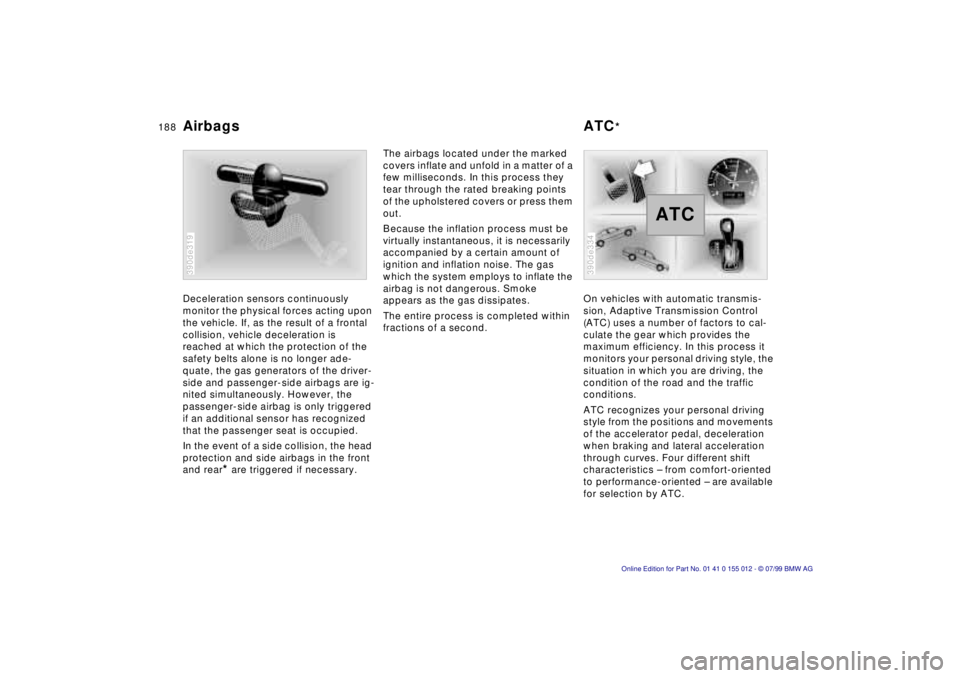
Deceleration sensors continuously
monitor the physical forces acting upon
the vehicle. If, as the result of a frontal
collision, vehicle deceleration is
reached at which the protection of the
safety belts alone is no longer ade-
quate, the gas generators of the driver-
side and passenger-side airbags are ig-
nited simultaneously. However, the
passenger-side airbag is only triggered
if an additional sensor has recognized
that the passenger seat is occupied.
In the event of a side collision, the head
protection and side airbags in the front
and rear
* are triggered if necessary.
390de319
The airbags located under the marked
covers inflate and unfold in a matter of a
few milliseconds. In this process they
tear through the rated breaking points
of the upholstered covers or press them
out.
Because the inflation process must be
virtually instantaneous, it is necessarily
accompanied by a certain amount of
ignition and inflation noise. The gas
which the system employs to inflate the
airbag is not dangerous. Smoke
appears as the gas dissipates.
The entire process is completed within
fractions of a second.On vehicles with automatic transmis-
sion, Adaptive Transmission Control
(ATC) uses a number of factors to cal-
culate the gear which provides the
maximum efficiency. In this process it
monitors your personal driving style, the
situation in which you are driving, the
condition of the road and the traffic
conditions.
ATC recognizes your personal driving
style from the positions and movements
of the accelerator pedal, deceleration
when braking and lateral acceleration
through curves. Four different shift
characteristics Ð from comfort-oriented
to performance-oriented Ð are available
for selection by ATC.
390de334
ATC
Airbags ATC
*
Page 189 of 217

189n
RepairsIndexOverview Controls Car care Technology Data
In order to take driving conditions into
account, ATC registers corners and
both uphill and downhill gradients. For
example, if you maintain speed through
a curve, the transmission does not up-
shift.
On uphill gradients, it shifts only when
the engine speed increases in order to
make more efficient use of power
reserves. On downhill gradients ATC
downshifts when the speed of the vehi-
cles increases, causing the driver to
step on the brakes.Precision sensors monitor the number
of revolutions of the wheels. When
equipped with DSC, they also monitor
steering angle, lateral acceleration,
brake pressure and the movement of
the vehicle around its vertical axis.
If differences in the wheel speeds
occur, the system counteracts the dan-
ger of wheelspin by reducing torque. If
necessary, the system also responds
with additional applications of the
brakes at the rear wheels.
If the system detects an instability in the
vehicle's condition, the braking action
can also be directed to help the front
wheels by the DSC in order to help sta-
bilize the vehicle.
You may need some time to become
accustomed to this system intervention.
However, it guarantees optimum drive
force and driving stability.
The braking intervention may be
accompanied by a certain degree of
noise.ATC
*
ASC+T/DSC
*
Page 192 of 217
192n
DSP sound system
*
Interior rearview mirror with automatic dimmer
*
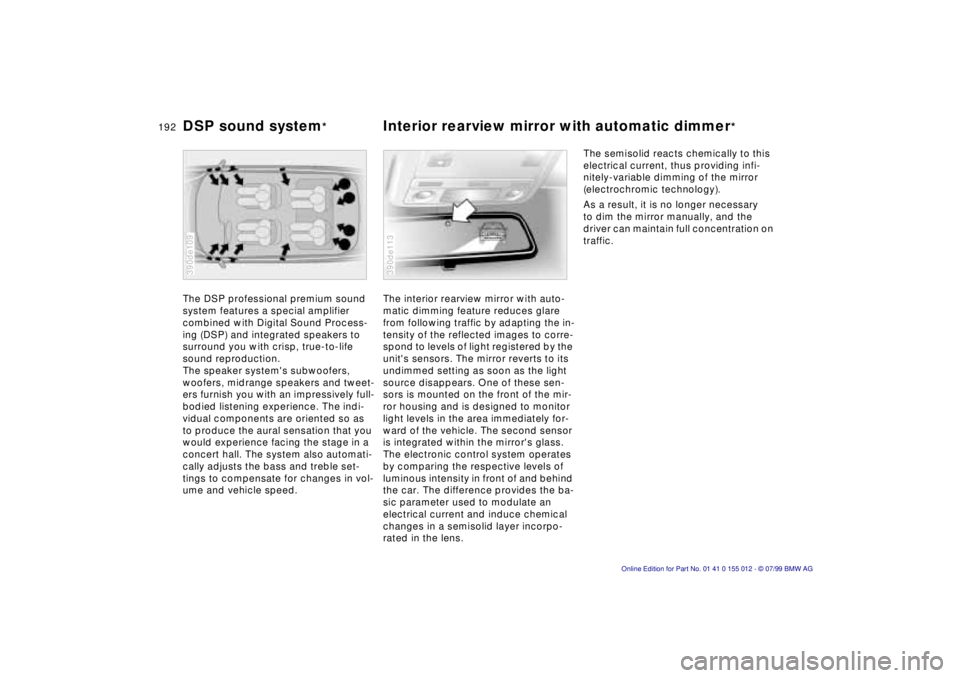
The DSP professional premium sound
system features a special amplifier
combined with Digital Sound Process-
ing (DSP) and integrated speakers to
surround you with crisp, true-to-life
sound reproduction.
The speaker system's subwoofers,
woofers, midrange speakers and tweet-
ers furnish you with an impressively full-
bodied listening experience. The indi-
vidual components are oriented so as
to produce the aural sensation that you
would experience facing the stage in a
concert hall. The system also automati-
cally adjusts the bass and treble set-
tings to compensate for changes in vol-
ume and vehicle speed.390de109
The interior rearview mirror with auto-
matic dimming feature reduces glare
from following traffic by adapting the in-
tensity of the reflected images to corre-
spond to levels of light registered by the
unit's sensors. The mirror reverts to its
undimmed setting as soon as the light
source disappears. One of these sen-
sors is mounted on the front of the mir-
ror housing and is designed to monitor
light levels in the area immediately for-
ward of the vehicle. The second sensor
is integrated within the mirror's glass.
The electronic control system operates
by comparing the respective levels of
luminous intensity in front of and behind
the car. The difference provides the ba-
sic parameter used to modulate an
electrical current and induce chemical
changes in a semisolid layer incorpo-
rated in the lens.390de113
The semisolid reacts chemically to this
electrical current, thus providing infi-
nitely-variable dimming of the mirror
(electrochromic technology).
As a result, it is no longer necessary
to dim the mirror manually, and the
driver can maintain full concentration on
traffic.
Page 193 of 217
193n
RepairsIndexOverview Controls Car care Technology Data
Rain sensor
*
Depending on the degree of wetness
on the windshield, the rain sensor
controls the operation of the windshield
wipers.
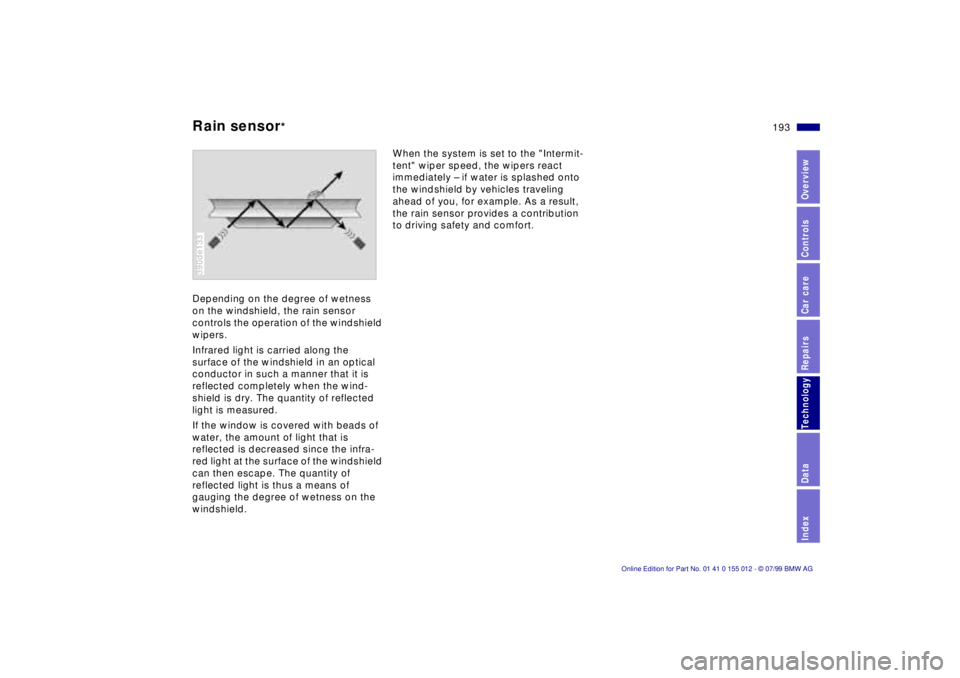
Infrared light is carried along the
surface of the windshield in an optical
conductor in such a manner that it is
reflected completely when the wind-
shield is dry. The quantity of reflected
light is measured.
If the window is covered with beads of
water, the amount of light that is
reflected is decreased since the infra-
red light at the surface of the windshield
can then escape. The quantity of
reflected light is thus a means of
gauging the degree of wetness on the
windshield.390de133
When the system is set to the "Intermit-
tent" wiper speed, the wipers react
immediately Ð if water is splashed onto
the windshield by vehicles traveling
ahead of you, for example. As a result,
the rain sensor provides a contribution
to driving safety and comfort.