2000 BMW 540I SEDAN roof
[x] Cancel search: roofPage 46 of 217
46n
Alarm system>If the indicator lamp flashes for
10 seconds when the system is
disarmed: An attempted entry has
been detected in the period since the
system was armed.
Following triggering of an alarm, the
indicator lamp will flash continuously.Avoiding unintentional alarmsThe tilt alarm sensor and interior motion
sensor may be switched off at the same
time to prevent a false alarm from being
triggered (in garages with elevator
ramps, for instance), or when the
vehicle is transported by trailer or train:
Lock the vehicle (arm the alarm system)
twice in succession: Press button 2 on
the remote-control transmitter twice
(refer to page 38), or turn the key in the
door lock to the right (lock) twice in
succession (refer to page 36).
The indicator lamp lights up briefly and
then flashes continuously. The tilt alarm
sensor and the interior motion sensor
are deactivated for as long as the
system remains armed.
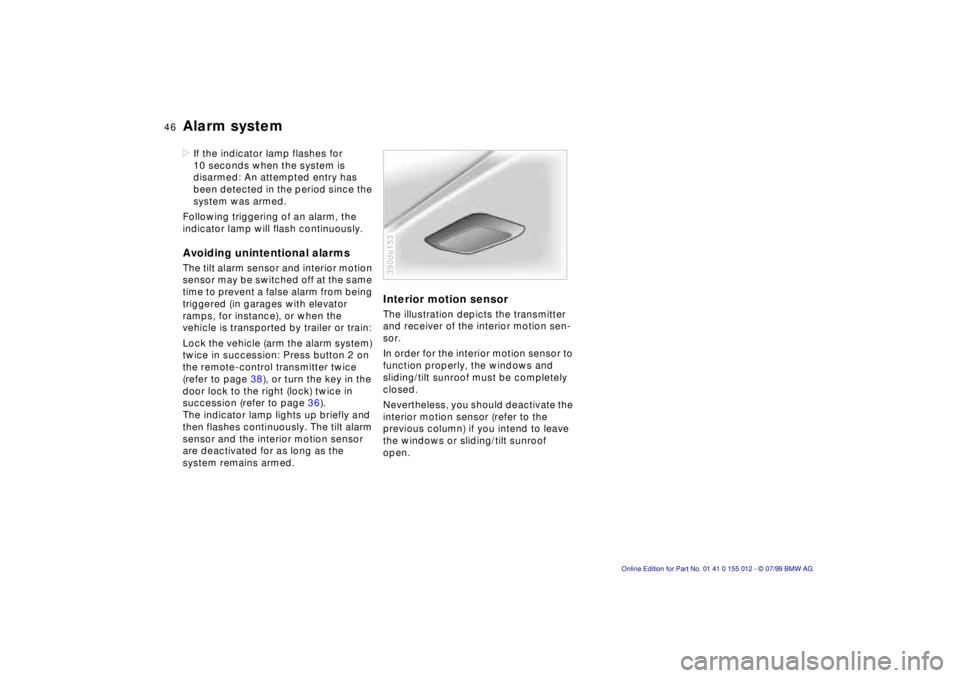
Interior motion sensorThe illustration depicts the transmitter
and receiver of the interior motion sen-
sor.
In order for the interior motion sensor to
function properly, the windows and
sliding/tilt sunroof must be completely
closed.
Nevertheless, you should deactivate the
interior motion sensor (refer to the
previous column) if you intend to leave
the windows or sliding/tilt sunroof
open.390de153
Page 48 of 217
48n
Electric power windows Sliding/Tilt sunroof
*
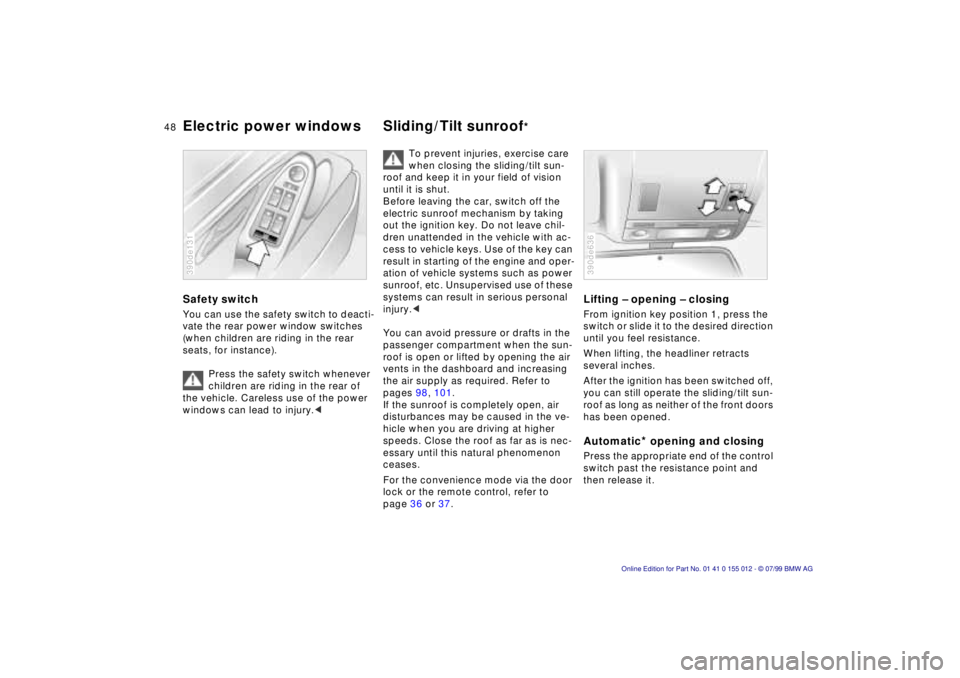
Safety switchYou can use the safety switch to deacti-
vate the rear power window switches
(when children are riding in the rear
seats, for instance).
Press the safety switch whenever
children are riding in the rear of
the vehicle. Careless use of the power
windows can lead to injury.< 390de131
To prevent injuries, exercise care
when closing the sliding/tilt sun-
roof and keep it in your field of vision
until it is shut.
Before leaving the car, switch off the
electric sunroof mechanism by taking
out the ignition key. Do not leave chil-
dren unattended in the vehicle with ac-
cess to vehicle keys. Use of the key can
result in starting of the engine and oper-
ation of vehicle systems such as power
sunroof, etc. Unsupervised use of these
systems can result in serious personal
injury.<
You can avoid pressure or drafts in the
passenger compartment when the sun-
roof is open or lifted by opening the air
vents in the dashboard and increasing
the air supply as required. Refer to
pages 98, 101.
If the sunroof is completely open, air
disturbances may be caused in the ve-
hicle when you are driving at higher
speeds. Close the roof as far as is nec-
essary until this natural phenomenon
ceases.
For the convenience mode via the door
lock or the remote control, refer to
page 36 or 37.
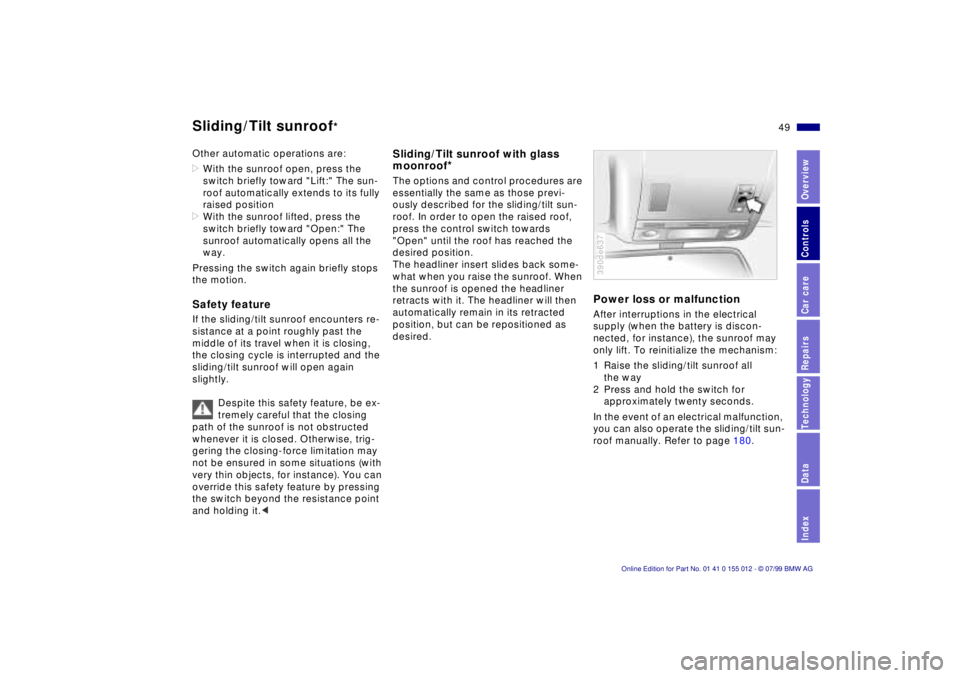
Lifting Ð opening Ð closingFrom ignition key position 1, press the
switch or slide it to the desired direction
until you feel resistance.
When lifting, the headliner retracts
several inches.
After the ignition has been switched off,
you can still operate the sliding/tilt sun-
roof as long as neither of the front doors
has been opened.Automatic
* opening and closing
Press the appropriate end of the control
switch past the resistance point and
then release it. 390de636
Page 49 of 217
49n
RepairsIndexOverview Controls Car care Technology Data
Sliding/Tilt sunroof
*
Other automatic operations are:
>With the sunroof open, press the
switch briefly toward "Lift:" The sun-
roof automatically extends to its fully
raised position
>With the sunroof lifted, press the
switch briefly toward "Open:" The
sunroof automatically opens all the
way.
Pressing the switch again briefly stops
the motion.Safety featureIf the sliding/tilt sunroof encounters re-
sistance at a point roughly past the
middle of its travel when it is closing,
the closing cycle is interrupted and the
sliding/tilt sunroof will open again
slightly.
Despite this safety feature, be ex-
tremely careful that the closing
path of the sunroof is not obstructed
whenever it is closed. Otherwise, trig-
gering the closing-force limitation may
not be ensured in some situations (with
very thin objects, for instance). You can
override this safety feature by pressing
the switch beyond the resistance point
and holding it.<
Sliding/Tilt sunroof with glass
moonroof
*
The options and control procedures are
essentially the same as those previ-
ously described for the sliding/tilt sun-
roof. In order to open the raised roof,
press the control switch towards
"Open" until the roof has reached the
desired position.
The headliner insert slides back some-
what when you raise the sunroof. When
the sunroof is opened the headliner
retracts with it. The headliner will then
automatically remain in its retracted
position, but can be repositioned as
desired.
Power loss or malfunctionAfter interruptions in the electrical
supply (when the battery is discon-
nected, for instance), the sunroof may
only lift. To reinitialize the mechanism:
1 Raise the sliding/tilt sunroof all
the way
2 Press and hold the switch for
approximately twenty seconds.
In the event of an electrical malfunction,
you can also operate the sliding/tilt sun-
roof manually. Refer to page 180.390de637
Page 117 of 217
117n
RepairsIndexOverview Controls Car care Technology Data
Luggage compartment Ð sport wagonRemoving the roll-up cover and
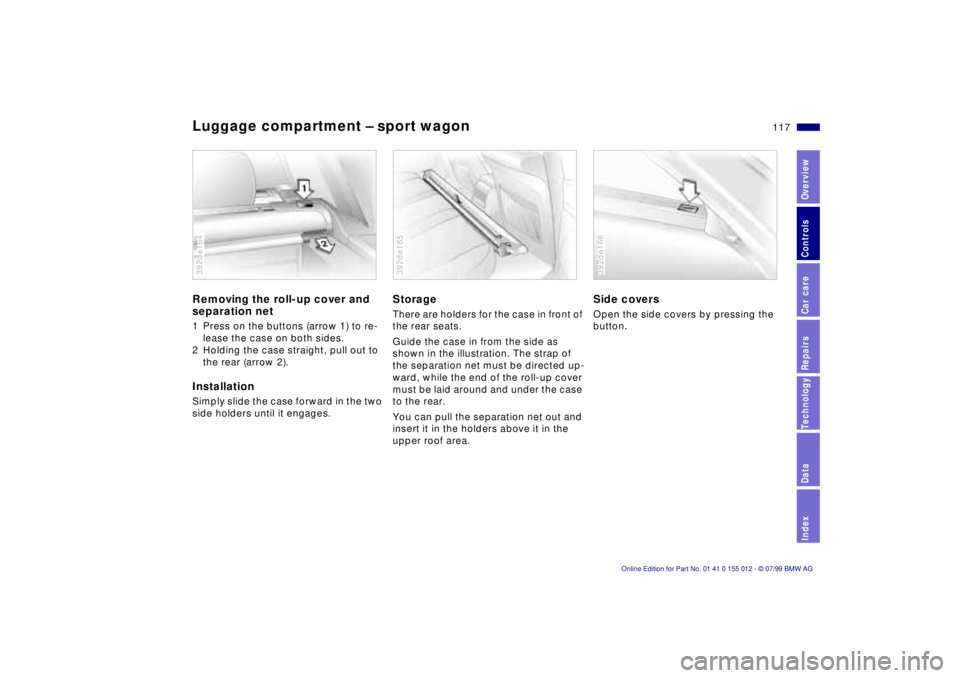
separation net1 Press on the buttons (arrow 1) to re-
lease the case on both sides.
2 Holding the case straight, pull out to
the rear (arrow 2).InstallationSimply slide the case forward in the two
side holders until it engages.392de164
StorageThere are holders for the case in front of
the rear seats.
Guide the case in from the side as
shown in the illustration. The strap of
the separation net must be directed up-
ward, while the end of the roll-up cover
must be laid around and under the case
to the rear.
You can pull the separation net out and
insert it in the holders above it in the
upper roof area.392de165
Side coversOpen the side covers by pressing the
button.392de166
Page 121 of 217
121n
RepairsIndexOverview Controls Car care Technology Data
Roof-mounted luggage rackMounting pointsAccess to the mounting points:
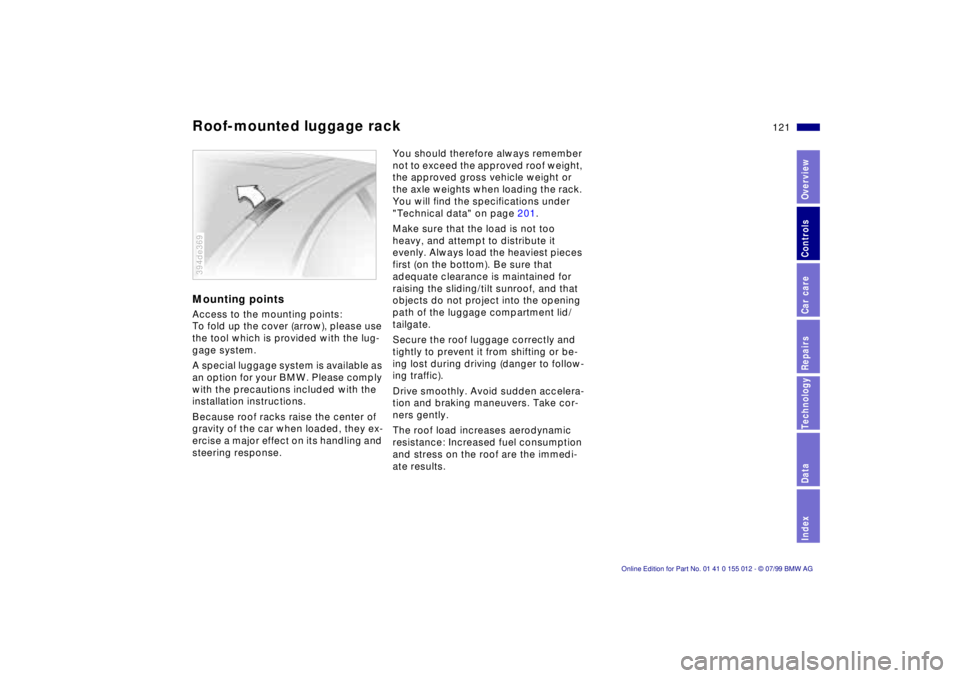
To fold up the cover (arrow), please use
the tool which is provided with the lug-
gage system.
A special luggage system is available as
an option for your BMW. Please comply
with the precautions included with the
installation instructions.
Because roof racks raise the center of
gravity of the car when loaded, they ex-
ercise a major effect on its handling and
steering response.394de369
You should therefore always remember
not to exceed the approved roof weight,
the approved gross vehicle weight or
the axle weights when loading the rack.
You will find the specifications under
"Technical data" on page 201.
Make sure that the load is not too
heavy, and attempt to distribute it
evenly. Always load the heaviest pieces
first (on the bottom). Be sure that
adequate clearance is maintained for
raising the sliding/tilt sunroof, and that
objects do not project into the opening
path of the luggage compartment lid/
tailgate.
Secure the roof luggage correctly and
tightly to prevent it from shifting or be-
ing lost during driving (danger to follow-
ing traffic).
Drive smoothly. Avoid sudden accelera-
tion and braking maneuvers. Take cor-
ners gently.
The roof load increases aerodynamic
resistance: Increased fuel consumption
and stress on the roof are the immedi-
ate results.
Page 154 of 217
154n
The BMW Maintenance System has
been designed as a reliable means of
providing maximum driving and operat-
ing safety Ð and as cost-effectively as
possible for you.
Please keep in mind that regular main-
tenance is not only necessary for the
safety of your vehicle, but also plays a
significant role in maintaining the resale
value of the vehicle.
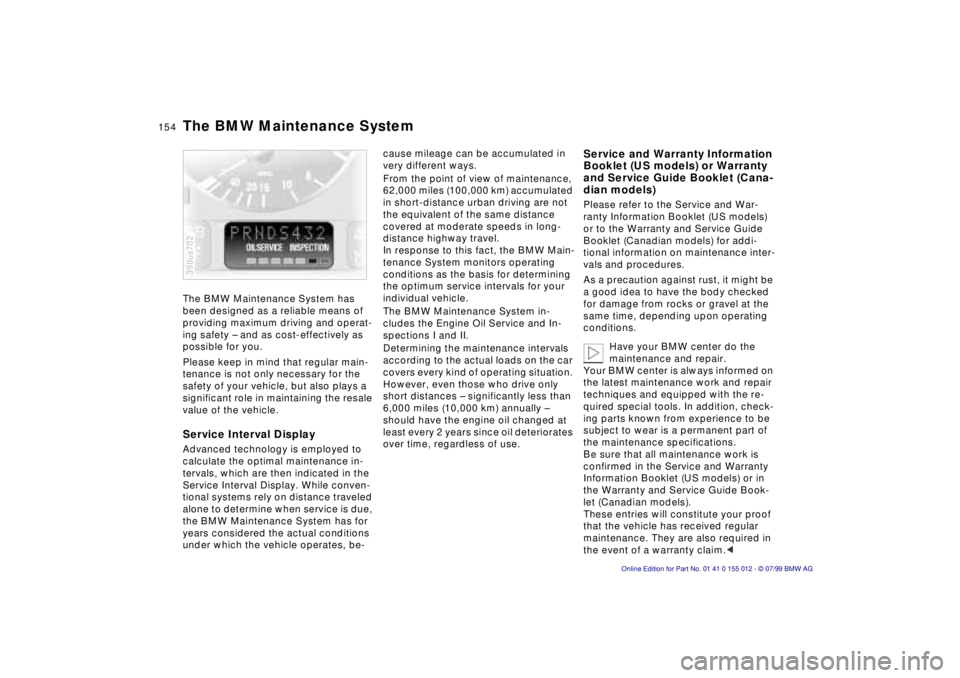
Service Interval DisplayAdvanced technology is employed to
calculate the optimal maintenance in-
tervals, which are then indicated in the
Service Interval Display. While conven-
tional systems rely on distance traveled
alone to determine when service is due,
the BMW Maintenance System has for
years considered the actual conditions
under which the vehicle operates, be-390us702
cause mileage can be accumulated in
very different ways.
From the point of view of maintenance,
62,000 miles (100,000 km) accumulated
in short-distance urban driving are not
the equivalent of the same distance
covered at moderate speeds in long-
distance highway travel.
In response to this fact, the BMW Main-
tenance System monitors operating
conditions as the basis for determining
the optimum service intervals for your
individual vehicle.
The BMW Maintenance System in-
cludes the Engine Oil Service and In-
spections I and II.
Determining the maintenance intervals
according to the actual loads on the car
covers every kind of operating situation.
However, even those who drive only
short distances Ð significantly less than
6,000 miles (10,000 km) annually Ð
should have the engine oil changed at
least every 2 years since oil deteriorates
over time, regardless of use.
Service and Warranty Information
Booklet (US models) or Warranty
and Service Guide Booklet (Cana-
dian models)Please refer to the Service and War-
ranty Information Booklet (US models)
or to the Warranty and Service Guide
Booklet (Canadian models) for addi-
tional information on maintenance inter-
vals and procedures.
As a precaution against rust, it might be
a good idea to have the body checked
for damage from rocks or gravel at the
same time, depending upon operating
conditions.
Have your BMW center do the
maintenance and repair.
Your BMW center is always informed on
the latest maintenance work and repair
techniques and equipped with the re-
quired special tools. In addition, check-
ing parts known from experience to be
subject to wear is a permanent part of
the maintenance specifications.
Be sure that all maintenance work is
confirmed in the Service and Warranty
Information Booklet (US models) or in
the Warranty and Service Guide Book-
let (Canadian models).
These entries will constitute your proof
that the vehicle has received regular
maintenance. They are also required in
the event of a warranty claim.<
The BMW Maintenance System
Page 160 of 217
160n
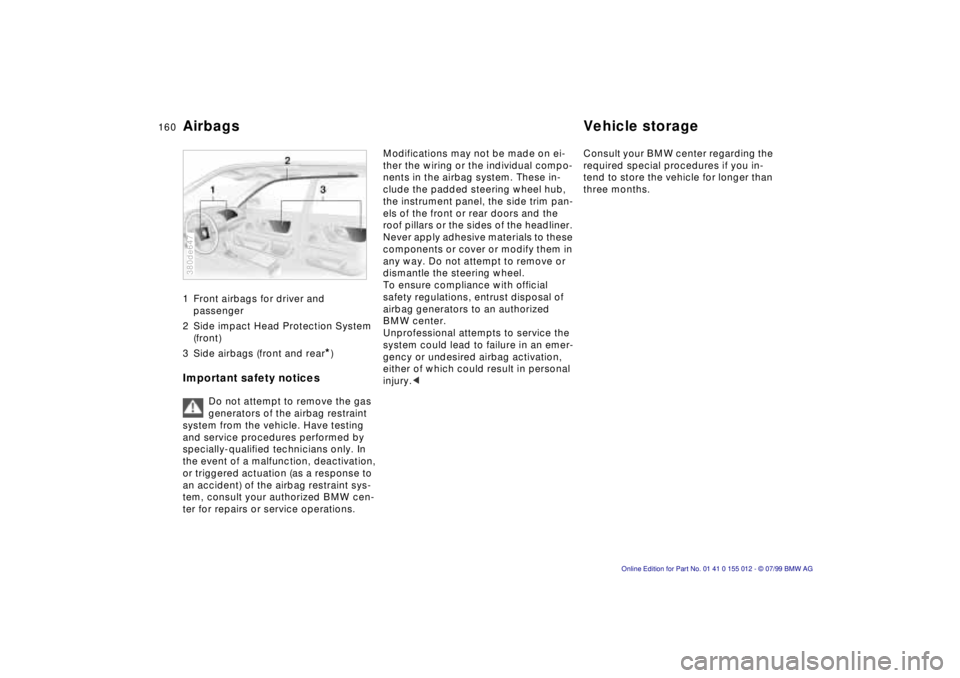
Airbags Vehicle storage 1 Front airbags for driver and
passenger
2 Side impact Head Protection System
(front)
3 Side airbags (front and rear
*)
Important safety notices
Do not attempt to remove the gas
generators of the airbag restraint
system from the vehicle. Have testing
and service procedures performed by
specially-qualified technicians only. In
the event of a malfunction, deactivation,
or triggered actuation (as a response to
an accident) of the airbag restraint sys-
tem, consult your authorized BMW cen-
ter for repairs or service operations.
380de647
Modifications may not be made on ei-
ther the wiring or the individual compo-
nents in the airbag system. These in-
clude the padded steering wheel hub,
the instrument panel, the side trim pan-
els of the front or rear doors and the
roof pillars or the sides of the headliner.
Never apply adhesive materials to these
components or cover or modify them in
any way. Do not attempt to remove or
dismantle the steering wheel.
To ensure compliance with official
safety regulations, entrust disposal of
airbag generators to an authorized
BMW center.
Unprofessional attempts to service the
system could lead to failure in an emer-
gency or undesired airbag activation,
either of which could result in personal
injury.< Consult your BMW center regarding the
required special procedures if you in-
tend to store the vehicle for longer than
three months.
Page 165 of 217
Overview
Controls and features
Operation, care
and maintenance
Owner service procedures
Technical data
Index Advanced technology
165n
RepairsIndexOverview Controls Car care Technology Data
Replacement procedures:
Onboard tool kit166
Wiper blades166
Lamps and bulbs167
Changing tires173
Battery176
Fuses178
In case of electrical
malfunction:
Fuel filler door180
Sliding/Tilt sunroof180
Tailgate181
Assistance, giving and
receiving:
Jump-starting182
Towing the vehicle183