2000 BMW 540I SEDAN maintenance
[x] Cancel search: maintenancePage 123 of 217
Overview
Controls and features
Operation, care
and maintenance
Owner service procedures
Technical data
Index Advanced technology
123n
RepairsIndexOverview Controls Car care Technology Data
Under the hood:
Hood143
Engine compartment144
Washer fluids148
Washer nozzles148
Engine oil149
Coolant151
Brake fluid152
Vehicle Identification
Number153
Care and maintenance:
The BMW Maintenance
System154
Caring for your car155
Airbags160
Vehicle storage160
Laws and regulations:
Technical modifications161
OBD connector162 Special operating instructions:
Break-in procedure124
Driving notes125
Catalytic converter126
Antilock Brake System
(ABS)127
Disc brakes128
Brake system130
Winter operation130
Power steering132
Level control system132
Cellular phone133
Radio reception133
Wheels and tires:
Tire inflation pressure134
Tire condition134
Tire replacement135
Tire rotation136
Wheel and tire
combinations137
Winter tires138
Snow chains139
Approved wheel and tire
specifications140
Page 126 of 217

126n
Catalytic converterThe catalytic converter reduces harmful
exhaust emissions, and is designed for
use with unleaded fuel only.
Even minute quantities of lead would be
enough to permanently damage both
the catalytic converter and the system
oxygen sensor.
To ensure efficient, trouble-free engine
operation and avoid potential damage:
>Be sure to comply with the scheduled
maintenance requirements
>Fill the fuel tank well before it is
empty
>Tow-start the vehicle only when the
engine is cold, since unburned fuel
may otherwise reach the catalytic
converter. It is better to start the vehi-
cle with an outside starting aid>Avoid other situations in which the
fuel is not burned, or burns incom-
pletely, such as engaging the starter
frequently or for extended periods, or
repeated start attempts in which the
engine does not start (stopping and
restarting an engine which is running
properly does not present a problem).
Never let the engine run with any of
the spark plug cables disconnected.Be sure to comply with the in-
structions above to prevent un-
burned fuel from reaching the catalytic
converter. Otherwise there is danger of
overheating and damage to the cata-
lytic converter.
Extreme temperatures occur at the cat-
alytic converter on this and every cata-
lyst-equipped vehicle. Heat shields are
installed adjacent to some sections of
the exhaust system. Never remove
these shields; do not apply undercoat-
ing to their surfaces. When driving,
standing at idle, and parking the vehi-
cle, take care to avoid contact between
the exhaust system and flammable ma-
terials (grass, hay, leaves, etc.). Such
contact could lead to a fire, resulting in
personal injury and property damage.<
Page 154 of 217
154n
The BMW Maintenance System has
been designed as a reliable means of
providing maximum driving and operat-
ing safety Ð and as cost-effectively as
possible for you.
Please keep in mind that regular main-
tenance is not only necessary for the
safety of your vehicle, but also plays a
significant role in maintaining the resale
value of the vehicle.
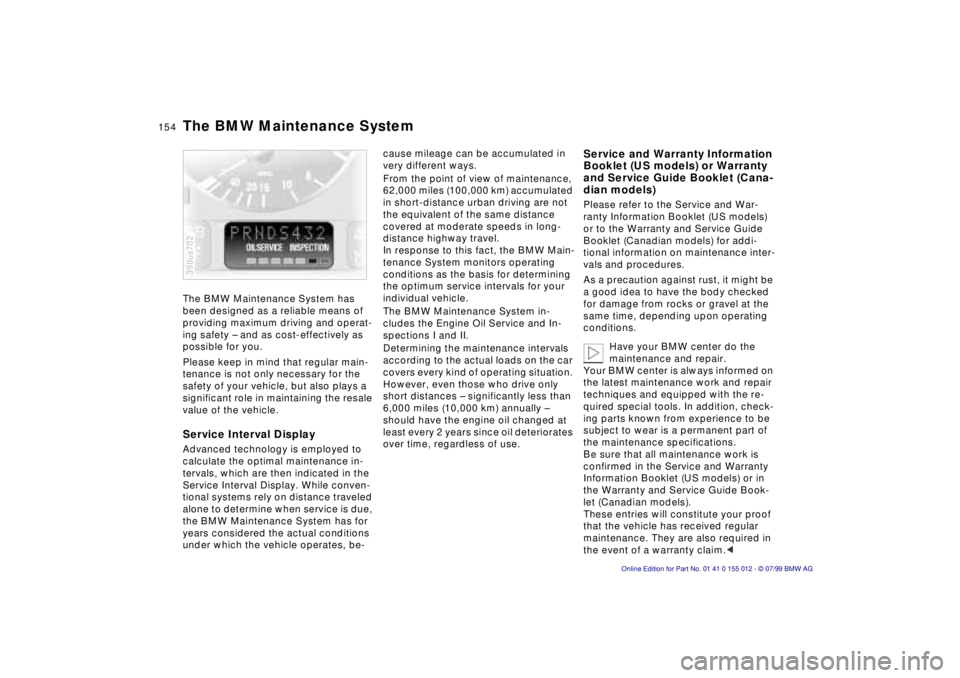
Service Interval DisplayAdvanced technology is employed to
calculate the optimal maintenance in-
tervals, which are then indicated in the
Service Interval Display. While conven-
tional systems rely on distance traveled
alone to determine when service is due,
the BMW Maintenance System has for
years considered the actual conditions
under which the vehicle operates, be-390us702
cause mileage can be accumulated in
very different ways.
From the point of view of maintenance,
62,000 miles (100,000 km) accumulated
in short-distance urban driving are not
the equivalent of the same distance
covered at moderate speeds in long-
distance highway travel.
In response to this fact, the BMW Main-
tenance System monitors operating
conditions as the basis for determining
the optimum service intervals for your
individual vehicle.
The BMW Maintenance System in-
cludes the Engine Oil Service and In-
spections I and II.
Determining the maintenance intervals
according to the actual loads on the car
covers every kind of operating situation.
However, even those who drive only
short distances Ð significantly less than
6,000 miles (10,000 km) annually Ð
should have the engine oil changed at
least every 2 years since oil deteriorates
over time, regardless of use.
Service and Warranty Information
Booklet (US models) or Warranty
and Service Guide Booklet (Cana-
dian models)Please refer to the Service and War-
ranty Information Booklet (US models)
or to the Warranty and Service Guide
Booklet (Canadian models) for addi-
tional information on maintenance inter-
vals and procedures.
As a precaution against rust, it might be
a good idea to have the body checked
for damage from rocks or gravel at the
same time, depending upon operating
conditions.
Have your BMW center do the
maintenance and repair.
Your BMW center is always informed on
the latest maintenance work and repair
techniques and equipped with the re-
quired special tools. In addition, check-
ing parts known from experience to be
subject to wear is a permanent part of
the maintenance specifications.
Be sure that all maintenance work is
confirmed in the Service and Warranty
Information Booklet (US models) or in
the Warranty and Service Guide Book-
let (Canadian models).
These entries will constitute your proof
that the vehicle has received regular
maintenance. They are also required in
the event of a warranty claim.<
The BMW Maintenance System
Page 156 of 217

156n
Caring for your carExterior finishTo provide effective corrosion protec-
tion, multilayer paintwork is applied at
the factory. Cataphoretic immersion
priming techniques are supplemented
using special body-cavity protectants,
with the application of specially-devel-
oped and extensively tested materials.
A layer of flexible PVC is first applied to
the undercarriage. Following this, a
comprehensive undercoating treatment
with a wax-based protectant is applied.
Regular maintenance makes an impor-
tant contribution to maintaining the
safety and value of your vehicle.
Increasing awareness of the effects of
harmful environmental factors on vehi-
cle finishes have led paint and vehicle
manufacturers to initiate ongoing pro-
grams designed to further improve the
durability of their finishes. Despite this,
environmental factors that occur locally
or regionally can have negative effects
on the finish of your vehicle. These
should guide you in determining the fre-
quency and extent of your efforts to
maintain the vehicle finish.Depending upon material and type of
impact (perforation of paint layer), phys-
ical stresses from sand, road salt,
gravel, etc., can cause corrosion to
start extending beneath the finish, start-
ing at the point of impact.
Road dirt, tar spots, dead insects, ani-
mal droppings (strong alkali effect) and
tree excretions (resins and pollen) all
contain substances capable of causing
damage when allowed to remain on the
finish of your car for any period of time
(spots, etching, flaking, separation in
the top coat).
In industrial areas, deposits from fly
ash, lime, oil deposits, sulfur-dioxide in
precipitation (acid rain) and other envi-
ronmental pollutants will all damage the
surface of the car unless adequate pro-
tection is provided.In coastal regions, high levels of
atmospheric salt and humidity promote
corrosion.
In tropical zones, temperatures of over
1057 (406) in the shade prevail, in
addition to heavy ultraviolet radiation
and high humidity. Under those circum-
stances, light exterior finishes reach
temperatures of up to 1757 (806)
and dark finishes up to 2507 (1206).
Page 165 of 217
Overview
Controls and features
Operation, care
and maintenance
Owner service procedures
Technical data
Index Advanced technology
165n
RepairsIndexOverview Controls Car care Technology Data
Replacement procedures:
Onboard tool kit166
Wiper blades166
Lamps and bulbs167
Changing tires173
Battery176
Fuses178
In case of electrical
malfunction:
Fuel filler door180
Sliding/Tilt sunroof180
Tailgate181
Assistance, giving and
receiving:
Jump-starting182
Towing the vehicle183
Page 177 of 217
177n
RepairsIndexOverview Controls Car care Technology Data
Battery
A highly-explosive gas is
generated when the battery is
charged.
If you happen to get acid in your
eyes, rinse thoroughly for
15 minutes with clear water.
Following that, consult a physician
immediately. If you get acid spray on
your skin or clothing, rinse with plenty
of water. If electrolyte is accidentally
swallowed, consult a physician immedi-
ately.
In order to protect the battery
case from ultraviolet radiation,
do not place it in direct sunlight.
A discharged battery can freeze. Store
the battery in areas where temperature
remains above freezing.
MaintenanceThe battery is absolutely maintenance-
free, that is, the original electrolyte will
normally last for the service life of the
battery under moderate climatic condi-
tions.
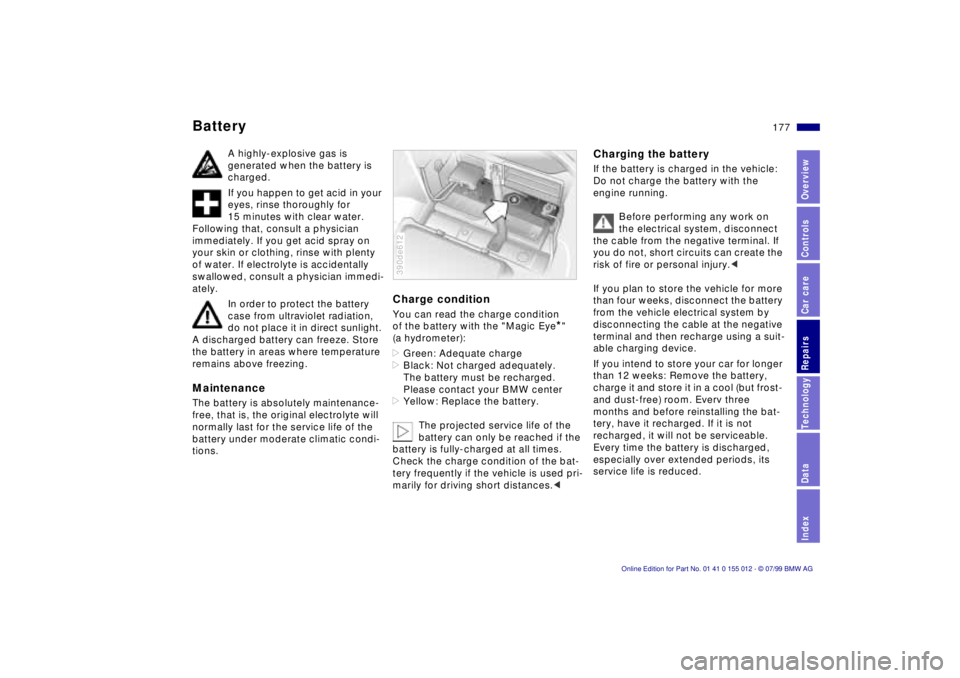
Charge conditionYou can read the charge condition
of the battery with the "Magic Eye
*"
(a hydrometer):
>Green: Adequate charge
>Black: Not charged adequately.
The battery must be recharged.
Please contact your BMW center
>Yellow: Replace the battery.
The projected service life of the
battery can only be reached if the
battery is fully-charged at all times.
Check the charge condition of the bat-
tery frequently if the vehicle is used pri-
marily for driving short distances.<
390de612
Charging the batteryIf the battery is charged in the vehicle:
Do not charge the battery with the
engine running.
Before performing any work on
the electrical system, disconnect
the cable from the negative terminal. If
you do not, short circuits can create the
risk of fire or personal injury.<
If you plan to store the vehicle for more
than four weeks, disconnect the battery
from the vehicle electrical system by
disconnecting the cable at the negative
terminal and then recharge using a suit-
able charging device.
If you intend to store your car for longer
than 12 weeks: Remove the battery,
charge it and store it in a cool (but frost-
and dust-free) room. Everv three
months and before reinstalling the bat-
tery, have it recharged. If it is not
recharged, it will not be serviceable.
Every time the battery is discharged,
especially over extended periods, its
service life is reduced.
Page 187 of 217
Overview
Controls and features
Operation, care
and maintenance
Owner service procedures
Technical data
Index Advanced technology
187n
RepairsIndexOverview Controls Car care Technology Data
Airbags188
Adaptive Transmission Control
(ATC)188
Automatic Stability Control plus
Traction (ASC+T)/Dynamic
Stability Control (DSC)189
Radio reception190
BMW active seat190
Safety belt tensioner191
DSP sound system191
Interior rearview mirror with
automatic dimmer192
Rain sensor193
Tire Pressure Control (RDC)194
Integrated rear suspension194
Level control system195
Xenon lamps195
Page 197 of 217
Overview
Controls and features
Operation, care
and maintenance
Owner service procedures
Technical data
Index Advanced technology
197n
RepairsIndexOverview Controls Car care Technology Data
Engine specifications198
Dimensions Ð sedan199
Dimensions Ð sport wagon200
Weights Ð sedan201
Weights Ð sport wagon202
Capacities203
Electrical system204
Drive belts204