2000 BMW 540I SEDAN heating
[x] Cancel search: heatingPage 126 of 217

126n
Catalytic converterThe catalytic converter reduces harmful
exhaust emissions, and is designed for
use with unleaded fuel only.
Even minute quantities of lead would be
enough to permanently damage both
the catalytic converter and the system
oxygen sensor.
To ensure efficient, trouble-free engine
operation and avoid potential damage:
>Be sure to comply with the scheduled
maintenance requirements
>Fill the fuel tank well before it is
empty
>Tow-start the vehicle only when the
engine is cold, since unburned fuel
may otherwise reach the catalytic
converter. It is better to start the vehi-
cle with an outside starting aid>Avoid other situations in which the
fuel is not burned, or burns incom-
pletely, such as engaging the starter
frequently or for extended periods, or
repeated start attempts in which the
engine does not start (stopping and
restarting an engine which is running
properly does not present a problem).
Never let the engine run with any of
the spark plug cables disconnected.Be sure to comply with the in-
structions above to prevent un-
burned fuel from reaching the catalytic
converter. Otherwise there is danger of
overheating and damage to the cata-
lytic converter.
Extreme temperatures occur at the cat-
alytic converter on this and every cata-
lyst-equipped vehicle. Heat shields are
installed adjacent to some sections of
the exhaust system. Never remove
these shields; do not apply undercoat-
ing to their surfaces. When driving,
standing at idle, and parking the vehi-
cle, take care to avoid contact between
the exhaust system and flammable ma-
terials (grass, hay, leaves, etc.). Such
contact could lead to a fire, resulting in
personal injury and property damage.<
Page 129 of 217

129n
RepairsIndexOverview Controls Car care Technology Data
Disc brakesDriving notesWhen driving in wet conditions and in
heavy rain, it is a good idea to apply
light pressure to the brake pedal every
few miles (kilometers). Watch traffic
conditions to ensure that this maneuver
does not endanger other road users.
The heat which is generated by the
brake applications helps to dry the
brake pads and rotors.
Maximum braking force is obtained
while the wheels continue to rotate,
peaking when the wheels remain on the
verge of locking without actually doing
so. ABS maintains this state automati-
cally. If the ABS fails, you should revert
to the staggered braking technique de-
scribed below (refer to page 131).
Extended or steep mountain descents
do not necessarily have to lead to re-
duced braking efficiency. Shift down to
a gear in which only minimal periodic
brake applications are required or move
the selector lever to the appropriate
lower range with automatic transmis-
sion.
You can increase the engine's braking
effect by selecting progressively lower
gears, downshifting as far as 1st gear,
or the 1st or 2nd shift position, on steep
descents.Should engine braking prove inade-
quate, you should still avoid extended,
continuous braking. Instead of main-
taining low to moderate pressure over
an extended period of time, you should
decelerate by applying more substantial
pressure to the brake pedal (watch for
following traffic!), then releasing the
pedal, then repeating the application.
This staggered braking technique al-
lows the brakes to cool in the intervals
between active braking phases, pre-
venting overheating and ensuring that
full braking capacity remains available
at all times.
Do not coast with the clutch de-
pressed or with the transmission
or selector lever in neutral. Do not coast
with the engine shut off. The engine
provides no braking effect when the
clutch is depressed or the transmission
is in neutral, and there is no power-as-
sist for braking or steering when the
engine is not running.
Never allow floor mats, carpets or any
other objects to protrude into the area
around the accelerator, clutch and
brake pedals and obstruct their move-
ment.<
Dynamic Brake Control (DBC)
*
If you apply the brakes rapidly, this sys-
tem automatically produces the maxi-
mum braking force boost and thus
helps to achieve the shortest possible
braking distance during "panic stops."
All of the benefits of the ABS system
are exploited under these circum-
stances.
Do not reduce the pressure on the
brake pedal for the duration of the
brake application. When the brake
pedal is released, the DBC is deacti-
vated.
In the event of a malfunction, the yellow
warning lamp comes on. Conventional
braking efficiency is available without
limitations.
Have the system checked and repaired
at your BMW center as soon as possi-
ble.
For "Information for your safety"
covering the ABS system, refer to
page 128. This information also gener-
ally applies for DBC.<
Page 134 of 217
134n
Information for your safety The factory-approved radial tires are
matched to the car and have been se-
lected to provide optimum safety and
driving comfort on your car.
It is not merely the tire's service life, but
also driving comfort and Ð above all else
Ð driving safety which depend on the
condition of the tires and the mainte-
nance of the specified tire pressure.
Incorrect inflation pressure is a frequent
cause of tire damage. It also signifi-
cantly influences the roadholding ability
of your BMW.
Check tire inflation pressures Ð in-
cluding the spare tire Ð regularly,
at least every two weeks and before be-
ginning a longer trip. If this is not done,
incorrect tire pressures can cause driv-
ing instability and tire damage, ulti-
mately resulting in accidents.<
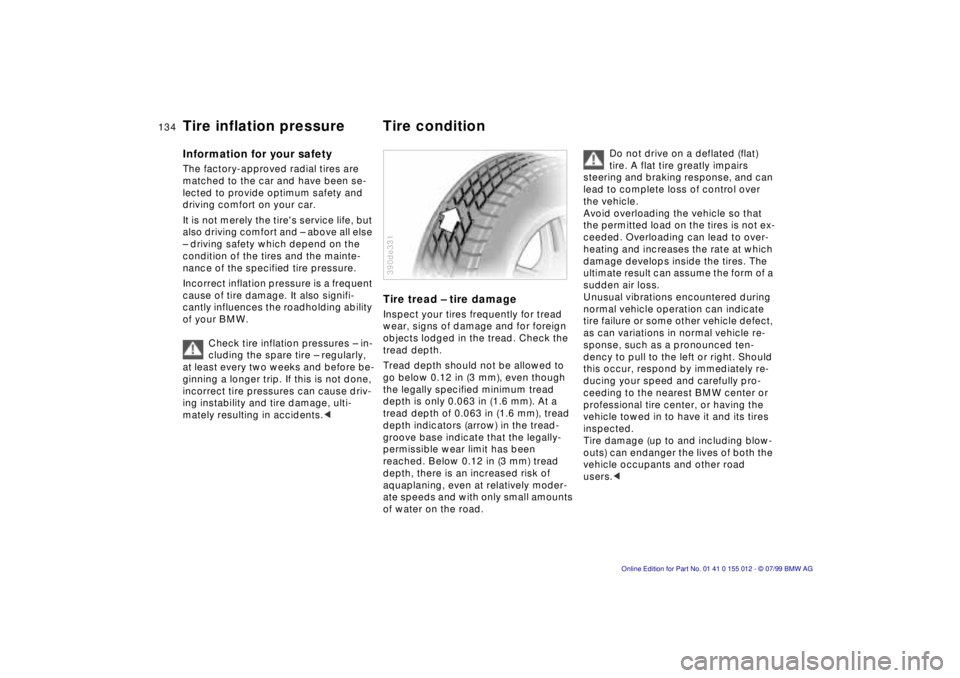
Tire tread Ð tire damageInspect your tires frequently for tread
wear, signs of damage and for foreign
objects lodged in the tread. Check the
tread depth.
Tread depth should not be allowed to
go below 0.12 in (3 mm), even though
the legally specified minimum tread
depth is only 0.063 in (1.6 mm). At a
tread depth of 0.063 in (1.6 mm), tread
depth indicators (arrow) in the tread-
groove base indicate that the legally-
permissible wear limit has been
reached. Below 0.12 in (3 mm) tread
depth, there is an increased risk of
aquaplaning, even at relatively moder-
ate speeds and with only small amounts
of water on the road.390de331
Do not drive on a deflated (flat)
tire. A flat tire greatly impairs
steering and braking response, and can
lead to complete loss of control over
the vehicle.
Avoid overloading the vehicle so that
the permitted load on the tires is not ex-
ceeded. Overloading can lead to over-
heating and increases the rate at which
damage develops inside the tires. The
ultimate result can assume the form of a
sudden air loss.
Unusual vibrations encountered during
normal vehicle operation can indicate
tire failure or some other vehicle defect,
as can variations in normal vehicle re-
sponse, such as a pronounced ten-
dency to pull to the left or right. Should
this occur, respond by immediately re-
ducing your speed and carefully pro-
ceeding to the nearest BMW center or
professional tire center, or having the
vehicle towed in to have it and its tires
inspected.
Tire damage (up to and including blow-
outs) can endanger the lives of both the
vehicle occupants and other road
users.<
Tire inflation pressure Tire condition
Page 209 of 217

209n
RepairsIndexOverview Controls Car care Technology Data
Everything from A to Z
Clock, refer to the Radio
Owner's Manual
Cockpit16
Cold start68
Comfort seat51
Compartments108
Compression ratio198
Computer, refer to Onboard
computer88
Consumption display83
Convenience operating
mode of windows and
sliding/tilt sunroof36
Coolant130, 151
Antifreeze130
Capacity203
Temperature gauge84
Cover, sun blinds104
Cruise control80
Cruising range88
Cup holder109
Curb weight201
D
Dashboard16
Data link connector for
Onboard Diagnostics162
Daytime-driving lamp94
DBC (Dynamic Brake
Control)24, 129
Deep water125Defrost windshields101
Digital sound processor192
Dimensions199
Dipstick, engine oil149
Disc brakes124, 128
Disconnect the battery178
Displacement198
Display lighting94
Displays18
Distance warning90
Diversity Antenna
system190
Divided rear-seat
backrest112
Door keys35
Door locks, care130
Doors
Emergency release36
Manual operation36
Unlocking and locking36
Drive belts204
Driving notes125
Driving through water125
DSC (Dynamic Stability
Control)24, 91, 189
Dynamic Brake Control
(DBC)24, 129
Dynamic Stability Control
(DSC)24, 91, 189
E
Electric power seat50
Electric power windows47
Electrical defect
Fuel filler door180
Sliding/Tilt sunroof180
Tailgate181
Electrical heating exterior
mirror55
Electrical steering wheel
adjustment54
Elements of operation16
Emergency operation
Doors36
Fuel filler door180
Luggage compartment lid/
Tailgate41, 181
Sliding/Tilt sunroof180
Energy Control83
Engine
Compartment144
Coolant151
Specifications198
Engine oil
Capacity203
Consumption149
Grades150
Level23
Pressure23
Error indicators85
Exterior finish156
Exterior mirror54
Electrical heating55
F
Failure of an electrical
accessorry180
Failure warnings85
Filler cap cover28
Filling capacities203
First-aid kit27
Fittings, tow-starting and
towing183
Flashlight108
Flat tire134
Footbrake
Footwell lamps96
Forward/Back adjustment,
seat50, 52
Front fog lamps95, 169
bulb replacement169
Front seat adjustment50
Frost protection,
radiator151
Fuel29
Capacity203
Consumption indicator83
Gauge83
Quality29
Reserve203
Fuel filler door release after
electrical fault180
Fuel tank, capacity203
Fuses178
Page 210 of 217

Everything from A to Z
G
Gasoline29
Gasoline gauge83
Glove compartment108
Gross weight201
H
Handbrake23, 69
Handsfree system109
Hazard warning system27
Hazard warning triangle27
Head restraint53
Headlamp cleaning78
Headlamp covers,
care155, 167
Headlamp flasher77
Headlamp washer
system148
Heated seats103
Heated steering wheel103
Heating and ventilation98
Heating while stopped102
Heavy loads120
Height199
Height adjustment
Seats52
Steering wheel54
HiFi system192
High beams24
Bulb replacement167
High Performance Synthetic
Oils150Hood release143
Horn25, 26
Hydraulic Brake Assistant,
refer to DBC24, 129
I
Ice warning82
Identification number of the
vehicle153
Identification, tires137
Ignition key35
Ignition lock67
Independent ventilation104
Indicator77
Indicator lamps22
Inflation pressure30, 134
Monitoring92, 194
INSPECTION84
Instrument cluster18, 20
Instrument lighting94
Instrument panel20
Instrument panel switch77
Instruments18
Integrated rear axle194
Intensive automatic cleaning
unit78
Intensive cleaning
system148
Interaxle tire rotation136
Interference indicators85
Interference with
car phones133Interior lamps96
Remote control38
Interior mirror55
automatic dimming
feature55
Interior motion sensor46
Deactivation46
Interior rearview mirror
with automatic dimming
feature55, 192
Interlock67
Intermittent wiper switch77
J
Jack173
Jump-starting182
K
Key Memory58
Keys35
Kickdown72, 75
L
Lashing eye44, 120
Leather care159
Length199
Level control
system24, 132, 195
Light switch94
Light-alloy wheels138, 140
Lighter110Lights-on warning94
Load-securing devices120
Locking and unlocking the
doors36, 37
Low beams94
Bulb replacement167
Low beams, bulb
replacement167
Low-fuel warning lamp83
Lug bolts174
Lug wrench174
Luggage compartment
Capacity201
Lamps96
Net44
Luggage compartment lid/
Tailgate44
Emergency actuation41
Opening separately41
Remote control39
Luggage space44
Luggage straps44
Lumbar support51
M
M Multifunction steering
wheel (MFL)26
M+S tires138
Magic Eye177
Maintenance84, 154
Page 211 of 217

211n
RepairsIndexOverview Controls Car care Technology Data
Everything from A to Z
Manual operation
Doors36
Fuel filler door180
Luggage compartment lid/
Tailgate41, 181
Sliding/Tilt sunroof180
Manual transmission70
Manually controlled
recirculated-air101
Master key34
Mechanical seat52
Memory56
MFL (M Multifunction
steering wheel)26
MFL (Multifunction steering
wheel)25
Microfilter103
Mirror54
Mirror heating55
Mirror memory56
Mobile communications
systems, refer to the
separate Owner's Manual
Mobile phones133
Modifications,
technical6, 161
Multifunction steering wheel
(MFL)25
N
Navigation System, refer to
the separate Owner's
Manual
Nonsmoker equipment110
Nozzles98
O
OBD connector162
Odometer82
Oil
Additives149
Consumption149
Grades150
Oil change interval, see the
Service and Warranty
Information Booklet (US
models) or Warranty and
Service Guide Booklet
(Canadian models)
Oil dipstick149
Oil level, indicator lamp23
Oil quantity, engine203
OILSERVICE84
Old batteries177
Onboard computer88
Average fuel
consumption88
Average speed88
Cruising range88
Outside temperature88
Onboard tool kit166Open luggage compartment
lid/tailgate from
interior41
Opening and closing
From the inside38
From the outside36
Operating range88
Outside temperature88
Outside temperature
display82
P
Paint blemishes156
Paint, care156
Paintwork, minor
repairs157
Paintwork, waxing157
Park Distance Control
(PDC)90
Parking brake23, 69
Parking help90
Parking lamps95
Bulb replacement168
Parking, Winter132
PDC (Park Distance
Control)90
Playing cassettes
Refer to the Radio Owner's
Manual
Playing CDs
Refer to the Radio Owner's
Manual
Pocket light108Pollen filter103
Power output198
Power steering132
Power windows47
Safety switch48
Power-slip control
Refer to ASC+T/DSC91
Pressure, tire30, 134
Monitoring92, 194
R
Radio reception133, 190
Radio, refer to the separate
Owner's Manual
Radios133
Rain sensor155
RDC (Tire Pressure
Control)92, 194
Reading lamps96
Rear view mirror54
Rear window blind104
Rear window
defrosting79, 102
Rear window wiper79
Rear-seat backrest,
removable112
Recirculated-air control101
Reclining seat50
Refueling28
Remote control37
Removable rear-seat
backrest112
Page 212 of 217

Everything from A to Z
Remove condensation from
windshields101
Replacement keys35
Replacement of tires135
Reporting safety defects7
Reserve capacity
Cooling system203
Engine oil203
Fuel tank203
Washer system203
Residual heat102
Restraint system59
Reverse70
Rims137
Roof load201
Roof-mounted luggage
rack121
Rubber parts130
S
Safety belt tensioner191
Safety belts59
Safety lock buttons40
Seat heating103
Seat memory56
Seat, electric power50
Seat, forward/back
adjustment50, 52
Seat, mechanical52
Secure the load44, 120
Selector lever, automatic
transmission71, 74Service and Warranty
Information Booklet
(US models)154
Service Interval
Display84, 154
Servotronic132
Shift lever70
Shoulder support51
Shutting off the engine69
Side airbags60
Side impact Head Protection
System60
Ski bag113
Ski bag in the sport
wagon115
Skid control132
Sliding132
Sliding/Tilt sunroof48
Closure after electrical
fault180
Convenience
operation36
Manual operation180
Power supply
interruption49
Slippery roads131
Snow chains131, 139
Socket110
Sound system192
Spare key35
Spare tire136, 174
Spark plugs204Speaker109
Special oils150
Specifications for engine
oil150
Speed control80
Speedometer18, 20
sport wagon
Compartments in the
luggage
compartment117
Folding down the rear
backrest116
Lashing eyes120
Load-securing
devices120
Luggage
compartment116
Luggage compartment
lamps, bulb
replacement172
Opening the rear
window42
Rear window wiper79
Rear window wiper, wiper
blade replacement166
Roll-up cover116
Securing a load120
Separation net116
Ski bag115
Tail lamp assembly, bulb
replacement170
Tailgate, manual release
after electrical fault180Sports seat52
Start the engine68
Starting help182
Steering132
Steering wheel heating103
Steering wheel lock67
Steering wheel memory56
Storage108
Stroke198
Summer tires137
Sun visors55
Symbols4
T
Tachometer82
Tail lamps170
Tail lamps,
bulb replacement169
Tailgate44, 181
Convenience opening
mode38
Manual release after
electrical fault181
Taillamps170
Technical Data198
Technical
modifications6, 161
Telephone hookup109
Temperature display, engine
coolant84
Temperature gauge, outside
temperature82
Tensioning straps44