2000 BMW 528i vacuum
[x] Cancel search: vacuumPage 780 of 1002

Downloaded from www.Manualslib.com manuals search engine
.- -
Brakes
Disconnect master cylinder brake lines (A)
Plug open brake lines to prevent contamination.
Remove master cylinder mounting nuts
(6) and remove
cylinder.
NOTE-
It may be necessary to remove the brake booster with master
cylinder attached due to limited access.
Bralce master cylin-
dercan then be removed from booster. See Brake booster,
removing and installing later
in this repair group.
- During reinstallation, make sure all nuts, fluid couplings,
thread bores, and mating surfaces are clean.
- Mount master cylinder to bralte booster using new sealing O-
ring and new self-locking nuts.
CAUTIOI\C
* Be sure to align master cylinderpushrod and booster
pushrod.
* Do not over-torque master cylinder mounting nuts. This
could damage the brake booster and prevent proper
vacuum build-up.
Tightening torque Brake master cylinder to brake booster
26 Nm (19 ft-lb)
- Connect bralte fluid lines to master cylinder.
Tightening torque Brake fluid line to master cylinder
18 Nm (13 ft-lb)
- Carefully reinstall fluid reservoir using new sealing grommets.
- Reconnect precharge pump fluid supply hose, if applicable. -
- Reconnect hydraulic clutch fluid supply hose, if applicable.
- Remainder of installation is reverse of removal.
Top up with fresh brake fluid.
Bleed entire brake system as described earlier
Page 781 of 1002

Downloaded from www.Manualslib.com manuals search engine
Brakes
The brake booster is mounted to the bulkhead on driver's side
of the engine compartment, directly behind the brake master
cylinder. Intake manifold vacuum acts on a large diaphragm
in the brake booster to reduce brake pedal effort.
Brake booster check valve
The checlc valve in the bralte booster vacuum line prevents
contamination from engine backfires and other sources from
entering the bralte booster.
Location of
check valve varies, depending on year and mod-
el.
4 6-cylinder models (528i):
1. Intake manifold
2 Hose clamp
3. Vacuum line
4. Upper hose bracket
5. Grommet 6. From 911998: Check valve in grommet in booster.
Remove left ventilation filter housing for access.
7. To 911 998: Check valve in vacuum hose. Remove left
ventilation filter housing, peel back trim rubber below
housing and
unclip upper hose brackets to access hose
clamps and valve.
8. Lower hose
bracket
9. Brake master cylinder
10. Brake booster
< 6-cylinder models (525i, 530i): Remove left ventilation filter
housing to access
checlc valve.
1. Vacuum hose
2. Hose clamp
3. Hose bracket
4. Check valve in grommet in booster
5.
Braite master cylinder
6. Grommet
7. Brake booster
4 V-8 models (540i) to 911998: Check valve (arrow) in vacuum
line behind left cylinder head.
- V-8 models (540i) from 911998: Checkvalve in brake booster.
Remove left ventilation filter housing to access valve.
Page 782 of 1002

Downloaded from www.Manualslib.com manuals search engine
Brakes
- Pump brake pedal a few times to reduce vacuum in brake
booster. This makes removal of
check valve easier.
- Remove or loosen hose clamp(s) at check valve.
- Disconnect hoses. Remove valve to test or replace.
NOTE-
If valve is pressed into grommet in vacuum booster, pry it out
carefully.
- Reinstall valve using new hose clamps
NOTE-
Install the valve so that the molded arrow is pointing toward
the intake manifold.
Brake booster, removing and installing
CAUTIO&
All E39 vehicles sold in the USA are equipped with Antiloclc
Braking System (ABS) and either Automatic Stability Control
(ASC) or Dynamic Stability Control (DSC). In order for the
bralchg and stability controls to work properk if brake fluid
lines are disconnected and reconnected,
male sure that the
brake system is bled by an authorized BMW dealer or other
qualified repair facility using the BMW Service Tester: See
Brake Bleeding earlier in this group.
- Disconnect negative (-) cable from battery.
I CAUTION- I
Prior to disconnecting the battery read the battery discon-
nection cautions given in
001 General Cautions and
I Warnings. I
- Remove bralte master cylinder as described earlier.
- Disconnect engine vacuum hose from bralte booster.
Page 783 of 1002

Downloaded from www.Manualslib.com manuals search engine
1 Brakes
Pull down panel
If applicable, disconnect electrical harness
rows) from 16-pin OBD-ll plug.
Remove panel from interior. connectors
(ar-
Working
above and in front of pedals, remove locking clip (A)
and slide brake booster pushrod off bralte pedal pin. Remove
brake booster mounting nuts
(6).
Working in engine compartment, carefully separate bralte
booster from engine compartment bulkhead.
CAUTION-
Do not use force on booster when separating from bulkhead.
This can damage booster and pushrod.
Remove booster by tilting out in direction of engine. Lift
booster up and out of engine compartment.
- Installation is reverse of removal, noting the following:
Make sure all nuts, fluid couplings, thread bores and mat-
ing surfaces are clean.
Replace bralte booster self-locking mounting nuts.
Replace sealing O-ring between master cylinder and bralte
booster.
Bleed bralte system as described earlier.
CAUTION--
Do not over-torque tlie master cylinder mounting bolts.
This could damage the
bralce booster and prevent proper
vacuum build-up.
After
30 minutes of use recheclc the torque on bralce
booster mounting nuts.
Tightening torques
Brake master cylinder to brake booster
26 Nm (19 it-lb)
Brake booster to bulkhead 22 Nm (16 it-lb)
(Recheck torque after
30 minutes of use.)
Brake fluid line to master cylinder 18 Nm (13 it-lb)
NOTE-
When replacing the brake booster check valve or vacuum
hose, install the valve so that the molded arrow is pointing to-
ward the
fntalce manifold. Use new hose clamps
Page 869 of 1002

Downloaded from www.Manualslib.com manuals search engine
Door windows1
Window motor limit stop function
If repeated window activation (upldown cycles) exceeds one
minute, the
GM Ill deactivates the internal relays and disre-
gards any further
upldown requests. The GM Ill provides mo-
tor activation after a short duration but not for the full one
minute monitoring cycle.
The
GM Ill monitors the number of times a window motor is
activated. It counts each cycle and stores the number in
memory. Afler the stop function limit is reached and the win-
dow motor is deactivated, the
GM Ill slowly reverses the
stored count of activation until the stored number equals
0,
thus allowing the window motor to cool down.
WARNING-
* Always wear hand and eye protection when working with
brolen glass.
If a window is brolen, all of the glass bits should be
vacuumed out of the door cavity. Use a blunt
so-ewdi-iv-
er to clean out any remaining glass pieces from the
window guide rails.
When servicing the door windows, the harness con-
nector to the window regulator should always be dis-
connected to prevent pinching fingers in the moving
window mechanism.
Sedan and Sport Wagon doors are similar. Use the following
procedures for window service on these models.
WARNING-
E39 cars are iitted with side-impact airbags in the front
doors. Some are equipped with
airbags in the rear doors
as well. When
servicing the door windows on cars with
side-impact airbags, always disconnect the negative
(-)
battery cable. See 721 Airbag System (SRS) for cau-
tions and procedures relating to the
airbag system.
* Prior to disconnecting the battery, read the battery dis-
connection cautionsgiven
001 General Warnings and
Cautions.
Page 965 of 1002

Downloaded from www.Manualslib.com manuals search engine
On-Board Diagnostics
Catalyst monitoring. Thisstrategy monitors the outputofthe
precatalyst and post-catalyst oxygen sensors, comparing the
oxygen content going into the catalytic converter to the
oxygen leaving the converter.
The diagnostic executive
lknows that most of the oxygen
should be used up during the oxidation phase. If it detects
higherthan programmed values, afault is set and the MIL
illuminates.
Misfire detection. This strategy monitors crankshaft speed
fluctuations and determines if an enoine misfire occurs bv
monitoring variations in speed between each crankshaft
sensortrigger point. This strategy is so finely tuned that it can
determine the severity of the misfire.
The system determines
if a misfire is occurring, as well as
other pertinent misfire
information such as:
Specific
cylinder(s)
Severity of the misfire event
Emissions relevant or catalyst damaging
Misfire detection is an on-going monitoring process that is
only disabled under certain limited conditions.
Secondary air injection monitoring. Secondary air
injection is used to reduce HC and CO emissions during
engine warm up. Immediately following a cold engine start
(-1 0" to 40°C), fresh air (and therefore oxygen) is pumped
directly into the exhaust
manifold. By injecting additional
oxygen into the exhaust manifold, catalyst warm-up time is
reduced.
Secondary air system components are:
Electric air injection pump
* Electric pump relay
* Non-return valve
Vacuum
I vent valve
- Stainless steel air injection pipes
Vacuum reservoir
The secondary air system is monitored via the use
of the pre-
catalyst oxygen sensors. Once the air pump is active and air
is injected into the system, the signal at the oxygen sensor
reflects a lean condition. If the oxygen sensor signal does not
change, a fault is set and the faulty
bank(s) identified. If after
completing the next cold startafault is again present, the MIL
illuminates.
Page 1001 of 1002
Downloaded from www.Manualslib.com manuals search engine
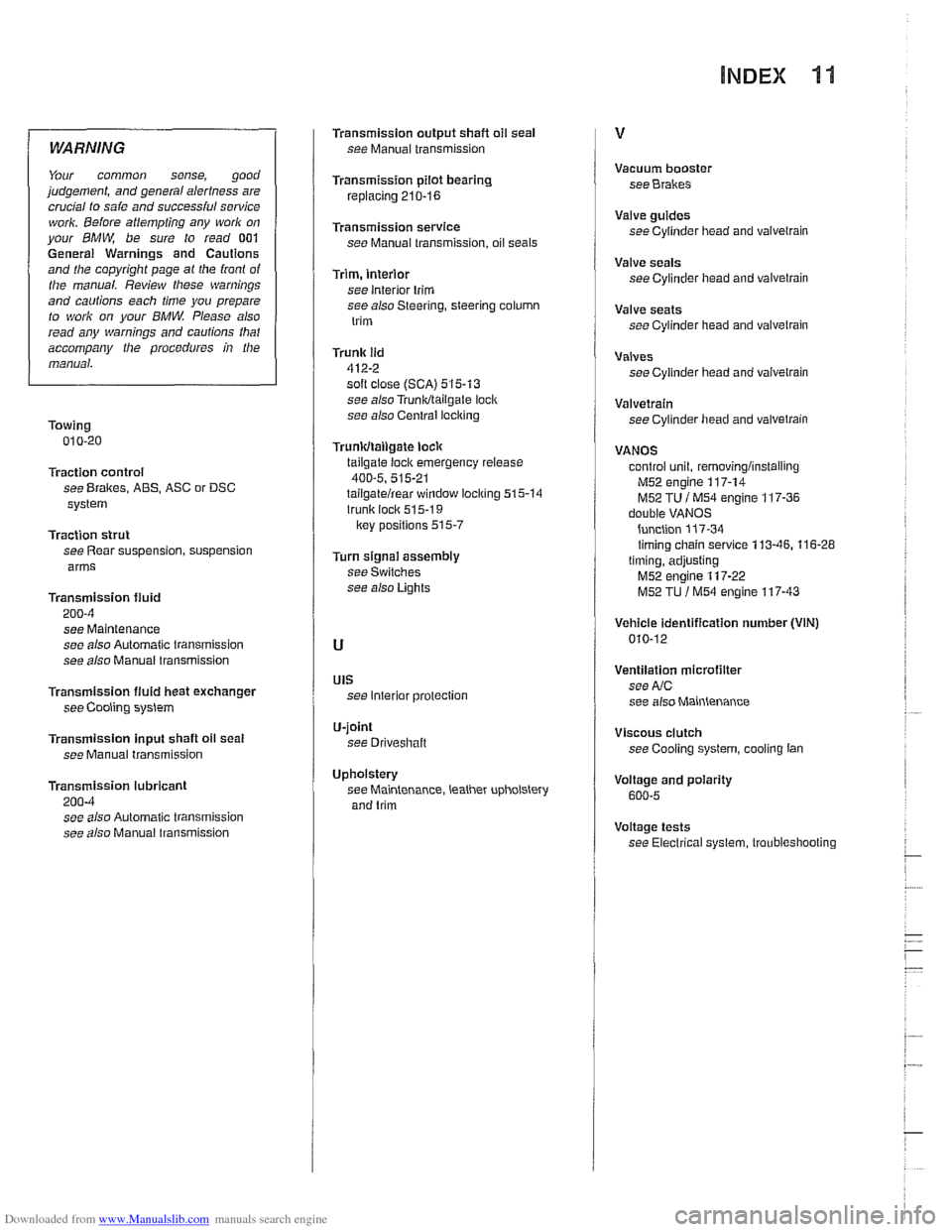
WARNING
Your common sense, good
judgement, and general alertness are
crucial to saie and
successiul sewice
work. Beiore attempting any work on
your BMW be sure to read 001
General Warnings and Cautions
and the copyright page
a1 the iront of
the manual. Review tliese warnings
and cautions each time you prepare
to work on your
BMW. Please also
read any warnings and
cautions that
accompany the procedures in the
manual.
Towing 010-20
Traction control
see Brakes, ABS, ASC or DSC
system
Traction strut
see Rear suspension, suspension
arms
Transmission fluid
200-4
see Maintenance
see also Automatic transmission
see also Manuai transmission
Transmission
fluid heat exchanger
see Cooling system
Transmission input shaft oil seat
see Manual transmission
Transmission lubricant
200-4 see also Automatic transmission
see also Manual
lransmission
Transmission output shafl oil seal
see Manual transmission
Transmission pilot bearing
replacing 210-16
Transmission service see Manual transmission, oil seals
Trim, interior
see interior trim
see also Steering, steering column
trim
Trunk lid
412-2 soft close (SCA) 515-13
see also Trunkltailgale loci(
see also Central iocl
tailgate loci( emergency release
400-5, 515-21 tailgatelrear window locl(ing 515-14
trunk lock 51 5-1 9
lrey positions 515-7
Turn signai assembly
see Switches
see also Lights
UIS see Interior protection
U-joint
see Driveshaft
Upholstery see Maintenance, leather upholstery
and trim Vacuum
booster
see Brakes
Valve guides
see Cylinder
head and valvetrain
Valve seals
see Cylinder head and valvetrain
Valve seats
see Cylinder head and valvetrain
Valves see Cylinder head and
vaivelrain
Valvetrain see Cylinder head and valvetrain
VANOS control unit,
removinglinstalling
M52 engine 117-14
M52 TU i M54 engine 117-36 double VANOS
function
117-34 timing chain service 113-46. 116-28
timing, adjusting
M52 engine 117-22
M52 TU l M54 engine 117-43
Vehicle identification number (VIN)
010-12
Ventilation microfilter
see
AIC
see also Maintenance
Viscous clutch see Cooling
system, cooling tan
Voitage and polarity
600-5
Voltage tests
see Electrical system, troubleshooting