2000 BMW 528i Trim
[x] Cancel search: TrimPage 273 of 1002

Downloaded from www.Manualslib.com manuals search engine
Camshaft Timing Chain
VANOS control unit, removing
(M52 TU and M54 engines)
This procedure includes removal of the Double VANOS con-
trol unit.
NOTE-
If the Double VANOS control unit is being replaced, camshaft
timing must be checked. This procedure requires multiple
special tools. Be sure to read the procedures through before
beginning the repair.
- Working inside luggage compartment, disconnect negative
(-) battery cable.
Prior to disconnecting the
batteg read the battery discon-
nection cautions given in
001 General Cautions and
Remove engine cooling fan assembly. See 170 Radiator
and Cooling System.
Remove engine trim covers.
Pry out plastic trim caps (arrows).
Remove cover fasteners, oil filler cap, and covers.
Remove ignition coils:
Disconnect ignition coil electrical harness connectors.
Remove coil mounting fasteners and coils.
NOTE-
Make note of ignition coil ground strap locations.
Remove spark plugs,
Page 303 of 1002
Downloaded from www.Manualslib.com manuals search engine
Camshaft Timing chain1
- Disconnect negative cable (-) from battery.
CAUTION-
Prior to disconnecting the battery, read the battery discon-
nection cautions given
in 001 General Cautions and
Warnings.
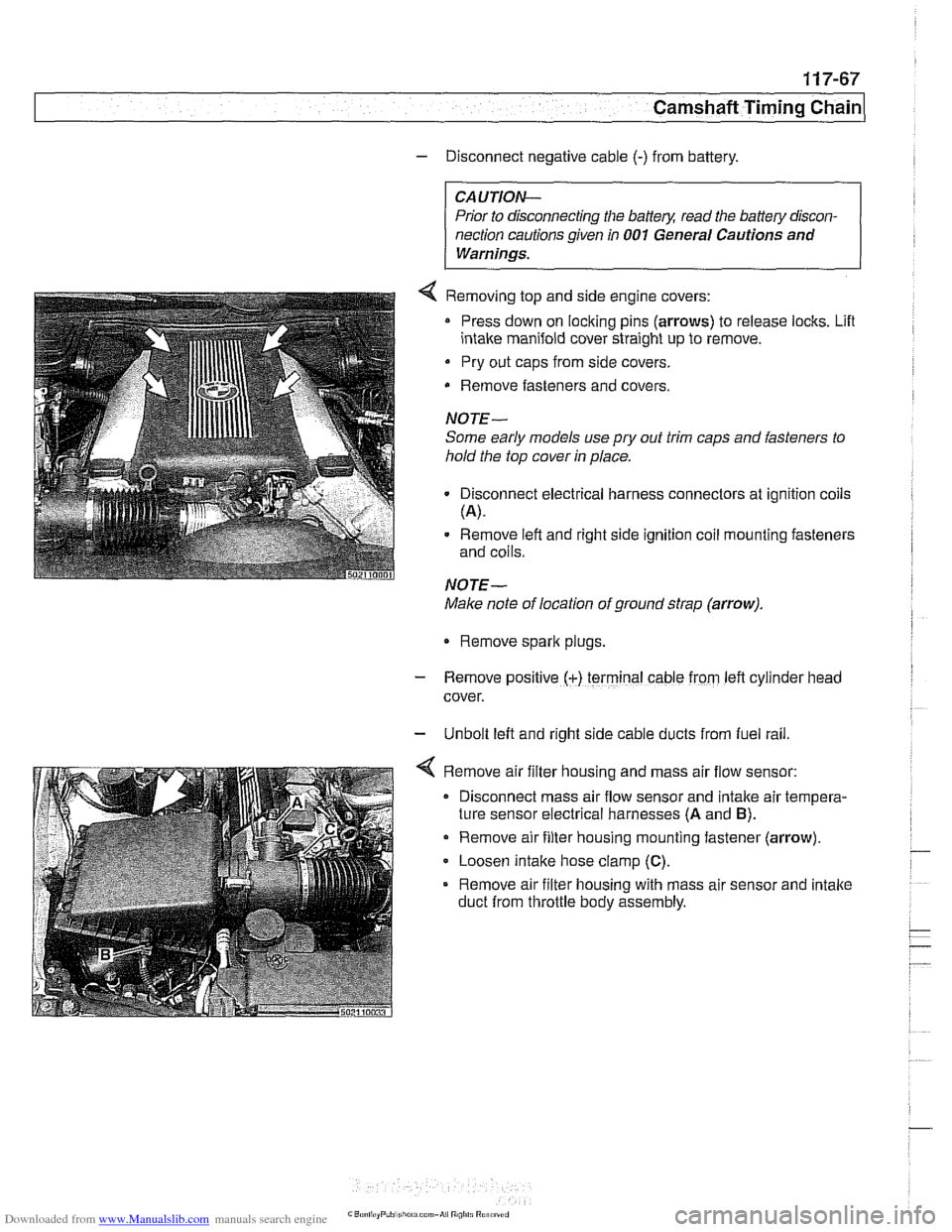
4 Removing top and side engine covers:
Press down on locking pins (arrows) to release locks. Lifl
intake manifold cover straight up to remove.
Pry out caps from side covers.
Remove fasteners
and covers.
NOTE-
Some early models use
pry out trim caps and fasteners to
hold the top cover in place.
Disconnect electrical harness connectors at ignition coils
(A).
Remove left and right side ignition coil mounting fasteners
and coils.
NOTE-
Make note of location of ground strap (arrow).
Remove spark plugs.
- Remove posltlve (+) terminal cable from left cylrnder head
cover.
- Unbolt left and right side cable ducts from fuel rail
Remove air filter housing and mass air flow sensor:
Disconnect mass air flow sensor and intake air tempera-
ture sensor electrical harnesses
(A and B).
Remove air filter housing mounting fastener (arrow)
Loosen intake hose clamp
(C).
Remove air filter housing with mass air sensor and intake
duct from throttle body assembly.
Page 371 of 1002

Downloaded from www.Manualslib.com manuals search engine
Battery, Starter, ~iternatorl
The battery is mounted in the right side of the luggage com-
partment, concealed behind a trim panel. Battery capacity is
determined by the amount of current needed to start the vehi-
cle and by the amount of current consumed by the electrical
system. This will vary from model to model.
BMW batteries are rated by
amperelhours (Ah) and cold
cranking amps (CCA) rating, which are listed on the battery.
The Ah rating is determined by the average amount of cur-
rent the battery can deliver over time without dropping below
a specified voltage. The CCA is determined by the battery's
ability to deliver starting current at
On F (-18" C) without drop-
ping below a specified voltage. Always replace the battery
with one having the same or higher ratings.
Battery testing
Battery testing determines the state of battery charge. On
conventional or low-maintenance batteries. the most com-
mon method of testing the battery is that
ofchecking the spe-
cific gravity of the electrolyte using a hydrometer. Before
testing the battery, check that the cables are tight and free of
- corrosion.
Hydrometer testing
Before hydrometertesting, load the battery with 15 amperes
for one minute. If the battery is installed in the vehicle, this can
be done by turning on the headlights without the engine run-
ning. The state of battery charge based on specific gravity
values are given in Table
b. Specific gravity of battery elec-
trolyte at
27" C (80°F).
The hydrometer indicates the specific gravity of the electro-
lyte. The more dense the concentration of sulfuric acid in the
electrolyte, the higher the state of charge
NOTE-
Electrolyte temperature affects hydrometer reading. Checlc
the electrolyte temperature with a thermometer. Add 0.004 to
the hydrometerreading
forevery 6°C (10°F) that the electro-
lyte is above 27°C
(80°F). Subtract 0.004 from the reading
forevery 6°C (10°F) that the electrolyte is below27"C
(80°F).
Page 373 of 1002

Downloaded from www.Manualslib.com manuals search engine
Battery, Starter, ~lternatorl
WARNING-
Always wear protective goggles and clothing when perform-
ing a load test.
Table
d. Battery load test - minimum voltage
Ambient temperature Voltage*
27
" C (80" F) 9.6 V
-I 8' C (0"
F) 8.5 V
* Measure
after applying a 200 amp load for 15 seconds.
Closed-circuit current measurement
If the vehicle battery is discharged for an unknown reason,
perform a closed-circuit current measurement as the first test.
For diagnostic purposes, it is important to not disconnect the
battery. Disconnecting the battery may reset a faulty control
unit, preventing proper diagnosis.
The following test is generally completed overnight using a
multimeterwith a closed circuitcurrent measurement adaptor
with a recording function
- Check that battery voltage is 12 volts or higher. If lower,
recharge battery.
- Switch off electrical consumers (interior lights, telephone,
aftermarket equipment, or others).
- Open luggage compartment and remove battery trim panel.
Use screwdriver to lock latch on trunk lid or hatch, simulating
closed luggage compartment. Close other doors.
- Open driver's door, then close it, simulating driver entering
vehicle.
- Switch ignition to RUN position for at least five seconds, then
turn ignition to OFF position. This simulates driving vehicle.
- Open and close driver's door, simulating driver leaving
vehicle.
- Lock car and arm alarm.
- Wait at least 16 minutes for consumer cut-off.
Page 375 of 1002

Downloaded from www.Manualslib.com manuals search engine
121-9
Battery, Starter, ~lternatorl
Battery charging
Discharged batteries can be recharged using a batterycharg-
er. Remove the battery from the trunk during charging.
Prolonged charging causes electrolyte evaporation to a level
that can damage the battery. It is best to use a low-current
charger
(6 amperes or less) to prevent battery damage
caused by overheating.
WARNING -
Hydrogen gas given off by the battery during charging is ex-
plosive. Do not smoke.
Keep open flames away from the top
ofthe batte~ and prevent electrical sparks by turning off the
battery charger before connecting or disconnecting it.
Battery electrolyte (sulfuric acid) can damage the car. If
electrolyte is spilled, clean the area with a solution
ofbak-
ing soda and water.
Always allow a frozen battery to thaw before attempting
to recharge it.
Always disconnect both battery cables and remove bat-
tery from vehicle during battery charging. Do not ex-
ceed
16.5 charging voltage at the battery
Battery safety terminal, replacing
If the battery safety terminal has been triggered, investigate
and correct the cause prior to replacement.
- Working in right side of luggage compartment, remove bat-
tery trim panel.
- Disconnect negative (-) battery terminal and cover with
insulator.
- Disconnect positive (+) cable from battery.
- Release positive (+) cable from cable brackets on luggage
compartment wall. Lay new repair cable parallel to positive
cable.
- Mark off length of new cable on old cable. Allow 10 cm
(2.5 in) of slack.
- Saw through old cable.
Do not use bolt cutters or similar tools to cut through cable.
A cable end that has been squashed
flat will not fit into the
Page 376 of 1002

Downloaded from www.Manualslib.com manuals search engine
121-10
I Battery, Starter, Alternator
- Strip approximately 15 rnm (0.6 in) of insulation from cable
end.
terminal harness
Shrink insulation
Terminal connector
4 Push terminal connector of new cable over stripped end of
old cable. Tighten clamp.
- Slip shrink-fit insulation over positive cable. Attach new safe-
ty harness to end of positive cable. Shrink insulation with hot
air blower.
- Reinstall cable in cable bracket and attach to battery.
- Reattach negative battery cable. Reinstall luggage cornpart-
rnent trim pieces.
- Use BMW scan tool DlSplus or equivalent to read out airbag
control module fault memory. Correct faults, then clear mem-
ory.
1 1 4 Various versions of alternators have been used in E39
vehicles. See Table e.
Table e. Alternator application chart
Model Alternator type
Air cooled, 90 amp or 120 amp
Air cooled, with multi-function control
(MFR), 120 amp or 140 amp
Air cooled with multi-function control
(MFR), 120 amp or 140 amp
540i 1997 Air
cooled. 120
amp or 140amp sazrz~orsl 1998 ~~~ ~ .~ . ...~ ~ ~-~~~~ Air cooled; with integrated mu~ii-
function control (MFR). 120 amp 140
amp 1999-2002 Water
cooled, with integrated multi-
function control (MFR), 90-150 amp
(variable output)
Page 382 of 1002

Downloaded from www.Manualslib.com manuals search engine
121-16
Battery, Starter, Alternator
- installation is reverse of removal.
Tightening torques Belt tensloner to engine block
M8 (8.8 grade) 22
Nm (16 ft-ib)
Fan clutch to coolant pump
with BMW special tool 11
5 040 30 Nm (22
ft-lb)
without BMW special tool
11 5 040 40 Nm
(29 ft-ib)
Pulley to alternator 70
Nm (44 ft-lb)
Terminal 30
(B+) wire to alternator (M8) 13 Nm (10 ft-ib)
Alternator, removing and installing
(M62 engine, air cooled)
A replacement alternator should have the same rating as the
original. Alternator manufacturer and ampere rating are nor-
mally
marked on the alternator housing.
- Disconnect negative (-) battery cable.
CAUTION-
Prior to disconnecting the battery, read the battery discon-
nection cautions
001 General Warnings and Cautions.
- Remove cooling fan and alternator drive belt. See 020 Main-
tenance.
- Pry out trim caps and remove fasteners from plastic cover on
left head. Lift off cover.
Disconnect positive
(+) lead from jump start post (arrow).
Raise car and support in a safe manner.
WARNING-
Make sure the car is stable and well supported at aN times.
Use a professional automotive lift
orjack stands designed for
the purpose.
A floorjack is not adequate support.
Page 405 of 1002

Downloaded from www.Manualslib.com manuals search engine
Fuel injectors, checking and replacing
The fuel injectors are electronically controlled solenoid valves
that provide precisely metered and atomized fuel into the en-
gine intake ports.
The injectors receive voltage from the ECM relay. The ECM
controls the opening by activating the ground circuit
forthe in-
jector valve solenoids. The ECM varies the duration (in milli-
seconds) of "opening" time to regulate the
airlfuel ratio.
For a quick
check of the injectors, run the engine and touch
each injector with a screwdriver or stethoscope. You should
feel a vibration or hear a buzzing
Remove fuel injection harness from injectors by unclipping
locking clip at each injector. Lift harness off injectors.
CA U JIOG
Be sure ignition is OFF before disconnecting or reconnecting
DME system components.
Use a multimeter to test injector coil resistance between in-
jector terminals.
l~uel injector coil resistance 16R at 20" C (68" F)
Disconnect negative
(-) battery cable
CAUTIOG
Prior to disconnecting the battery, read the battery discon-
nection cautionsgiven
in 001 General Warnings and Cau-
tions.
4 Remove plastic trim plugs (arrows) and fasteners, then re.
move cover from above fuel injectors.
- Disconnect vacuum line from fuel pressure regulator.
- Remove wiring harness duct mounting fasteners.