2000 BMW 323Ci fuel
[x] Cancel search: fuelPage 81 of 189
79n
RepairsIndexOverview Controls Car care Technology Data
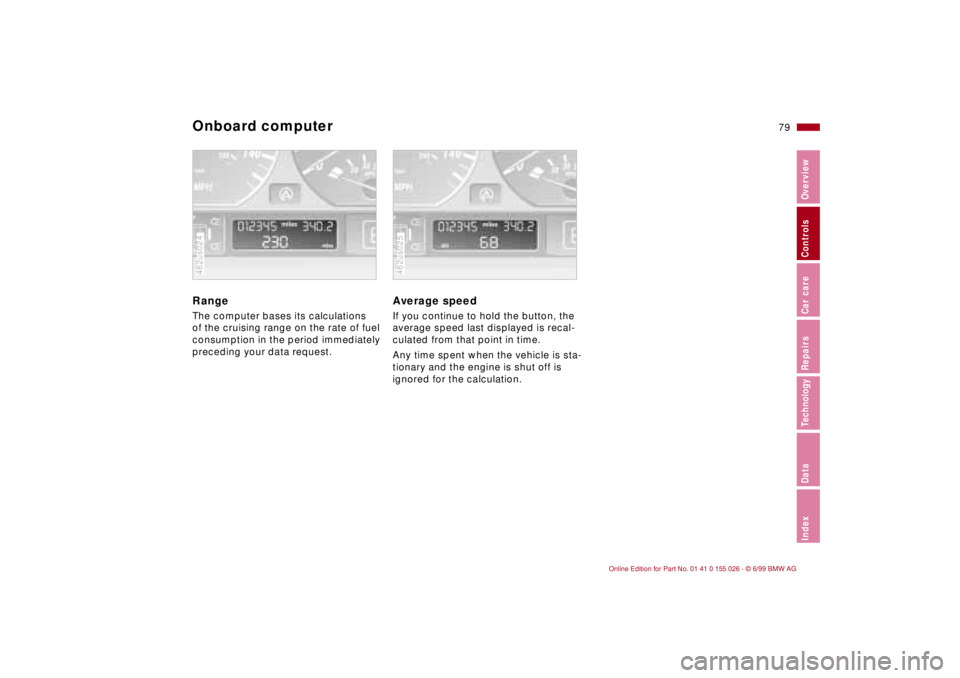
Onboard computer Range The computer bases its calculations
of the cruising range on the rate of fuel
consumption in the period immediately
preceding your data request.462us024
Average speed If you continue to hold the button, the
average speed last displayed is recal-
culated from that point in time.
Any time spent when the vehicle is sta-
tionary and the engine is shut off is
ignored for the calculation.462us025
Page 103 of 189
101n
RepairsIndexOverview Controls Car care Technology Data
Cargo loading Roof-mounted luggage rack
*
Always position and secure the
load correctly, otherwise it can en-
danger the passengers in the event of
braking or swerving.
Do not exceed the permissible gross
weight and axle load (refer to page 172),
otherwise the vehicle's operating safety
is no longer assured and you are in vio-
lation of the law.
Do not stow heavy or hard objects in the
passenger compartment without first
securing them. Otherwise they would
be thrown around during braking and
evasive maneuvers and endanger the
occupants.<
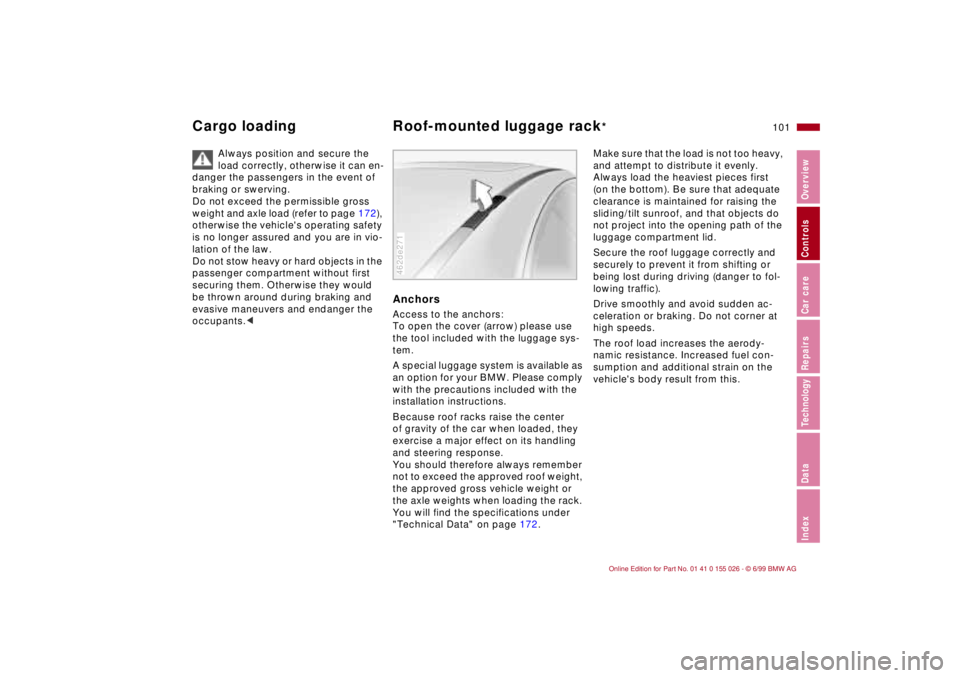
AnchorsAccess to the anchors:
To open the cover (arrow) please use
the tool included with the luggage sys-
tem.
A special luggage system is available as
an option for your BMW. Please comply
with the precautions included with the
installation instructions.
Because roof racks raise the center
of gravity of the car when loaded, they
exercise a major effect on its handling
and steering response.
You should therefore always remember
not to exceed the approved roof weight,
the approved gross vehicle weight or
the axle weights when loading the rack.
You will find the specifications under
"Technical Data" on page 172.462de271
Make sure that the load is not too heavy,
and attempt to distribute it evenly.
Always load the heaviest pieces first
(on the bottom). Be sure that adequate
clearance is maintained for raising the
sliding/tilt sunroof, and that objects do
not project into the opening path of the
luggage compartment lid.
Secure the roof luggage correctly and
securely to prevent it from shifting or
being lost during driving (danger to fol-
lowing traffic).
Drive smoothly and avoid sudden ac-
celeration or braking. Do not corner at
high speeds.
The roof load increases the aerody-
namic resistance. Increased fuel con-
sumption and additional strain on the
vehicle's body result from this.
Page 107 of 189

105n
RepairsIndexOverview Controls Car care Technology Data
Clothes hooks:
When suspending clothing from the
hooks, ensure that they will not obstruct
the driver's vision. In order to avoid per-
sonal injuries during braking maneu-
vers, do not hang heavy objects on the
hooks.
use with unleaded fuel only.
Even minute quantities of lead would be
enough to permanently damage both
the catalytic converter and the system
oxygen sensor.
To ensure efficient, trouble-free engine
operation and avoid potential damage:
>Be sure to comply with the scheduled
maintenance requirements
>Do not drive until the fuel tank is
empty
>Tow-start only when the engine is
cold, otherwise unburned, residual
fuel in the catalytic converter could
ignite and cause damage. It is better
to start the vehicle with an outside
starting aid
>Avoid other situations in which the
fuel is not burned, or burns incom-
pletely, such as engaging the starter
frequently or for extended periods, or
repeated start attempts in which the
engine does not start (stopping and
restarting an engine that is running
properly does not present a problem).
Never let the engine run with any of
the spark plug cables disconnected.Be sure to comply with the in-
structions above to prevent un-
burned fuel from reaching the catalytic
converter. Otherwise, the catalytic con-
verter could respond by overheating,
leading to serious damage.
Extreme temperatures occur at the cat-
alytic converter. Heat shields are in-
stalled adjacent to some sections of the
exhaust system. Never remove these
shields; do not apply undercoating to
their surfaces. When driving, standing
at idle, and parking the vehicle, take
care to avoid contact between the ex-
haust system and flammable materials
(grass, hay, leaves, etc.). Such contact
could lead to a fire, resulting in serious
injury and property damage.
Page 118 of 189

116n
Winter tiresChoosing the right tireBMW recommends winter tires (M+S
radial tires) for driving in adverse winter
road conditions. Although all-season
M+S tires provide better winter traction
than standard summer tires with H, V,
W, Y and ZR speed ratings, they gener-
ally fail to provide the same levels of
performance as standard snow tires in
winter driving.
For of safe tracking and steering re-
sponse, install winter tires made by the
same manufacturer having the same
tread configuration on all four wheels.
Mount only winter tires approved by
BMW. Any BMW center will be glad to
provide you with information on the
best winter tires for your particular driv-
ing conditions.Never exceed the maximum speed
for that the tires are rated.
Unprofessional attempts by laymen to
service tires can lead to damage and
accidents.
Have this work performed by skilled
professionals only. Your BMW center
will be glad to assist you with both their
expertise and the proper equipment for
your vehicle.<
Tire condition, tire pressureWinter tires display a perceptible loss in
their ability to cope with winter driving
conditions once the tread wears to be-
low 0.16 in (4 mm), and should thus be
replaced.
Comply with the specified tire inflation
pressures – and be sure to have the
wheel and tire assemblies balanced
every time you change the tires.
StorageStore tires in a cool, dry place, away
from light whenever possible. Protect
the tires against contact with oil, grease
and fuel.Snow chains
*
Use narrow-link BMW snow chains on
summer or winter tires only in pairs and
only on the rear wheels. Comply with all
manufacturer's safety precautions when
mounting the chains.
Page 125 of 189
123n
RepairsIndexOverview Controls Car care Technology Data
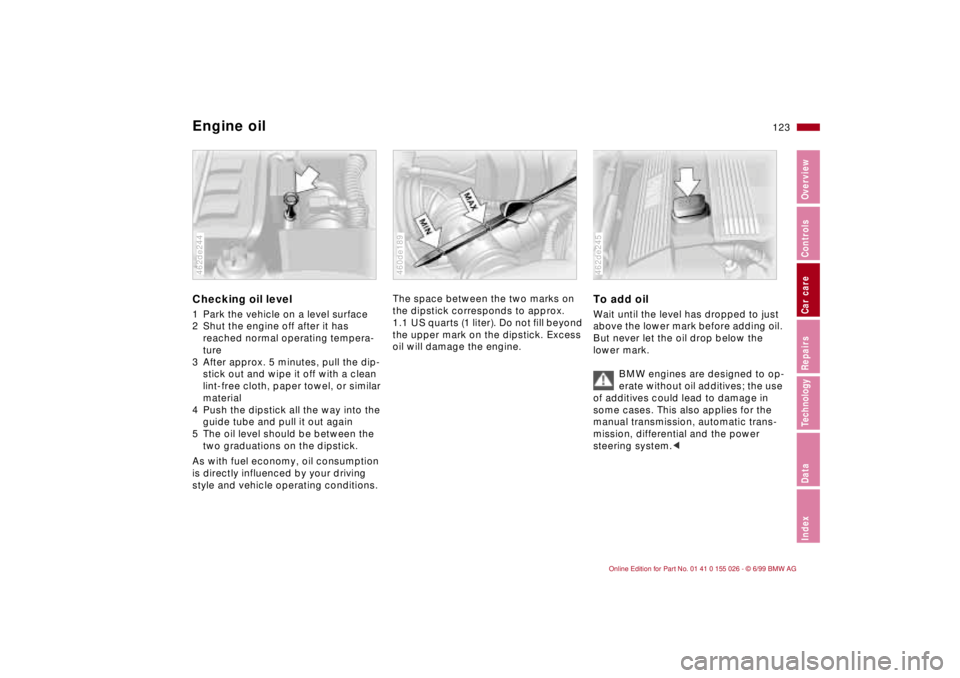
Engine oilChecking oil level 1 Park the vehicle on a level surface
2 Shut the engine off after it has
reached normal operating tempera-
ture
3 After approx. 5 minutes, pull the dip-
stick out and wipe it off with a clean
lint-free cloth, paper towel, or similar
material
4 Push the dipstick all the way into the
guide tube and pull it out again
5 The oil level should be between the
two graduations on the dipstick.
As with fuel economy, oil consumption
is directly influenced by your driving
style and vehicle operating conditions.462de244
The space between the two marks on
the dipstick corresponds to approx.
1.1 US quarts (1 liter). Do not fill beyond
the upper mark on the dipstick. Excess
oil will damage the engine.460de189
To add oil Wait until the level has dropped to just
above the lower mark before adding oil.
But never let the oil drop below the
lower mark.
BMW engines are designed to op-
erate without oil additives; the use
of additives could lead to damage in
some cases. This also applies for the
manual transmission, automatic trans-
mission, differential and the power
steering system.<462de245
Page 133 of 189

131n
RepairsIndexOverview Controls Car care Technology Data
Caring for your carExterior finish To provide effective corrosion protec-
tion, multilayer paintwork is applied at
the factory. Cataphoretic immersion
priming techniques are supplemented
using special body-cavity protectants,
with the application of specially-devel-
oped and extensively tested materials.
A layer of flexible PVC is first applied to
the undercarriage. Following this, a
comprehensive undercoating treatment
with a wax-based protectant is applied.
Regular maintenance makes an impor-
tant contribution to maintaining the
safety and resale value of your vehicle.
Increasing awareness of the effects of
harmful environmental factors on vehi-
cle finishes have led paint and vehicle
manufacturers to initiate ongoing pro-
grams designed to further improve the
durability of their finishes. Despite this,
environmental factors that occur locally
or regionally can have negative effects
on the finish of your vehicle. These
should guide you in determining the fre-
quency and extent of your efforts to
maintain the vehicle finish.
Depending upon material and type
of impact (perforation of paint layer),
physical stresses from sand, road salt,
gravel, etc., can cause corrosion to
start extending beneath the finish, start-
ing at the point of impact.Road dirt, tar spots, dead insects, ani-
mal droppings (strong alkali concentra-
tion) and tree excretions (resins and
pollen) all contain substances capable
of causing damage when allowed to re-
main on the finish of your car for any
period of time (spots, etching, flaking,
separation in the top coat).
In industrial areas, deposits of flue dust,
lime, oily soot, precipitation containing
sulfur-dioxide (acid rain) and other envi-
ronmental pollutants will damage the
car's finish unless adequate care is pro-
vided – even though this generally lim-
ited to the outside horizontal surfaces.
In coastal regions, high levels of atmo-
spheric salt and humidity promote cor-
rosion.
In tropical zones temperatures of over
1007 (406) in the shade prevail, in
addition to heavy ultraviolet radiation
and high humidity. Under those circum-
stances light colored paints reach tem-
peratures of up to 1807 (806) and
dark paints up to 2507 (1206).
Caring for the vehicle finish Regular washing is a preventive mea-
sure against long-term effects from
substances that are harmful to the vehi-
cle's finish, especially if you drive your
vehicle in areas with high levels of air
pollution or aggressive natural sub-
stances (tree resins, pollen).
Nevertheless, you should immediately
remove especially aggressive sub-
stances. Failure to do so can lead to
changes in the paint's chemical struc-
ture or to discoloration. Gasoline spilled
during refueling, oil, grease and brake
fluid should always be cleaned away
immediately, as should bird droppings.
All of these substances cause damage
to the finish.
Any contamination remaining on the
surface of the vehicle will be especially
conspicuous after washing. Use clean-
ing fluid or alcohol with a clean cloth or
cotton pad to remove. Remove tar
spots with tar remover. After cleaning,
the affected areas should be waxed to
ensure continued protection.
A full range of car-care products is
available from your BMW center.<
Page 135 of 189

133n
RepairsIndexOverview Controls Car care Technology Data
Caring for your carPlastic components, vinyl upholstery,
headliners, lamp lenses, the clear cover
of the instrument panel and compo-
nents with a sprayed dull black surface
can be cleaned with water (add plastic
shampoo as required). Do not allow
moisture to soak through the seats or
headliner. Never use solvents such as
lacquer thinner, heavy-duty grease re-
mover, fuels, etc.
Rubber components should be cleaned
with water only; a rubber treatment or
silicone spray may also be applied.
Clean the wiper blades with soapy wa-
ter. The wiper blades should be re-
placed twice a year, before and after
the cold season. This especially impor-
tant for vehicles with a rain sensor.
Use only wiper blades approved
by BMW.<
The safety belts should be cleaned with
a mild soap and water solution without
removing them from the car. Never at-
tempt chemical or dry cleaning, as
damage to the belt fabric could result.
After cleaning, never allow the inertia
reel to retract the belts until they are
completely dry. Dirty safety belts pre-
vent the inertia reel mechanism from
retracting the strap properly, and thus
constitute a safety hazard.
Heavily soiled floor carpets and mats
*
can be cleaned with an interior cleaner.
The floor mats can be removed from the
vehicle for cleaning.
Please use only a damp cloth to clean
wooden fascia panels and components.
Follow up by drying with a soft cloth.
A full range of car-care products is
available from your BMW center.<
Care of upholstery materials Depressions in the upholstered materi-
als resulting from everyday use can be
brushed up by brushing "against the
nap" with a lightly dampened brush.
The tendency of the pile to lie in a par-
ticular direction on velour upholstery is
not a quality defect, and, just as on
home textiles or clothing, cannot be
avoided.
Lint on upholstery materials, textile or
leather remnants that have been worn
into the upholstery may be removed
with a lint brush or a Velcro
â brush. A
cleaning glove is available for particu-
larly "stubborn" lint. Stains and fairly
large areas of dirt should be cleaned off
without delay, using lukewarm water
and an interior cleaner, stain remover or
cleaning-grade benzene. Brush the fab-
ric afterwards to restore its appearance.
If the vehicle will be stored for an ex-
tended period, or if it is exposed to in-
tense sunlight, cover all seats or the
windows to prevent fading.
A full range of car-care products is
available from your BMW center.<
Page 139 of 189
137n
RepairsIndexOverview Controls Car care Technology Data
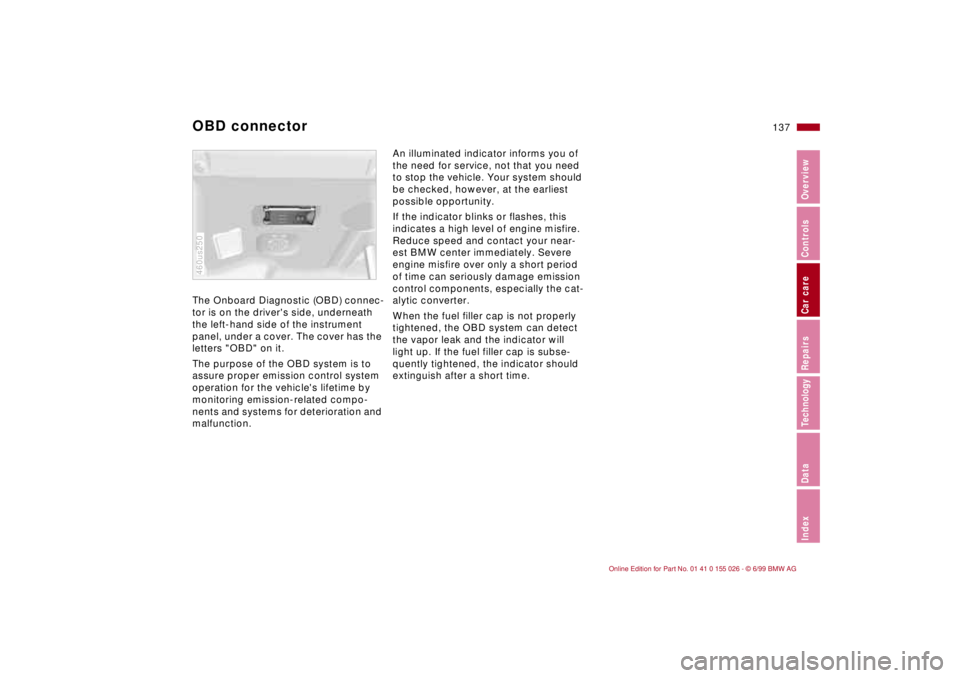
OBD connector The Onboard Diagnostic (OBD) connec-
tor is on the driver's side, underneath
the left-hand side of the instrument
panel, under a cover. The cover has the
letters "OBD" on it.
The purpose of the OBD system is to
assure proper emission control system
operation for the vehicle's lifetime by
monitoring emission-related compo-
nents and systems for deterioration and
malfunction.460us250
An illuminated indicator informs you of
the need for service, not that you need
to stop the vehicle. Your system should
be checked, however, at the earliest
possible opportunity.
If the indicator blinks or flashes, this
indicates a high level of engine misfire.
Reduce speed and contact your near-
est BMW center immediately. Severe
engine misfire over only a short period
of time can seriously damage emission
control components, especially the cat-
alytic converter.
When the fuel filler cap is not properly
tightened, the OBD system can detect
the vapor leak and the indicator will
light up. If the fuel filler cap is subse-
quently tightened, the indicator should
extinguish after a short time.