Page 151 of 189
149n
RepairsIndexOverview Controls Car care Technology Data
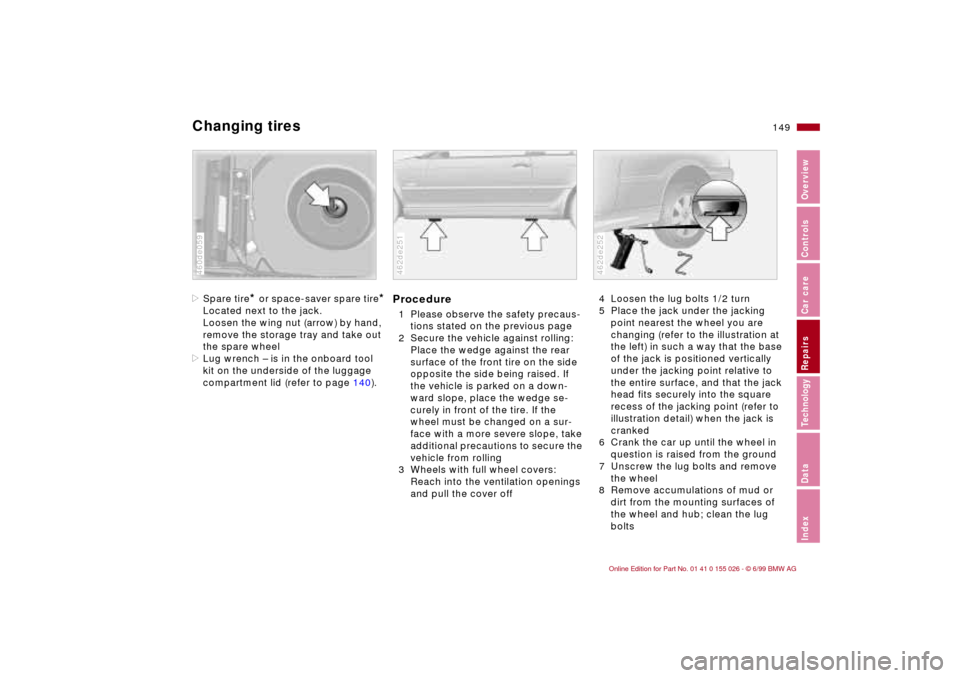
Changing tires>Spare tire
* or space-saver spare tire
*
Located next to the jack.
Loosen the wing nut (arrow) by hand,
remove the storage tray and take out
the spare wheel
>Lug wrench – is in the onboard tool
kit on the underside of the luggage
compartment lid (refer to page 140).460de059
Procedure1 Please observe the safety precaus-
tions stated on the previous page
2 Secure the vehicle against rolling:
Place the wedge against the rear
surface of the front tire on the side
opposite the side being raised. If
the vehicle is parked on a down-
ward slope, place the wedge se-
curely in front of the tire. If the
wheel must be changed on a sur-
face with a more severe slope, take
additional precautions to secure the
vehicle from rolling
3 Wheels with full wheel covers:
Reach into the ventilation openings
and pull the cover off462de251
4 Loosen the lug bolts 1/2 turn
5 Place the jack under the jacking
point nearest the wheel you are
changing (refer to the illustration at
the left) in such a way that the base
of the jack is positioned vertically
under the jacking point relative to
the entire surface, and that the jack
head fits securely into the square
recess of the jacking point (refer to
illustration detail) when the jack is
cranked
6 Crank the car up until the wheel in
question is raised from the ground
7 Unscrew the lug bolts and remove
the wheel
8 Remove accumulations of mud or
dirt from the mounting surfaces of
the wheel and hub; clean the lug
bolts462de252
Page 152 of 189
150n
Changing tires9 Position the new wheel or the
space-saver spare tire
* on the hub
and screw at least two lug bolts
finger-tight into opposite bolt holes
10 Screw in the remaining lug bolts.
Tighten all the bolts securely
11 Lower the jack and remove it from
beneath the car
12 Tighten the lug bolts, alternating
between bolts positioned opposite
one another
462de266
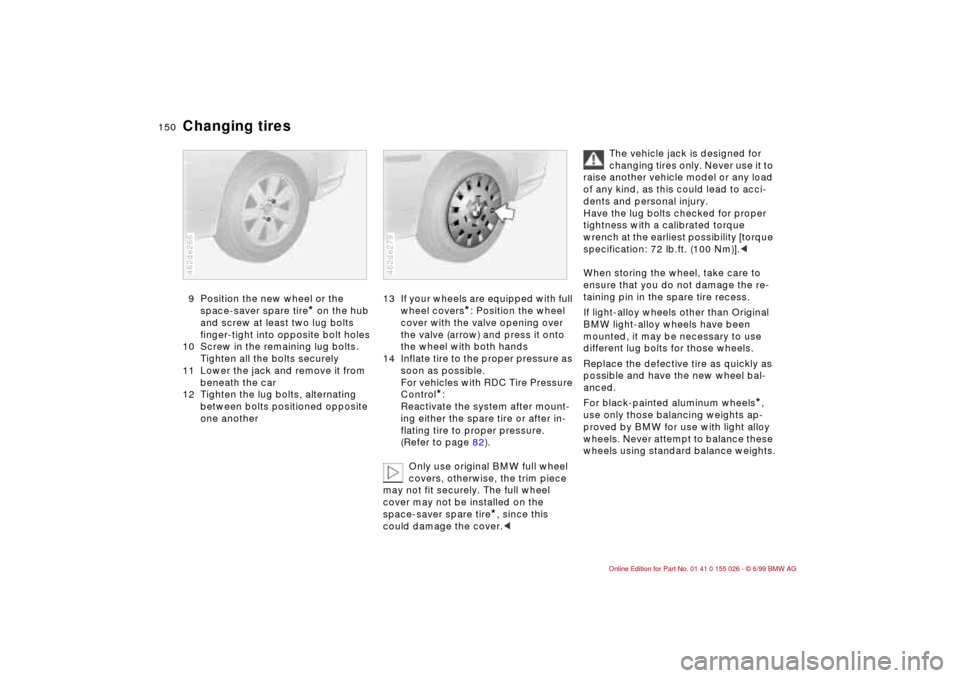
13 If your wheels are equipped with full
wheel covers
*: Position the wheel
cover with the valve opening over
the valve (arrow) and press it onto
the wheel with both hands
14 Inflate tire to the proper pressure as
soon as possible.
For vehicles with RDC Tire Pressure
Control
*:
Reactivate the system after mount-
ing either the spare tire or after in-
flating tire to proper pressure.
(Refer to page 82).
Only use original BMW full wheel
covers, otherwise, the trim piece
may not fit securely. The full wheel
cover may not be installed on the
space-saver spare tire
*, since this
could damage the cover.<
462de279
The vehicle jack is designed for
changing tires only. Never use it to
raise another vehicle model or any load
of any kind, as this could lead to acci-
dents and personal injury.
Have the lug bolts checked for proper
tightness with a calibrated torque
wrench at the earliest possibility [torque
specification: 72 lb.ft. (100 Nm)].<
When storing the wheel, take care to
ensure that you do not damage the re-
taining pin in the spare tire recess.
If light-alloy wheels other than Original
BMW light-alloy wheels have been
mounted, it may be necessary to use
different lug bolts for those wheels.
Replace the defective tire as quickly as
possible and have the new wheel bal-
anced.
For black-painted aluminum wheels
*,
use only those balancing weights ap-
proved by BMW for use with light alloy
wheels. Never attempt to balance these
wheels using standard balance weights.
Page 153 of 189
151n
RepairsIndexOverview Controls Car care Technology Data
Changing tires Battery Driving with the space-saver
spare tire
*
Drive cautiously and do not exceed a
speed of 45 mph (80 km/h).
Be aware that vehicle handling will be
altered. Slower brake response time,
longer braking distances and changed
steering characteristics may be antici-
pated when approaching limit condi-
tions.
The changes in handling characteristics
will be even more pronounced in con-
junction with winter tires.
Only one space-saver spare tire
may be mounted. Mount a wheel
and tire with the same size and specifi-
cations as the others at the earliest
possible opportunity. Maintain correct
tire pressures. Refer to page 28.<
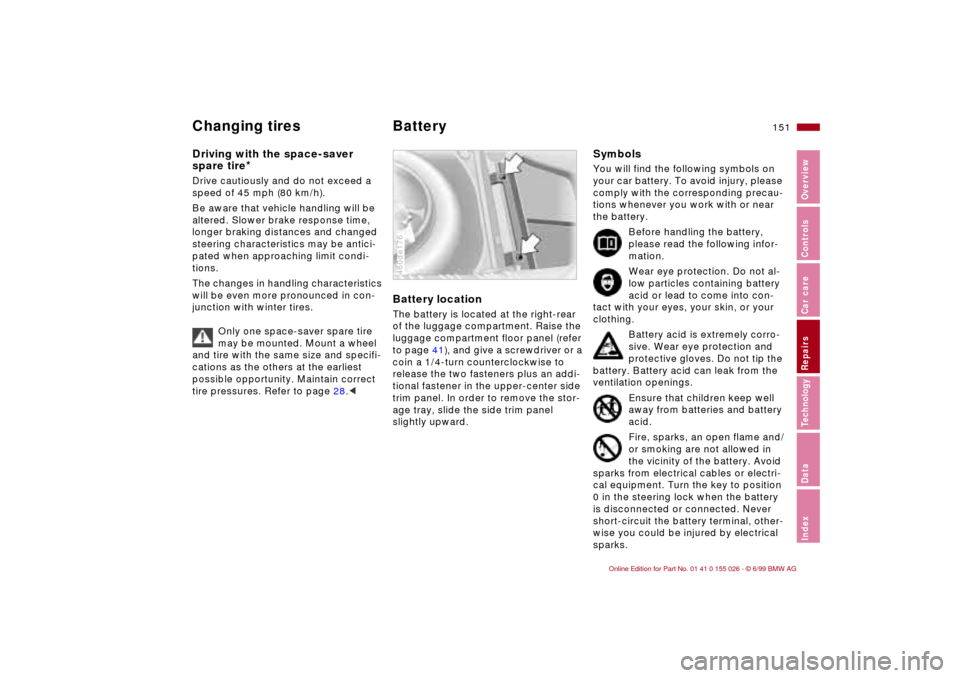
Battery location The battery is located at the right-rear
of the luggage compartment. Raise the
luggage compartment floor panel (refer
to page 41), and give a screwdriver or a
coin a 1/4-turn counterclockwise to
release the two fasteners plus an addi-
tional fastener in the upper-center side
trim panel. In order to remove the stor-
age tray, slide the side trim panel
slightly upward.460de176
SymbolsYou will find the following symbols on
your car battery. To avoid injury, please
comply with the corresponding precau-
tions whenever you work with or near
the battery.
Before handling the battery,
please read the following infor-
mation.
Wear eye protection. Do not al-
low particles containing battery
acid or lead to come into con-
tact with your eyes, your skin, or your
clothing.
Battery acid is extremely corro-
sive. Wear eye protection and
protective gloves. Do not tip the
battery. Battery acid can leak from the
ventilation openings.
Ensure that children keep well
away from batteries and battery
acid.
Fire, sparks, an open flame and/
or smoking are not allowed in
the vicinity of the battery. Avoid
sparks from electrical cables or electri-
cal equipment. Turn the key to position
0 in the steering lock when the battery
is disconnected or connected. Never
short-circuit the battery terminal, other-
wise you could be injured by electrical
sparks.
Page 155 of 189
153n
RepairsIndexOverview Controls Car care Technology Data
Battery FusesCharging the battery Charge the battery in the vehicle only
when the engine is not running.
Before doing any work on the
electrical system, be sure to
unclamp the cable from the battery's
negative terminal, or it could cause
short-circuiting, a fire or personal
injury.<
If the vehicle is to be parked longer than
4 weeks, disconnect the battery from
the vehicle's electrical system by dis-
connecting the negative terminal cable.
If you intend to store your car for longer
than six weeks: Remove the battery,
charge it and store it in a cool (but frost-
free) room. Recharge the battery every
6 months at the latest, at the very least
before each installation, or else it will be
unusable. Every time the battery is dis-
charged, especially over extended peri-
ods, its service life is reduced.
Return used batteries to a recy-
cling point or your authorized
BMW center. Maintain the battery in an
upright position for transport and stor-
age. Secure the battery against tilting in
transit.<
Storage periods during which the
battery is disconnected are not
taken into consideration by the Service
Interval Display for changing the brake
fluid.
Therefore, make sure that the brake
fluid is changed every two years at the
latest, regardless of the display. Com-
ply with the information provided on
page 127.<
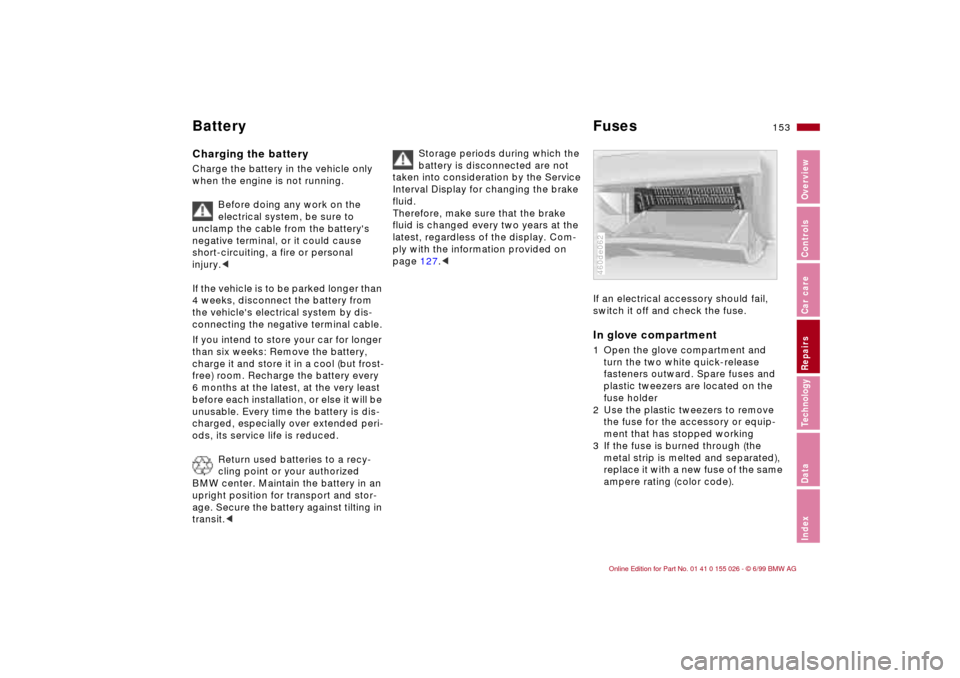
If an electrical accessory should fail,
switch it off and check the fuse. In glove compartment1 Open the glove compartment and
turn the two white quick-release
fasteners outward. Spare fuses and
plastic tweezers are located on the
fuse holder
2 Use the plastic tweezers to remove
the fuse for the accessory or equip-
ment that has stopped working
3 If the fuse is burned through (the
metal strip is melted and separated),
replace it with a new fuse of the same
ampere rating (color code).460de062
Page 157 of 189
155n
RepairsIndexOverview Controls Car care Technology Data
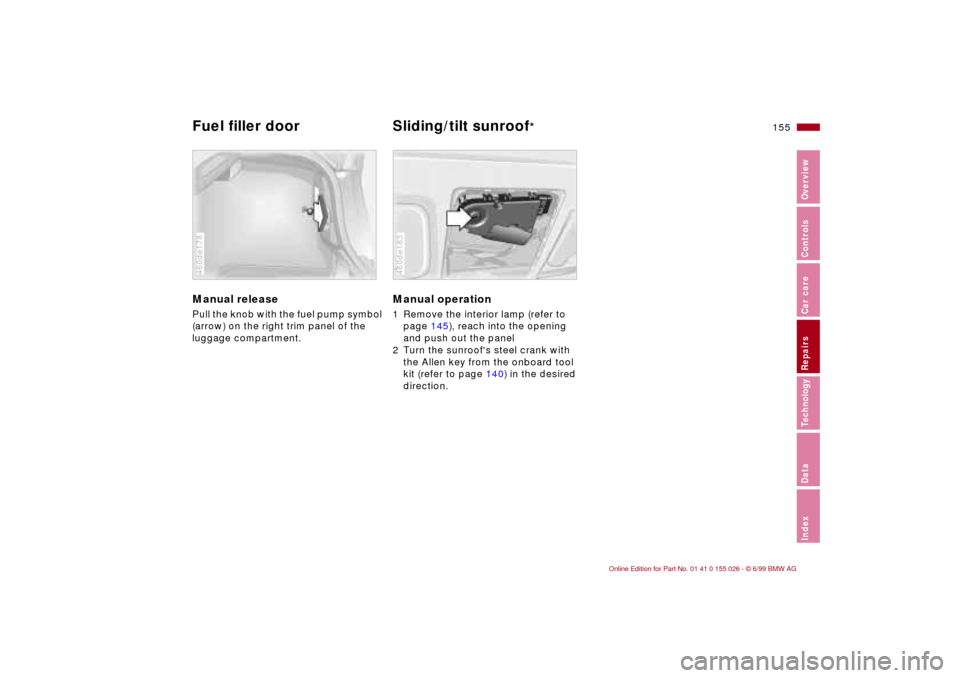
Manual release Pull the knob with the fuel pump symbol
(arrow) on the right trim panel of the
luggage compartment. 460de178
Manual operation 1 Remove the interior lamp (refer to
page 145), reach into the opening
and push out the panel
2 Turn the sunroof's steel crank with
the Allen key from the onboard tool
kit (refer to page 140) in the desired
direction.460de183
Fuel filler door Sliding/tilt sunroof
*
Page 175 of 189
173n
RepairsIndexOverview Controls Car care Technology Data
Capacities
Notes
Fuel tank
reserve gal. (liters)
gal. (liters)approx. 16.6 (approx. 63)
approx. 2.1 (approx. 8)Fuel specification: Page 26
Windshield washer system/
Headlamp washer system
*
quarts (liters) approx. 5.6 (approx. 5.3) For details: Page 122
Cooling system including heater circuit quarts (liters) approx. 8.9 (approx. 8.4) For details: Page 126
Engine oil and filter change quarts (liters) approx. 6.9 (approx. 6.5) BMW High Performance
Synthetic Oil
Specifications: Page 124
Manual transmission, automatic transmission
and differential– Lifetime fluid, no fluid change
required
Page 188 of 189
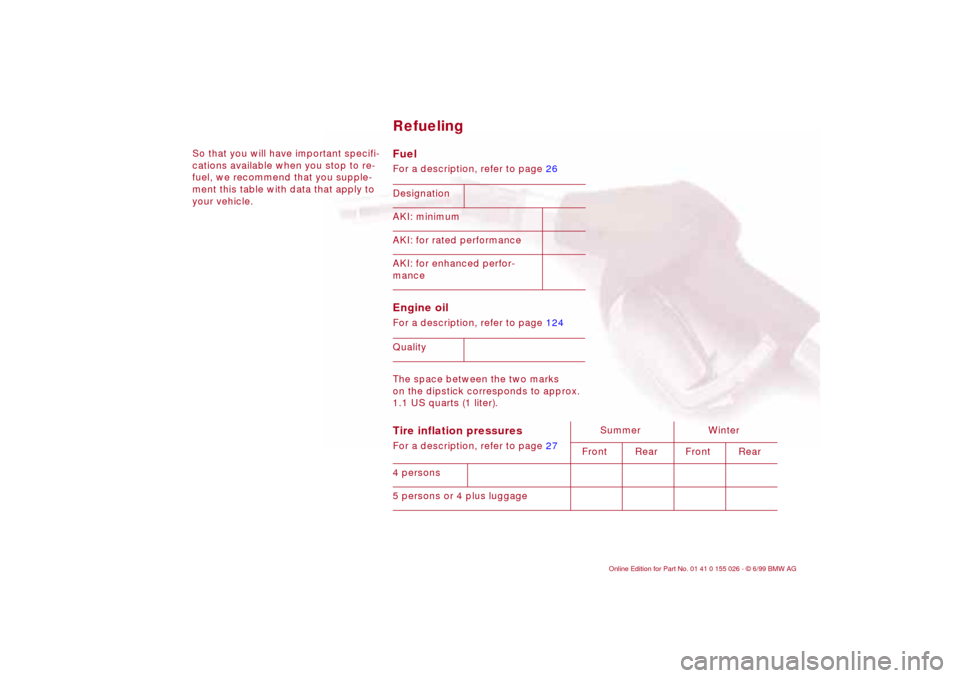
So that you will have important specifi-
cations available when you stop to re-
fuel, we recommend that you supple-
ment this table with data that apply to
your vehicle.
Fuel For a description, refer to page 26 Engine oil For a description, refer to page 124
The space between the two marks
on the dipstick corresponds to approx.
1.1 US quarts (1 liter). Designation
AKI: minimum
AKI: for rated performance
AKI: for enhanced perfor-
mance
QualityTire inflation pressures For a description, refer to page 27Summer Winter
Front Rear Front Rear
4 persons
5 persons or 4 plus luggageRefueling