2000 BMW 323Ci CONVERTIBLE steering
[x] Cancel search: steeringPage 120 of 199

120n
Power steering Cellular phone* Radio reception Changes in steering response, e.g. high
steering effort:
Consult a BMW center to have the sys-
tem checked.
If the power steering fails, in-
creased effort will be required to
steer the vehicle.<
Only mobile communications systems
(cellular phone, two-way radios, etc.)
with an output up to 10 watts are per-
mitted. Mobile communications devices
not specifically designed for use in your
vehicle may trigger malfunctions while
operating your vehicle. BMW can nei-
ther test nor assume responsibility for
every individual product being offered
on the market. We recommend that you
consult your BMW center before pur-
chasing any device of this kind.
To ensure that your BMW continues to
provide reliable and trouble-free opera-
tion, do not use a cellular phone or
other radio device with an antenna
located inside the passenger compart-
ment. The antenna should always be
mounted on the outside of the vehicle.
Before loading the vehicle on
a car-carrier train or driving it
through a car-wash, remove the
antenna.<
The reception and sound quality
obtained from mobile radios varies
according to a variety of factors, includ-
ing the broadcast range of the transmit-
ter and the directional orientation of the
antenna. Interference factors such as
high-tension power lines, structural or
natural obstructions can all lead to un-
avoidable reception interference, re-
gardless of how well the vehicle sound
system is operating.
Climatic factors such as intense solar
radiation, fog, rain and snow can also
interfere with reception.
Car telephones or cellular phones not
approved by BMW can also cause in-
terference in the radio during a tele-
phone call. This phenomenon assumes
the form of a low-pitched hum emanat-
ing from the speaker system.
Please refer to the supplementary
Owner's Manual provided with your car
radio
* for detailed information on its
use.
Page 123 of 199
123n
IndexDataTechnologyRepairsCar careControlsOverview
Information for your safetyThe factory approved radial tires are
matched to the vehicle and have been
selected to provide optimum safety and
driving comfort.
It is not merely the tire's service life, but
also driving comfort and – above all else
– driving safety that depend on the con-
dition of the tires and the maintenance
of the specified tire pressure.
Incorrect inflation pressure is a frequent
cause of tire damage. It also signifi-
cantly influences the roadholding ability
of your BMW.
Check tire inflation pressures reg-
ularly – including the space-saver
spare tire – at least twice a month and
before beginning a longer trip (see
page 27). If this is not done, incorrect
tire pressures can cause driving insta-
bility and tire damage, ultimately result-
ing in accidents.<
Tire tread – tire damageInspect your tires frequently for tread
wear, signs of damage and for foreign
objects lodged in the tread. Check the
tread depth.
Tread depth should not be allowed to
go below 0.12 in (3 mm), even though
the legally specified minimum tread
depth is only 0.063 in (1.6 mm). At a
tread depth of 0.063 in (1.6 mm), tread
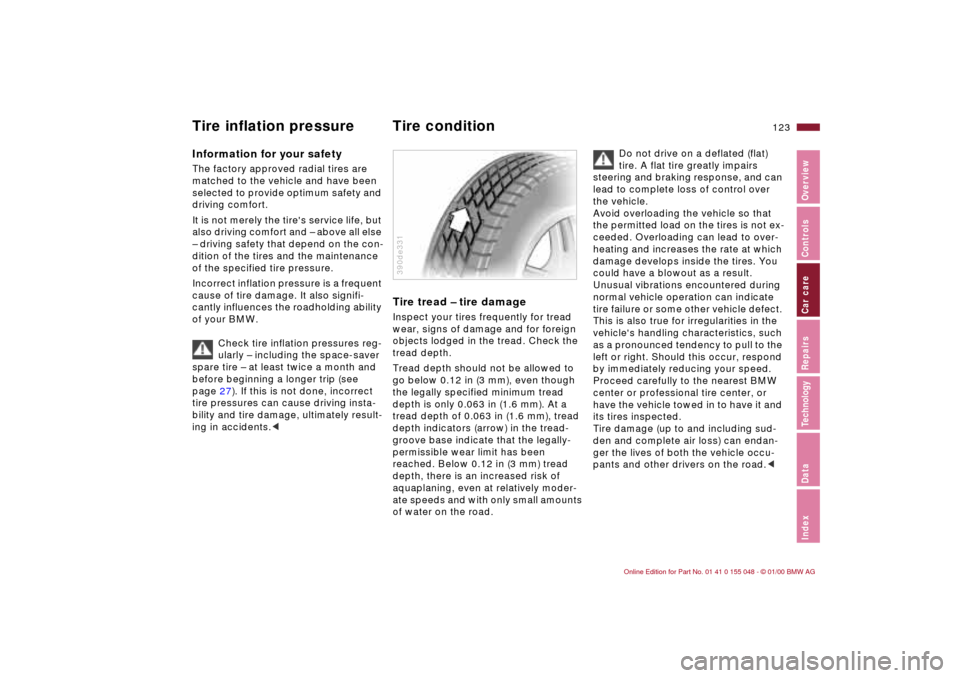
depth indicators (arrow) in the tread-
groove base indicate that the legally-
permissible wear limit has been
reached. Below 0.12 in (3 mm) tread
depth, there is an increased risk of
aquaplaning, even at relatively moder-
ate speeds and with only small amounts
of water on the road.390de331
Do not drive on a deflated (flat)
tire. A flat tire greatly impairs
steering and braking response, and can
lead to complete loss of control over
the vehicle.
Avoid overloading the vehicle so that
the permitted load on the tires is not ex-
ceeded. Overloading can lead to over-
heating and increases the rate at which
damage develops inside the tires. You
could have a blowout as a result.
Unusual vibrations encountered during
normal vehicle operation can indicate
tire failure or some other vehicle defect.
This is also true for irregularities in the
vehicle's handling characteristics, such
as a pronounced tendency to pull to the
left or right. Should this occur, respond
by immediately reducing your speed.
Proceed carefully to the nearest BMW
center or professional tire center, or
have the vehicle towed in to have it and
its tires inspected.
Tire damage (up to and including sud-
den and complete air loss) can endan-
ger the lives of both the vehicle occu-
pants and other drivers on the road.<
Tire inflation pressure Tire condition
Page 127 of 199

127n
IndexDataTechnologyRepairsCar careControlsOverview
Do not exceed specified
maximum speeds
Never exceed the maximum speed
for which winter tires are rated.
Unprofessional attempts by laymen to
service tires can lead to damage and
accidents.
Have this work performed by skilled
professionals only. Any BMW center
has the required technical knowledge
and the proper equipment and will be
happy to assist you.<
Tire condition, tire pressureOnce the tire wears to a tread depth
below 0.16 in (4 mm), winter tires dis-
play a perceptible decrease in their
ability to cope with winter driving condi-
tions, and should be replaced in the
interest of safety.
Comply with the specified tire inflation
pressures – and be sure to have the
wheel and tire assemblies balanced
every time you change the tires.
Winter tiresChoosing the right tireBMW recommends winter tires (M+S
radial tires) for driving in adverse winter
road conditions. Although all-season
tires with the M+S identification provide
better winter traction than summer tires
with H, V, W Y and ZR speed ratings,
they generally fail to provide the same
levels of performance as standard
winter tires.
In the interests of safe tracking and
steering response, install winter tires
made by the same manufacturer having
the same tread configuration on all four
wheels.
Mount only winter tires which have
been approved by BMW. Any BMW
center will be glad to provide you with
information on the best winter tires for
your particular driving conditions.
StorageAlways store tires in a cool, dry place.
Store them away from light whenever
possible. Protect the tires against con-
tact with oil, grease and fuel.Snow chains
*
The use of narrow-link BMW snow
chains on summer or winter tires is
approved only in pairs and only on the
rear wheels. Comply with all manufac-
turer's safety precautions when mount-
ing the chains.
Page 133 of 199
133n
IndexDataTechnologyRepairsCar careControlsOverview
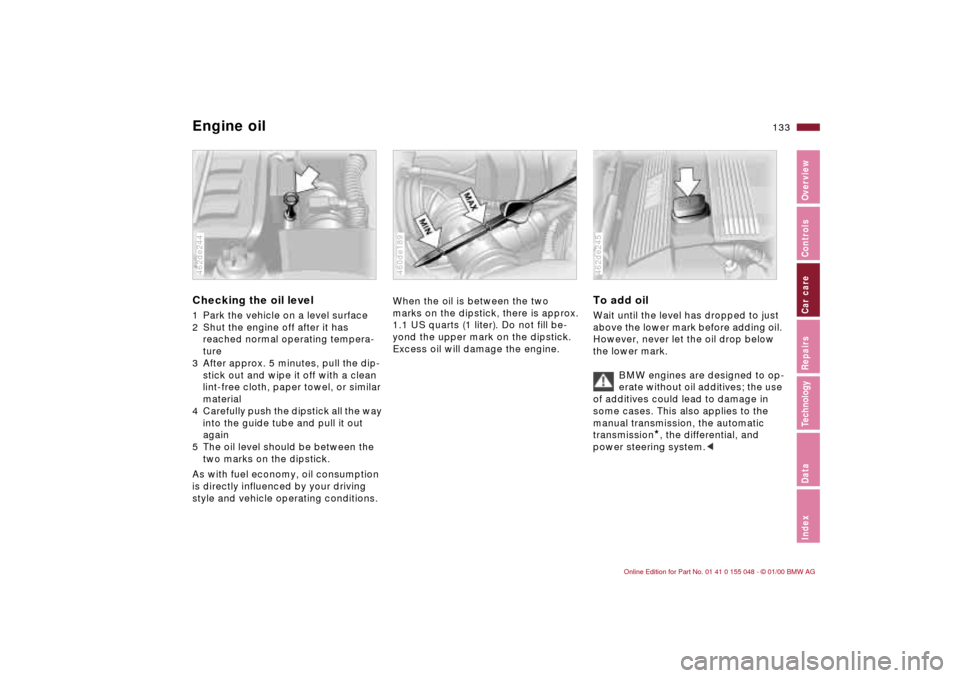
Engine oilChecking the oil level 1 Park the vehicle on a level surface
2 Shut the engine off after it has
reached normal operating tempera-
ture
3 After approx. 5 minutes, pull the dip-
stick out and wipe it off with a clean
lint-free cloth, paper towel, or similar
material
4 Carefully push the dipstick all the way
into the guide tube and pull it out
again
5 The oil level should be between the
two marks on the dipstick.
As with fuel economy, oil consumption
is directly influenced by your driving
style and vehicle operating conditions.462de244
When the oil is between the two
marks on the dipstick, there is approx.
1.1 US quarts (1 liter). Do not fill be-
yond the upper mark on the dipstick.
Excess oil will damage the engine.460de189
To add oil Wait until the level has dropped to just
above the lower mark before adding oil.
However, never let the oil drop below
the lower mark.
BMW engines are designed to op-
erate without oil additives; the use
of additives could lead to damage in
some cases. This also applies to the
manual transmission, the automatic
transmission
*, the differential, and
power steering system.<
462de245
Page 146 of 199
146n
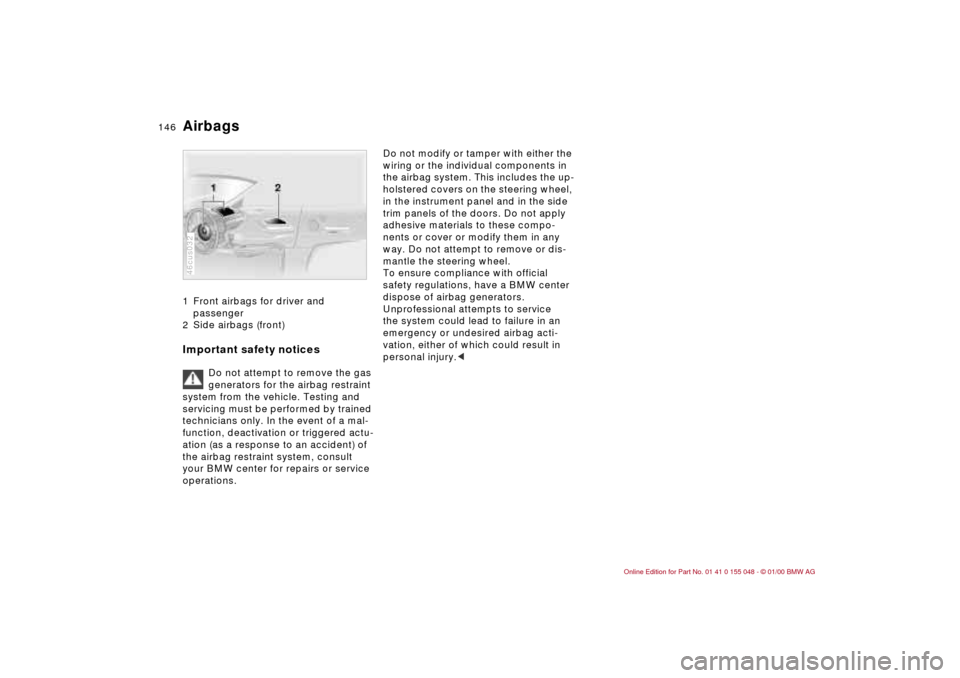
Airbags 1 Front airbags for driver and
passenger
2 Side airbags (front)Important safety notices
Do not attempt to remove the gas
generators for the airbag restraint
system from the vehicle. Testing and
servicing must be performed by trained
technicians only. In the event of a mal-
function, deactivation or triggered actu-
ation (as a response to an accident) of
the airbag restraint system, consult
your BMW center for repairs or service
operations.
46cus032
Do not modify or tamper with either the
wiring or the individual components in
the airbag system. This includes the up-
holstered covers on the steering wheel,
in the instrument panel and in the side
trim panels of the doors. Do not apply
adhesive materials to these compo-
nents or cover or modify them in any
way. Do not attempt to remove or dis-
mantle the steering wheel.
To ensure compliance with official
safety regulations, have a BMW center
dispose of airbag generators.
Unprofessional attempts to service
the system could lead to failure in an
emergency or undesired airbag acti-
vation, either of which could result in
personal injury.<
Page 159 of 199
159n
IndexDataTechnologyRepairsCar careControlsOverview
Changing a wheel
Safety measures in the event of a
flat tire or wheel change:
Stop the vehicle as far as possible from
passing traffic. Park on a firm, flat sur-
face. Switch on the hazard flashers.
Turn the steering wheel to the straight-
ahead position, remove the key and en-
gage the steering lock. Shift into 1st or
reverse (selector lever in "Park" with au-
tomatic transmission) and engage the
parking brake.
Have all passengers leave the vehicle
and remain well away from your immedi-
ate working area (behind a guardrail, for
instance).
If a warning triangle
* or portable hazard
warning lamp is available, set it up on
the roadside at an appropriate distance
from the rear of the vehicle. Comply with
all safety guidelines and regulations.
Change the wheel only on a level, firm
surface that is not slippery. Avoid jack-
ing the vehicle on a soft or slippery sup-
port surface (snow, ice, loose gravel,
etc.), as it could slide sideways.
Position the jack on a firm support sur-
face.
Do not place wooden blocks or similar
objects under the jack, otherwise, the
jack might not be able to reach its full
support capacity because of the limited
height.
Do not lie under the vehicle or start the
engine when the vehicle is supported by
the jack. Failure to comply with this cre-
ates a risk of fatal injury.<
Your BMW has a space-saver spare
tire for temporary use to ensure your
mobility.
To remove the space-saver spare
tire, lift the floor panel in the lug-
gage compartment completely out
(refer to page 41).<
What you will needIn order to avoid rattling noises later,
note the position of the tools when you
remove them and return them to their
original position when you are through
using them.
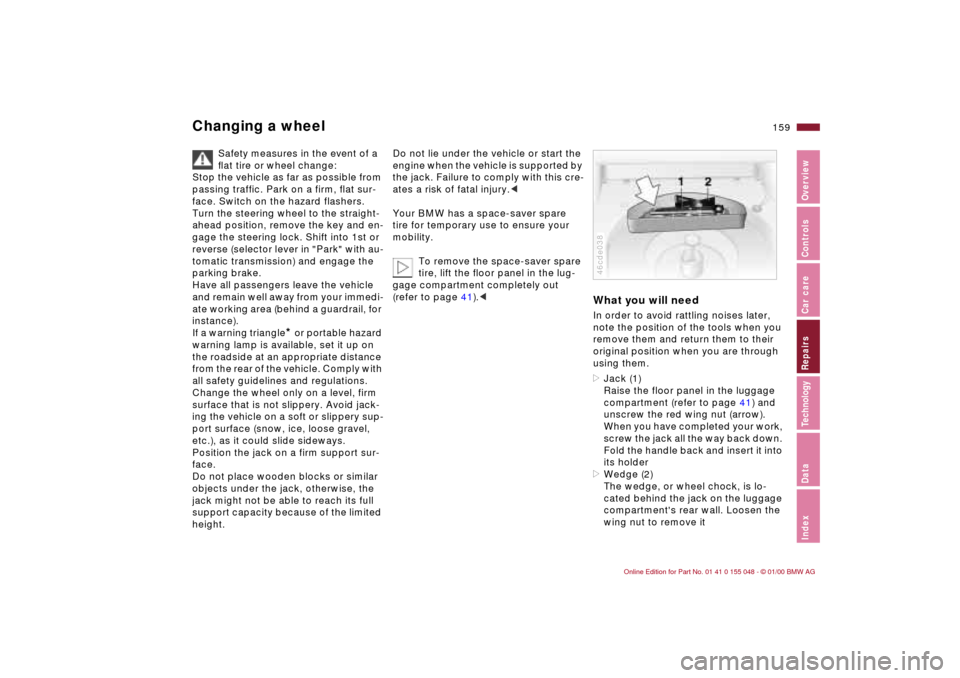
>Jack (1)
Raise the floor panel in the luggage
compartment (refer to page 41) and
unscrew the red wing nut (arrow).
When you have completed your work,
screw the jack all the way back down.
Fold the handle back and insert it into
its holder
>Wedge (2)
The wedge, or wheel chock, is lo-
cated behind the jack on the luggage
compartment's rear wall. Loosen the
wing nut to remove it46cde038
Page 162 of 199
162n
Changing a wheel Battery Driving with the space-saver
spare tireDrive cautiously. Do not exceed a speed
of 45 mph (80 km/h).
You can anticipate changes in vehicle
handling such as delayed braking re-
sponse, longer braking distances and
changes in self-steering properties
when approaching stability limits.
The changes in handling characteristics
will be even more pronounced in con-
junction with winter tires.
Only one space-saver spare tire
may be mounted at one time. Re-
install wheels and tires of the same size
and specification as soon as possible.
Maintain correct tire pressures. Refer to
page 28.<
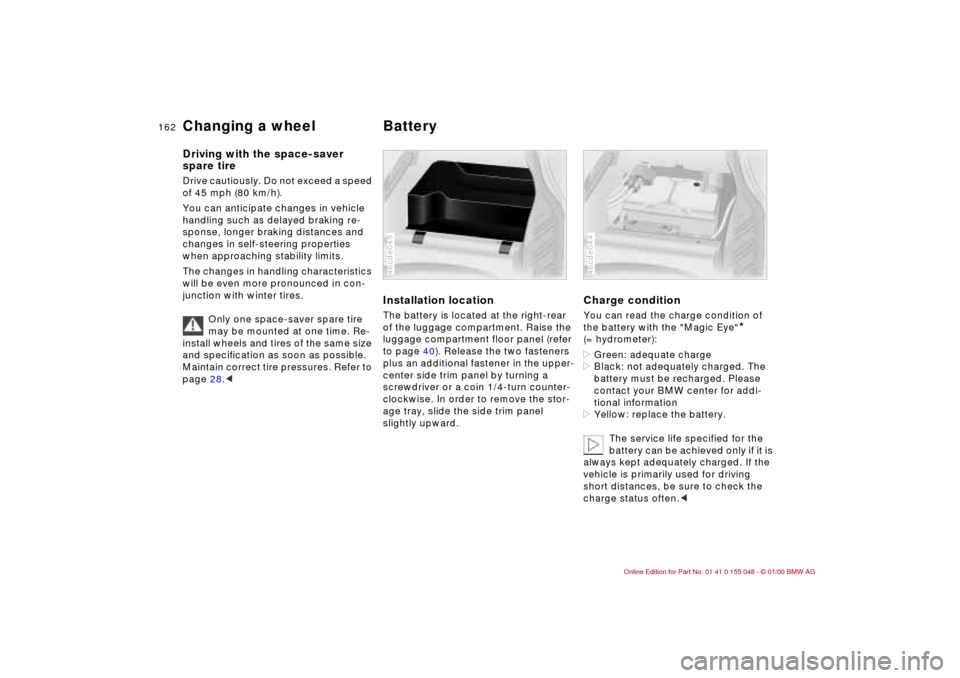
Installation locationThe battery is located at the right-rear
of the luggage compartment. Raise the
luggage compartment floor panel (refer
to page 40). Release the two fasteners
plus an additional fastener in the upper-
center side trim panel by turning a
screwdriver or a coin 1/4-turn counter-
clockwise. In order to remove the stor-
age tray, slide the side trim panel
slightly upward.46cde045
Charge conditionYou can read the charge condition of
the battery with the "Magic Eye"
*
(= hydrometer):
>Green: adequate charge
>Black: not adequately charged. The
battery must be recharged. Please
contact your BMW center for addi-
tional information
>Yellow: replace the battery.
The service life specified for the
battery can be achieved only if it is
always kept adequately charged. If the
vehicle is primarily used for driving
short distances, be sure to check the
charge status often.<
46cde044
Page 163 of 199
163n
IndexDataTechnologyRepairsCar careControlsOverview
BatteryBattery careThe battery is absolutely maintenance-
free, that is, the original acid will nor-
mally last for the service life of the
battery under temperate climatic
conditions.
For all questions regarding the
battery, please consult your BMW
center. Since the battery is absolutely
maintenance-free, the following infor-
mation is for your use only.<
SymbolsYou will find the following symbols on
your vehicle battery. For your safety,
please be cautious whenever you work
with or near the battery.
Before handling the battery,
please read the following infor-
mation.
Wear eye protection. Do not al-
low particles containing battery
acid or lead to come into con-
tact with your eyes, your skin, or your
clothing.
Battery acid is extremely corro-
sive. Wear eye protection and
protective gloves. Do not tip the
battery. Battery acid can leak from the
ventilation openings.
Do not allow children to have
access to batteries and battery
acid.
Never allow sparks or open
flame near the battery. Do not
smoke in the vicinity of the bat-
tery. Avoid sparks from electrical cables
or electrical equipment. Turn the key to
position 0 in the steering lock when dis-
connecting or connecting the battery.
Do not short-circuit the battery termi-
nals. This creates a risk of injury from
high-energy sparks.
A highly explosive gas is
generated when the battery is
charged.
If you happen to get acid in
your eyes, rinse thoroughly for
15 minutes with clear water.
Consult a physician immediately. If you
get acid spray on your skin or clothing,
rinse with plenty of water. If acid is ac-
cidentally ingested, consult a physician
immediately.
In order to protect the battery
case from ultraviolet radiation,
do not place it in direct sunlight.
A drained battery can freeze. Store the
battery in areas where temperature
remains above freezing.