2000 AUDI ALLROAD steering
[x] Cancel search: steeringPage 31 of 306
SAFETY FIRST--------------------------
�
WARNING continued
- Always sit upright with your
back against the backrest of
your seat.
. 30 Never
place your feet on the in
strument panel or on the seat.
Always keep both feet on the
floor in front of the seat to help
prevent serious injuries to the
legs and hips if the airbag in
flates. BBN-163
There is a lot that you and your passengers
can do to help the individual safety features
installed in your Audi work together as a
system. Adjusting
the driver's seat
For detailed steps for adjusting the driver's
seat please see "Front Seats" on page 76.
We recommend that you adjust the driver's
seat as follows:
- adjust the seat in fore and aft direction so
that you can easily push the pedals all the
way while keeping your knee slightly
bent.
- adjust the seatback so that when you sit
with your back against the seatback, you
can still grasp the top of the steering
wheel.
adjust the steering wheel -see chapter
"Adjustable steering column" page 98.
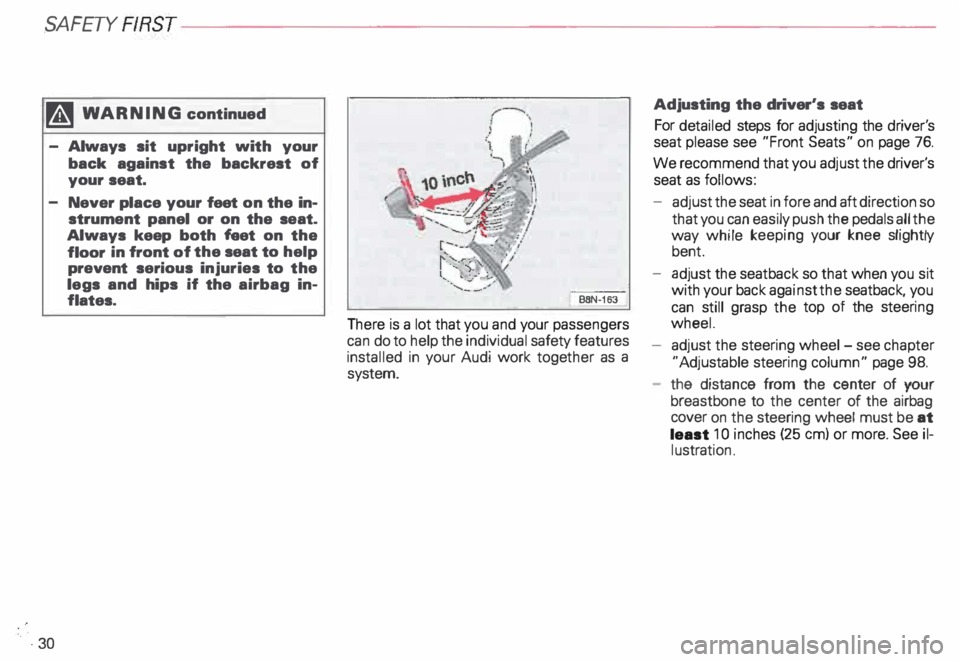
- the distance from the center of your
breastbone to the center of the airbag
cover on the steering wheel must be at
least 1 0 inches (25 em) or more. See il
lustration .
Page 32 of 306
-----------------------------------------------------SAFETY RRST
�W ARNING
• Never sit closer than 10 inches
(25 em) to the stee ring wheel.
• If you cannot sit more than
10 inches (25 em) from the steer
ing wheel, we recommend that
you investigate whether adaptive
equipment may be available to
help you reach the pedals and in
crease your seating distance from
the steering wheel.
Adjusting the steering wheel
For detailed steps for adjusting the steering
wheel please see "Adjustable steering col
umn" page 98.
Adjust the steering wheel so that the steer
ing wheel and airbag cover points at your
chest and not at your face. The steer ing
wheel should be adjusted so that you can
hold the outer rim of the steering wheel
comfortably with your hands at the 3 o'clock
and 9 o'clock positions. �W
ARNING
• Pointing the steering wheel to
ward your face decreases the abil
ity of the supplementa l driver's air
bag to protect you in an accident.
• Holding the steering wheel the
wrong way can cause serious inju
ries to the hands, arms and head if
the driver's airbag inflates.
• Never hold the steering wheel at
the 12 o'clock position or with
your hands at other positions in
side the steering wheel rim or on
the steering wheel hub.
Adjusting the passenger's seat
For detailed steps for adjusting the pas
senger's seat please see "Front Seats" on
page 76.
We recommend that you adjust the passen
ger's seat as follows:
- backrest upright (never reclined)
place your feet on the floor in front of the
passenger's seat adjust
the passenger's seat as far as pos
sible to the rear of the fore and aft adjust-
1)1ent range.
�W ARNING
• Always keep both feet on the
floor in front of the seat.
• Never place your feet on the in
strument panel or on the seat. If
the airbag inflates and your feet
are on the instrument panel or on
the seat, your could receive seri
ous personal injuries.
Some other important points to
know
Because airbags inflate in the blink of an eye
with great force, things you have on your lap
or have placed on the seat could become
dangerous projectiles and be pushed into
you if the airbag inflates.
Always head all WARNINGS
on next page.
31
Page 33 of 306

SAF
ETY RRST---------------------------------------------------
. � WARNING
• Objects between you and the
airbag can increase the risk of in
jury in an accident by interfering
with the way the airbag unfolds or
by being pushed into you as the
airbag inflates.
• Never hold things in your hands
or on your lap when the vehicle is
in use.
• Never place or attach accesso
ries or other objects (such as cup
holders, telephone brackets or
even large and bulky objects) on
the doors, over or near the area
marked ,. Airbag" on the steering
wheel, instrument panel, seat
backrests or between those areas
and yourself. These objects could
cause injury in a crash especially
when the airbags inflate.
32 �,
WARNING continued
• Never transport items on or in
the area of the front passenger
seat. Objects could move into the
area of the front alrbags during
braking or other sudden maneuver
and become dangerous projectiles
that can cause serious personal in
jury if the airbags inflate.
• Never recline the front passen
ger's seat to transport objects.
Items can also move into the area
of the side airbags or the front air
bag during braking or sudden ma
neuver. Objects near the airbags
can become projectiles and cause
injury particularly when the seat is
reclined. Child
restraints on the front seat -
important things to know
All children, especially 12 years old and
younger should always ride in the back seat
properly restrained for their age and size.
The ai rbag on the passenger side makes the
front seat a potentially dangerous place for
a child to ride. The front seat is not the saf
est place for a child in a forward-facing child
seat. It is a very dangerous place for an in
fant or a larger child in a rearward-facing
seat.
• Never install rear-facing child
seats or infant carriers on the front
passenger seat. A child will be se
riously injured and can be killed
when the passenger airbag in
flates.
Page 43 of 306
SA
FETY RRST-----------------------------------------------------
�WARNING continued
• Do not cover, obstruct, or
change the steering wheel horn
pad or airbag cover or the instru
ment panel, particularly in the area
of the passenger side airbag mod
ule.
• For cleaning the horn pad or in
strument panel, use only a soft,
dry cloth or one moistened with
plain water. Solvents or cleaners
could damage the airbag cover. Do
not make any repairs, adjust
ments, or modifications to any
parts of the airbag system.
• Do not modify the front bumper
or vehicle body structure.
42 ftl
WARNING continued
• Never place protective seat cov
ers or replacement upholstery
over the front and rear seatbacks
that have not been specifically ap
proved by Audi. Since the side air
bags deploy out of the side of the
seatback, it would not be able to
deploy and protect properly.
• Do not use additional seat cush
ions that cover or interfere with
the areas where the side airbags
inflate.
• Damage to the original seat cov
ers or to the seam in the area of the
side airbag module must be re
paired immediately by an autho
rized Audi Dealer.
• The airbag system must be re
placed by your authorized Audi
Dealer no later than 14 years after
the manu facture date of your ve
hicle. �,
WARNING continued
• The manufacture date can be
found on the Safety Compliance
Sticker located on the left door
jamb as well as on the Vehicle
Identification Label in your
Maintenance booklet. It is abso
lutely essential to observe this
date in order to assure that the sy
stem is in good working order.
• If components of the airbag sys
tem must be discarded, or ifthe ve
hicle must be scrapped, certain
safety precautions must be ob
served. Your authorized Audi
Dealer knows these precautions
and can give you the necessary in
forma tion. Failure to follow these
precautions and procedures could
increase the risk of personal in
jury.
Page 62 of 306

Unlocking the
vehicle and
opening doors
To unlock and open door from
outside
• Press unlock button on your remote con
trol twice or turn the key in the lock of the
driver's door or the rear lid two times to the
unlock position.
• Open doors by pulling the outside door
handle.
When you unlock your vehicle:
- the locking knobs in all doors will rise,
- the anti-theft alarm system is turned off,
- the anti-theft alarm system readiness
lights in the front doors goes out,
- the .vehicle interior lights come on for
about 30 seconds. See page 171.
- the seat and mirror memory is activated
and the driver's seat, exterior mirror and
steering wheel positions are retrieved.
See pages 74 and 83 for more details. To
unlock and open door from
inside
Each door can be unlocked independently
of the power locking system from the inside
by pulling the inside door handle:
Pulling the handle one time raises the
locking knob only.
Pulling the handle two times opens the
door.
Locking the vehicle
To lock vehicle from outside
• Close all windows and doors properly.
• Press lock button on your remote control
or turn the key in the lock of the driver's door
or the rear lid to the lock position.
When you lock the vehicle:
- all doors and the rear lid are locked, (the
locking knobs in all doors will lower),
- the anti-t .heft alarm system is turned on,
the vehicle interior lights turn off, and
the anti-theft alarm system readiness
lights near the locking knobs in the front
doors will start to blink. CONT
ROLS AND EQUIPMENT
To lock vehicle from Inside
Yo u can lock the vehicle from inside by
- depressing the locking knobs in the
doors or by
- pressing the lower part of power locking
switch. See next column.
Please note:
The anti-theft alarm system will not be
turned on when you lock the vehicle from in
side.
If the driver's door is open, or not
closed properly, you will not be able to
lock this door.
61
Page 63 of 306
CONT
ROLS AND EQUIPMENT---------------------
Power locking switch
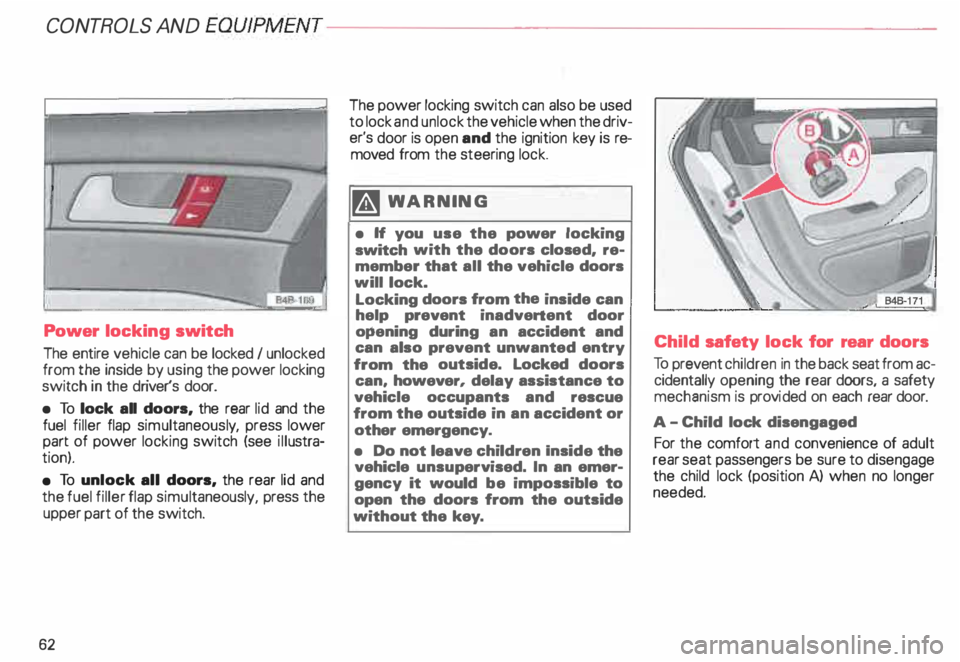
The entire vehicle can be locked I unlocked
from the inside by using the power locking
switch in the driver's door.
• To lock all doors, the rear lid and the
fuel filler flap simultaneous ly, press lower
part of power locking switch (see illustra
tion).
• To unlock all doors, the rear lid and
the fuel filler flap simul taneously, press the
upper part of the switch.
62 The
power locking switch can also be used
to lock and unlock the vehicle when the driv
er's door is open and the ignition key is re
moved from the steering lock.
�W ARNING
• H you use the power locking
switch with the doors closed, re
member that all the vehicle doors
will lock.
Locking doors from the inside can
help prevent inadvertent door
opening during an accident and
can also prevent unwanted entry
from the outside. Locked doors
can, however, delay assistance to
vehicle occupants and rescue
from the outside in an accident or
other emergency.
• Do not leave children Inside the
vehicle unsupervised. In an emer
gency it would be impossible to
open the doors from the outside
without the key. Child
safety lock for rear doors
To prevent children in the back seat from ac
cidentally opening the rear doors, a safety
mechanism is provi ded on each rear door.
A -C hild lock disengaged
For the comfort and convenience of adult
rear seat passengers be sure to disengage
the child lock (position A) when no longer
needed.
Page 77 of 306

CONTROLS ANDEOUWMENT-----------------------------------------
Front seats
The correct positioning of the seats is im
porta nt:
so that you can reach all the controls on
the vehicle quickly and safely;
so that you can drive or ride relaxed and
help reduce fatigue;
and for maximum protection of
fered by the safety belts and air
bag system.
Therefore, always adjust the position of the
seat as described on the following pages.
Remember to adjust the seats before fas
tening the safety belts and before driving
off. Always be sure to follow these general
guidelines:
76 m
WARNING
• Always sit as far away from the
stee ring wheel and the instrument
panel as possible.
• Never sit less than 10 inches
(25 em.) from the steering wheel
and the instrument panel.
• Do not adjust seats while the ve
hicle is moving. Your seat may
move unexpectedly, causing sud·
den loss of vehicle control and
personal injury.
• Passengers must always keep
their feet on the floor whenever
the vehicle is moving. Never place
feet on the dashboard or on top of
the seats. In an accident, serious
personal injury can result from an
improper seating position. BSN-163
Driver's seat
To avoid contact with the airbag while it is
unfolding, the driver must not sit any closer
to the steering wheel than necessary and al
ways properly wear available three point
belts.
Page 78 of 306
·---------------------CONTROLS AND
EQUIPMENT
We recommend that you adjust the driver's
seat as follows:
adjust the seat in fore and aft direction so
that you can easily push the pedals all the
way while keeping your knee slightly
bent.
adjust the seatback so that when you sit
with your back against the seatback, you
can still grasp the top of the steeri ng
wheel.
adjust the steeri ng wheel so that the dis
tance from the center of your breastb one
to the center of the airbag cover on the
steering wheel must be at least
10 inches (25 em) or more.
See illustration on previous page. �W
ARNING
• Navar sit closer than 10 inches
(25 em) to the steering wheal.
• If you cannot sit more than
10 inches (25 em) from the steer
ing wheel, we recommend that
you investigate whether adaptive
equipment may be available to
help you reach the pedals and in
crease your seating distance from
the steering wheal. Front
passenger's seat
To avoid contact with the airbag while it is
unfolding, the adult front seat passenger
must not sit any closer to the instrument
panel than necessary and always properly
wear availaple three point belts.
We recommend that you adjust the passen
ger's seat as follows:
backrest upright (never reclined)
place your feet on the
floor _in front
of the
passenger's seat
adjust the passenger's seat as far as pos
sible to the rear of the fore and aft adjust
ment range.
77