Page 80 of 273

Sea
t Adjustments , Foldin g Rea r Sea t
Hea d Restraint s
See page 14 for important safety
information and a warning about how to
properly position the head restraints.
The front head restraints help
protect you and your passenger from whiplash and other injuries. They are
most effective when you adjust them so the back of the occupant's head
rests against the center of the
restraint. A taller person should adjust the restraint as high as
possible.
The front head restraints adjust forheight. You need both hands toadjust the restraint. Do not attempt
to adjust it while driving. To raise it,
pull upward. To lower the restraint,
push the release button sideways
and push the restraint down.
To remove a head restraint for
cleaning or repair, pull it up as far as it will go. Push the release button
and pull the restraint out of the seat-
back.
Foldin
g Rea r Sea t
The back of the rear seat folds down, giving you direct access to the trunk. The seat-back can be released from
inside the vehicle or inside the trunk.
CONTINUED
Instrument s an d Control s
RELEAS
E
BUTTO N
Page 149 of 273
Drivin
g in Ba d Weathe r
Tractio n — Check your tires
frequently for wear and proper
pressure. Both are important in
preventing "hydroplaning" (loss of
traction on a wet surface). In the
winter, mount snow tires on all four
wheels for the best handling.
Watch road conditions carefully, they can change from moment to
moment. Wet leaves can be as slip- pery as ice. "Clear" roads can have
patches of ice. Driving conditions can be very hazardous when theoutside temperature is near freezing.
The road surface can become covered with areas of water puddles
mixed with areas of ice, so your
traction can change without warning.
Be careful when downshifting. If
traction is low, you can lock up thedrive wheels for a moment and cause
a skid.
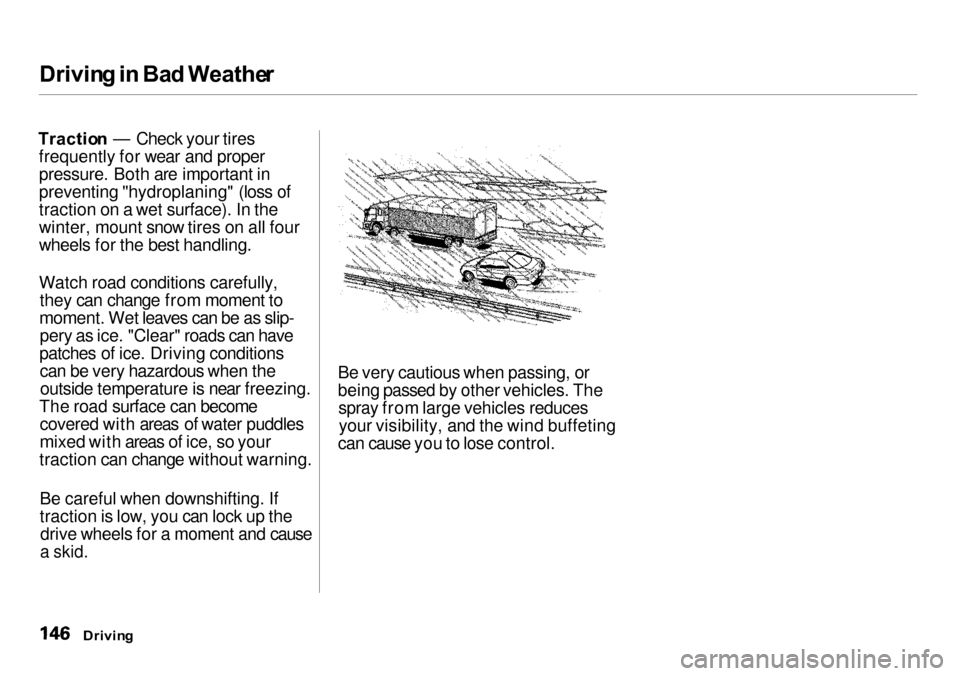
Be very cautious when passing, or
being passed by other vehicles. The
spray from large vehicles reduces your visibility, and the wind buffeting
can cause you to lose control.
Drivin g
Page 224 of 273

Changin
g a Fla t Tir e
If you have a flat tire while driving,
stop in a safe place to change it.
Stopping in traffic or on the shoulder
of a busy road is dangerous. Drive slowly along the shoulder until you
get to an exit or an area to stop that is far away from the traffic lanes.
1. Park the car on firm, level, non-slippery ground away from traffic.
Put the transmission in Park.
Apply the parking brake.
2. Turn on the hazard warning lights and turn the ignition switch to
LOCK (0). Have all the
passengers get out of the car while
you change the tire. 3. Open the trunk. Raise the trunk
floor by lifting up on the back edge.
4. Take the tool kit out of the trunk.
5. Unscrew the wing bolt and take the spare tire out of the trunk.
CONTINUED
Takin g Car e o f th e Unexpecte d
TOO
L KI T
SPAR E TIR E
JAC
K
The car can easily roll off the
jack, seriously injuring anyone
underneath.
Follow the directions for
changing a tire exactly, and
never get under the car when it
is supported only by the jack.
Page 230 of 273

I
f You r Engin e Won' t Start , Jum p Startin g
Th e Starte r Operate s Normall y
In this case, the starter motor's speed sounds normal, or even faster
than normal, when you turn the ignition switch to START (III), but
the engine does not run. Are you using the proper starting
procedure? Refer to Startin g th e
Engin e on page 133 . Do you have fuel? Turn the
ignition switch to ON (II) for a
minute and watch the fuel gauge.
The low fuel level warning light may not be working, so you were
not reminded to fill the tank. There may be an electrical
problem, such as no power to the
fuel pump. Check all the fuses (see page 237).
If you find nothing wrong, you will
need a qualified technician to find
the problem. See Emergenc y
Towin g on page 241. Jum
p Startin g
If your car's battery has run down,
you may be able to start the engine
by using a booster battery. Although this seems like a simple procedure,
you should take several precautions.
You cannot start an Acura with an automatic transmission by pushing
or pulling it. To jump start your car, follow these
directions closely:
1. Open the hood and check the physical condition of the battery
(see page 187). In very cold weather, check the condition of the electrolyte. If it seems slushyor like ice, do not try jump starting
until it thaws.
If a battery sits in extreme cold, the
electrolyte inside can freeze.
Attempting to jump start with a frozen
battery can cause it to rupture.
2. Turn off all the electrical acces- sories: heater, A/C, stereo system,
lights, etc.
Put the transmission in Neutral or
Park and set the parking brake.
CONTINUED
Takin g Car e o f th e Unexpecte d
A battery can explode if you do
not follow the correct procedure,
seriously injuring anyone
nearby.
Keep all sparks, open flames,
and smoking materials away
from the battery.
NOTIC
E
Page 232 of 273

I
f You r Engin e Overheat s
The pointer of your car's tempera- ture gauge should stay in the mid-
range under most conditions. It may
go higher if you are driving up a longsteep hill on a very hot day. If it
climbs to the red mark, you should
determine the reason.
Driving with the temperature gauge
pointer at the red mark can cause
serious damage to your engine.
Your car can overheat for several
reasons, such as lack of coolant or amechanical problem. The only
indication may be the temperature
gauge climbing to or above the red
mark. Or you may see steam or spray coming from under the hood.
In either case, you should take immediate action.
1. Safely pull to the side of the road. Put the transmission in Neutral or
Park and set the parking brake. Turn off the heating and cooling
system and all other accessories. Turn on the hazard warning
indicators. 2. If you see steam and/or spray
coming from under the hood, turn
off the engine.
3. If you do not see steam or spray, leave the engine running and
watch the temperature gauge. If
the high heat is due to overloading(climbing a long, steep hill on a
hot day with the A/C running, for
example), the engine should start
to cool down almost immediately. If it does, wait until the tempera-
ture gauge comes down to the mid-
point then continue driving.
4. If the temperature gauge stays at the red mark, turn off the engine.
5. Wait until you see no more signs of steam or spray, then open the
hood.
CONTINUED
Takin g Car e o f th e Unexpecte d
Steam and spray from an
overheated engine can
seriously scald you.
Do not open the hood if steam
is coming out.
NOTIC
E
Page 234 of 273

Lo
w Oi l Pressur e Indicato r
This indicator should light when the ignition switch is ON (II), and go out
after the engine starts. It should
never come on when the engine is
running. If it starts flashing, it
indicates that the oil pressuredropped very low for a moment, then
recovered. If the indicator stays on
with the engine running, it shows
that the engine has lost oil pressure and serious engine damage is
possible. In either case, you should
take immediate action.
Running the engine with low oil
pressure can cause serious mechanical damage almost immediately. Turn offthe engine as soon as you can safely get
the car stopped.
1. Safely pull off the road and shut off the engine. Turn on the hazard
warning indicators.
2. Let the car sit for a minute. Open the hood and check the oil level(see page 122 ). Although oil level
and oil pressure are not directly
connected, an engine that is very
low on oil can lose pressure during cornering and other driving
maneuvers.
3. If necessary, add oil to bring the level back to the full mark on the
dipstick (see page 167).
4. Start the engine and watch the oil pressure indicator. If the light
does not go out within ten seconds,
turn off the engine. There is a mechanical problem that needs to
be repaired before you can
continue driving. (See Emergenc y
Towin g on page 241.)
Takin g Car e o f th e Unexpecte d
NOTIC
E
LO W OI L PRESSUR E INDICATO R
Page 251 of 273

DO
T Tir e Qualit y Gradin g (U.S . Cars )
The tires on your car meet all U.S. Federal Safety Requirements. All
tires are also graded for treadwear, traction, and temperature perform-ance according to Department of
Transportation (DOT) standards.
The following explains these
gradings.
Unifor m Tir e Qualit y Gradin g
Quality grades can be found where
applicable on the tire sidewall between the tread shoulder and the
maximum section width. For
example:
Treadwea r 20 0
Tractio n A A
Temperatur e A
Treadwea
r
The treadwear grade is a compara- tive rating based on the wear rate ofthe tire when tested under controlled
conditions on a specified government
test course. For example, a tire
graded 150 would wear one and one
half (1-1/2) times as well on the
government course as a tire graded 100. The relative performance of
tires depends upon the actual condi-
tions of their use, however, and may depart significantly from the norm
due to variations in driving habits, service practices, and differences in
road characteristics and climate.
Tractio
n
The traction grades, from highest to lowest, are AA, A, B, and C. Those
grades represent the tire's ability to stop on wet pavement as measured
under controlled conditions on specified government test surfaces
of asphalt and concrete. A tire
marked C may have poor traction
performance.
Warning: The traction grade assigned to this tire is based on
straight-ahead braking traction tests,
and does not include acceleration,
cornering, hydroplaning, or peak
traction characteristics.
Technica l Informatio n
Page 252 of 273

DO
T Tir e Qualit y Gradin g (U.S . Cars )
Temperatur e
The temperature grades are A (the highest), B, and C, representing the
tire's resistance to the generation of
heat and its ability to dissipate heat
when tested under controlled conditions on a specified indoor
laboratory test wheel. Sustained high
temperature can cause the material of the tire to degenerate and reduce
tire life, and excessive temperature can lead to sudden tire failure. The
grade C corresponds to a level of
performance which all passenger car
tires must meet under the Federal Motor Vehicle Safety Standard No.109. Grades B and A represent
higher levels of performance on the laboratory test wheel than the
minimum required by law. Warning: The temperature grade for
this tire is established for a tire thatis properly inflated and not over-
loaded. Excessive speed, underinfla-tion, or excessive loading either separately or in combination, can
cause heat build-up and possible tire
failure.
Technical Informatio n