1999 TOYOTA SOLARA ECU
[x] Cancel search: ECUPage 35 of 244
SOLARA_U35
Toyota strongly urges that the driver and
passengers in the vehicle be properly re-
strained at all times with the seat belts
provided. Failure to do so could increase
the chance of injury and/or the severity of
injury in accidents.
Child.
Use a child restraint system ap-
propriate for the child until the child be-
comes large enough to properly wear the
vehicle's seat belts. See ºChild restraintº
for details.
If a child is too large for a child restraint
system, the child s hould sit in the rear
seat and must be restrained using the
vehicle's seat belt. According to accident
statistics, the child is safer when properly
restrained in the rear seat than in the
front seat.
If a child must sit in the front seat, the
seat belts should be worn properly. If an
accident occurs and the seat belts are not
worn properly, the force of the rapid infla-
tion of the airbag may cause death or
serious injury to the child. Do not allow the child to stand up or
kneel on either rear or front seats. An
unrestrained child could suffer serious in-
jury or death during emergency braking or
a collision. Also, do not let the child sit
on your lap. It does not provide sufficient
restraint.
Pregnant woman.
Toyota recommends the
use of a seat belt. Ask your doctor for
specific recommendations. The lap belt
should be worn securely and as low as
possible over the hips and not on the
waist.
Injured person. Toyota recommends the
use of a seat belt. Depending on the inju-
ry, first check with your doctor for specific
recommendations.
CAUTION
Persons should ride in their seats
properly wearing their seat belts
whenever the vehicle is moving.
Otherwise, they are much more likely
to suffer serious bodily injury or
death in the event of sudden braking
or a collision.
When using the seat belts, observe
the following: Use the belt for only one person at
a time. Do not use a single belt for
two or more peopleÐeven children.
Avoid reclining the seatbacks too
much. The seat belts provide maxi-
mum protection when the seatbacks
are in the upright position. (Refer
to the seat adjustment instructions.)
Be careful not to damage the belt
webbing or hardware. Take care that
they do not get caught or pinched
in the seat or doors.
Inspect the belt system periodically.
Check for cuts, fraying, and loose
parts. Damaged parts should be re-
placed. Do not disassemble or
modify the system.
Seat beltsÐ
ÐSeat belt precautions
Page 37 of 244
SOLARA_U37
If the seat belt cannot be pulled out of the
retractor, firmly pull the belt and release
it. You will then be able to smoothly pull
the belt out of the retractor.
When a passenger 's shoulder belt is com-
pletely extended and is then retracted
even slightly, the belt is locked in that
position and cannot be extended. This fea-
ture is used to hold the child restraint
system securely. (For details, see ºChild
restraintº in this chapter.) To free the belt
again, fully retract the belt and then pull
the belt out once more.
CAUTION
After inserting the tab, make sure
the tab and buckle are locked and
that the belt is not twisted.
Do not insert coins, clips, etc. in
the buckle as this may prevent you
from properly latching the tab and
buckle.
If the seat belt does not function
normally, immediately contact your
Toyota dealer. Do not use the seat
until the seat belt is fixed. It cannot
protect an adult occupant or your
child from injury.
Ta k e u p
slack
To o h i g h
Keep as low on
hips as possible
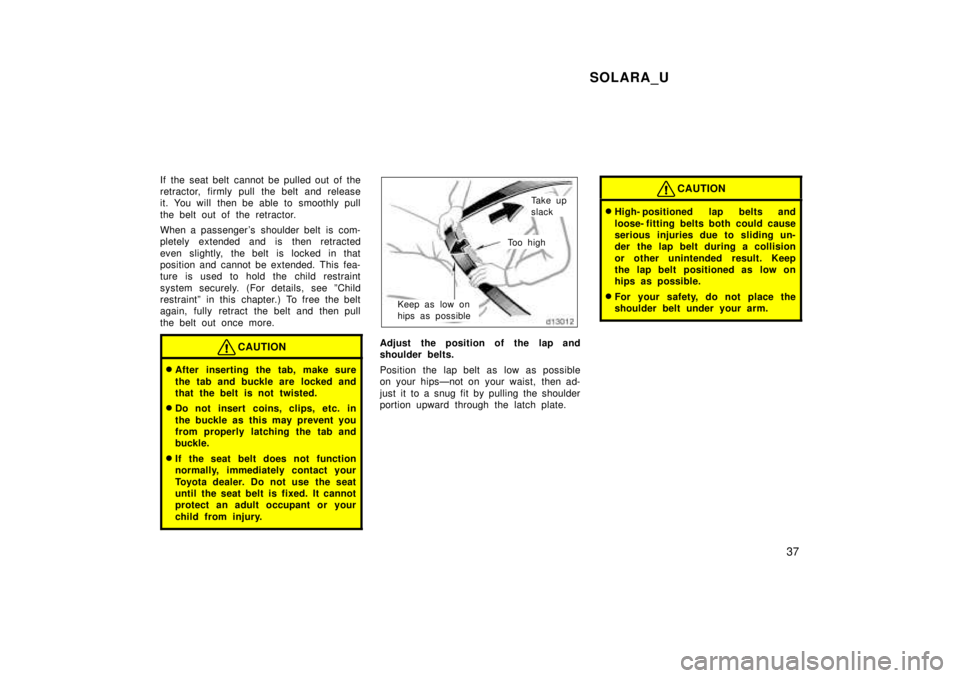
Adjust the position of the lap and
shoulder belts.
Position the lap belt as low as possible
on your hipsÐnot on your waist, then ad-
just it to a snug fit by pulling the s houlder
portion upward through the latch plate.
CAUTION
High- positioned lap belts and
loose- fitting belts both could cause
serious injuries due to sliding un-
der the lap belt during a collision
or other unintended result. Keep
the lap belt positioned as low on
hips as possible.
For your safety, do not place the
shoulder belt under your arm.
Page 38 of 244
SOLARA_U
38
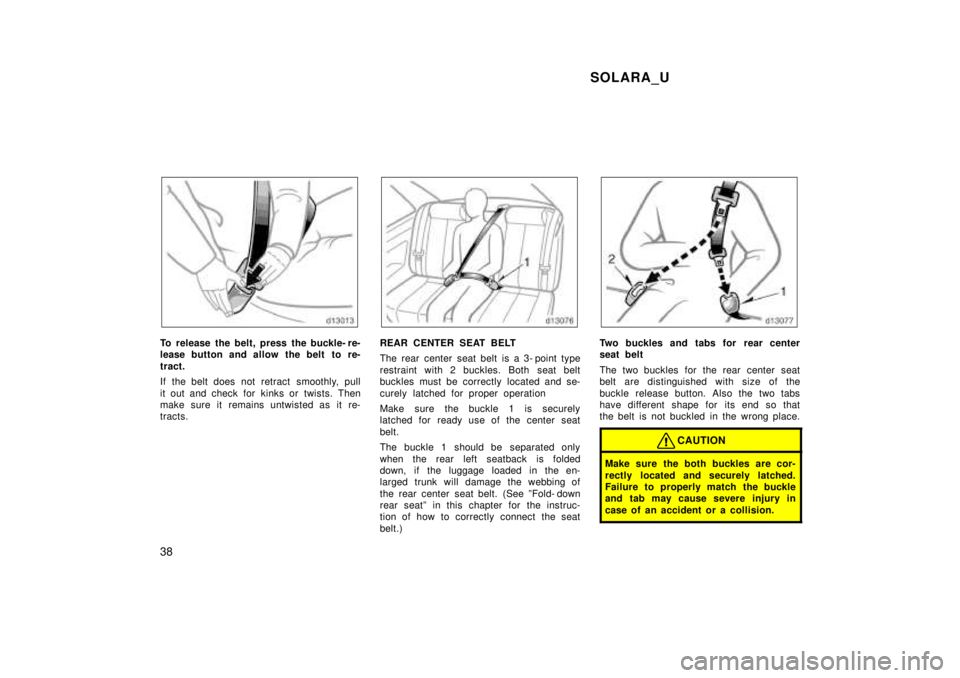
To release the belt, press the buckle- re-
lease button and allow the belt to re-
tract.
If the belt does not retract smoothly, pull
it out and check for kinks or twists. Then
make sure it remains untwisted as it re-
tracts.REAR CENTER SEAT BELT
The rear center seat belt is a 3- point type
restraint with 2 buckles. Both seat belt
buckles must be correctly located and se-
curely latched for proper operation
Make sure the buckle 1 is securely
latched for ready use of the center seat
belt.
The buckle 1 should be separated only
when the rear left seatback is folded
down, if the luggage loaded in the en-
larged trunk will damage the webbing of
the rear center seat belt. (See ºFold- down
rear seatº in this chapter for the instruc-
tion of how to correctly connect the seat
belt.)Two buckles and tabs for rear center
seat belt
The two buckles for the rear center seat
belt are distinguished with size of the
buckle release button. Also the two tabs
have different shape for its end so that
the belt is not buckled in the wrong place.
CAUTION
Make sure the both buckles are cor-
rectly located and securely latched.
Failure to properly match the buckle
and tab may cause severe injury in
case of an accident or a co llision.
Page 46 of 244
SOLARA_U
46
A crash severe enough to inflate the air-
bags may break the windshield as the
vehicle buckles. In vehicles with a pas-
senger airbag the windshield may also be
damaged by absorbing some of the force
of the inflating airbag.
CAUTION
The SRS airbag system is designed
only as a supplement to the prima-
ry protection of the driver side and
front passenger side seat belt sys-
tems. The front seat occupants can
be killed or seriously injured by an
inflating airbag if they do not wear
the available seat belts. During sud-
den braking just before a collision,
an unrestrained driver or front pas-
senger can move forward into direct
contact with or close proximity to
the airbag which may then deploy
during the collision. To obtain maxi-
mum protection in an accident, the
driver and all passengers in the ve-
hicle must wear their seat belts.
Wearing a seat belt during an acci-
dent reduces the chances of death
or serious injuries or being thrown
out of the vehicle. For instructions
and precautions concerning the seat
belt system, see ºSeat beltsº in this
chapter.
Improperly seated and/or restrained
infants and children can be killed
or seriously injured by a deploying
airbag. An infant or child who is
too small to use a seat belt should
be properly secured using a child
restraint system. Toyota strongly
recommends that all infants and
children be placed in the rear seat
of the vehicle and properly re-
strained. The rear seat is the safest
for infants and children. For in-
structions concerning the installa-
tion of a child restraint system, see
ºChild restraintº in this chapter.
Page 53 of 244
SOLARA_U53
In a severe side impact, the side airbag
sensor triggers the side airbag inflators.
Then a chemical reaction in the inflators
momentarily fills the air
bags with non- tox-
ic gas to help restrain the lateral motion
of the occupants.
When the airbags inflate, they produce a
fairly loud noise and release some smoke
and residue along with non- toxic gas. This
does not indicate a fire. This gas is nor-
mally harmless, however, for those who
have delicate skin, it may cause minor
skin irritation. Be sure to wash off any
residue as soon as possible to prevent
minor skin irritation.
Deployment of the airbags happens in a
fraction of a second, so the airbags must
inflate with considerable force. While the
system is desi gned to reduce serious inju-
ries, it may also cause minor burns or
abrasions and swellings.
Front seats may be hot for several min-
utes, but the airbags themselves will not
be hot. The airbags are designed to inflate
only once.
CAUTION
The SRS side airbag system is de-
signed only as a supplement to the
primary protection of the driver
side and front passenger side seat
belt systems. The front seat occu-
pants can be killed or seriously in-
jured by an inflating airbag if they
do not wear the available seat
belts. During sudden braking just
before a collision, an unrestrained
driver or front passenger can move
sideward into direct contact with or
close proximity to the airbag which
may then deploy during the colli-
sion. To obtain maximum protection
in an accident, the driver and all
passengers in the vehicle must
wear their seat belts. Wearing a
seat belt during an accident re-
duces the chances of death or seri-
ous injuries or being thrown out of
the vehicle. For instructions and
precautions concerning the seat
belt system, see ºSeat beltsº in this
chapter.
Improperly seated and/or restrained
infants and children can be killed
or seriously injured by a deploying
airbag. An infant or child who is
too small to use a seat belt should
be properly secured using a child
restraint system. Toyota strongly
recommends that all infants and
children be placed in the rear seat
of the vehicle and properly re-
strained. The rear seat is the safest
for infants and children. For in-
structions concerning the installa-
tion of a child restraint system, see
ºChild restraintº in this chapter.
Do not allow the child to lean
against the front door or around
the front door even if the child is
seated in the child restraint system.
It is dangerous if the side airbag
inflates and the impact could cause
death or serious injury to the child.
For instructors concerning the
installation of a child restraint sys-
tem, see ºChild restraintº in this
chapter.
Page 57 of 244
SOLARA_U57
A forward- facing child restraint sys-
tem should be allowed to put on
the front seat only when it is un-
avoidable. Always move the seat as
far back as possible, because the
force of a deploying airbag could
cause death or serious injury to the
child. Do not allow the child to lean
against the front door or around
the front door even if the child is
seated in the child restraint system.
It is dangerous if the side airbag
inflates, and the impact could cause
death or serious injury to the child.
Make sure that you have complied
with all installation instructions pro-
vided by the child restraint
manufacturer and that the system is
properly secured.
ÐChild restraint system
A child restraint system for a small
child or baby must itself be properly
restrained on the seat with the lap por-
tion of the lap/shoulder belt. You must
carefully consult the manufacturer 's in-
structions which accompany your child
restraint system.
To provide proper restraint, use a child
restraint system following the manufactur-
er 's instructions about the appropriate age
and size of the child for the restraint sys-
tem.
Install the child restraint system correctly
following the instructions provided by its
manufacturer of the system. General di-
rections are also provided under the fol-
lowing illustrations.
The child restraint system should be
installed on the rear seat. According to
accident statistics, the child is safer when
properly restrained in the rear seat than
in the front seat.
CAUTION
Never put a rear- facing child re-
straint system on the front seat. In
the event of an accident, the force
of the rapid inflation of the airbag
can cause death or serious injury if
a rear- facing child restraint system
is put on the front seat.
Unless it is unavoidable, do not put
a child restraint system on the
front seat.
A forward- facing child restraint sys-
tem should be allowed to put on
the front seat only when it is un-
avoidable. Always move the seat as
far back as possible, because the
force of a deploying airbag could
cause death or serious injury to the
child. Do not allow the child to lean
against the front door or around
the front door even if the child is
seated in the child restraint system.
It is dangerous if the side airbag
inflates, and the impact could cause
death or serious injury to the child.
Page 58 of 244

SOLARA_U
58
After installing the child restraint
system, make sure it is secured in
place following the manufacturer 's
instructions. If it is not restrained
securely, it may cause death or se-
rious injury to the child in the
event of a sudden stop or accident.
When not using the child restraint system,
keep it secured with the seat belt or place
it in the trunk or somewhere other than
the passenger compartment. This will pre-
vent it from injuring passengers in the
event of a sudden stop or accident.
Your vehicle has anchors for securing the
top strap of a child restraint system. The
anchor nuts are welded beneath the sheet
metal to permit installation of an anchor
bracket for a child restraint system.
To install an anchor bracket, use an 8 mm 30 mm 1.25 mm coarse thread met-
ric bolt and 15 mm (0.6 in.) spacer. Note
that the bolts accompanying many child
restraint systems are not metric. You can
damage the anchor nuts on your vehicle
if you force bolts with different thread into
the anchor nuts. For instructions about how to install the
anchor bracket, see ºTop strap anchors
and locationsº.
If your child restraint system does not
provide any of the necessary parts, you
can purchase the following items from
your Toyota dealer.
CRS installation kit
(Part No. 04731- 22012)Ðcontains 1
bolt, 3 types of spacers and 1 lock-
ing clip.
Bolt (Part No. 91511- 60830) ÐTypes of child restraint system
Child restraint systems are classified into
the following 3 types depending on the
child's age and size.
(A) Infant seat
(B) Convertible seat
(C) Booster seat
Install the child restraint system following
the instructions provided by its manufac-
turer.
Page 61 of 244
SOLARA_U61
CAUTION
After inserting the tab, make sure
the tab and buckle are locked and
that the lap and shoulder portions
of the belt are not twisted.
Do not insert coins, clips, etc. in
the buckle as this may prevent you
from properly latching the tab and
buckle.
If the seat belt does not function
normally, it cannot protect your
child from injury. Contact your
Toyota dealer immediately. Do not
use the seat until the seat belt is
fixed.
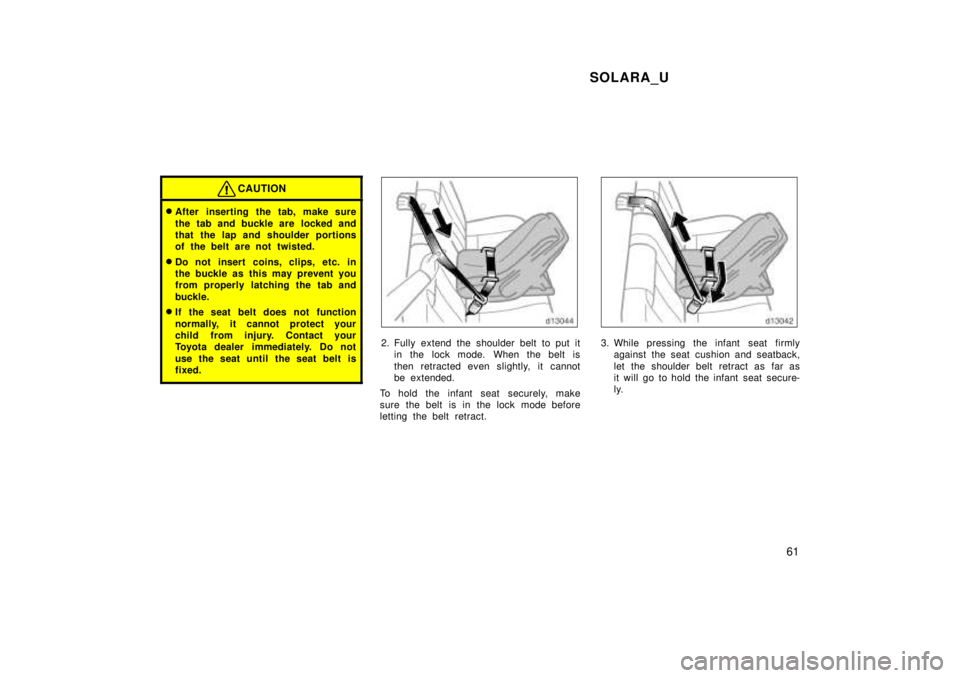
2. Fully extend the shoulder belt to put it
in the lock mode. When the belt is
then retracted even slightly, it cannot
be extended.
To hold the infant seat securely, make
sure the belt is in the lock mode before
letting the belt retract.3. While pressing the infant seat firmly against the seat cushion and seatback,
let the shoulder belt retract as far as
it will go to hold the infant seat secure-
ly.