'99 Rav4.U
140
ºABSº warning light
This light comes on when the ignition key
is turned to the ºONº position. After a few
seconds, the light will go off.
If either of the following conditions occurs,
this indicates a malfunction somewhere in
the parts monitored by the warning light
system. Contact your Toyota dealer as
soon as possible to service the vehicle.
The light does not come on as de-
scribed above, or remains on.
The light comes on while driving.
Even if the anti- lock brake system should
fail, the brake system will still operate
conventionally. However, when the ºABSº
warning light is on (and the brake system
warning light is off), anti- lock brake sys-
tem is not assisting brake performance so
that the wheel can lock- up during sudden
braking or braking on slippery road sur-
faces. Have your vehicle checked by your
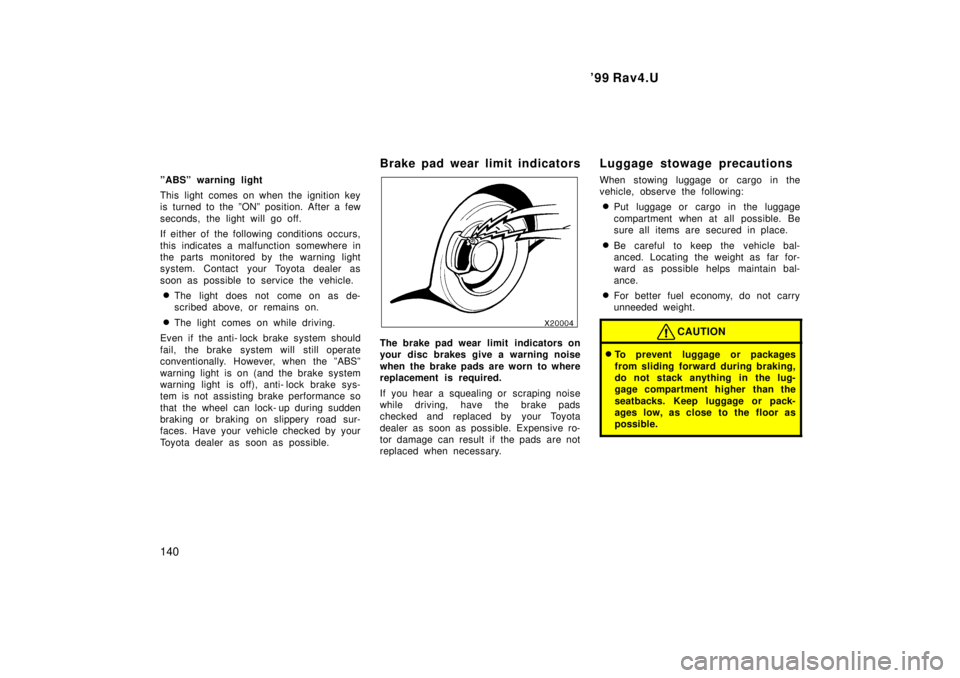
Toyota dealer as soon as possible. Brake pad wear limit indicators
The brake pad wear limit indicators on
your disc brakes give a warning noise
when the brake pads are worn to where
replacement is required.
If you hear a squealing or scraping noise
while driving, have the brake pads
checked and replaced by your Toyota
dealer as soon as possible. Expensive ro-
tor damage can result if the pads are not
replaced when necessary.Luggage stowage pr
ecautions
When stowing luggage or cargo in the
vehicle, observe the following: Put luggage or cargo in the luggage
compartment when at all possible. Be
sure all items are secured in place.
Be careful to keep the vehicle bal-
anced. Locating the weight as far for-
ward as possible helps maintain bal-
ance.
For better fuel economy, do not carry
unneeded weight.CAUTION
To prevent luggage or packages
from sliding forward during braking,
do not stack anything in the lug-
gage compartment higher than the
seatbacks. Keep luggage or pack-
ages low, as close to the floor as
possible.
'99 Rav4.U
196
Checking brake fluid
To check the fluid level, simply look at
the see- through reservoir. The level
should be between the ºMAXº and
ºMINº lines on the reservoir.
It is normal for the brake fluid level to go
down slightly as the brake pads wear. So
be sure to keep the reservoir filled.
If the reservoir needs frequent ref
illing, it
may indicate a serious mechanical problem.
If the level is low, add SAE J1703 or
FMVSS No.116 DOT 3 brake fluid to the
brake reservoir.
Remove and replace the reservoir cover by
hand. Fill the brake fluid to the dotted line.
This brings the fluid to the correct level when
you put the cover back on. Use only newly opened brake fluid. Once
opened, brake fluid absorbs moisture from
the air, and excess moisture can cause a
dangerous loss of braking.
CAUTION
Take care when filling the r
eservoir
because brake fluid can harm your
eyes and damage painted surfaces. If
fluid gets in your eyes, flush your
eyes with clean water.
NOTICE
If you spill the fluid, be sure to wash
it off with water to prevent it fromdamaging the parts or paint.
Checking power steering fluid
Close Open
If hot O.K. If hot add If cold O.K.
If cold add
Check the fluid level through the reser-
voir. If necessary, add automatic trans-
mission fluid DEXRON II or III.
If the vehicle has been driven around 80
km/h (50 mph) for 20 minutes (a little more
in frigid temperatures), the fluid is hot
(60 CÐ80 C or 140 FÐ175 F). You may
also check the level when the fluid is cold
(about room temperature, 10 CÐ30 C or
50 FÐ85 F) if the engine has not been run
for about five hours.