Page 164 of 226
'99 Rav4.U
164
To remove the spare tire:
Turn the hold- down nuts counterclockwise
with the wheel nut wrench and remove
them.
When storing the spare tire, put it in place
and secure it to prevent it from flying
forward during a collision or s udden brak-
ing. ÐBlocking the wheel2. Block the wheel diagonally opposite
the flat tire to keep the vehicle from
rolling when it is j acked up.
When blocking the wheel, place a wheel
block from the front for the front wheels
or from the rear for the rear wheels. ÐRemoving wheel ornamentSteel wheels
Aluminum wheels
Page 165 of 226
'99 Rav4.U165
3. Remove the wheel ornament.
Pry off the wheel ornament, using the
beveled end of the wheel nut wrench as
shown.
CAUTION
Do not try to pull the ornament by
hand. Take due care in handling the
ornament to avoid unexpected person-
al injury.
ÐLoosening wheel nuts
4. Loosen all the wheel nuts.
Always loosen the wheel nuts before rais-
ing the vehicle.
The nuts turn counterclockwise to loosen.
To get maximum leverage, fit the wrench
to the nut so that the handle is on the
right side, as shown above. Grab the
wrench near the end of the handle and
pull up on the handle. Be careful that the
wrench does not slip off the nut.
Do not remove the nuts yetÐjust unscrew
them about one- half turn. ÐPositioning the jack5. Position the jack at the following
jack points.
1 Front suspension arm rear mounting
2 Rear suspension arm
Make sure the jack is positioned on a
level and solid place.
Page 166 of 226
'99 Rav4.U
166
ÐRaising your vehicle
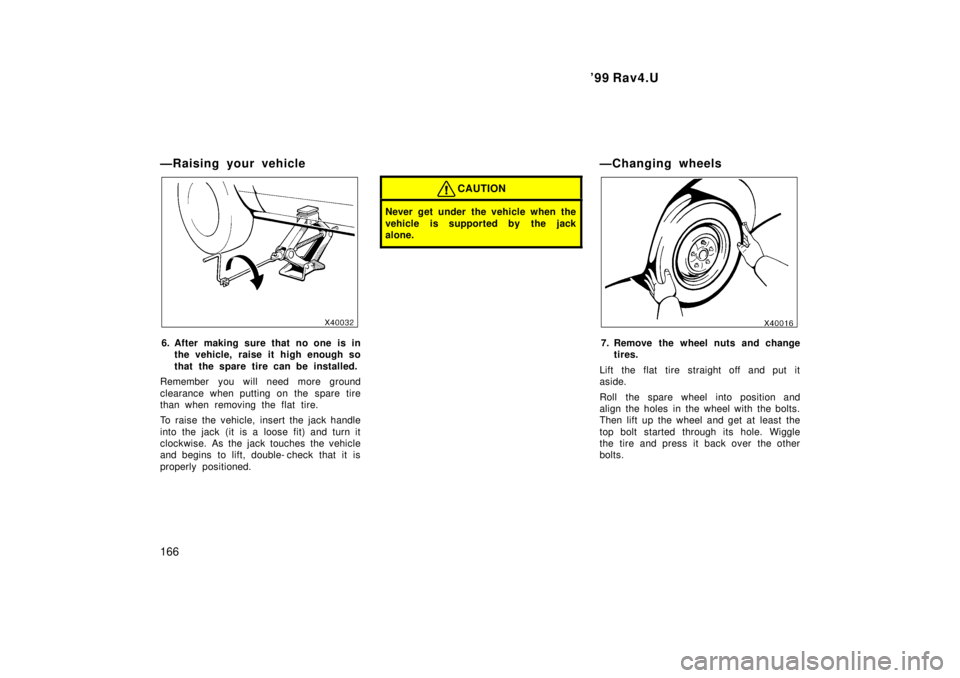
6. After making sure that no one is in
the vehicle, raise it high enough so
that the spare tire can be installed.
Remember you will need more ground
clearance when putting on the spare tire
than when removing the flat tire.
To raise the vehicle, insert the jack handle
into the jack (it is a loose fit) and turn it
clockwise. As the jack touches the vehicle
and begins to lift, double- check that it is
properly positioned.
CAUTION
Never get under the vehicle when the
vehicle is supported by the jack
alone.
ÐChanging wheels
7. Remove the wheel nuts and change tires.
Lift the flat tire straight off and put it
aside.
Roll the spare wheel into position and
align the holes in the wheel with the bolts.
Then lift up the wheel and get at least the
top bolt started through its hole. Wiggle
the tire and press it back over the other
bolts.
Page 167 of 226

'99 Rav4.U167
Before putting on wheels, remove any cor-
rosion on the mounting surfaces with a
wire brush or such. Installation of wheels
without good metal- to- metal contact at the
mounting surface can cause wheel nuts to
loosen and eventually cause a wheel to
come off while driving. Therefore after the
first 1600 km (1000 miles), check to see
that the wheel nuts are tight. ÐReinstalling wheel nuts8. Reinstall all the wheel nuts finger
tight.
Reinstall the wheel nuts (tapered end in-
ward) and tighten them as much as you
can by hand. Press back on the tire back
and see if you can tighten them more. ÐLowering your vehicle9. Lower the vehicle completely and
tighten the wheel nuts.
Turn the jack handle counterclockwise to
lower the vehicle.
Use only the wheel nut wrench and turn
it clockwise to tighten the nuts. Do not
use other tools or any additional leverage
other than your hands, such as a hammer,
pipe or your foot. Make sure the wrench
is securely engaged over the nut.
Tighten each nut a little at a time in the
order shown. Repeat the process until all
the nuts are tight.
Page 168 of 226
'99 Rav4.U
168
CAUTION
When lowering the vehicle, make sure
all portions of your body and all oth-
er persons around will not be injured
as the vehicle is lowered to the
ground.
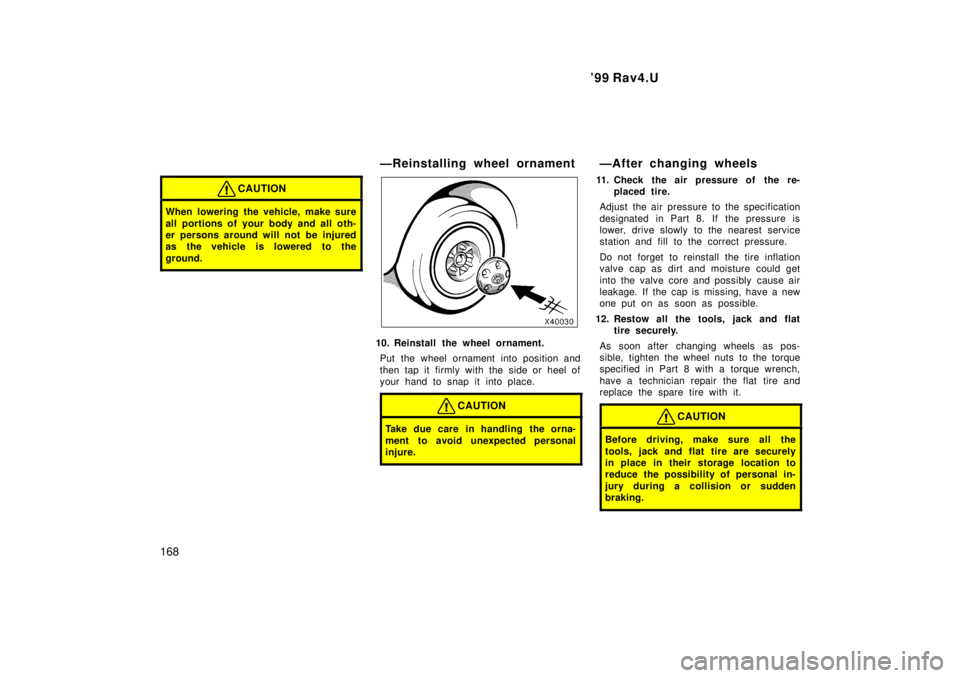
ÐReinstalling wheel ornament
10. Reinstall the wheel ornament. Put the wheel ornament into position and
then tap it firmly with the side or heel of
your hand to snap it into place.
CAUTION
Take due care in handling the orna-
ment to avoid unexpected personal
injure.
ÐAfter changing wheels
11. Check the air pressure of the re- placed tire.
Adjust the air pressure to the specification
designated in Part 8. If the pressure is
lower, drive slowly to the nearest service
station and fill to the correct pressure.
Do not forget to reinstall the tire inflation
valve cap as dirt and moisture could get
into the valve core and possibly cause air
leakage. If the cap is missing, have a new
one put on as soon as possible.
12. Restow all the tools, jack and flat tire securely.
As soon after changing wheels as pos-
sible, tighten the wheel nuts to the torque
specified in Part 8 with a torque wrench,
have a technician repair the flat tire and
replace the spare tire with it.
CAUTION
Before driving, make sure all the
tools, jack and flat tire are securely
in place in their storage location to
reduce the possibility of personal in-
jury during a collision or s udden
braking.
Page 169 of 226

'99 Rav4.U169
(a) Towing with wheel lift type truckÐÐFrom front
ÐFrom rear
(b) Using flat bed truck
Two- wheel drive models
(a) Towing with wheel lift type truckÐ ÐFrom front
ÐFrom rear
(b) Using flat bed truck
Four- wheel drive models If towing is necessary, we recommend
you to have it done by your Toyota
dealer or a commercial tow truck ser-
vice. In consultation with them, have
your vehicle towed using either (a) or
(b).
Only when you cannot receive a towing
service from a Toyota dealer or com-
mercial tow truck service, tow your ve-
hicle carefully in accordance with the
instructions given in ºÐEmergency tow-
ingº in this part.
Proper equipment will help ensure that
your vehicle is not damaged while being
towed. Commercial operators are generally
aware of the state/provincial and local
laws pertaining to towing.
Your vehicle can be damaged if it is
towed incorrectly. Although most operators
know the correct procedure, it is possible
to make a mistake. To avoid damage to
your vehicle, make sure the following few
precautions are observed. If necessary,
show this page to the tow truck driver.
If your vehicle needs to be
towedÐ
Page 170 of 226
'99 Rav4.U
170
TOWING PRECAUTIONS:
Use a safety chain system for all towing,
and abide by the state/provincial and local
laws. The wheels and axle on the ground
must be in good condition. If they are
damaged, use a towing dolly.
Two- wheel drive modelsÐ
(a) Towing with wheel lift type truck
From frontÐ
Release the parking brake.
NOTICE
When lifting wheels, take care to en-
sure adequate ground clearance fortowing at the opposite end of the
raised vehicle. Otherwise, the bumper
and/or underbody of the towed vehiclewill be damaged during towing.
From rearÐ
Manual transmission:
We recommend using a towing dolly
under the front wheels. If you do not
use a towing dolly, place the ignition
key in the ºACCº position and put the
transmission in neutral.
NOTICE
Do not tow with the key removed or
in the ºLOCKº position when towingfrom the rear without a towing dolly. The steering lock mechanism is not
strong enough to hold the frontwheels straight.
Automatic transmission:
Use a towing dolly under the front
wheels.
NOTICE
Never tow a vehicle with an automatic
transmission from the rear with thefront wheels on the ground, as this
may cause serious damage to the
transmission.
(b) Using flat bed truck
Four- wheel drive modelsÐ
(a) Towing with wheel lift type truck
Use a towing dolly under the wheels not
lifted by the truck.
(b) Using flat bed truck
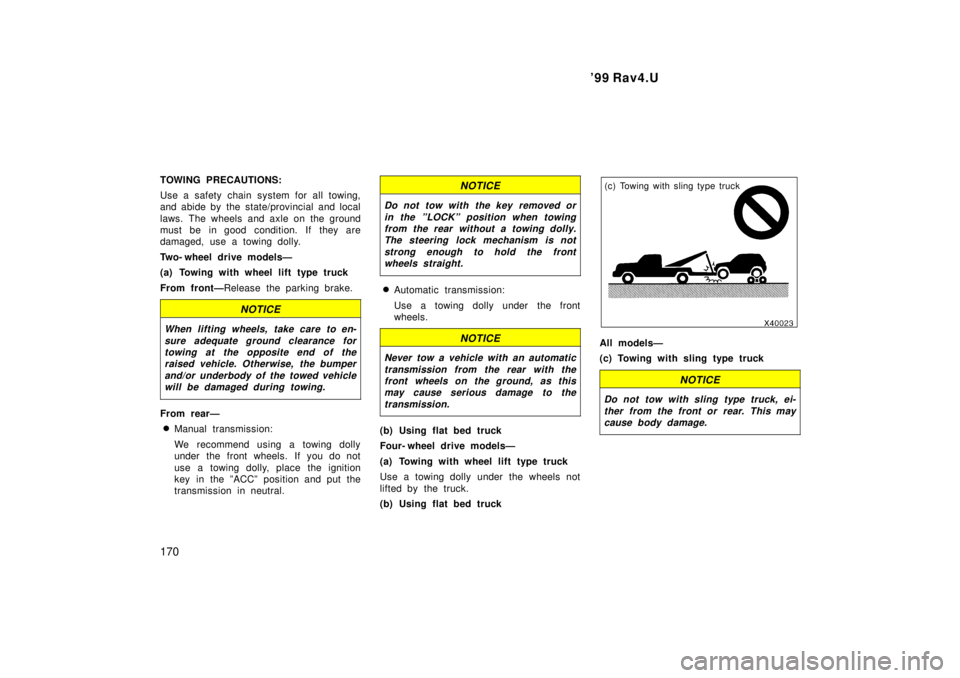
(c) Towing with sling type truck
All modelsÐ
(c) Towing with sling type truck
NOTICE
Do not tow with sling type truck, ei- ther from the front or rear. This maycause body damage.
Page 171 of 226
'99 Rav4.U171
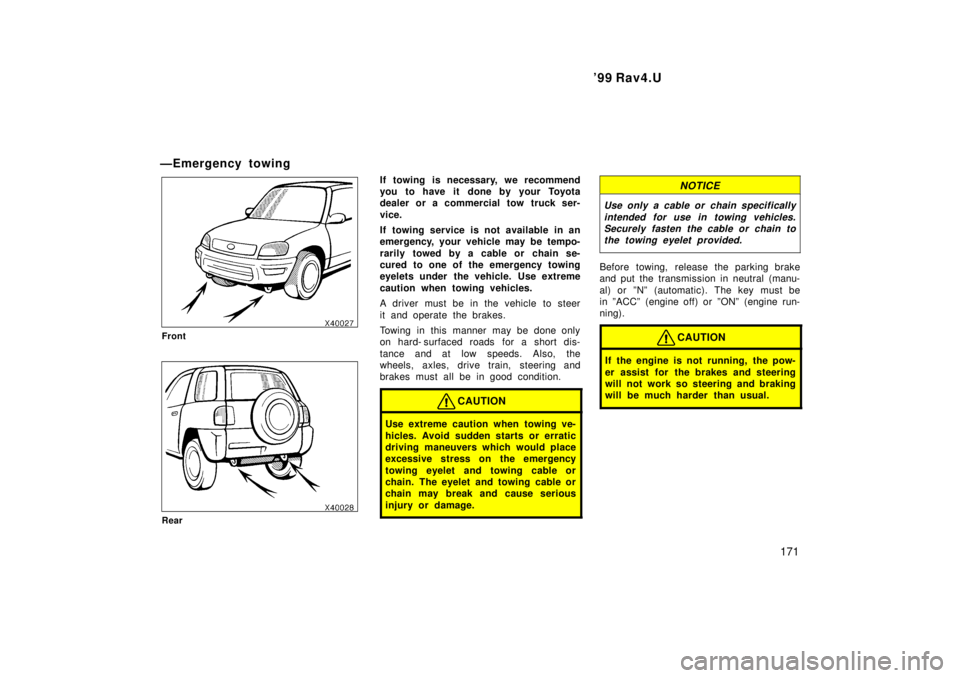
ÐEmergency towing
Front
Rear
If towing is necessary, we recommend
you to have it done by your Toyota
dealer or a commercial tow truck ser-
vice.
If towing service is not available in an
emergency, your vehicle may be tempo-
rarily towed by a cable or chain se-
cured to one of the emergency towing
eyelets under the vehicle. Use extreme
caution when towing vehicles.
A driver must be in the vehicle to steer
it and operate the brakes.
Towing in this manner may be done only
on hard- surfaced roads for a short dis-
tance and at low speeds. Also, the
wheels, axles, drive train, steering and
brakes must all be in good condition.
CAUTION
Use extreme caution when towing ve-
hicles. Avoid sudden starts or erratic
driving maneuvers which would place
excessive stress on the emergency
towing eyelet and towing cable or
chain. The eyelet and towing cable or
chain may break and cause serious
injury or damage.
NOTICE
Use only a cable or chain specifically
intended for use in towing vehicles.Securely fasten the cable or chain to the towing eyelet provided.
Before towing, release the parking brake
and put the transmission in neutral (manu-
al) or ºNº (automatic). The key must be
in ºACCº (engine off) or ºONº (engine run-
ning).
CAUTION
If the engine is not running, the pow-
er assist for the brakes and steering
will not work so steering and braking
will be much harder than usual.