New L/C100(U)165
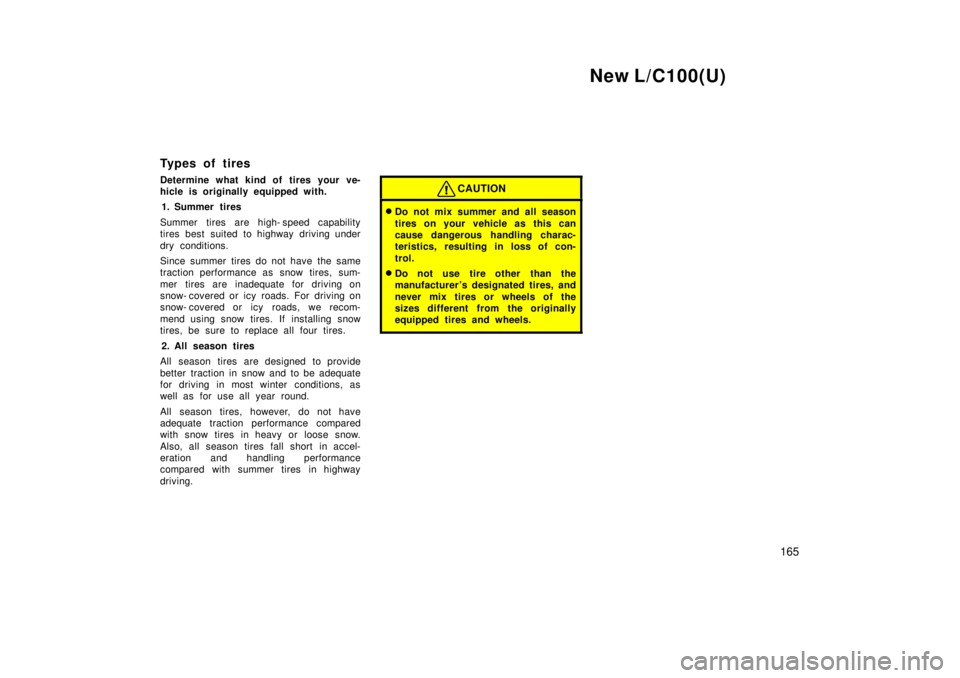
Types of tires
Determine what kind of tires your ve-
hicle is originally equipped with.
1. Summer tires
Summer tires are high- speed capab ility
tires best suited to highway driving under
dry conditions.
Since summer tires do not have the same
traction performance as snow tires, sum-
mer tires are inadequate for driving on
snow- covered or icy roads. For driving on
snow- covered or icy roads, we recom-
mend using snow tires. If installing snow
tires, be sure to replace all four tires.
2. All season tires
All season tires are designed to provide
better traction in snow and to be adequate
for driving in most winter conditions, as
well as for use all year round.
All season tires, however, do not have
adequate traction performance compared
with snow tires in heavy or loose snow.
Also, all season tires fall short in accel-
eration and handling performance
compared with summer tires in highway
driving.
CAUTION
Do not mix summer and all season
tires on your vehicle as this can
cause dangerous handling charac-
teristics, resulting in loss of con-
trol.
Do not use tire other than the
manufacturer 's designated tires, and
never mix tires or wheels of the
sizes different from the originally
equipped tires and wheels.
New L/C100(U)
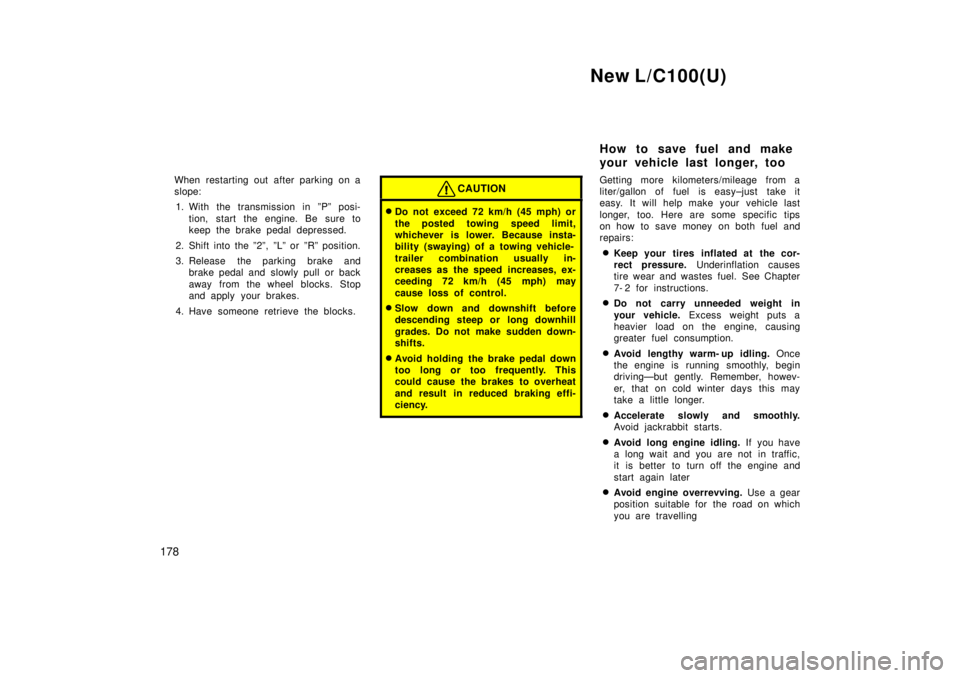
178 When restarting out after parking on a
slope:
1. With the transmission in ºPº posi- tion, start the engine. Be sure to
keep the brake pedal depressed.
2. Shift into the º2º, ºLº or ºRº position.
3. Release the parking brake and brake pedal and slowly pull or back
away from the wheel blo cks. Stop
and apply your brakes.
4. Have someone retrieve the blo cks.
CAUTION
Do not exceed 72 km/h (45 mph) or
the posted towing speed limit,
whichever is lower. Because insta-
bility (swaying) of a towing vehicle-
trailer combination usually in-
creases as the speed increases, ex-
ceeding 72 km/h (45 mph) may
cause loss of control.
Slow down and downshift before
descending steep or long downhill
grades. Do not make sudden down-
shifts.
Avoid holding the brake pedal down
too long or too frequently. This
could cause the brakes to overheat
and result in reduced braking effi-
ciency.
Getting more kilometers/mileage from a
liter/gallon of fuel is easy±just take it
easy. It will help make your vehicle last
longer, too. Here are some specific tips
on how to save money on both fuel and
repairs:
Keep your tires inflated at the cor-
rect pressure. Underinflation causes
tire wear and wastes fuel. See Chapter
7- 2 for instructions.
Do not carry unneeded weight in
your vehicle. Excess weight puts a
heavier load on the engine, causing
greater fuel consumption.
Avoid lengthy warm- up idling. Once
the engine is running smoothly, begin
drivingÐbut gently. Remember, howev-
er, that on cold winter days this may
take a little longer.
Accelerate slowly and smoothly.
Avoid jackrabbit starts.
Avoid long engine idling. If you have
a long wait and you are not in traffic,
it is better to turn off the engine and
start again later
Avoid engine overrevving. Use a gear
position suitable for the road on which
you are travelling
How to save fuel and make
your vehicle last longer, too