1999 SUZUKI BALENO Air conditioner
[x] Cancel search: Air conditionerPage 24 of 65
60G-74E
INSTRUMENT PANEL
60G-05-018
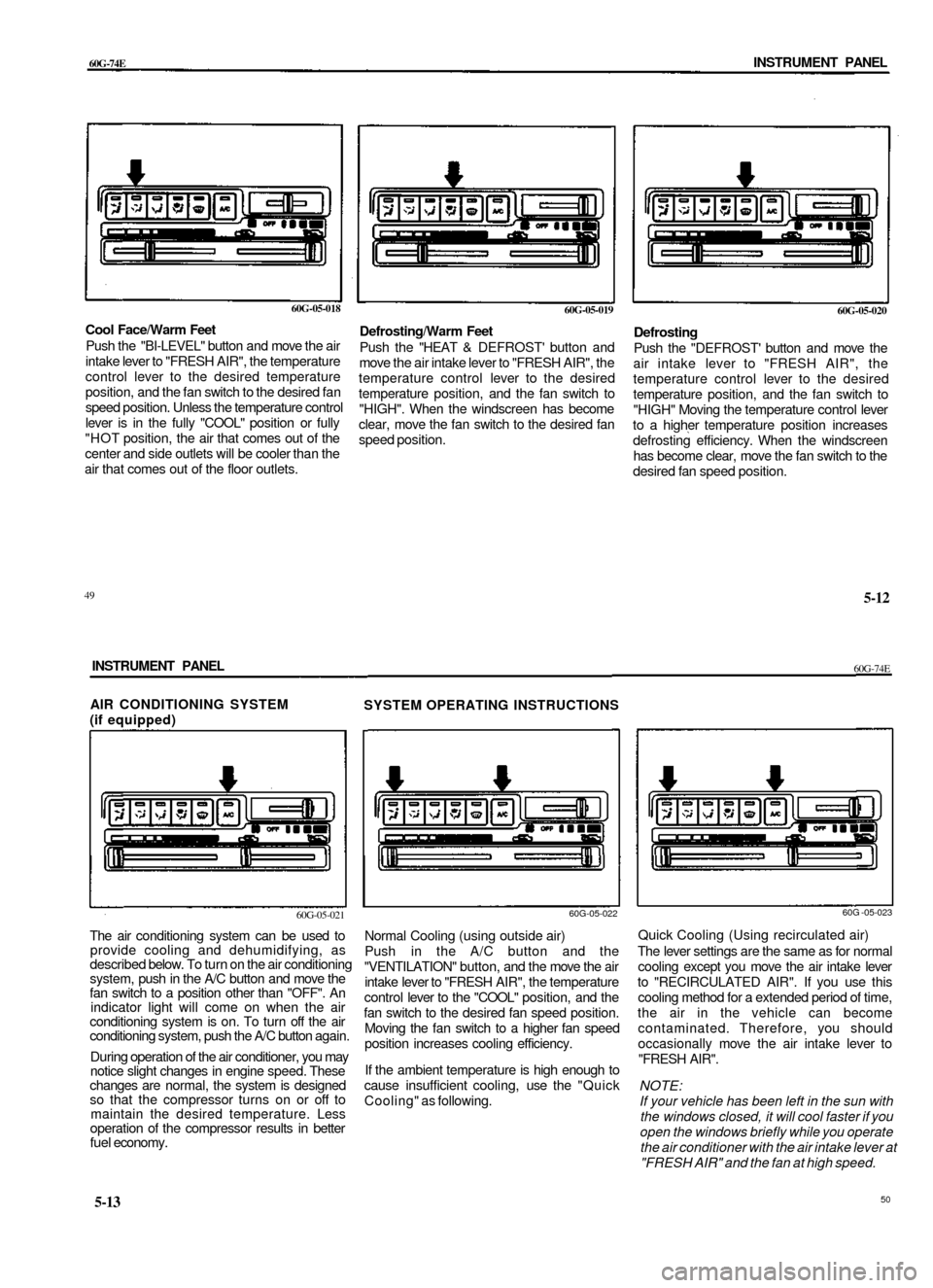
Cool Face/Warm Feet
Push the "BI-LEVEL" button and move the air
intake lever to "FRESH AIR", the temperature
control lever to the desired temperature
position, and the fan switch to the desired fan
speed position. Unless the temperature control
lever is in the fully "COOL" position or fully
"HOT position, the air that comes out of the
center and side outlets will be cooler than the
air that comes out of the floor outlets.
60G-05-019
Defrosting/Warm Feet
Push the "HEAT & DEFROST' button and
move the air intake lever to "FRESH AIR", the
temperature control lever to the desired
temperature position, and the fan switch to
"HIGH". When the windscreen has become
clear, move the fan switch to the desired fan
speed position.
60G-05-020
Defrosting
Push the "DEFROST' button and move the
air intake lever to "FRESH AIR", the
temperature control lever to the desired
temperature position, and the fan switch to
"HIGH" Moving the temperature control lever
to a higher temperature position increases
defrosting efficiency. When the windscreen
has become clear, move the fan switch to the
desired fan speed position.
49
5-12
INSTRUMENT PANEL
60G-74E
AIR CONDITIONING SYSTEM
(if equipped)
SYSTEM OPERATING INSTRUCTIONS
60G-05-021
The air conditioning system can be used to
provide cooling and dehumidifying, as
described below. To turn on the air conditioning
system, push in the A/C button and move the
fan switch to a position other than "OFF". An
indicator light will come on when the air
conditioning system is on. To turn off the air
conditioning system, push the A/C button again.
During operation of the air conditioner, you may
notice slight changes in engine speed. These
changes are normal, the system is designed
so that the compressor turns on or off to
maintain the desired temperature. Less
operation of the compressor results in better
fuel economy.
60G-05-022
Normal Cooling (using outside air)
Push in the A/C button and the
"VENTILATION" button, and the move the air
intake lever to "FRESH AIR", the temperature
control lever to the "COOL" position, and the
fan switch to the desired fan speed position.
Moving the fan switch to a higher fan speed
position increases cooling efficiency.
If the ambient temperature is high enough to
cause insufficient cooling, use the "Quick
Cooling" as following.
60G -05-023
Quick Cooling (Using recirculated air)
The lever settings are the same as for normal
cooling except you move the air intake lever
to "RECIRCULATED AIR". If you use this
cooling method for a extended period of time,
the air in the vehicle can become
contaminated. Therefore, you should
occasionally move the air intake lever to
"FRESH AIR".
NOTE:
If your vehicle has been left in the sun with
the windows closed, it will cool faster if you
open the windows briefly while you operate
the air conditioner with the air intake lever at
"FRESH AIR" and the fan at high speed.
5-13
50
Page 25 of 65
60G-74E
INSTRUMENT PANEL
60G-05-024
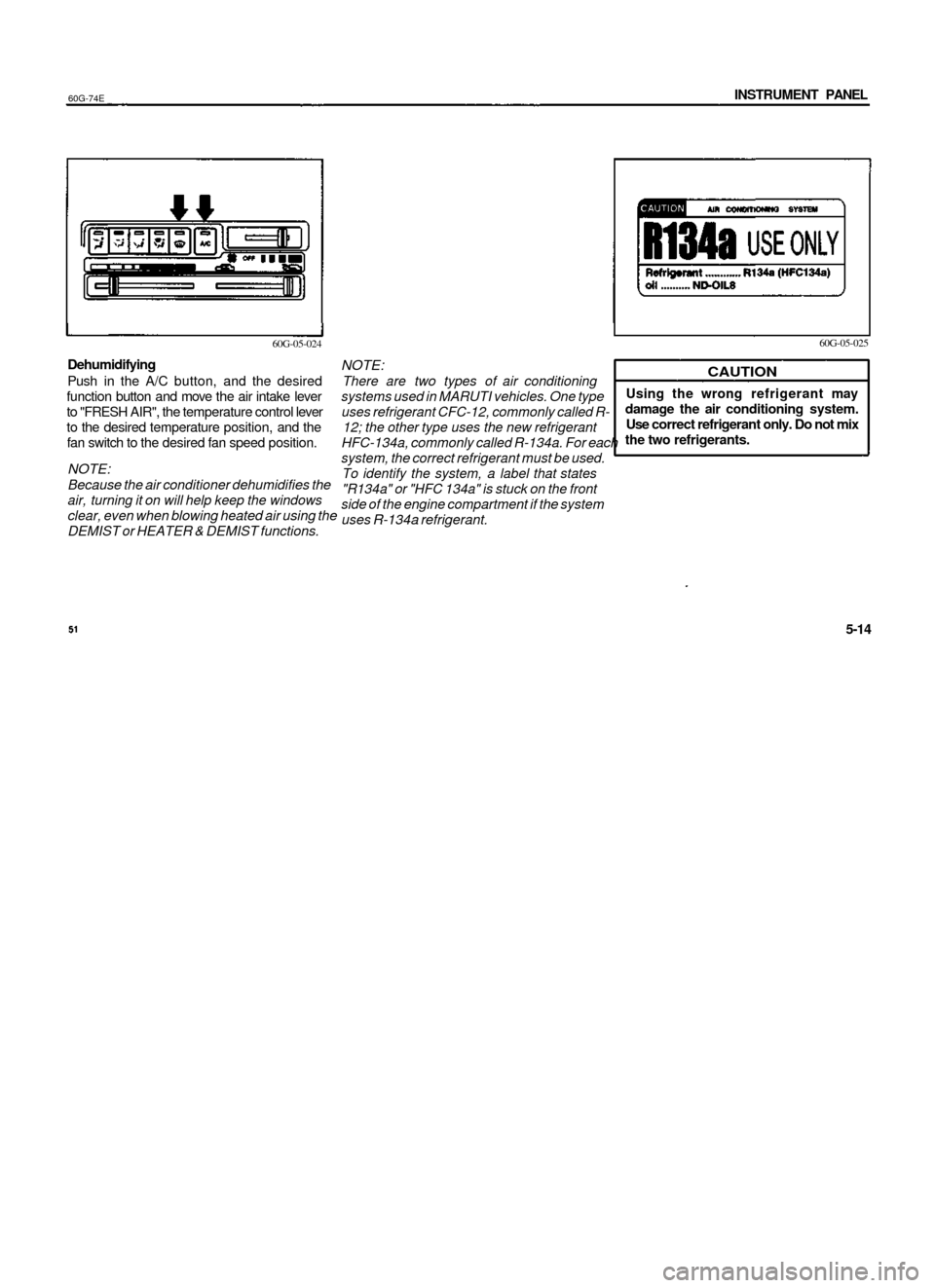
Dehumidifying
Push in the A/C button, and the desired
function button and move the air intake lever
to "FRESH AIR", the temperature control lever
to the desired temperature position, and the
fan switch to the desired fan speed position.
NOTE:
Because the air conditioner dehumidifies the
air, turning it on will help keep the windows
clear, even when blowing heated air using the
DEMIST or HEATER & DEMIST functions.
60G-05-025
NOTE:
There are two types of air conditioning
systems used in MARUTI vehicles. One type
uses refrigerant CFC-12, commonly called R-
12; the other type uses the new refrigerant
HFC-134a, commonly called R-134a. For each
system, the correct refrigerant must be used.
To identify the system, a label that states
"R134a" or "HFC 134a" is stuck on the front
side of the engine compartment if the system
uses R-134a refrigerant.
CAUTION
Using the wrong refrigerant may
damage the air conditioning system.
Use correct refrigerant only. Do not mix
the two refrigerants.
60G-74E
5-14
OTHER CONTROLS AND EQUIPMENT
OTHER CONTROLS AND EQUIPMENT
Parking Brake Lever 6-1
Pedals 6-2
Gear Lever 6-2
Fuel Filler Cap 6-3
Folding Rear Seats 6-4
Sun Visor 6-5
Interior Light Switch 6-5
Assist Grips 6-5
Bonnet 6-6
Cup Holder (if equipped) 6-7
Tyre Changing Tools 6-7
Luggage Compartment Trim 6-8
Trunk (Boot) Light 6-8
Front Seat Back Pocket (if equipped) 6-9
Rear spoiler with Stop lamp (if equipped) 6-9
Alloy Wheels (if equipped) 6-9
Power Antenna (if equipped) 6-10
Leather Cover (if equipped) 6-10
High Mount Stop Lamp 6-10
53
Page 26 of 65
60G-74E
INSTRUMENT PANEL
60G-05-024
Dehumidifying
Push in the A/C button, and the desired
function button and move the air intake lever
to "FRESH AIR", the temperature control lever
to the desired temperature position, and the
fan switch to the desired fan speed position.
NOTE:
Because the air conditioner dehumidifies the
air, turning it on will help keep the windows
clear, even when blowing heated air using the
DEMIST or HEATER & DEMIST functions.
60G-05-025
NOTE:
There are two types of air conditioning
systems used in MARUTI vehicles. One type
uses refrigerant CFC-12, commonly called R-
12; the other type uses the new refrigerant
HFC-134a, commonly called R-134a. For each
system, the correct refrigerant must be used.
To identify the system, a label that states
"R134a" or "HFC 134a" is stuck on the front
side of the engine compartment if the system
uses R-134a refrigerant.
CAUTION
Using the wrong refrigerant may
damage the air conditioning system.
Use correct refrigerant only. Do not mix
the two refrigerants.
60G-74E
5-14
OTHER CONTROLS AND EQUIPMENT
OTHER CONTROLS AND EQUIPMENT
Parking Brake Lever 6-1
Pedals 6-2
Gear Lever 6-2
Fuel Filler Cap 6-3
Folding Rear Seats 6-4
Sun Visor 6-5
Interior Light Switch 6-5
Assist Grips 6-5
Bonnet 6-6
Cup Holder (if equipped) 6-7
Tyre Changing Tools 6-7
Luggage Compartment Trim 6-8
Trunk (Boot) Light 6-8
Front Seat Back Pocket (if equipped) 6-9
Rear spoiler with Stop lamp (if equipped) 6-9
Alloy Wheels (if equipped) 6-9
Power Antenna (if equipped) 6-10
Leather Cover (if equipped) 6-10
High Mount Stop Lamp 6-10
53
Page 44 of 65

60G-74E
INSPECTION AND MAINTENANCE
Interval: This Interval should be judged
by odometer reading or months,
whichever comes first.
km (x 1,000)
months
ROAD TEST
1. Operation of Brakes, Gear shifting & speedometer
2. Body and Chassis noise
AIR CONDITIONER (if equipped)
1. Check belt tension
2. Check Receiver Drier bubbles.
3. Tighten compressor mounting bolts
4. Check all hose joints, tighten if necessary
5. Check functioning of Recirc flap .*
6. Clean condenser with low pressure water
7. Check belt for frayed edges, change if necessary
8. Check all mounting bolts
FREE
1
1
I
I
I
I
—
I
I
_
-
-
INSPECTIONS
5
6
I
I
I
I
T
I
I
C
I
I
10
12
I
I
I
I
T
I
I
C
I
I
PERIODIC
20
24
I
I
I
I
T
I
I
C
I
I
30
36
I
I
I
I
T
I
I
C
I
I
MAINTENANCE
40
48
I
I
I
I
T
I
I
C
I
I
50
60
I
I
I
I
T
I
I
C
I
I
SERVICE
60
72
I
I
I
I
T
I
I
C
I
I
AT,
70
84
I
I
I
I
T
I
I
C
I
I
COST
80
96
I
I
I
I
T
I
I
C
I
I
The rear shock absorbers are filled with
high pressure gas. Never attempt to
disassemble it or throw it into a fire.
Avoid storing it near a heater or heating
device. When scrapping the absorber,
the gas must be released from the
absorber safely. Ask your dealer for
assistance.
89
9-6
INSPECTION AND MAINTENANCE
60G-74E
All maintenance should be carried
out with the Ignition switch in the
"OFF" position and the car parked
securely on the level ground unless
otherwise specified.
If you are In any way unsure of your
ability to undertake a task, then do
not start it but contact your Maruti
dealer to perform the work for you.
ENGINE OIL AND FILTER
Specified oil
Be sure that the engine oil you use comes
under the API classification of SF, SG or SH.
Select the appropriate oil viscosity according
to the above chart.
9-7
90
70F-07-004E
Page 59 of 65

EMERGENCY SERVICE
60G-74E
CAUTION
Vehicle equipped with electronic fuel
injection system will not start by
pushing or towing as the fuel pump
will not work in this condition. This
starting method could also result in
permanent damage to the catalytic
converter. Use jump leads to start a
vehicle with a weak or flat battery.
60G-10-004E
When jump starting your vehicle, use the
following procedure:
1) Use only a 12 volt battery to jump start
your vehicle. Position the good 12V battery
close to your vehicle so that the jump leads
will reach both batteries. When using a
battery installed on another vehicle, DO
NOT LET THE VEHICLES TOUCH. Apply
the parking brakes fully on both vehicles.
2) Turn off all vehicle accessories, except
those necessary for safety reasons (for
example, headlights or hazard lights).
3) Make jump lead connections as follows:
a) Connect one end of the first jump lead
to the positive (+) terminal of the flat
battery.
b) Connect the other end to the positive
(+) terminal of the booster battery.
c) Connect one end of the second jump
lead to the negative (-) terminal of the
booster battery.
d) Make the final connection to an
unpainted, heavy metal part of the
engine of the vehicle with the flat
battery.
Never connect the jump lead directly
to the negative (-) terminal of the
discharged battery, or an explosion
may occur.
10-3
4) If the booster battery you are using is fitted
to another vehicle, start the engine of the
vehicle with the booster battery. Run the
engine at moderate speed.
5) Start the engine of the vehicle with the flat
battery.
6) Remove the jump leads in the exact
reverse order in which you connected
them.
118
60G-74E
EMERGENCY SERVICE
TOWING
If you need to have your vehicle towed, contact
a professional service.
CAUTION
To help avoid damage to your vehicle
during towing, proper equipment and
towing procedures must be used.
Manual Transmission
Whenever possible, your vehicle should be
towed from the front with the front wheels lifted.
If the steering and drivetrain are in good
condition, your vehicle may be towed from the
rear with the rear wheels lifted and the front
wheels on the ground. Before towing, make
sure the steering is unlocked and the
transmission is in neutral.
EMERGENCY REMEDIES
If the Starter Does Not Operate:
1) Try turning the ignition switch to the
"START" position with the headlights
turned on to determine the battery
condition. If the headlights go excessively
dim or go off, it usually means that either
the battery is flat or the battery terminal
contact is poor. Recharge the battery or
correct battery terminal contact as
necessary.
2) If the headlights remain bright, check the
fuses. If the reason for failure of the starter
is not obvious, there may be a major
electrical problem. Have the vehicle
inspected by your authorized MARUTI
dealer.
If the Engine is Flooded
If the engine is flooded with petrol, it may be
hard to start. If this happens, press the
accelerator pedal all the way to the floor and
hold it there while cranking the engine. (Do
not operate the starter motor for more than
15 seconds). Release the accelerator as soon
as the engine has started.
If the Engine Overheats
The engine could overheat temporarily under
severe driving conditions. If the engine coolant
temperature gauge indicates overheating
during driving:
1) Turn off the air conditioner, if equipped.
2) Take the vehicle to a safe place and park.
3) Let the engine run at normal idle speed
for a few minutes until the indicator is within
the normal, acceptable temperature range
between "H" and "C".
If you see or hear escaping steam, stop
the vehicle in a safe place and
Immediately turn off the engine to let it
cool. Do not open the bonnet when
steam is present. When the steam can
no longer be seen or heard, open the
hood to see if the coolant is still boiling.
If it is, you must wait until it stops
boiling before you proceed.
119
10-4
Page 60 of 65

EMERGENCY SERVICE
60G-74E
WARNING TRIANGLE (TYPE-1)
If the temperature indication does not come
down to within the normal, acceptable range:
1) Turn off the engine and check that the
water pump belt and pulleys are not
damaged or slipping. If any abnormality is
found, correct it.
2) Check the coolant level in the reservoir. If
it is found to be lower than the "LOW" line,
look for leaks at the radiator, water pump,
and radiator and heater hoses. If you
locate any leaks that may have caused the
overheating, do not run the engine until
these problems have been corrected.
3) If you do not find a leak, carefully add
coolant to the reservoir and then the
radiator, if necessary. (Refer to "ENGINE
COOLANr in the "INSPECTION AND
MAINTENANCE" section.)
K is dangerous to remove the radiator
cap when the water temperature is
high, because scalding fluid and steam
may be blown out under pressure. The
cap should only be taken off when the
coolant temperature has lowered.
To help prevent personal Injury, keep
hands, tools and clothing away from the
engine cooling fan and airconditioner
fan (if equipped). These electric fans
can automatically turn on without
warning.
843-10-004
In case of vehicle break-down or during
emergency stopping where your vehicle could
become a potential traffic hazard, please keep
the warning triangle, provided with your
vehicle, on the pathway (road) behind the
vehicle so as to warn the approaching traffic,
at an approximate distance of 5-15 m, such
that reflecting side of the triangle faces the
rear. Please activate the hazard warning lamps
before alighting the vehicle to keep the warning
triangle.
10-5
120
60G-74E
EMERGENCY SERVICE
WARNING TRIANGLE (TYPE-2)
In case of vehicle breakdown or during
emergency stopping where your vehicle
could become a potential traffic hazard,
keep the warning triangle, provided with
your vehicle, on the road free from any
obstacles behind your vehicle so as to warn
the approaching traffic, at an approximate
distance of 50-100 m, the reflecting side of
the triangle should face the on coming
traffic. Please activate the hazard warning
lamps before alighting the vehicle to keep
the warning triangle.
Remove the warning triangle
carefully from the box as shown by arrow
1.
Open both the reflector arms as shown
by arrows and lock arms with each other
with the clip provided in the right arm.
Open the bottom stand in counter clock-
wise direction as shown by arrow 3.
Position the warning triangle behind the
vehicle on a plain surface.
Reverse the removal procedure
keeping inside the box.
for
121
10-6