1999 SUZUKI BALENO Fuel
[x] Cancel search: FuelPage 24 of 65
60G-74E
INSTRUMENT PANEL
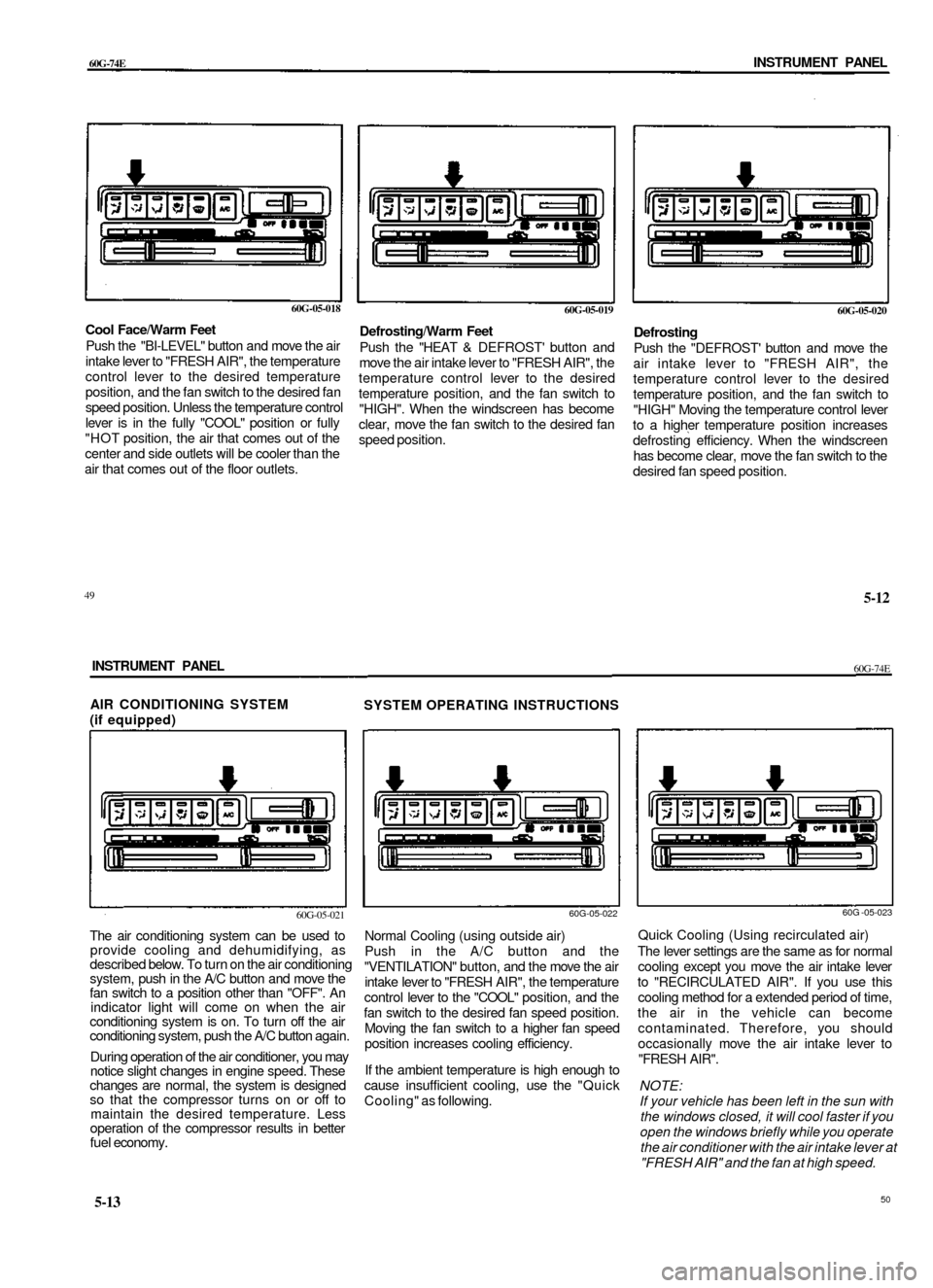
60G-05-018
Cool Face/Warm Feet
Push the "BI-LEVEL" button and move the air
intake lever to "FRESH AIR", the temperature
control lever to the desired temperature
position, and the fan switch to the desired fan
speed position. Unless the temperature control
lever is in the fully "COOL" position or fully
"HOT position, the air that comes out of the
center and side outlets will be cooler than the
air that comes out of the floor outlets.
60G-05-019
Defrosting/Warm Feet
Push the "HEAT & DEFROST' button and
move the air intake lever to "FRESH AIR", the
temperature control lever to the desired
temperature position, and the fan switch to
"HIGH". When the windscreen has become
clear, move the fan switch to the desired fan
speed position.
60G-05-020
Defrosting
Push the "DEFROST' button and move the
air intake lever to "FRESH AIR", the
temperature control lever to the desired
temperature position, and the fan switch to
"HIGH" Moving the temperature control lever
to a higher temperature position increases
defrosting efficiency. When the windscreen
has become clear, move the fan switch to the
desired fan speed position.
49
5-12
INSTRUMENT PANEL
60G-74E
AIR CONDITIONING SYSTEM
(if equipped)
SYSTEM OPERATING INSTRUCTIONS
60G-05-021
The air conditioning system can be used to
provide cooling and dehumidifying, as
described below. To turn on the air conditioning
system, push in the A/C button and move the
fan switch to a position other than "OFF". An
indicator light will come on when the air
conditioning system is on. To turn off the air
conditioning system, push the A/C button again.
During operation of the air conditioner, you may
notice slight changes in engine speed. These
changes are normal, the system is designed
so that the compressor turns on or off to
maintain the desired temperature. Less
operation of the compressor results in better
fuel economy.
60G-05-022
Normal Cooling (using outside air)
Push in the A/C button and the
"VENTILATION" button, and the move the air
intake lever to "FRESH AIR", the temperature
control lever to the "COOL" position, and the
fan switch to the desired fan speed position.
Moving the fan switch to a higher fan speed
position increases cooling efficiency.
If the ambient temperature is high enough to
cause insufficient cooling, use the "Quick
Cooling" as following.
60G -05-023
Quick Cooling (Using recirculated air)
The lever settings are the same as for normal
cooling except you move the air intake lever
to "RECIRCULATED AIR". If you use this
cooling method for a extended period of time,
the air in the vehicle can become
contaminated. Therefore, you should
occasionally move the air intake lever to
"FRESH AIR".
NOTE:
If your vehicle has been left in the sun with
the windows closed, it will cool faster if you
open the windows briefly while you operate
the air conditioner with the air intake lever at
"FRESH AIR" and the fan at high speed.
5-13
50
Page 25 of 65
60G-74E
INSTRUMENT PANEL
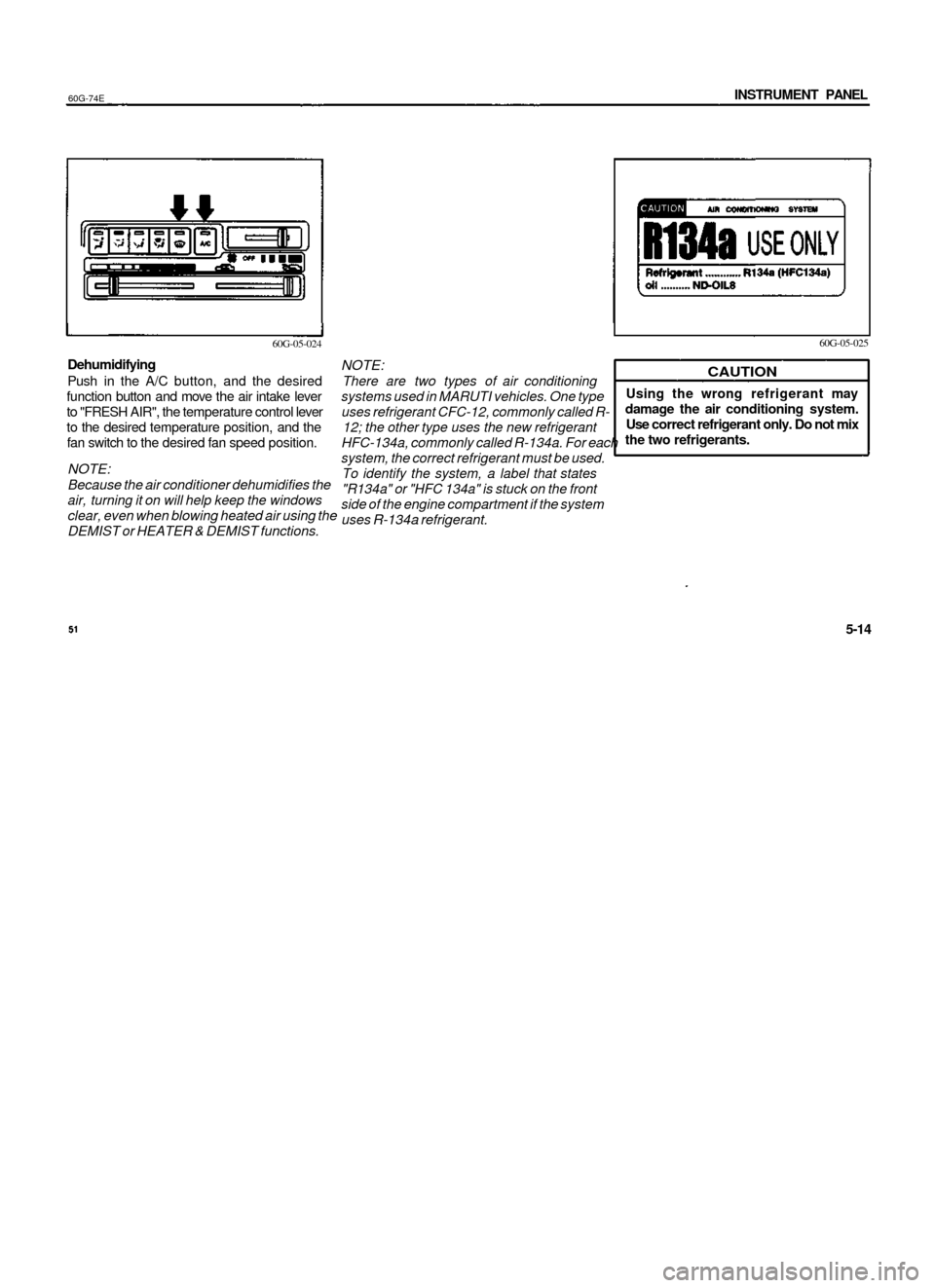
60G-05-024
Dehumidifying
Push in the A/C button, and the desired
function button and move the air intake lever
to "FRESH AIR", the temperature control lever
to the desired temperature position, and the
fan switch to the desired fan speed position.
NOTE:
Because the air conditioner dehumidifies the
air, turning it on will help keep the windows
clear, even when blowing heated air using the
DEMIST or HEATER & DEMIST functions.
60G-05-025
NOTE:
There are two types of air conditioning
systems used in MARUTI vehicles. One type
uses refrigerant CFC-12, commonly called R-
12; the other type uses the new refrigerant
HFC-134a, commonly called R-134a. For each
system, the correct refrigerant must be used.
To identify the system, a label that states
"R134a" or "HFC 134a" is stuck on the front
side of the engine compartment if the system
uses R-134a refrigerant.
CAUTION
Using the wrong refrigerant may
damage the air conditioning system.
Use correct refrigerant only. Do not mix
the two refrigerants.
60G-74E
5-14
OTHER CONTROLS AND EQUIPMENT
OTHER CONTROLS AND EQUIPMENT
Parking Brake Lever 6-1
Pedals 6-2
Gear Lever 6-2
Fuel Filler Cap 6-3
Folding Rear Seats 6-4
Sun Visor 6-5
Interior Light Switch 6-5
Assist Grips 6-5
Bonnet 6-6
Cup Holder (if equipped) 6-7
Tyre Changing Tools 6-7
Luggage Compartment Trim 6-8
Trunk (Boot) Light 6-8
Front Seat Back Pocket (if equipped) 6-9
Rear spoiler with Stop lamp (if equipped) 6-9
Alloy Wheels (if equipped) 6-9
Power Antenna (if equipped) 6-10
Leather Cover (if equipped) 6-10
High Mount Stop Lamp 6-10
53
Page 26 of 65
60G-74E
INSTRUMENT PANEL
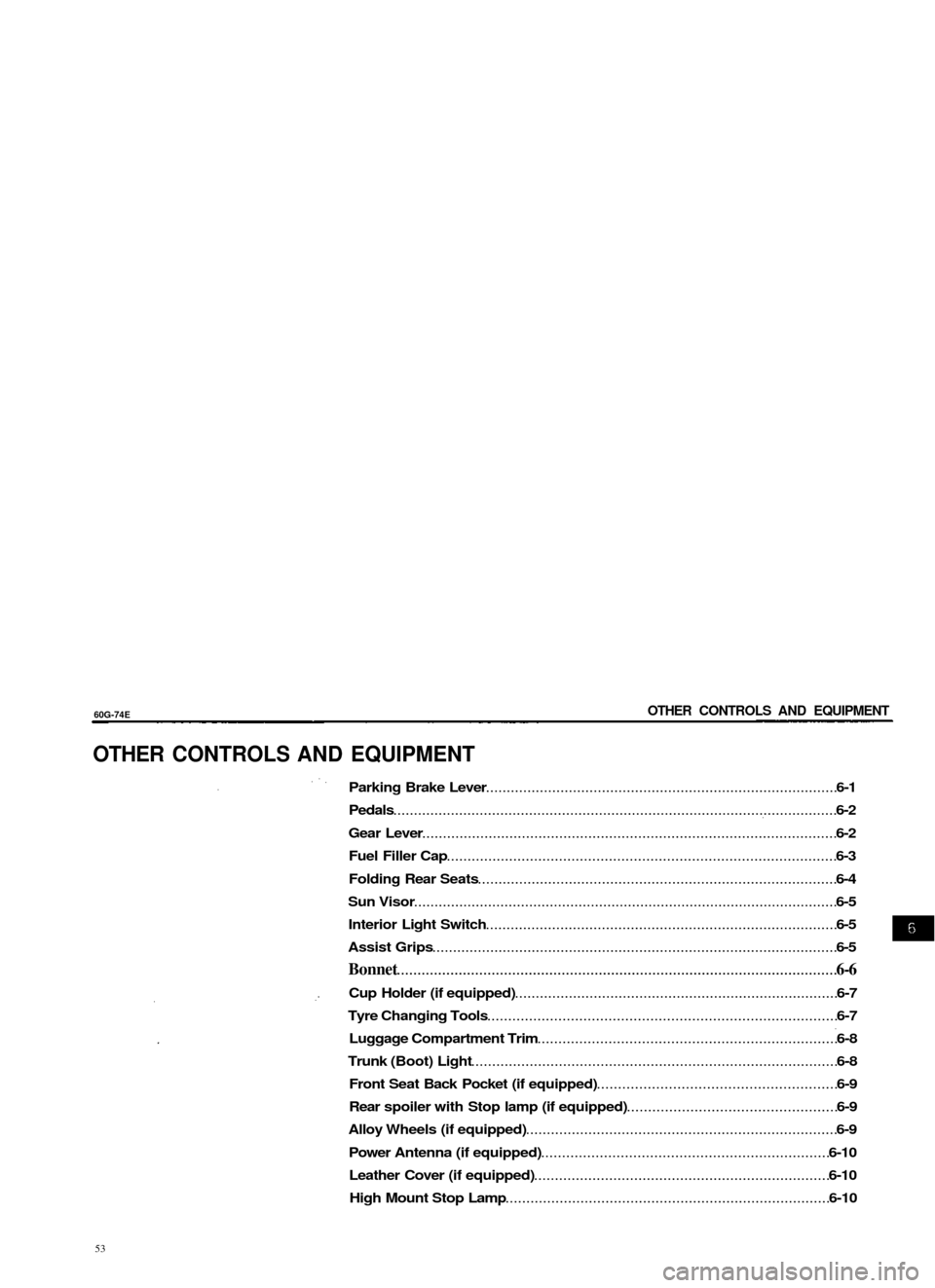
60G-05-024
Dehumidifying
Push in the A/C button, and the desired
function button and move the air intake lever
to "FRESH AIR", the temperature control lever
to the desired temperature position, and the
fan switch to the desired fan speed position.
NOTE:
Because the air conditioner dehumidifies the
air, turning it on will help keep the windows
clear, even when blowing heated air using the
DEMIST or HEATER & DEMIST functions.
60G-05-025
NOTE:
There are two types of air conditioning
systems used in MARUTI vehicles. One type
uses refrigerant CFC-12, commonly called R-
12; the other type uses the new refrigerant
HFC-134a, commonly called R-134a. For each
system, the correct refrigerant must be used.
To identify the system, a label that states
"R134a" or "HFC 134a" is stuck on the front
side of the engine compartment if the system
uses R-134a refrigerant.
CAUTION
Using the wrong refrigerant may
damage the air conditioning system.
Use correct refrigerant only. Do not mix
the two refrigerants.
60G-74E
5-14
OTHER CONTROLS AND EQUIPMENT
OTHER CONTROLS AND EQUIPMENT
Parking Brake Lever 6-1
Pedals 6-2
Gear Lever 6-2
Fuel Filler Cap 6-3
Folding Rear Seats 6-4
Sun Visor 6-5
Interior Light Switch 6-5
Assist Grips 6-5
Bonnet 6-6
Cup Holder (if equipped) 6-7
Tyre Changing Tools 6-7
Luggage Compartment Trim 6-8
Trunk (Boot) Light 6-8
Front Seat Back Pocket (if equipped) 6-9
Rear spoiler with Stop lamp (if equipped) 6-9
Alloy Wheels (if equipped) 6-9
Power Antenna (if equipped) 6-10
Leather Cover (if equipped) 6-10
High Mount Stop Lamp 6-10
53
Page 28 of 65
OTHER CONTROLS AND EQUIPMENTS
60G-74E
FUEL FILLER CAP
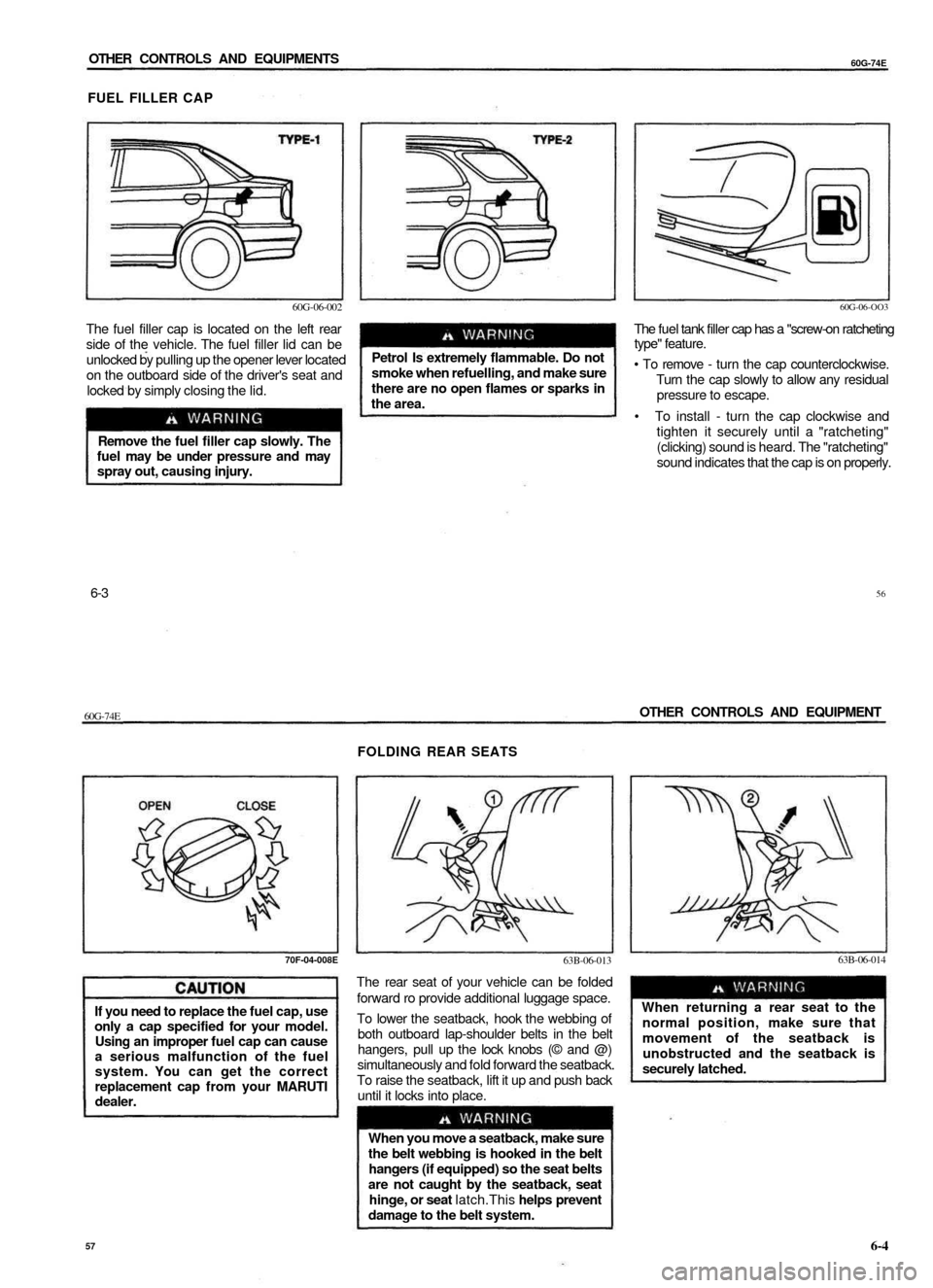
60G-06-002
The fuel filler cap is located on the left rear
side of the vehicle. The fuel filler lid can be
unlocked by pulling up the opener lever located
on the outboard side of the driver's seat and
locked by simply closing the lid.
Remove the fuel filler cap slowly. The
fuel may be under pressure and may
spray out, causing injury.
Petrol Is extremely flammable. Do not
smoke when refuelling, and make sure
there are no open flames or sparks in
the area.
60G-06-OO3
The fuel tank filler cap has a "screw-on ratcheting
type" feature.
• To remove - turn the cap counterclockwise.
Turn the cap slowly to allow any residual
pressure to escape.
• To install - turn the cap clockwise and
tighten it securely until a "ratcheting"
(clicking) sound is heard. The "ratcheting"
sound indicates that the cap is on properly.
6-3
56
60G-74E
OTHER CONTROLS AND EQUIPMENT
FOLDING REAR SEATS
70F-04-008E
If you need to replace the fuel cap, use
only a cap specified for your model.
Using an improper fuel cap can cause
a serious malfunction of the fuel
system. You can get the correct
replacement cap from your MARUTI
dealer.
63B-06-013
The rear seat of your vehicle can be folded
forward ro provide additional luggage space.
To lower the seatback, hook the webbing of
both outboard lap-shoulder belts in the belt
hangers, pull up the lock knobs (© and @)
simultaneously and fold forward the seatback.
To raise the seatback, lift it up and push back
until it locks into place.
When you move a seatback, make sure
the belt webbing is hooked in the belt
hangers (if equipped) so the seat belts
are not caught by the seatback, seat
hinge, or seat latch.This helps prevent
damage to the belt system.
63B-06-014
When returning a rear seat to the
normal position, make sure that
movement of the seatback is
unobstructed and the seatback is
securely latched.
57
6-4
Page 31 of 65
OTHER CONTROLS AND EQUIPMENTS
60G-74E
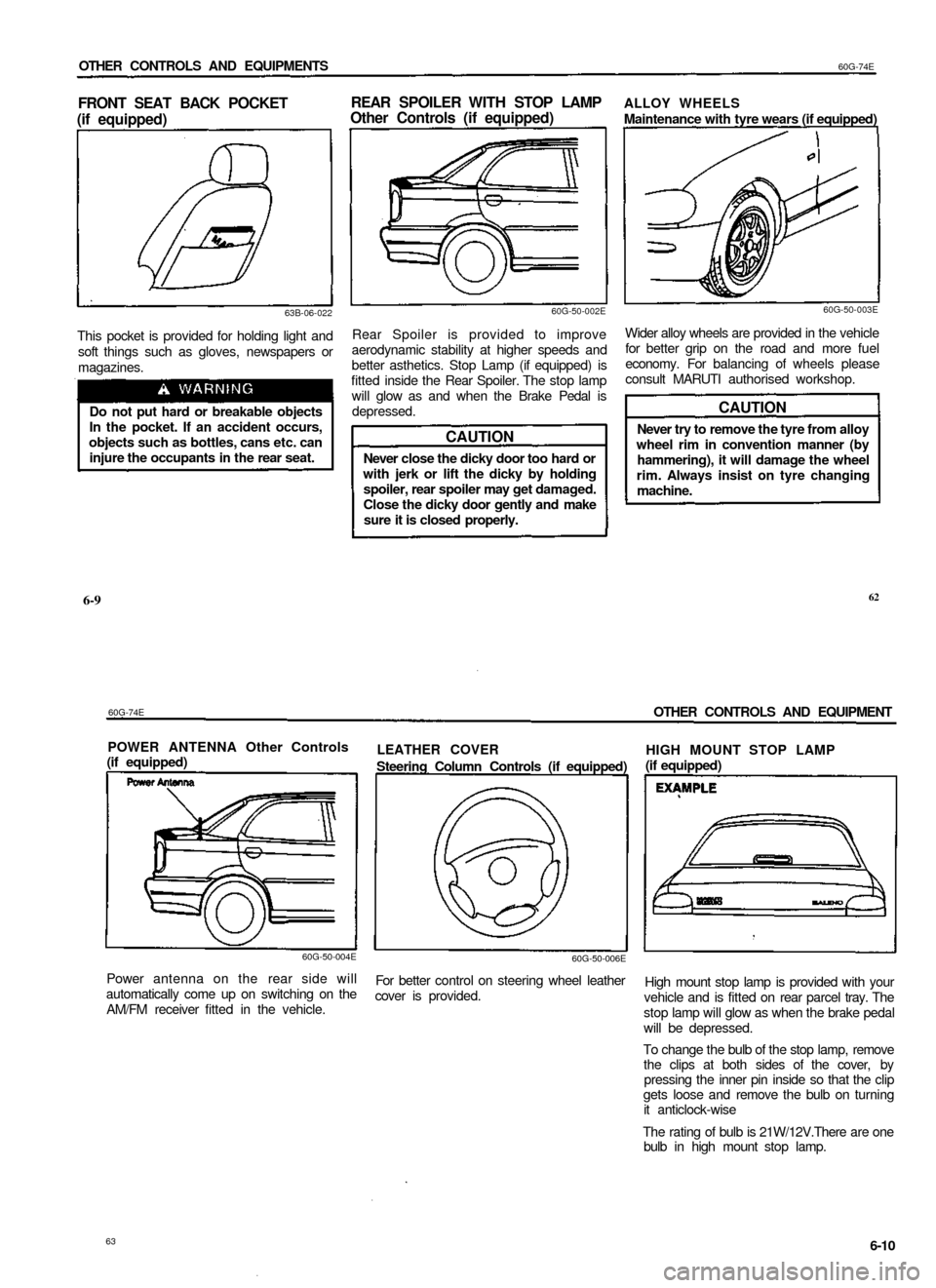
FRONT SEAT BACK POCKET
(if equipped)
REAR SPOILER WITH STOP LAMP
Other Controls (if equipped)
63B-06-022
This pocket is provided for holding light and
soft things such as gloves, newspapers or
magazines.
Do not put hard or breakable objects
In the pocket. If an accident occurs,
objects such as bottles, cans etc. can
injure the occupants in the rear seat.
60G-50-002E
Rear Spoiler is provided to improve
aerodynamic stability at higher speeds and
better asthetics. Stop Lamp (if equipped) is
fitted inside the Rear Spoiler. The stop lamp
will glow as and when the Brake Pedal is
depressed.
CAUTION
Never close the dicky door too hard or
with jerk or lift the dicky by holding
spoiler, rear spoiler may get damaged.
Close the dicky door gently and make
sure it is closed properly.
ALLOY WHEELS
Maintenance with tyre wears (if equipped)
60G-50-003E
Wider alloy wheels are provided in the vehicle
for better grip on the road and more fuel
economy. For balancing of wheels please
consult MARUTI authorised workshop.
CAUTION
Never try to remove the tyre from alloy
wheel rim in convention manner (by
hammering), it will damage the wheel
rim. Always insist on tyre changing
machine.
6-9
62
60G-74E
OTHER CONTROLS AND EQUIPMENT
POWER ANTENNA Other Controls
(if equipped)
LEATHER COVER
Steering Column Controls (if equipped)
60G-50-004E
60G-50-006E
Power antenna on the rear side will
automatically come up on switching on the
AM/FM receiver fitted in the vehicle.
For better control on steering wheel leather
cover is provided.
HIGH MOUNT STOP LAMP
(if equipped)
High mount stop lamp is provided with your
vehicle and is fitted on rear parcel tray. The
stop lamp will glow as when the brake pedal
will be depressed.
To change the bulb of the stop lamp, remove
the clips at both sides of the cover, by
pressing the inner pin inside so that the clip
gets loose and remove the bulb on turning
it anticlock-wise
The rating of bulb is 21W/12V.There are one
bulb in high mount stop lamp.
63
6-10
Page 32 of 65

S0G-74E
OPERATING YOUR VEHICLE
OPERATING YOUR VEHICLE
Exhaust Gas Warning 7-1
Daily Inspection Checklist 7-1
Starting the Engine 7-2
Using the Transmission 7-3
Braking 7-4
Running-in 7-5
Catalytic Converter (if equipped) 7-6
Improving Fuel Economy 7-7
Trailer Towing 7-7
OPERATING YOUR VECHILE
60G-74E
EXHAUST GAS WARNING
DAILY INSPECTION CHECKLIST
60G-07-001E
Avoid breathing exhaust gases.
Exhaust gases contain carbon
monoxide, a potentially lethal gas that
is colourless and odourless. Since
carbon monoxide is difficult to detect
by itself, be sure to take the following
precautions to help prevent carbon
monoxide from entering your vehicle.
• Do not leave the engine running in
garages or other confined areas.
• Do not park with the engine running
for a long period of time, even in an
open area. If it is necessary to sit for
a short time in a parked vehicle <=>
with the engine running, make sure
the air intake lever is set to "FRESH
AIR" and the fan is at high speed.
To allow proper operation of your
vehicle's ventilation system, keep
the air inlet grille in front of the
windscreen clear of snow, leaves, or
other obstructions at all times.
Keep the exhaust tailpipe area clear
of snow and other material to help
reduce the buildup of exhaust gases
under the vehicle.This is particularly
important when parked in blizzard
conditions.
Have the exhaust system inspected
periodically for damage and leaks.
Any damage or leaks should be
repaired immediately.
7-1
70F-05-007
Before driving:
1) Make sure that windows, mirrors, lights,
and reflectors are clean and unobstructed.
2) Check the tyres.
3) Look for fluid and oil leaks.
NOTE:
It is normal for water to drip from the air
conditioning system after use.
4) Adjust the seat/head restraint.
5) Check the brake pedal and the parking
brake lever.
6) Adjust the mirrors.
7) Make sure that you and passengers have
properly fastened your seat belts.
8) Make sure that all warning lights come on
as the key is turned to the "ON" or "START'
position.
9) Check all gauges.
10) Make sure that the brake fluid level
warning light is off when the parking brake
is released with the ignition switch in "ON"
position.
66
65
Page 33 of 65

60G-74E
OPERATING YOUR VEHICLE
Once a week, or each time you fill your fuel
tank, perform the following under-bonnet
checks:
1) Engine oil level.
2) Coolant level.
3) Brake fluid level.
4) Power steering (if equipped) fluid level.
5) Windscreen washer fluid level.
6) Battery solution level.
7) Bonnet latch operation.
Pull the bonnet release handle inside the
vehicle. Make sure that you can not open
the hood all the way without releasing the
secondary latch. Be sure to close the hood
securely after checking for proper
operation. See "All Latches, Hinges &
Locks" of "PERIODIC MAINTENANCE
SCHEDULE" in the "INSPECTION AND
MAINTENANCE" section for lubrication
schedule.
Make sure the bonnet is fully closed
and latched before driving. If it is not,
it can fly up unexpectedly during
driving, obstructing your view and
resulting in an accident.
STARTING THE ENGINE
Before starting the engine:
1) Make sure the parking brake is applied
fully.
2) Manual Transmission - Shift into "N"
(neutral) and depress the clutch pedal all
the way to the floor. Hold it while starting
the engine.
Make sure that the parking brake is
applied fully and the transmission is in
Neutral before attempting to start the
engine.
CAUTION
Stop turning the starter immediately
after the engine has started or the
starter system can be damaged.
Do not crank the engine for more
than 15 seconds at a time. If the
engine doesn't start on the first try,
wait about 15 seconds before trying
again.
Starting a Cold Engine
Engine which is started after 6 hours should
be treated as cold engine.
For Electronic fuel injection models
• With your foot off the accelerator pedal,
crank the engine by turning the ignition
key to "START1. Release the key when the
engine starts.
• If the engine does not start after 15
seconds of cranking, wait about 15
seconds, then press down the accelerator
pedal to 1/3 of its travel and try cranking
the engine again. Release the key and
accelerator pedal when the engine starts.
• If the engine still does not start, try holding
the accelerator pedal all the way to the
floor while cranking. This should clear the
engine if it is flooded.
Starting a Warm Engine
For Electronic fuel injection models:
Use the same procedure as for "Starting a cold
Engine".
67
7-2
OPERATING YOUR VECHILE
60G-74E
USING THE TRANSMISSION
70F-04-005E
Starting off
To start off, depress and maintain pressure
upon the clutch pedal and change into 1st
gear. After releasing the parking brake,
gradually release the clutch. When you hear
a change in the engine's sound (speed), gently
apply pressure to the accelerator to keep the
engine sound (speed) constant whilst
continuing to gradually release the clutch.
Gear changing
All forward gears are synchronized, which
provides for quiet, easy changing. Always
depress the clutch pedal fully before changing
gears.The following table shows the maximum
allowable speed for each gear.
GEAR
First
Second
Third
Fourth
Fifth
MAXIMUM SPEED
50 km/h
95 km/h
140 km/h
Top Speed
Top Speed
7-3
68
Page 35 of 65

60G-74E
OPERATING YOUR VEHICLE
CATALYTIC CONVERTER
(if equipped)
70F-05-005
The purpose of the catalytic converter installed
on your vehicle is to convert exhaust pollutants
to harmless water vapour, carbon dioxide, and
nitrogen. Use of leaded fuel in vehicles
equipped with catalytic converters is
prohibited, because lead deactivates the
pollutant-reducing components of the catalyst
system.
It is very important to keep the engine properly
tuned. Engine misfiring, which can result from
an improperly tuned engine, may cause
overheating of the catalyst. This may result in
permanent heat damage to the catalyst and
other vehicle components.
CAUTION
To minimize the possibility of catalyst
or other vehicle damage:
• Maintain the engine in the proper
operating condition.
• In the event of an engine
malfunction, particularly one
involving engine misfire or other
apparent loss of performance, have
the vehicle serviced promptly.
• Do not turn off the engine or
interrupt the ignition when the
transmission is in gear and the
vehicle is in motion.
• Do not try to start the engine by
pushing or towing the vehicle, or
coasting down a hill.
• Do not idle the engine with any spark
plug wires disconnected or
removed, such as during diagnostic
testing.
• Do not idle the vehicle for prolonged
periods if idling seems rough or
there are other malfunctions.
• Do not allow the fuel tank to get near
the empty level.
60Q-07-002E
Be careful where you park and drive;
the catalytic converter and other
exhaust components can get very hot.
As with any vehicle, do not park or
operate this vehicle in areas where
combustible materials such as dry
grass or leaves can come in contact
with a hot exhaust system.
7-6
OPERATING YOUR VECHILE
60G-74E
IMPROVING FUEL ECONOMY
The following instructions will help you improve
fuel economy.
Avoid excessive idling:
If you are to wait for more than a minute while
you are parked, stop the engine and start it
again later. When warming up a cold engine,
allow the engine to idle until the temperature
gauge pointer comes up to the "C" position. In
this position, the engine is sufficiently warm
for starting off.
Avoid "fast" starts:
Fast starts away from lights or stop signs will
consume fuel unnecessarily and shorten
engine life. Start off slowly.
Avoid unnecessary stops:
Avoid unnecessary deceleration and stopping.
Try to maintain a slow, steady speed whenever
possible. Slowing down and then accelerating
again uses more fuel.
Keep a steady cruising speed:
Keep as constant a speed as road and traffic
conditions will permit.
Air Outlet side
(Facing up)
60G-09-010
Keep the air cleaner clean:
A dirty air cleaner will cause the carburation
system to supply too much fuel to the engine
for the amount of air being supplied. The result
is waste of fuel due to incomplete combustion.
Keep weight to a minimum:
The heavier the load, the more fuel the vehicle
consumes. Take out any luggage or cargo
when it is not necessary.
Keep tyre pressures correct:
Under-inflation of the tyres can waste fuel due
to increased running resistance of the tyres.
Keep your tyres inflated to the correct pressure
shown on the label on the driver's side door
or door lock pillar.
TRAILER TOWING
Your MARUTI was originally designed to carry
people and a normal amount of cargo, not to
tow a trailer. Maruti does not recommend you
use your vehicle to tow a trailer.Towing a trailer
can adversely affect handling, durability, and
fuel economy.
7-7
72
71