Page 1 of 376

yellowblue
i
The 1999 Pontiac Grand Prix Owner's Manual
1-1 Seats and Restraint SystemsThis section tells you how to use your seats and safety belts properly. It also explains the ªSRSº system.
2-1 Features and ControlsThis section explains how to start and operate your vehicle.
3-1 Comfort Controls and Audio SystemsThis section tells you how to adjust the ventilation and comfort controls and how to operate your audio system.
4-1 Your Driving and the RoadHere you'll find helpful information and tips about the road and how to drive under different conditions.
5-1 Problems on the RoadThis section tells you what to do if you have a problem while driving, such as a flat tire or overheated engine, etc.
6-1 Service and Appearance CareHere the manual tells you how to keep your vehicle running properly and looking good.
7-1 Maintenance ScheduleThis section tells you when to perform vehicle maintenance and what fluids and lubricants to use.
8-1 Customer Assistance InformationThis section tells you how to contact Pontiac for assistance and how to get service and owner publications.
It also gives you information on ªReporting Safety Defectsº on page 8-12.
9-1 IndexHere's an alphabetical listing of almost every subject in this manual. You can use it to quickly find
something you want to read.
Page 7 of 376
1-
yellowblue
1-1
Section 1 Seats and Restraint Systems
Here you'll find information about the seats in your vehicle and how to use your safety belts properly. You can also
learn about some things you should not do with air bags and safety belts.
1
-2 Seats and Controls
1
-8 Safety Belts: They're for Everyone
1
-12 Here Are Questions Many People Ask About
Safety Belts
--and the Answers
1
-13 How to Wear Safety Belts Properly
1
-14 Driver Position
1
-21 Safety Belt Use During Pregnancy
1
-22 Right Front Passenger Position
1
-22 Supplemental Restraint System (SRS)
1
-29 Center Passenger Position1
-30 Rear Seat Passengers
1
-33 Rear Safety Belt Comfort Guides for Children
and Small Adults
1
-35 Children
1
-38 Child Restraints
1
-50 Larger Children
1
-53 Safety Belt Extender
1
-53 Checking Your Restraint Systems
1
-53 Replacing Restraint System Parts After
a Crash
Page 8 of 376
yellowblue
1-2
Seats and Seat Controls
This section tells you how to adjust the seats and
explains reclining seatbacks and head restraints.
Manual Front Seat
CAUTION:
You can lose control of the vehicle if you try to
adjust a manual driver's seat while the vehicle is
moving. The sudden movement could startle and
confuse you, or make you push a pedal when you
don't want to. Adjust the driver's seat only when
the vehicle is not moving.
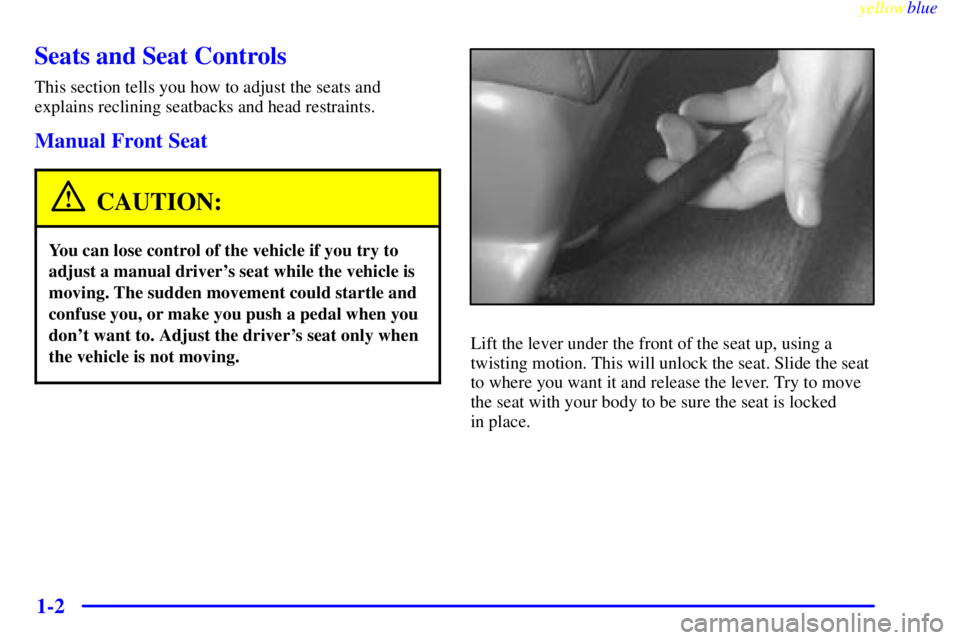
Lift the lever under the front of the seat up, using a
twisting motion. This will unlock the seat. Slide the seat
to where you want it and release the lever. Try to move
the seat with your body to be sure the seat is locked
in place.
Page 14 of 376

yellowblue
1-8
CAUTION:
It is extremely dangerous to ride in a cargo area,
inside or outside of a vehicle. In a collision,
people riding in these areas are more likely to be
seriously injured or killed. Do not allow people to
ride in any area of your vehicle that is not
equipped with seats and safety belts. Be sure
everyone in your vehicle is in a seat and using a
safety belt properly.
Your vehicle has a light that
comes on as a reminder to
buckle up. (See ªSafety
Belt Reminder Lightº in
the Index.)In most states and Canadian provinces, the law says to
wear safety belts. Here's why: They work.
You never know if you'll be in a crash. If you do have a
crash, you don't know if it will be a bad one.
A few crashes are mild, and some crashes can be so
serious that even buckled up a person wouldn't survive.
But most crashes are in between. In many of them,
people who buckle up can survive and sometimes walk
away. Without belts they could have been badly hurt
or killed.
After more than 30 years of safety belts in vehicles,
the facts are clear. In most crashes buckling up does
matter ... a lot!
Page 19 of 376
yellowblue
1-13
How to Wear Safety Belts Properly
Adults
This part is only for people of adult size.
Be aware that there are special things to know about
safety belts and children. And there are different rules
for smaller children and babies. If a child will be
riding in your vehicle, see the part of this manual
called ªChildren.º Follow those rules for
everyone's protection.
First, you'll want to know which restraint systems your
vehicle has.
We'll start with the driver position.
Driver Position
This part describes the driver's restraint system.
Lap-Shoulder Belt
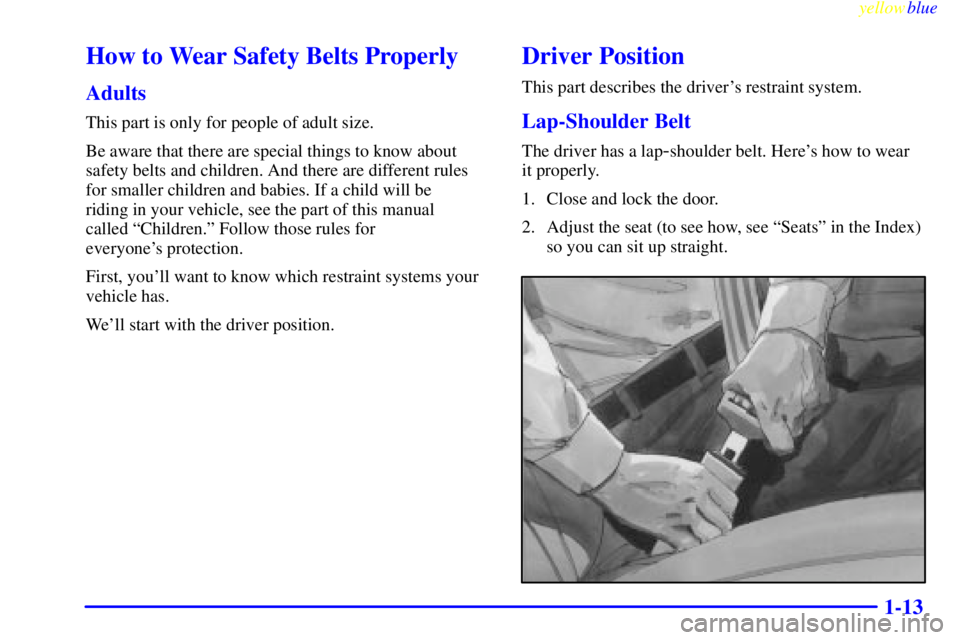
The driver has a lap-shoulder belt. Here's how to wear
it properly.
1. Close and lock the door.
2. Adjust the seat (to see how, see ªSeatsº in the Index)
so you can sit up straight.
Page 35 of 376
yellowblue
1-29
Center Passenger Position
Lap Belt
If your vehicle has front and rear bench seats, someone
can sit in the center positions.
When you sit in a center seating position, you have a lap
safety belt, which has no retractor. To make the belt
longer, tilt the latch plate and pull it along the belt.
Page 45 of 376
yellowblue
1-39
A rear-facing infant restraint (B) positions an infant
to face the rear of the vehicle. Rear
-facing infant
restraints are designed for infants of up to about
20 lbs. (9 kg) and about one year of age. This type
of restraint faces the rear so that the infant's head,
neck and body can have the support they need
in a frontal crash. Some infant seats come in
two parts
-- the base stays secured in the vehicle
and the seat part is removable.
Page 47 of 376
yellowblue
1-41
A booster seat (F, G) is designed for children who
are about 40 to 60 lbs., or even up to 80 lbs.
(18 to 27 kg, or even up to 36 kg), and about four
to eight years of age. A booster seat is designed to
improve the fit of the vehicle's safety belt system.
Booster seats with shields use lap
-only belts;
however, booster seats without shields use
lap
-shoulder belts. Booster seats can also help
a child to see out the window.