Page 154 of 392
First Edition for Pontiac Bonneville Owner's Manual ± 1999
yellowblue
3-8
Ventilation Tips
�Keep the hood and front air inlet free of ice, snow or
any other obstruction such as leaves. The heater and
defroster will work better, reducing the chance of
fogging your windows.
�When you enter a vehicle with the standard system
in cold weather, select HEATER to supply air
through the floor outlets. Then turn the fan on high
for a few moments before driving away. This will
blow moist air from the intake outlets toward the
floor, not the windshield. It reduces the chance of
fogging your windows. If you have the electronic
system, the AUTO setting will do this for you.
Manual operation of the electronic system in the
HEAT mode will also supply air through the
floor outlets.
�Keep the air path under the front seats clear of
objects. This helps air to circulate throughout
your vehicle.
�When the engine idles for a long time, the exterior
temperature sensor may cause the system to blow air
that is too cool. Once the vehicle is moving again the
system will try to maintain the set temperature inside
your vehicle.�When you start your vehicle and the EXT TEMP
display flashes (electronic system only) for some
time, the system may need repair. See your dealer.
Defogging and Defrosting
On cool, humid days, use DEFOG to keep the
windshield and side windows clear. Use DEFROST to
remove fog or ice from the windshield quickly in
extremely humid or cold conditions.
If you have the standard system, use DEFOG and adjust
the fan speed to your comfort level. Use DEFROST
with the temperature toward the red area and the fan
control toward high.
If you have the electronic system, press the DEFOG
button and adjust the fan speed by pressing the fan
button up or down to your comfort level. If you select
DEFROST from AUTO, the system will control the fan
speed. Adjust the temperature to your comfort level by
pressing the TEMP up or down button
Page 220 of 392
First Edition for Pontiac Bonneville Owner's Manual ± 1999
yellowblue
5-4
2. Get the vehicles close enough so the jumper cables
can reach, but be sure the vehicles aren't touching
each other. If they are, it could cause a ground
connection you don't want. You wouldn't be able to
start your vehicle, and the bad grounding could
damage the electrical systems.
To avoid the possibility of the vehicles rolling, set
the parking brake firmly on both vehicles involved in
the jump start procedure. Put an automatic transaxle
in PARK (P) before setting the parking brake.
3. Turn off the ignition on both vehicles. Unplug
unnecessary accessories plugged into the cigarette
lighter. Turn off all lamps that aren't needed as well
as radios. This will avoid sparks and help save both
batteries. In addition, it could save your radio.
NOTICE:
If you leave your radio on, it could be badly
damaged. The repairs wouldn't be covered by
your warranty.
4. Open the hoods and locate the batteries.
CAUTION:
An electric fan can start up even when the engine
is not running and can injure you. Keep hands,
clothing and tools away from any underhood
electric fan.
Page 228 of 392
First Edition for Pontiac Bonneville Owner's Manual ± 1999
yellowblue
5-12
Cooling System
When you decide it's safe to lift the hood, here's what
you'll see:
H±45±0741±T
A. Coolant Recovery Tank
B. Radiator Pressure Cap
C. Electric Engine Cooling Fans
CAUTION:
An electric engine cooling fan under the hood can
start up even when the engine is not running and
can injure you. Keep hands, clothing and tools
away from any underhood electric fan.
If the coolant inside the coolant recovery tank is boiling,
don't do anything else until it cools down.
H±45±0742±T
Page 251 of 392

6-
yellowblue
6-1
Section 6 Service and Appearance Care
Here you will find information about the care of your vehicle. This section begins with service and fuel information,
and then it shows how to check important fluid and lubricant levels. There is also technical information about your
vehicle, and a part devoted to its appearance care.
6
-2 Service
6
-3 Fuel
6
-5 Fuels in Foreign Countries
6
-6 Filling Your Tank
6
-9 Filling a Portable Fuel Container
6
-9 Checking Things Under the Hood
6
-13 Engine Oil
6
-17 Engine Air Cleaner/Filter
6
-20 Automatic Transaxle Fluid
6
-23 Radiator Pressure Cap
6
-24 Engine Coolant
6
-27 Power Steering Fluid
6
-28 Windshield Washer Fluid
6
-29 Brakes
6
-32 Battery
6
-33 Bulb Replacement6
-43 Windshield Wiper Blade Replacement
6
-44 Tires
6
-52 Appearance Care
6
-52 Cleaning the Inside of Your Vehicle
6
-55 Cleaning the Outside of Your Vehicle
6
-57 Cleaning Aluminum or Chrome-Plated
Wheels (If Equipped)
6
-57 Sheet Metal Damage
6
-59 GM Vehicle Care/Appearance Materials
6
-60 Vehicle Identification Number (VIN)
6
-61 Electrical System
6
-68 Replacement Bulbs
6
-69 Capacities and Specifications
6
-70 Air Conditioning Refrigerants
6
-70 Normal Maintenance Replacement Parts
Page 254 of 392

yellowblue
6-4
It is recommended that the gasoline meet specifications
which have been developed by the American
Automobile Manufacturers Association (AAMA) and
endorsed by the Canadian Motor Vehicle Manufacturers
Association for better vehicle performance and engine
protection. Gasolines meeting the AAMA specification
could provide improved driveability and emission
control system performance compared to other
gasolines. For more information, write to: American
Automobile Manufacturer's Association, 7430 Second
Ave, Suite 300, Detroit MI 48202.
Be sure the posted octane for premium is at least 91 (at
least 89 for middle grade and 87 for regular). If the
octane is less than 87, you may get a heavy knocking
noise when you drive. If it's bad enough, it can damage
your engine.
If your vehicle is certified to meet California Emission
Standards (indicated on the underhood emission control
label), it is designed to operate on fuels that meet
California specifications. If such fuels are not available
in states adopting California emissions standards, your
vehicle will operate satisfactorily on fuels meeting federal specifications, but emission control system
performance may be affected. The malfunction indicator
lamp on your instrument panel may turn on and/or your
vehicle may fail a smog
-check test. (See ªMalfunction
Indicator Lampº in the Index.) If this occurs, return to
your authorized Pontiac dealer for diagnosis to
determine the cause of failure. In the event it is
determined that the cause of the condition is the type of
fuels used, repairs may not be covered by your warranty.
Some gasolines that are not reformulated for low
emissions may contain an octane
-enhancing additive
called methylcyclopentadienyl manganese tricarbonyl
(MMT); ask your service station operator whether or not
the fuel contains MMT. General Motors does not
recommend the use of such gasolines. If fuels containing
MMT are used, spark plug life may be reduced and your
emission control system performance may be affected.
The malfunction indicator lamp on your instrument
panel may turn on. If this occurs, return to your
authorized Pontiac dealer for service.
Page 259 of 392

yellowblue
6-9
Filling a Portable Fuel Container
CAUTION:
Never fill a portable fuel container while it is in
your vehicle. Static electricity discharge from the
container can ignite the gasoline vapor. You can
be badly burned and your vehicle damaged if this
occurs. To help avoid injury to you and others:
�Dispense gasoline only into
approved containers.
�Do not fill a container while it is inside a
vehicle, in a vehicle's trunk, pickup bed or
on any surface other than the ground.
�Bring the fill nozzle in contact with the
inside of the fill opening before operating
the nozzle. Contact should be maintained
until the filling is complete.
�Don't smoke while pumping gasoline.
Checking Things Under the Hood
The following sections tell you how to check fluids,
lubricants and important underhood parts.
CAUTION:
An electric fan under the hood can start up and
injure you even when the engine is not running.
Keep hands, clothing and tools away from any
underhood electric fan.
CAUTION:
Things that burn can get on hot engine parts and
start a fire. These include liquids like gasoline,
oil, coolant, brake fluid, windshield washer and
other fluids, and plastic or rubber. You or others
could be burned. Be careful not to drop or spill
things that will burn onto a hot engine.
Page 287 of 392
yellowblue
6-37
The headlamp aiming devices are under the hood near
the headlamps.
Start with the horizontal aim. The adjustment screws can
be turned with
Once the horizontal aim is adjusted, then adjust the
vertical aim.
A. Turn the horizontal
aiming screw until the
indicator is lined up
with zero.
B. Turn the vertical aiming screw until the level bubble
is lined up with zero.
Page 312 of 392
yellowblue
6-62 Maxifuse
�/Relay Center
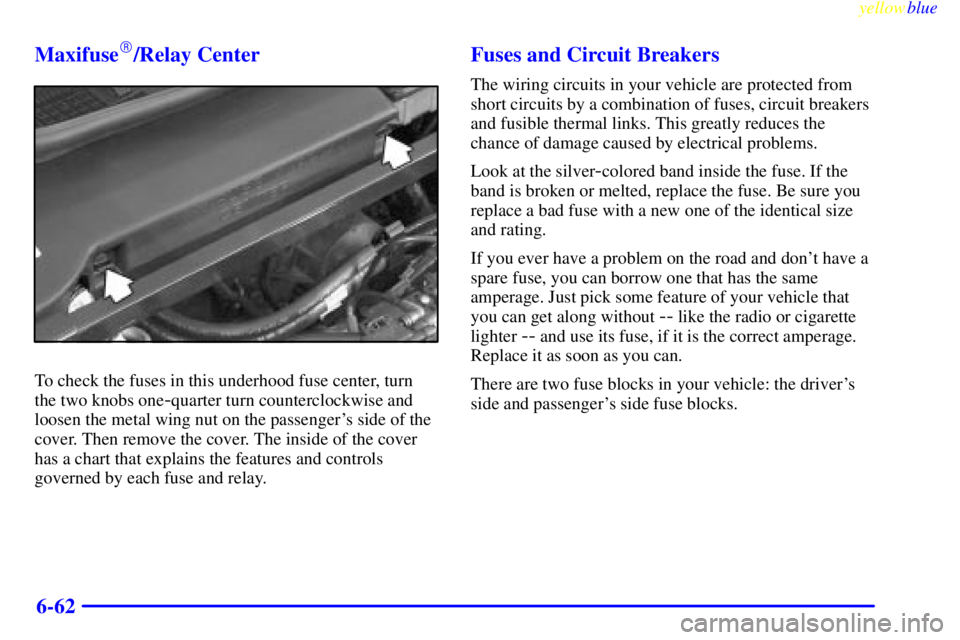
To check the fuses in this underhood fuse center, turn
the two knobs one
-quarter turn counterclockwise and
loosen the metal wing nut on the passenger's side of the
cover. Then remove the cover. The inside of the cover
has a chart that explains the features and controls
governed by each fuse and relay.
Fuses and Circuit Breakers
The wiring circuits in your vehicle are protected from
short circuits by a combination of fuses, circuit breakers
and fusible thermal links. This greatly reduces the
chance of damage caused by electrical problems.
Look at the silver
-colored band inside the fuse. If the
band is broken or melted, replace the fuse. Be sure you
replace a bad fuse with a new one of the identical size
and rating.
If you ever have a problem on the road and don't have a
spare fuse, you can borrow one that has the same
amperage. Just pick some feature of your vehicle that
you can get along without
-- like the radio or cigarette
lighter
-- and use its fuse, if it is the correct amperage.
Replace it as soon as you can.
There are two fuse blocks in your vehicle: the driver's
side and passenger's side fuse blocks.