Page 38 of 392
First Edition for Pontiac Bonneville Owner's Manual ± 1999
yellowblue
1-32
AS147144
1. Pull the elastic cord out from between the edge of
the seatback and the interior body to remove the
guide from its storage clip.
AS147145
2. Slide the guide under and past the belt. The elastic
cord must be under the belt. Then, place the guide
over the belt, and insert the two edges of the belt into
the slots of the guide.
Page 39 of 392
First Edition for Pontiac Bonneville Owner's Manual ± 1999
yellowblue
1-33
AS147146
3. Be sure that the belt is not twisted and it lies flat.
The elastic cord must be under the belt and the guide
on top.
AV147191
4. Buckle, position and release the safety belt as
described in ªRear Seat Outside Passenger Positionsº
earlier in this section. Make sure that the shoulder
belt crosses the shoulder.
To remove and store the comfort guides, squeeze the belt
edges together so that you can take them out from the
guides. Pull the guide upward to expose its storage clip,
and then slide the guide onto the clip. Rotate the guide and
clip inward and in between the seatback and the interior
body, leaving only the loop of elastic cord exposed.
Page 61 of 392
2-
yellowblue
2-1
Section 2 Features and Controls
Here you can learn about the many standard and optional features on your vehicle, and information on starting,
shifting and braking. Also explained are the instrument panel and the warning systems that tell you if everything is
working properly
-- and what to do if you have a problem.
2
-2 Keys
2
-4 Door Locks
2
-10 Remote Keyless Entry (Option)
2
-14 Trunk
2
-16 Theft
2
-17 Universal Theft-Deterrent (Option)
2
-18 PASS-Key� II
2
-19 New Vehicle ªBreak-Inº
2
-20 Ignition Positions
2
-21 Starting Your Engine
2
-22 Engine Coolant Heater (If Equipped)
2
-24 Automatic Transaxle Operation
2
-28 Computer Command Ride (Option)
2
-29 Shifting Into PARK (P)
2
-32 Shifting Out of PARK (P)
2
-33 Parking Over Things That Burn
2
-33 Engine Exhaust
2
-34 Running Your Engine While You're Parked
2
-35 Windows2
-35 Horn
2
-36 Tilt Wheel
2
-36 Turn Signal/Multifunction Lever
2
-43 Exterior Lamps
2
-46 Interior Lamps
2
-48 Mirrors
2
-51 Storage Compartments
2
-54 Ashtrays & Cigarette Lighter
2
-55 Sun Visors
2
-55 Air Inflator System (Option)
2
-56 Accessory Power Outlet
2
-57 Sunroof (Option)
2
-58 The Instrument Panel -- Your
Information System
2
-64 Tachometer
2
-64 Warning Lights, Gages and Indicators
2
-77 Head-Up Display (Option)
2
-80 Driver Information Center (Option)
2
-82 Electronic Compass (Option)
Page 71 of 392
yellowblue
2-11 Operation
The driver's door will unlock when UNLOCK is
pressed. The fuel door will also unlock when UNLOCK
is pressed, if you have the optional fuel door lock.
If UNLOCK is pressed again within five seconds, all
doors will unlock. Pressing the UNLOCK button will
also illuminate the interior lamps. See ªIlluminated
Entryº in the Index.
All doors will lock when LOCK is pressed.
The trunk will unlock when the trunk symbol is pressed
when the ignition is OFF. The trunk symbol will also work
when the ignition is on, but only while in PARK (P).
Instant Alarm
When the button with the horn symbol on the key
transmitter is pressed, the horn will sound and the
headlamps and taillamps will flash for up to one minute.
This can be turned off by pressing the instant alarm
button again or by turning the ignition to ON. If your
vehicle is equipped with the Universal Theft
-Deterrent
feature, you may also turn off the alarm by unlocking
the vehicle with a key. See ªUniversal Theft
-Deterrentº
in the Index.Personalization Features
The following list of features that are available on your
vehicle can be programmed to each driver's preference
for each of the key transmitters.
Programmable Automatic Door Locks: This feature
programs your door locks to automatically lock or
unlock when shifting in and out of PARK (P).
Security Feedback: This feature provides feedback to
the driver when the vehicle receives a command from
the key transmitter.
Delayed Locking: This feature lets the driver delay the
actual locking of the vehicle. When all doors have been
closed, the doors will lock automatically after five seconds.
For more detailed information and programming
instructions, refer to the Index for each individual
feature listed above.
Page 106 of 392
yellowblue
2-46
Interior Lamps
Instrument Panel/Brightness Control
You can brighten or dim your instrument cluster lights
by turning the headlamp knob. Turn the knob clockwise
to brighten the instrument cluster lights and displays.
Turn the knob clockwise all the way to turn on the
interior courtesy lamps. Turn the knob counterclockwise
to dim the instrument cluster lights and displays and to
turn off the courtesy lamps.
Illuminated Entry (Option)
When you press the UNLOCK button on the optional
remote keyless entry transmitter, the lamps inside your
vehicle will go on. These lamps will go off after about
25 seconds, or when you start your engine. Pressing the
LOCK button on your remote keyless entry transmitter
will turn the lights immediately off.
If a door is left ajar, your interior lamps will turn off
after 10 minutes to save your battery.
Delayed Illumination
When you open the door to enter your vehicle, the
interior lamps will come on. When you close the door
with the ignition off, the interior lamps will stay on for
25 seconds or until the ignition is turned on. Please note
that locking the doors with the power door lock switch
will override the delayed illumination feature and the
lamps will turn off right away.
Theater Dimming
This feature allows for a three to five-second fade out of
the courtesy lamps instead of immediate turn off.
Exit Lighting
With this feature, the interior lamps will come on for 25
seconds after you remove the key from the ignition. This
will give you time to find the door pull handle or lock
switches as you exit the vehicle.
Page 107 of 392
yellowblue
2-47 Front Reading Lamps
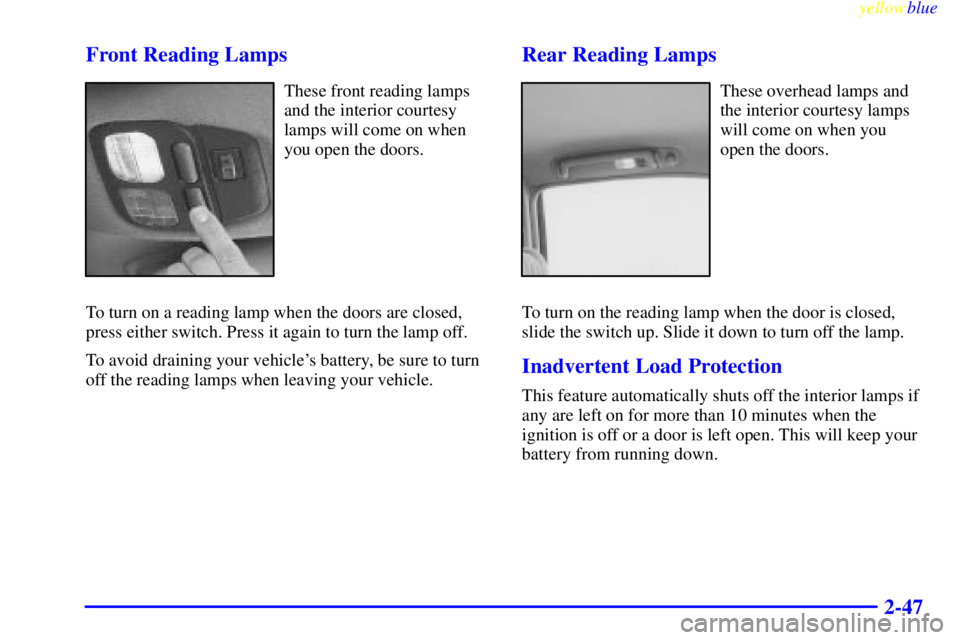
These front reading lamps
and the interior courtesy
lamps will come on when
you open the doors.
To turn on a reading lamp when the doors are closed,
press either switch. Press it again to turn the lamp off.
To avoid draining your vehicle's battery, be sure to turn
off the reading lamps when leaving your vehicle.
Rear Reading Lamps
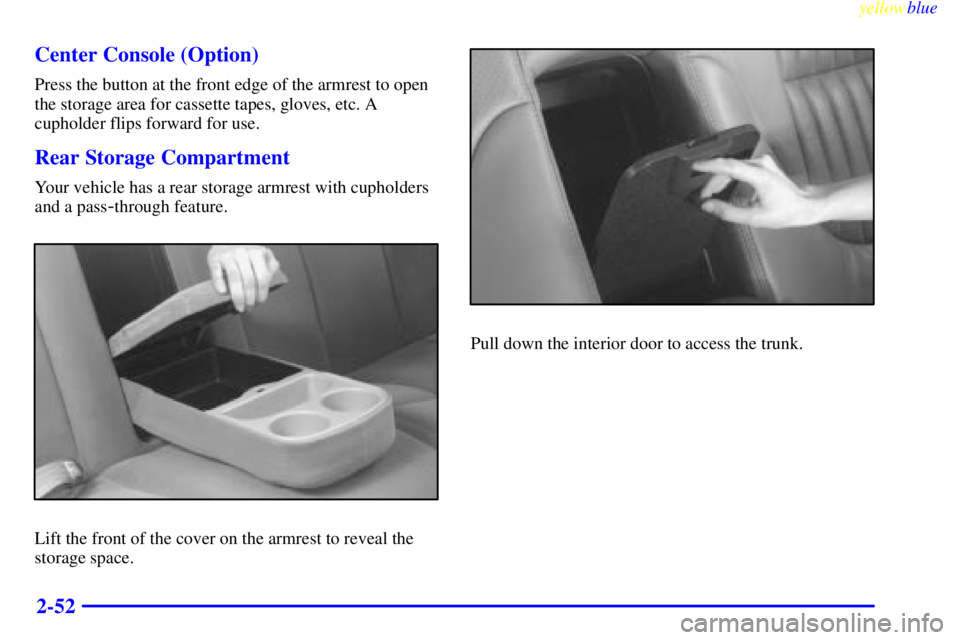
These overhead lamps and
the interior courtesy lamps
will come on when you
open the doors.
To turn on the reading lamp when the door is closed,
slide the switch up. Slide it down to turn off the lamp.
Inadvertent Load Protection
This feature automatically shuts off the interior lamps if
any are left on for more than 10 minutes when the
ignition is off or a door is left open. This will keep your
battery from running down.
Page 112 of 392
yellowblue
2-52 Center Console (Option)
Press the button at the front edge of the armrest to open
the storage area for cassette tapes, gloves, etc. A
cupholder flips forward for use.
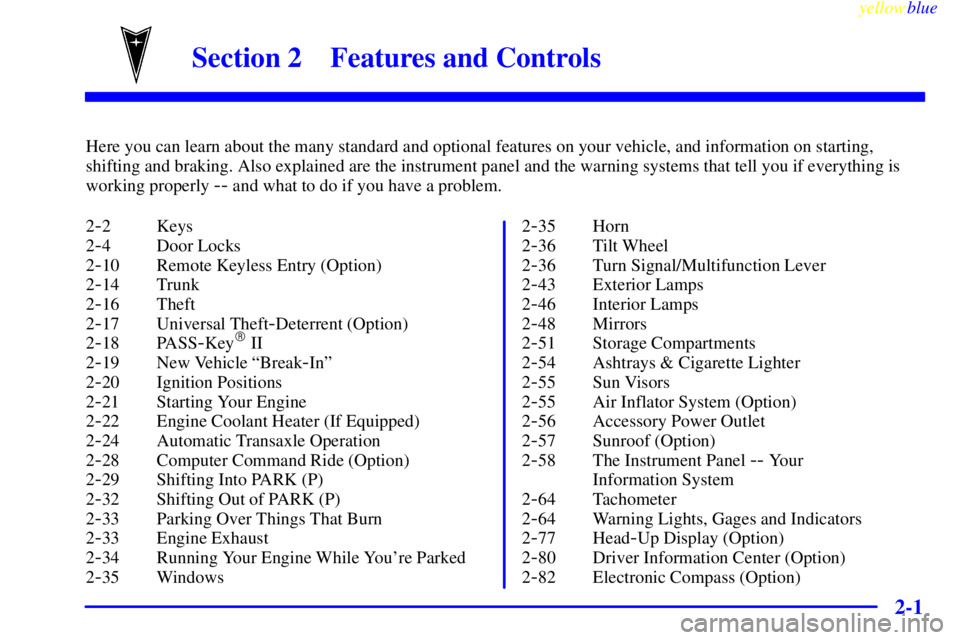
Rear Storage Compartment
Your vehicle has a rear storage armrest with cupholders
and a pass
-through feature.
Lift the front of the cover on the armrest to reveal the
storage space.
Pull down the interior door to access the trunk.
Page 201 of 392

First Edition for Pontiac Bonneville Owner's Manual ± 1999
yellowblue
4-23
Highway Hypnosis
Is there actually such a condition as ªhighway hypnosisº?
Or is it just plain falling asleep at the wheel? Call it
highway hypnosis, lack of awareness, or whatever.
There is something about an easy stretch of road with
the same scenery, along with the hum of the tires on the
road, the drone of the engine, and the rush of the wind
against the vehicle that can make you sleepy. Don't let it
happen to you! If it does, your vehicle can leave the
road in less than a second, and you could crash and
be injured.
What can you do about highway hypnosis? First, be
aware that it can happen.
Then here are some tips:
�Make sure your vehicle is well ventilated, with a
comfortably cool interior.
�Keep your eyes moving. Scan the road ahead and to
the sides. Check your rearview mirrors and your
instruments frequently.
�If you get sleepy, pull off the road into a rest, service
or parking area and take a nap, get some exercise, or
both. For safety, treat drowsiness on the highway as
an emergency.
Hill and Mountain Roads
AS470001
Driving on steep hills or mountains is different from
driving in flat or rolling terrain.