Page 79 of 360

yellowblue
2-21
RUN (D): This is the position the switch returns to after
you start your engine and release the switch. This is the
position for driving. Even when the engine is not
running, you can use RUN to operate your electrical
power accessories and to display some instrument panel
warning lights.
START (E): This position starts your engine. When the
engine starts, release the key. The ignition switch will
return to RUN for normal driving.
NOTICE:
If your key seems stuck in LOCK and you can't
turn it, be sure you are using the correct key; if
so, is it all the way in? If it is, then turn the
steering wheel left and right while you turn the
key hard. But turn the key only with your hand.
Using a tool to force it could break the key or the
ignition switch. If none of this works, then your
vehicle needs service.
Key Reminder Warning
If you leave your key in the ignition, with the engine off,
you will hear a warning chime when you open the
driver's door.
Retained Accessory Power
After you turn the ignition off and remove the key, you
will still have electrical power to such accessories as the
radio, power windows, and sunroof (option) for up to 10
minutes. But if you open a door, power is shut off.
Always leave your key in LOCK. If you leave your key
in any other position than LOCK, your battery will
discharge prematurely.
Starting Your Engine
Move your shift lever to PARK (P) or NEUTRAL (N).
Your engine won't start in any other position
-- that's a
safety feature. To restart when you're already moving,
use NEUTRAL (N) only.
ProCarManuals.com
Page 82 of 360

yellowblue
2-24
Automatic Transaxle Operation
There are several different positions for your shift lever.
PARK (P): This position locks your front wheels. It's
the best position to use when you start your engine
because your vehicle can't move easily.
CAUTION:
It is dangerous to get out of your vehicle if the
shift lever is not fully in PARK (P) with the
parking brake firmly set. Your vehicle can roll.
Don't leave your vehicle when the engine is
running unless you have to. If you have left the
engine running, the vehicle can move suddenly.
You or others could be injured. To be sure your
vehicle won't move, even when you're on fairly
level ground, always set your parking brake and
move the shift lever to PARK (P).
See ªShifting Into PARK (P)º in the Index. If
you're pulling a trailer, see ªTowing a Trailerº in
the Index.
Ensure the shift lever is fully in PARK (P) before
starting the engine. Your vehicle has a Brake
-Transaxle
Shift Interlock (BTSI). You have to fully apply your
regular brakes before you can shift from PARK (P)
when the ignition key is in RUN.
ProCarManuals.com
Page 83 of 360

yellowblue
2-25
REVERSE (R): Use this gear to back up.
NOTICE:
Shifting to REVERSE (R) while your vehicle
is moving forward could damage your transaxle.
Shift to REVERSE (R) only after your vehicle
is stopped.
To rock your vehicle back and forth to get out of snow,
ice or sand without damaging your transaxle, see
ªStuck: In Sand, Mud, Ice or Snowº in the Index.
NEUTRAL (N): In this position, your engine
doesn't connect with the wheels. To restart when you're
already moving, use NEUTRAL (N) only. Also, use
NEUTRAL (N) when your vehicle is being towed.
CAUTION:
Shifting out of PARK (P) or NEUTRAL (N) while
your engine is ªracingº (running at high speed) is
dangerous. Unless your foot is firmly on the
brake pedal, your vehicle could move very
rapidly. You could lose control and hit people or
objects. Don't shift out of PARK (P) or
NEUTRAL (N) while your engine is racing.
NOTICE:
Damage to your transaxle caused by shifting out
of PARK (P) or NEUTRAL (N) with the engine
racing isn't covered by your warranty.
ProCarManuals.com
Page 84 of 360

yellowblue
2-26
AUTOMATIC OVERDRIVE (�): This position is
for normal driving. If you need more power for passing,
and you're:
�Going less than approximately 35 mph (55 km/h),
push your accelerator pedal about halfway down.
�Going about 35 mph (55 km/h) or more, push the
accelerator all the way down.
You'll shift down to the next gear and have more power.
THIRD (3): This position is also used for normal
driving, however, it offers more power and lower fuel
economy than AUTOMATIC OVERDRIVE (�). Here
are some times you might choose THIRD (3) instead of
AUTOMATIC OVERDRIVE (�):
�when driving on hilly, winding roads,
�when towing a trailer, so there is less shifting
between gears, or
�when going down a steep hill.
SECOND (2): This position gives you more power but
lower fuel economy than AUTOMATIC OVERDRIVE
(�) or THIRD (3). You can use SECOND (2) on hills. It
can help control your speed as you go down steep
mountain roads, but then you would also want to use
your brakes off and on.FIRST (1): This position gives you even more power
but lower fuel economy than SECOND (2). You can
use it on very steep hills, or in deep snow or mud. If
the selector lever is put in FIRST (1), the transaxle
won't shift into FIRST (1) until the vehicle is going
slowly enough.
NOTICE:
If your front wheels can't rotate, don't try to
drive. This might happen if you were stuck in
very deep sand or mud or were up against a solid
object. You could damage your transaxle.
Also, if you stop when going uphill, don't hold
your vehicle there with only the accelerator
pedal. This could overheat and damage the
transaxle. Use your brakes or shift into PARK (P)
to hold your vehicle in position on a hill.
Selectable Shift
This button lets you change from a normal driving mode
to a power mode. For general driving conditions, use the
normal mode.
ProCarManuals.com
Page 91 of 360
yellowblue
2-33
Windows
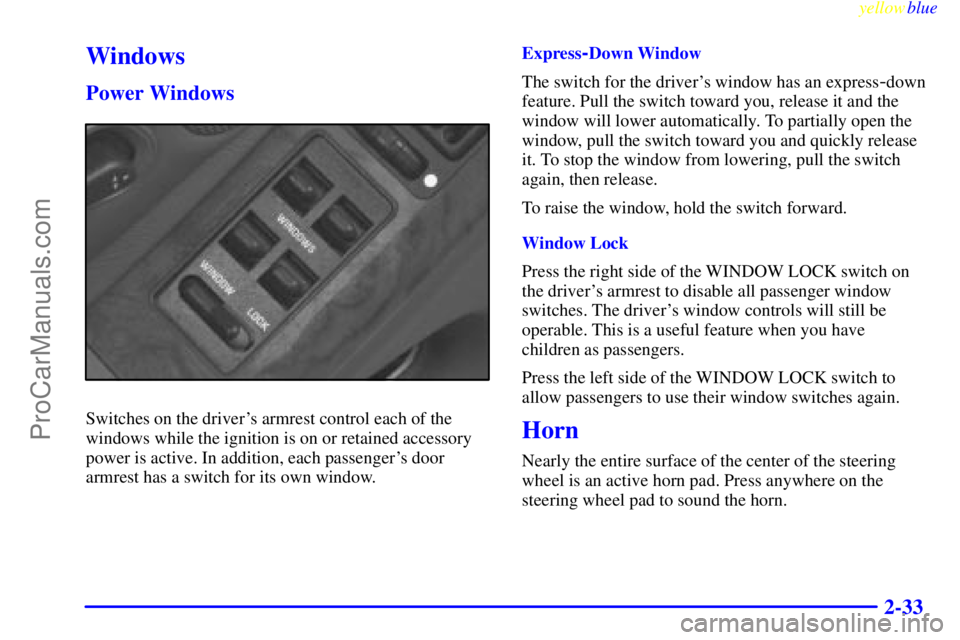
Power Windows
Switches on the driver's armrest control each of the
windows while the ignition is on or retained accessory
power is active. In addition, each passenger's door
armrest has a switch for its own window.Express
-Down Window
The switch for the driver's window has an express
-down
feature. Pull the switch toward you, release it and the
window will lower automatically. To partially open the
window, pull the switch toward you and quickly release
it. To stop the window from lowering, pull the switch
again, then release.
To raise the window, hold the switch forward.
Window Lock
Press the right side of the WINDOW LOCK switch on
the driver's armrest to disable all passenger window
switches. The driver's window controls will still be
operable. This is a useful feature when you have
children as passengers.
Press the left side of the WINDOW LOCK switch to
allow passengers to use their window switches again.
Horn
Nearly the entire surface of the center of the steering
wheel is an active horn pad. Press anywhere on the
steering wheel pad to sound the horn.
ProCarManuals.com
Page 92 of 360
yellowblue
2-34
Tilt Wheel
A tilt steering wheel allows you to adjust the steering
wheel before you drive.
You can also raise it to the highest level to give your
legs more room when you exit and enter the vehicle.
To tilt the wheel, hold the steering wheel and pull the
lever toward you. Move the steering wheel to a
comfortable level, then release the lever to lock the
wheel in place.
Turn Signal/Multifunction Lever
The lever on the left side of the steering column
includes your:
�Turn and Lane Change Signals
�Cruise Control
�Headlamp High/Low Beam Changer
�Headlamps
�Parking Lamps
�Flash
-To-Pass Feature
ProCarManuals.com
Page 97 of 360

yellowblue
2-39 Cruise Control
With cruise control, you can maintain a speed of about
25 mph (40 km/h) or more without keeping your foot on
the accelerator. This is helpful on long trips.
Cruise control does not work at speeds below about
25 mph (40 km/h).
When you apply your brakes, the cruise control
shuts off.
CAUTION:
�Cruise control can be dangerous where you
can't drive safely at a steady speed. So,
don't use your cruise control on winding
roads or in heavy traffic.
�Cruise control can be dangerous on
slippery roads. On such roads, fast changes
in tire traction can cause needless wheel
spinning, and you could lose control. Don't
use cruise control on slippery roads.
If your vehicle is in cruise control when the traction
control system begins to limit wheel spin, the cruise
control will automatically disengage. (See ªTraction
Control Systemº in the Index.) When road conditions
allow you to safely use it again, you may turn the cruise
control back on.
Setting Cruise Control
CAUTION:
If you leave your cruise control switch on when
you're not using cruise, you might hit a button
and go into cruise when you don't want to. You
could be startled and even lose control. Keep the
cruise control switch off until you want to use it.
ProCarManuals.com
Page 119 of 360
yellowblue
2-61
The main components of your instrument panel are:
A. Power Mirrors Control Switch
B. Fog Lamp Switch
C. Turn Signal/Multifunction Lever
D. Instrument Cluster/Gages
E. Hazard Warning Flashers Switch
F. Horn
G. Windshield Wiper/Washer Control
H. Driver Information Center
I. Climate Controls
J. Audio System
K. Glove Box (Remote Trunk Release Lockout
Switch inside)
L. Instrument Panel Intensity Control/Interior
Lamp ControlM. Twilight Sentinel� Control
N. Steering Wheel Touch Controls for Climate
Control System
O. Tilt Steering Wheel Lever
P. Ignition Switch
Q. Steering Wheel Touch Controls for Audio System
R. Trunk Release Switch
S. Fuel Door Release Switch
T. Ashtray and Lighter
U. Traction Control Button
V. Selectable Shift
W. Gearshift Lever
X. Accessory Power Outlet
ProCarManuals.com

