Page 208 of 360

yellowblue
4-38 When You Are Ready to Leave After
Parking on a Hill
1. Apply your regular brakes and hold the pedal down
while you:
�Start your engine;
�Shift into a gear; and
�Release the parking brake.
2. Let up on the brake pedal.
3. Drive slowly until the trailer is clear of the chocks.
4. Stop and have someone pick up and store the chocks.
Maintenance When Trailer Towing
Your vehicle will need service more often when you're
pulling a trailer. See the Maintenance Schedule for more
on this. Things that are especially important in trailer
operation are automatic transaxle fluid (don't overfill),
engine oil, drive belt, cooling system and brake system.
Each of these is covered in this manual, and the Index
will help you find them quickly. If you're trailering, it's
a good idea to review this information before you start
your trip.
Check periodically to see that all hitch nuts and bolts
are tight.
Engine Cooling When Trailer Towing
Your cooling system may temporarily overheat during
severe operating conditions. See ªEngine Overheatingº
in the Index.
ProCarManuals.com
Page 217 of 360

yellowblue
5-9
NOTICE:
Use the proper towing equipment to avoid
damage to the bumper, fascia or fog lamp areas
of the vehicle.
With current trends in automotive styles and design, it is
essential that the correct towing equipment is used to
tow a vehicle. Your vehicle can be towed with wheel
-lift
or car
-carrier equipment.
Consult your dealer or a professional towing service if
you need to have your vehicle towed. See ªRoadside
Assistanceº in the Index.
Engine Overheating
You will find a coolant temperature gage on your
vehicle's instrument panel. Your driver information
center will also display messages about engine
overheating. See ªEngine Coolant Temperature Gageº
in the Index.
Overheated Engine Protection
Operating Mode
Should an overheated engine condition exist and the
message HOT STOP ENGINE is displayed, an overheat
protection mode which alternates firing groups of
cylinders helps prevent engine damage. In this mode,
you will notice a loss in power and engine performance.
This operating mode allows your vehicle to be driven to
a safe place in an emergency; you may drive up to 50
miles (80 km). Towing a trailer in the overheat
protection mode should be avoided.
NOTICE:
After driving in the overheated engine protection
operating mode, to avoid engine damage, allow
the engine to cool before attempting any repair.
The engine oil will be severely degraded. Repair
the cause of coolant loss, change the oil and
reset the oil life indicator. See ªEngine Oilº in
the Index.
ProCarManuals.com
Page 220 of 360
yellowblue
5-12
Cooling System
When you decide it's safe to lift the hood, here's what
you'll see:
A. Coolant Surge Tank with Pressure Cap
B. Two Electric Engine Cooling Fans
CAUTION:
An electric engine cooling fan under the hood can
start up even when the engine is not running and
can injure you. Keep hands, clothing and tools
away from any underhood electric fan.
If the coolant inside the coolant surge tank is boiling,
don't do anything else until it cools down.
ProCarManuals.com
Page 223 of 360
yellowblue
5-15
CAUTION:
Adding only plain water to your cooling system
can be dangerous. Plain water, or some other
liquid like alcohol, can boil before the proper
coolant mixture will. Your vehicle's coolant
warning system is set for the proper coolant
mixture. With plain water or the wrong mixture,
your engine could get too hot but you wouldn't
get the overheat warning. Your engine could
catch fire and you or others could be burned. Use
a 50/50 mixture of clean, drinkable water and
DEX
-COOL� coolant.
NOTICE:
In cold weather, water can freeze and crack the
engine, radiator, heater core and other parts. So
use the recommended coolant.
ProCarManuals.com
Page 239 of 360

6-
yellowblue
6-1
Section 6 Service and Appearance Care
Here you will find information about the care of your vehicle. This section begins with service and fuel information,
and then it shows how to check important fluid and lubricant levels. There is also technical information about your
vehicle, and a part devoted to its appearance care.
6
-2 Service
6
-3 Fuel
6
-8 Filling a Portable Fuel Container
6
-8 Checking Things Under the Hood
6
-11 Engine Oil
6
-15 Engine Air Cleaner/Filter
6
-18 Automatic Transaxle Fluid
6
-21 Engine Coolant
6
-26 Windshield Washer Fluid
6
-28 Brakes
6
-31 Battery
6
-33 Bulb Replacement
6
-43 Tires6
-51 Appearance Care
6
-51 Cleaning the Inside of Your Vehicle
6
-55 Cleaning the Outside of Your Vehicle
6
-57 Underbody Maintenance
6
-57 Chemical Paint Spotting
6
-58 GM Vehicle Care/Appearance Materials
6
-59 Vehicle Identification Number (VIN)
6
-60 Electrical System
6
-64 Removing the Rear Seat Cushion
6
-70 Replacement Bulbs
6
-70 Capacities and Specifications
6
-71 Air Conditioning Refrigerants
6
-71 Normal Maintenance Replacement Parts
ProCarManuals.com
Page 247 of 360
yellowblue
6-9
CAUTION:
Things that burn can get on hot engine parts and
start a fire. These include liquids like gasoline,
oil, coolant, brake fluid, windshield washer and
other fluids, and plastic or rubber. You or others
could be burned. Be careful not to drop or spill
things that will burn onto a hot engine.
The following sections tell you how to check fluids,
lubricants and important parts underhood.
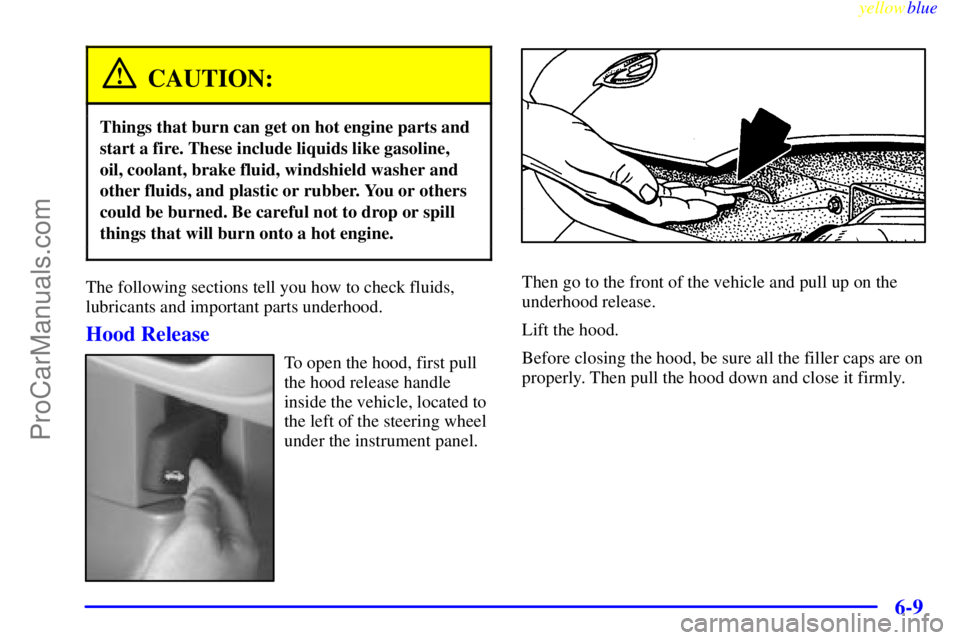
Hood Release
To open the hood, first pull
the hood release handle
inside the vehicle, located to
the left of the steering wheel
under the instrument panel.
Then go to the front of the vehicle and pull up on the
underhood release.
Lift the hood.
Before closing the hood, be sure all the filler caps are on
properly. Then pull the hood down and close it firmly.
ProCarManuals.com
Page 248 of 360
yellowblue
6-10 4.0L V8 Engine
When you open the hood, you'll see:
A. Remote Positive (+)
Battery Terminal
B. Windshield Washer
Fluid ReservoirC. Power Steering Fluid Reservoir
D. Engine Oil Fill Cap
E. Engine Oil Dipstick
F. Brake Fluid ReservoirG. Automatic Transaxle Fluid
Dipstick (behind the air cleaner)
H. Engine Coolant Surge Tank
I. Engine Air Cleaner/Filter
ProCarManuals.com
Page 249 of 360

yellowblue
6-11
Engine Oil
If the CHECK OIL LEVEL
message or the oil warning
light on the instrument
panel comes on, it means
you need to check your
engine oil level right away.
For more information, see ªCheck Oil Level Messageº
or ªOil Pressure Warning Lightº in the Index. You
should check your engine oil level regularly; this is an
added reminder.
It's a good idea to check your engine oil every time you
get fuel. In order to get an accurate reading, the oil must
be warm and the vehicle must be on level ground.
Turn off the engine and give the oil several minutes to
drain back into the oil pan. If you don't, the oil dipstick
might not show the actual level.
Checking Engine Oil
Pull out the dipstick and clean it with a paper towel or
cloth, then push it back in all the way. Remove it again,
keeping the tip down, and check the level.
When to Add Engine Oil
If the oil is at or below the ADD line, then you'll need
to add at least one quart of oil. But you must use the
right kind. This part explains what kind of oil to use. For
crankcase capacity, see ªCapacities and Specificationsº
in the Index.
ProCarManuals.com