Page 5 of 328
yellowblue
v
For example,
these symbols
are used on an
original battery:
CAUTION
POSSIBLE
INJURY
PROTECT
EYES BY
SHIELDING
CAUSTIC
BATTERY
ACID COULD
CAUSE
BURNS
AVOID
SPARKS OR
FLAMES
SPARK OR
FLAME
COULD
EXPLODE
BATTERY
These symbols
are important
for you and
your passengers
whenever your
vehicle is
driven:
DOOR LOCK
UNLOCK
FASTEN
SEAT
BELTS
POWER
WINDOW
AIR BAG
These symbols
have to do with
your lamps:
MASTER
LIGHTING
SWITCH
TURN
SIGNALS
PARKING
LAMPS
HAZARD
WARNING
FLASHER
DAYTIME
RUNNING
LAMPS
FOG LAMPS
These symbols
are on some of
your controls:
WINDSHIELD
WIPER
WINDSHIELD
WASHER
WINDSHIELD
DEFROSTER
REAR
WINDOW
DEFOGGER
VENTILATING
FAN
These symbols
are used on
warning and
indicator lights:
ENGINE
COOLANT
TEMP
BATTERY
CHARGING
SYSTEM
BRAKE
COOLANT
ENGINE OIL
PRESSURE
ANTI-LOCK
BRAKES
Here are some
other symbols
you may see:
FUSE
LIGHTER
HORN
SPEAKER
FUEL
Vehicle Symbols
These are some of the symbols you may find on your vehicle.
ProCarManuals.com
Page 33 of 328
yellowblue
1-27
In any particular crash, no one can say whether an air bag
should have inflated simply because of the damage to a
vehicle or because of what the repair costs were. Inflation
is determined by the angle of the impact and how quickly
the vehicle slows down in frontal or near
-frontal impacts.
What makes an air bag inflate?
In an impact of sufficient severity, the air bag sensing system
detects that the vehicle is in a crash. The sensing system
triggers a release of gas from the inflator, which inflates the
air bag. The inflator, air bag and related hardware are all part
of the air bag modules inside the steering wheel and in the
instrument panel in front of the right front passenger.
How does an air bag restrain?
In moderate to severe frontal or near
-frontal collisions,
even belted occupants can contact the steering wheel or the
instrument panel. Air bags supplement the protection
provided by safety belts. Air bags distribute the force of
the impact more evenly over the occupant's upper body,
stopping the occupant more gradually. But air bags would
not help you in many types of collisions, including
rollovers, rear impacts and side impacts, primarily because
an occupant's motion is not toward those air bags. Air
bags should never be regarded as anything more than a
supplement to safety belts, and then only in moderate to
severe frontal or near
-frontal collisions.What will you see after an air bag inflates?
After an air bag inflates, it quickly deflates, so quickly
that some people may not even realize the air bag
inflated. Some components of the air bag module
-- the
steering wheel hub for the driver's air bag, or the
instrument panel for the right front passenger's
bag
-- will be hot for a short time. The parts of the bag
that come into contact with you may be warm, but not
too hot to touch. There will be some smoke and dust
coming from vents in the deflated air bags. Air bag
inflation doesn't prevent the driver from seeing or from
being able to steer the vehicle, nor does it stop people
from leaving the vehicle.
CAUTION:
When an air bag inflates, there is dust in the air.
This dust could cause breathing problems for
people with a history of asthma or other
breathing trouble. To avoid this, everyone in the
vehicle should get out as soon as it is safe to do so.
If you have breathing problems but can't get out
of the vehicle after an air bag inflates, then get
fresh air by opening a window or door.
ProCarManuals.com
Page 36 of 328
yellowblue
1-30
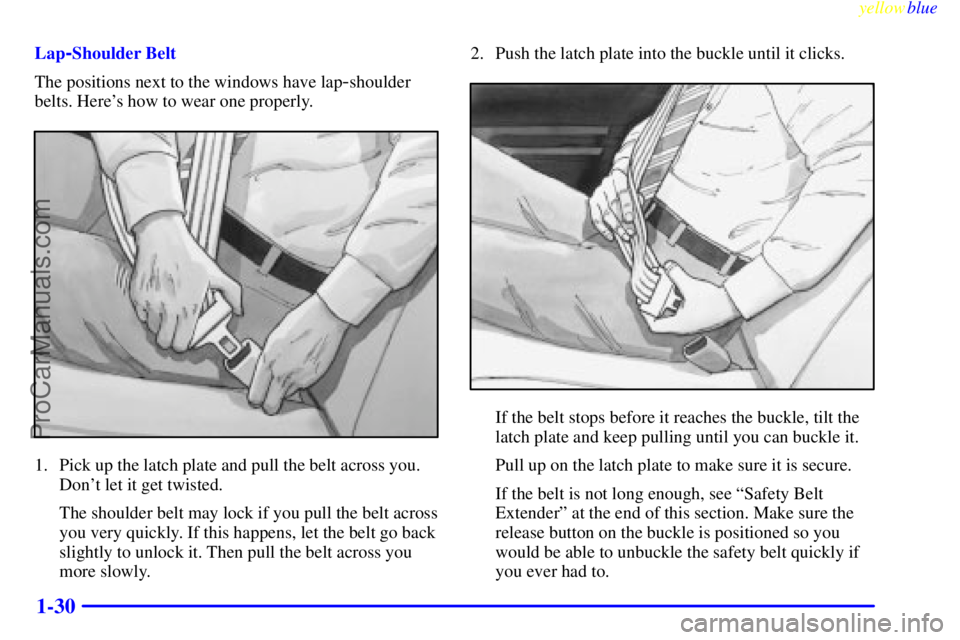
Lap-Shoulder Belt
The positions next to the windows have lap
-shoulder
belts. Here's how to wear one properly.
1. Pick up the latch plate and pull the belt across you.
Don't let it get twisted.
The shoulder belt may lock if you pull the belt across
you very quickly. If this happens, let the belt go back
slightly to unlock it. Then pull the belt across you
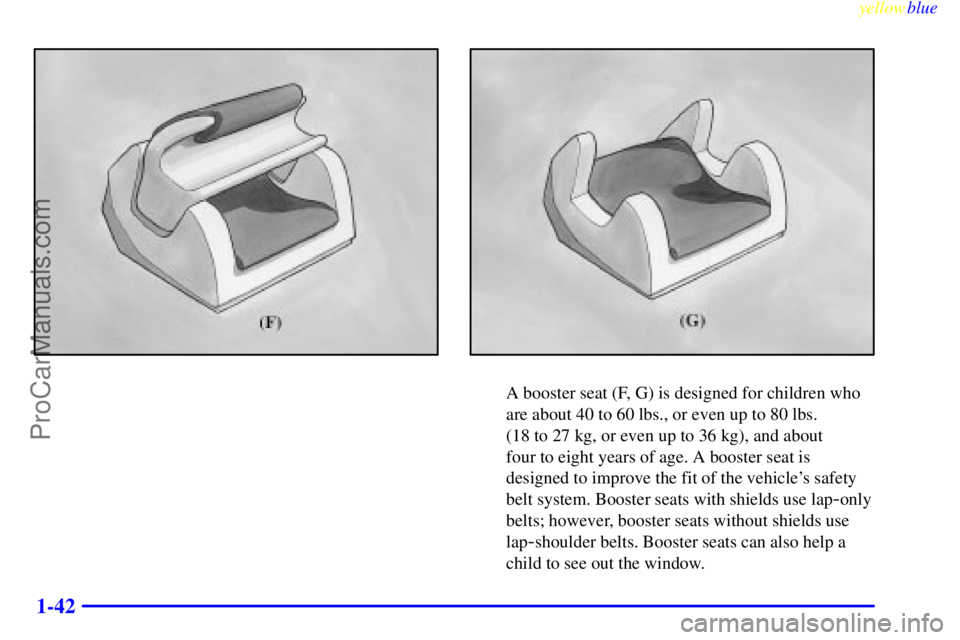
more slowly.2. Push the latch plate into the buckle until it clicks.
If the belt stops before it reaches the buckle, tilt the
latch plate and keep pulling until you can buckle it.
Pull up on the latch plate to make sure it is secure.
If the belt is not long enough, see ªSafety Belt
Extenderº at the end of this section. Make sure the
release button on the buckle is positioned so you
would be able to unbuckle the safety belt quickly if
you ever had to.
ProCarManuals.com
Page 48 of 328
yellowblue
1-42
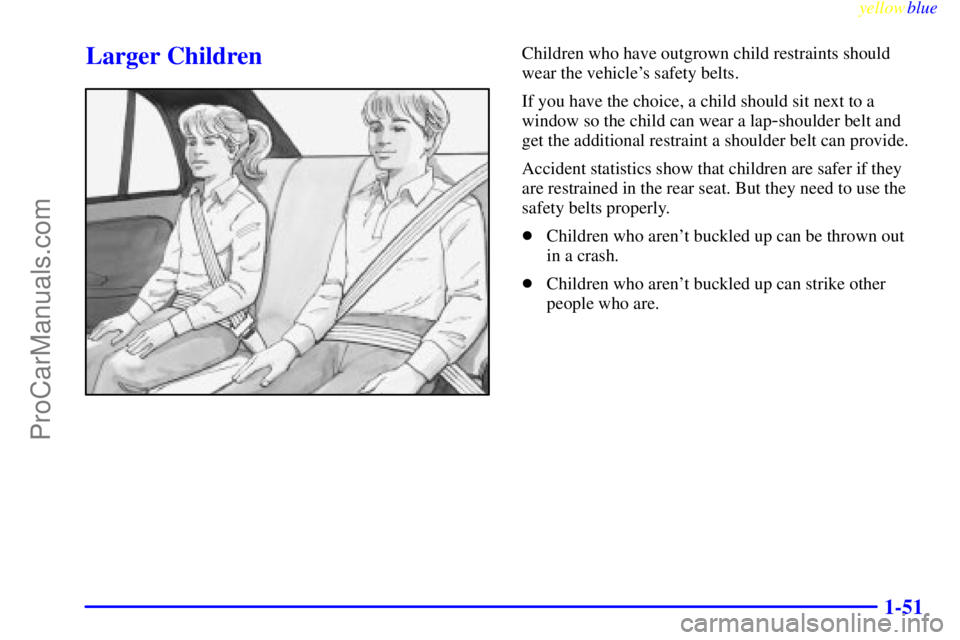
A booster seat (F, G) is designed for children who
are about 40 to 60 lbs., or even up to 80 lbs.
(18 to 27 kg, or even up to 36 kg), and about
four to eight years of age. A booster seat is
designed to improve the fit of the vehicle's safety
belt system. Booster seats with shields use lap
-only
belts; however, booster seats without shields use
lap
-shoulder belts. Booster seats can also help a
child to see out the window.
ProCarManuals.com
Page 57 of 328
yellowblue
1-51
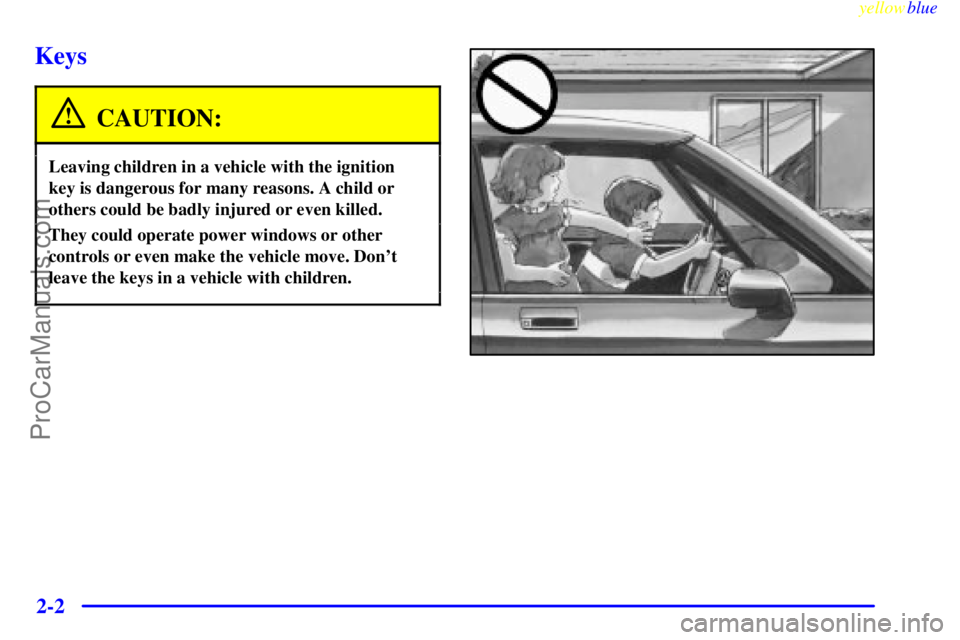
Larger ChildrenChildren who have outgrown child restraints should
wear the vehicle's safety belts.
If you have the choice, a child should sit next to a
window so the child can wear a lap
-shoulder belt and
get the additional restraint a shoulder belt can provide.
Accident statistics show that children are safer if they
are restrained in the rear seat. But they need to use the
safety belts properly.
�Children who aren't buckled up can be thrown out
in a crash.
�Children who aren't buckled up can strike other
people who are.
ProCarManuals.com
Page 61 of 328
2-
yellowblue
2-1
Section 2 Features and Controls
Here you can learn about the many standard and optional features on your vehicle, and information on starting,
shifting and braking. Also explained are the instrument panel and the warning systems that tell you if everything is
working properly
-- and what to do if you have a problem.
2
-2 Keys
2
-4 Door Locks
2
-8 Remote Lock Control (If Equipped)
2
-12 Trunk
2
-13 Theft
2
-14 Passlock�
2-15 New Vehicle ªBreak-Inº
2
-15 Ignition Switch
2
-17 Starting Your Engine
2
-20 Engine Coolant Heater (If Equipped)
2
-22 Automatic Transaxle Operation
2
-26 Parking Brake
2
-27 Shifting Into PARK (P)
2
-29 Shifting Out of PARK (P)
2
-29 Parking Over Things That Burn2
-30 Engine Exhaust
2
-30 Running Your Engine While You're Parked
2
-31 Windows
2
-32 Tilt Wheel
2
-33 Turn Signal/Multifunction Lever
2
-39 Exterior Lamps
2
-42 Interior Lamps
2
-44 Mirrors
2
-46 Storage Compartments
2
-47 Ashtray and Lighter (If Equipped)
2
-48 Sun Visors
2
-48 Auxiliary Power Accessory Outlet
2
-49 Sunroof (If Equipped)
2
-50 Instrument Panel
2
-54 Warning Lights, Gages and Indicators
ProCarManuals.com
Page 62 of 328
yellowblue
2-2
Keys
CAUTION:
Leaving children in a vehicle with the ignition
key is dangerous for many reasons. A child or
others could be badly injured or even killed.
They could operate power windows or other
controls or even make the vehicle move. Don't
leave the keys in a vehicle with children.
ProCarManuals.com
Page 72 of 328
yellowblue
2-12
Trunk
CAUTION:
It can be dangerous to drive with the trunk lid
open because carbon monoxide (CO) gas can
come into your vehicle. You can't see or smell
CO. It can cause unconsciousness and even death.
If you must drive with the trunk lid open or if
electrical wiring or other cable connections must
pass through the seal between the body and the
trunk lid:
�Make sure all other windows are shut.
�Turn the fan on your heating or cooling
system to its highest speed with the setting
on VENT. That will force outside air into
your vehicle. See ªComfort Controlsº in
the Index.
�If you have air outlets on or under the
instrument panel, open them all the way.
See ªEngine Exhaustº in the Index.
Remote Trunk Release
The remote trunk release button is located on the
driver's door. Push the remote release button to
release the trunk lid. Make sure the lockout feature is
not activated.
ProCarManuals.com