1999 NISSAN ALTIMA ignition
[x] Cancel search: ignitionPage 151 of 220
When performing any inspection or mainte-
nance work on your vehicle, always take
care to prevent serious accidental injury to
yourself or damage to the vehicle. The
following are general precautions which
should be closely observed.
WARNING
cPark the vehicle on a level surface,
apply the parking brake securely and
block the wheels to prevent the ve-
hicle from moving. For a manual
transmission, move the shift lever to
Neutral. For an automatic transmis-
sion, move the shift lever to P (Park).
cBe sure the ignition key is OFF when
performing any parts replacement or
repairs.
cYour vehicle is equipped with an
automatic engine cooling fan. It may
come on at any time without warn-
ing, even if the ignition key is in the
OFF position and the engine is not
running. To avoid injury, always dis-
connect the negative battery cable
before working near the fan.c
If you must work with the engine run-
ning, keep your hands, clothing, hair
and tools away from moving fans,
belts and any other moving parts.
cIt is advisable to remove ties and any
jewelry, such as rings, watches, etc.
before working on your vehicle.
cAlways wear eye protection when-
ever you work on your vehicle.
cIf you must run the engine in an
enclosed space such as a garage, be
sure there is proper ventilation for
exhaust gases.
cNever get under the vehicle while it
is supported only by a jack. If it is
necessary to work under the vehicle,
support it with safety stands.
c
Keep smoking materials, flame and
sparks away from fuel and the battery.
cOn gasoline engine models with the
Multiport Fuel Injection (MFI) sys-
tem, the fuel filter or fuel lines
should be serviced by a NISSAN
dealer because the fuel lines are
under high pressure even when the
engine is off.
CAUTION
cDo not work under the hood while
the engine is hot. Turn off the engine
and wait until it cools down.
cNever connect or disconnect either
the battery or any transistorized
component connector while the igni-
tion is ON.
cNever leave the engine or the auto-
matic transmission related compo-
nent harness connector discon-
nected while the ignition is ON.
c
Avoid contact with used engine oil.
Improperly disposed motor oil and/or
other vehicle fluids can hurt the en-
vironment. Always conform to local
regulations for disposal of vehicle
fluid.
This ``Do-it-yourself'' section gives instruc-
tions regarding only those items which are
relatively easy for an owner to perform.
You should be aware that incomplete or
improper servicing may result in operating
difficulties or excessive emissions, and
could affect your warranty coverage.If in
doubt about any servicing, have it done
by an authorized NISSAN dealer.
MAINTENANCE
PRECAUTIONS
8-2Do-it-yourself
ZX
Page 154 of 220
If the cooling system frequently requires
coolant, have it checked by an autho-
rized NISSAN dealer.
CHANGING ENGINE COOLANT
cMajor cooling system repairs should be
performed by an authorized NISSAN
dealer. The service procedures can be
found in an appropriate NISSAN Service
Manual.cImproper servicing can result in reduced
heater performance and engine over-
heating.
WARNING
cTo avoid the danger of being
scalded, never change the coolant
when the engine is hot.
cNever remove the radiator cap when
the engine is hot. Serious burns
could be caused by high pressure
fluid escaping from the radiator.
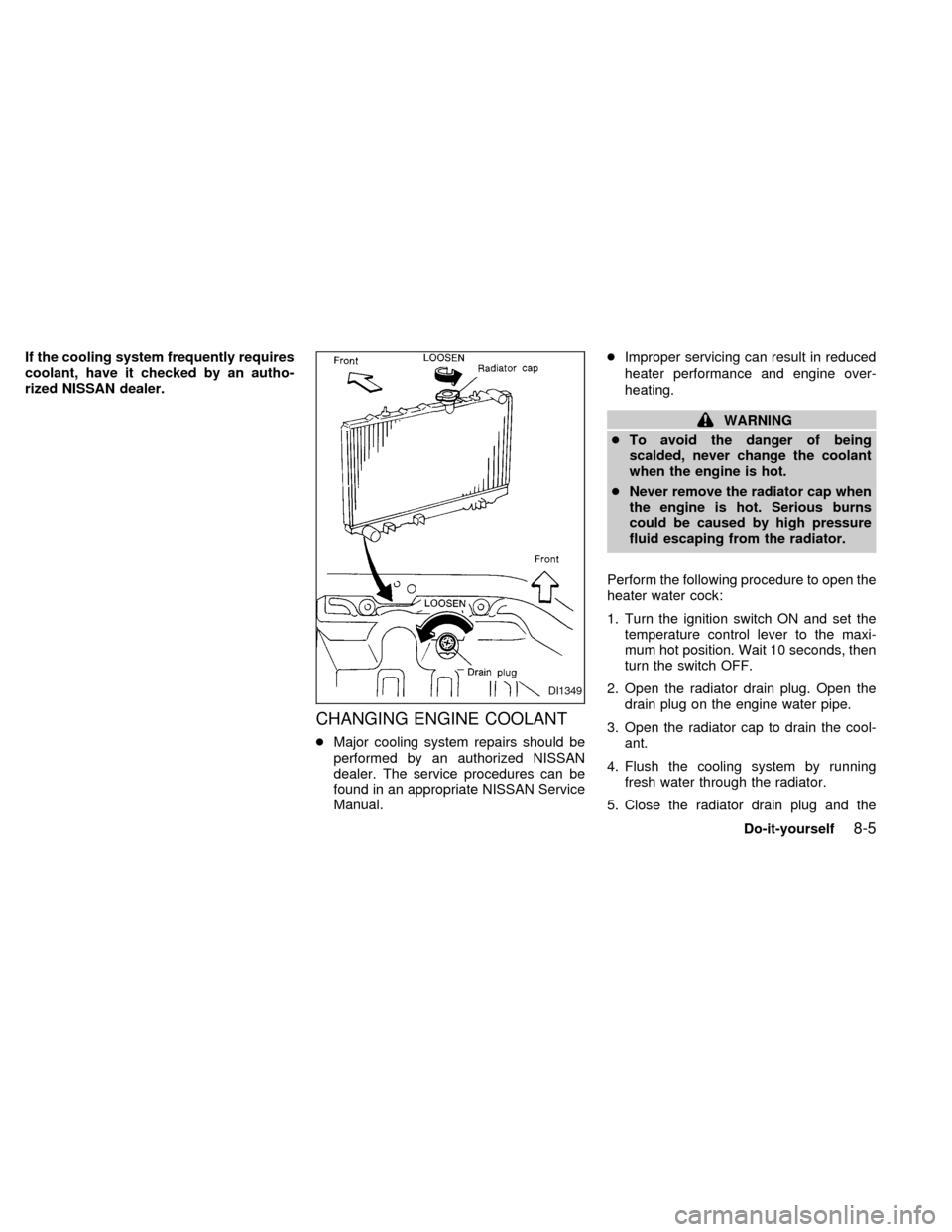
Perform the following procedure to open the
heater water cock:
1. Turn the ignition switch ON and set the
temperature control lever to the maxi-
mum hot position. Wait 10 seconds, then
turn the switch OFF.
2. Open the radiator drain plug. Open the
drain plug on the engine water pipe.
3. Open the radiator cap to drain the cool-
ant.
4. Flush the cooling system by running
fresh water through the radiator.
5. Close the radiator drain plug and the
DI1349
Do-it-yourself8-5
ZX
Page 163 of 220
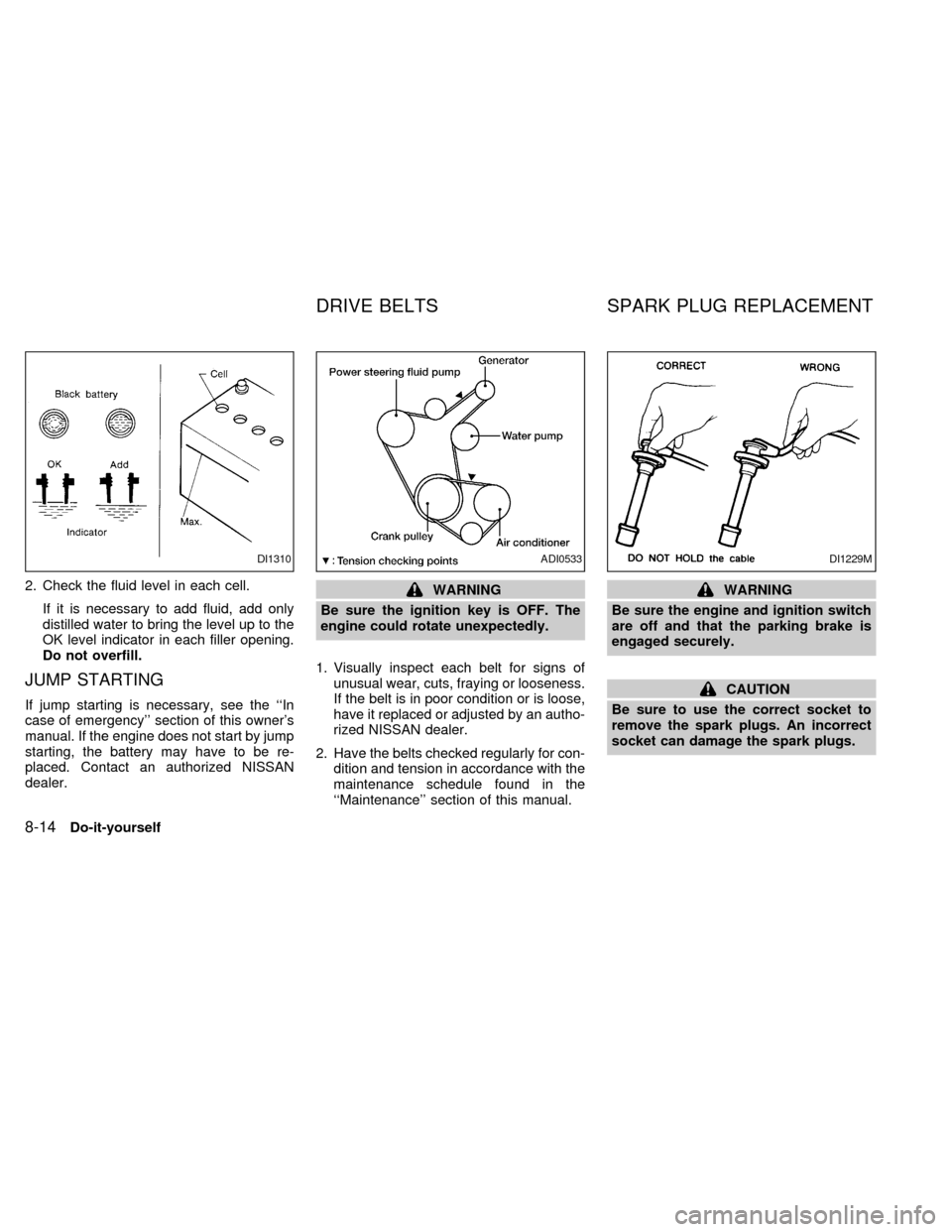
2. Check the fluid level in each cell.
If it is necessary to add fluid, add only
distilled water to bring the level up to the
OK level indicator in each filler opening.
Do not overfill.
JUMP STARTING
If jump starting is necessary, see the ``In
case of emergency'' section of this owner's
manual. If the engine does not start by jump
starting, the battery may have to be re-
placed. Contact an authorized NISSAN
dealer.
WARNING
Be sure the ignition key is OFF. The
engine could rotate unexpectedly.
1. Visually inspect each belt for signs of
unusual wear, cuts, fraying or looseness.
If the belt is in poor condition or is loose,
have it replaced or adjusted by an autho-
rized NISSAN dealer.
2. Have the belts checked regularly for con-
dition and tension in accordance with the
maintenance schedule found in the
``Maintenance'' section of this manual.WARNING
Be sure the engine and ignition switch
are off and that the parking brake is
engaged securely.
CAUTION
Be sure to use the correct socket to
remove the spark plugs. An incorrect
socket can damage the spark plugs.
DI1310ADI0533DI1229M
DRIVE BELTS SPARK PLUG REPLACEMENT
8-14Do-it-yourself
ZX
Page 169 of 220
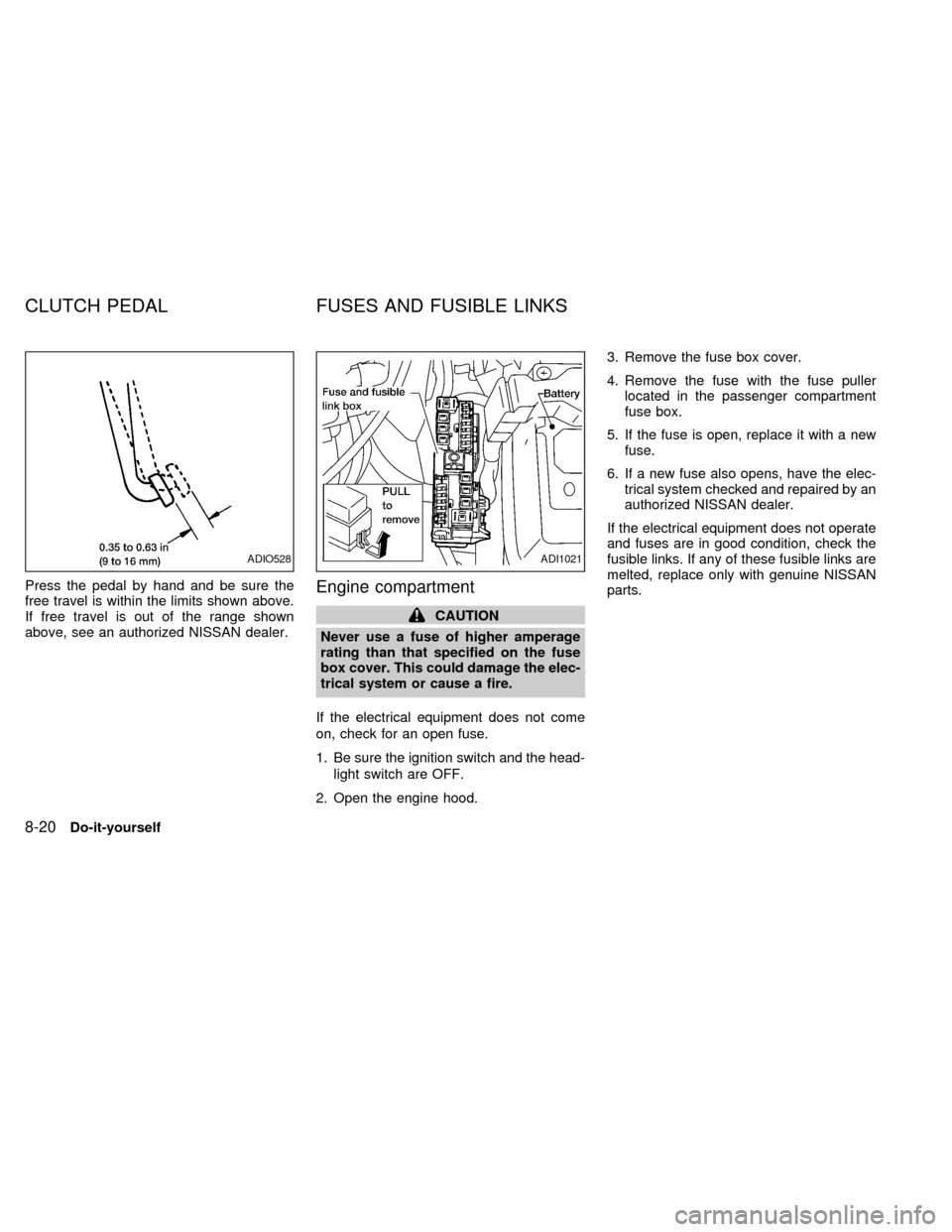
Press the pedal by hand and be sure the
free travel is within the limits shown above.
If free travel is out of the range shown
above, see an authorized NISSAN dealer.Engine compartment
CAUTION
Never use a fuse of higher amperage
rating than that specified on the fuse
box cover. This could damage the elec-
trical system or cause a fire.
If the electrical equipment does not come
on, check for an open fuse.
1. Be sure the ignition switch and the head-
light switch are OFF.
2. Open the engine hood.3. Remove the fuse box cover.
4. Remove the fuse with the fuse puller
located in the passenger compartment
fuse box.
5. If the fuse is open, replace it with a new
fuse.
6. If a new fuse also opens, have the elec-
trical system checked and repaired by an
authorized NISSAN dealer.
If the electrical equipment does not operate
and fuses are in good condition, check the
fusible links. If any of these fusible links are
melted, replace only with genuine NISSAN
parts.
ADIO528ADI1021
CLUTCH PEDAL FUSES AND FUSIBLE LINKS
8-20Do-it-yourself
ZX
Page 170 of 220
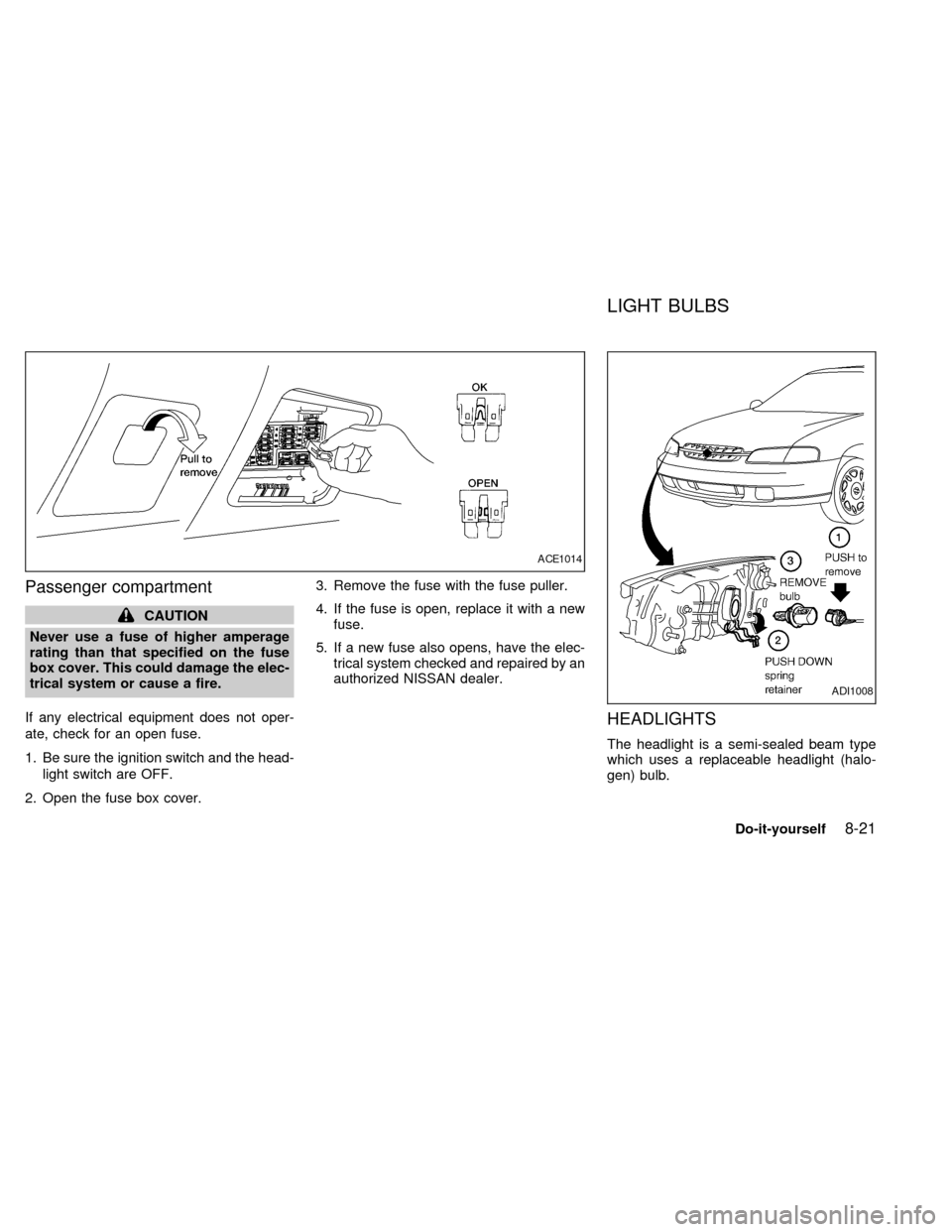
Passenger compartment
CAUTION
Never use a fuse of higher amperage
rating than that specified on the fuse
box cover. This could damage the elec-
trical system or cause a fire.
If any electrical equipment does not oper-
ate, check for an open fuse.
1. Be sure the ignition switch and the head-
light switch are OFF.
2. Open the fuse box cover.3. Remove the fuse with the fuse puller.
4. If the fuse is open, replace it with a new
fuse.
5. If a new fuse also opens, have the elec-
trical system checked and repaired by an
authorized NISSAN dealer.
HEADLIGHTS
The headlight is a semi-sealed beam type
which uses a replaceable headlight (halo-
gen) bulb.
ACE1014
ADI1008
LIGHT BULBS
Do-it-yourself8-21
ZX
Page 195 of 220

of at least 87 AKI (Anti-Knock Index) num-
ber. However, you may use unleaded gaso-
line with an octane rating as low as 85 AKI
(Anti-Knock Index) number in high altitude
areas [over 4,000 ft (1,219 m)] such as:
Colorado, Montana, New Mexico, Utah,
Wyoming, northeastern Nevada, southern
Idaho, western South Dakota, western Ne-
braska, and the part of Texas which is
directly south of New Mexico.
Using unleaded gasoline with an octane
rating lower than stated above can cause
persistent, heavy ``spark knock.''
(``Spark knock'' is a metallic rapping
noise.) If severe, this can lead to engine
damage. If you detect a persistent heavy
spark knock even when using gasoline
of the stated octane rating, or if you hear
steady spark knock while holding a
steady speed on level roads, have an
authorized dealer correct the condition.
Failure to correct the condition is misuse
of the vehicle, for which NISSAN is not
responsible.
Incorrect ignition timing may result in spark
knock, after-run or overheating, which may
cause excessive fuel consumption or en-
gine damage. If any of the above symptomsare encountered, have your vehicle
checked at an authorized NISSAN dealer or
other competent service facility.
However, now and then you may notice
light spark knock for a short time while
accelerating or driving up hills. This is
no cause for concern, because you get
the greatest fuel benefit when there is
light spark knock for a short time under
heavy engine load.
10-4Technical and consumer information
ZX
Page 199 of 220

Model KA24DE
Type Gasoline, 4-cycle, DOHC
Cylinder arrangement 4-cylinder, in-line
Bore x Stroke in (mm) 3.504 x 3.780 (89.0 x 96.0)
Displacement cu in (cm
3) 145.7 (2,389)
Firing order 1-3-4-2
Idle speed rpm
M/T 700650
A/T (in ``N'' position) 700650
Ignition timing
(degree B.T.D.C. at idle speed)20É62É
CO % at idleIdle mixture screw is preset and
sealed at factory
Spark plugFR5AP-10 (Standard)
FR6AP-10 (Cold)
FR7AP-10 (Cold)
Camshaft operation Timing Chain
Generator belt size
Width x Length in (mm) 0.8409 x 52.56 (21.36 x 1,335)
The spark ignition system of this ve-
hicle meets all requirements of the
Canadian Interference - Causing
Equipment Regulations.
ENGINE
10-8Technical and consumer information
ZX
Page 216 of 220

Fuel gauge.............................................. 2-4
Odometer ................................................ 2-3
Speedometer .......................................... 2-3
Tachometer............................................. 2-3
Trip odometer ......................................... 2-3
General maintenance .................................. 9-2
Glove box..................................................... 3-9
Glove box lock ............................................. 3-9
H
Hazard warning flasher switch .................. 2-14
Head restraints ............................................ 1-6
Headlight aiming adjustment ..................... 8-22
Headlight and turn signal switch ............... 2-12
Headlights .................................................. 8-21
Heater
Heater and air conditioner controls ........ 4-3
Heater and air conditioner (manual)....... 4-3
Heater operation ..................................... 4-4
Heater operation .......................................... 4-4
Hood release ............................................... 3-8
I
Ignition switch .............................................. 5-4
Important vehicle information label.......... 10-11
Increasing fuel economy............................ 5-15
Indicator lights and chimes (See warning/
indicator lights and chimes) ......................... 2-5
Inside mirror ............................................... 3-13Instrument brightness control .................... 2-13
Interior light ................................................ 2-21
J
Jack
Screw type .............................................. 6-2
Jump starting ...................................... 6-7, 8-14
K
Key ............................................................... 3-2
Keyless entry system (See multi-remote
control system) ............................................ 3-4
L
Labels
Air conditioner specification label ....... 10-12
Emission control information label...... 10-12
Engine serial number ......................... 10-11
F.M.V.S.S. certification label .............. 10-11
Vehicle identification number (VIN)
plate .................................................... 10-10
Warning labels (for SRS) ..................... 1-14
License plate
Installing the license plate .................. 10-13
Light
Air bag warning light ............ 1-12, 1-14, 2-6
Brake light (See stop light) ................... 8-27
Bulb check/instrument panel .................. 2-5Bulb replacement.................................. 8-24
Charge warning light .............................. 2-5
Front fog light switch ............................ 2-14
Headlight aiming adjustment ................ 8-22
Headlight and turn signal switch .......... 2-12
Headlights ............................................. 8-21
Interior light ........................................... 2-21
Light bulbs ............................................ 8-21
Low washer fluid warning light ............... 2-6
Spotlights (See map light) .................... 2-22
Trunk light ............................................. 2-22
Warning/indicator lights and chimes ...... 2-5
Lock
Child safety rear door lock ..................... 3-4
Door locks............................................... 3-2
Fuel filler lid lock opener lever ............. 3-11
Glove box lock ........................................ 3-9
Trunk lid lock opener lever ..................... 3-9
M
Maintenance
General maintenance ............................. 9-2
Inside the vehicle.................................... 9-3
Maintenance precautions ....................... 8-2
Outside the vehicle ................................. 9-2
Periodic maintenance schedules ............ 9-5
Seat belt maintenance.......................... 1-24
Under the hood and vehicle ................... 9-4
Malfunction indicator lamp (MIL) ................. 2-8
Manual antenna ......................................... 4-27
Manual front seat adjustment ...................... 1-3
11-3
ZX