Page 69 of 432
GAUGES, METERS AND SERVICE REMINDER INDICATORS
51
The gauge indicates the engine coolant temperature when
the ignition switch is on. The engine operating
temperature
will vary with changes in weather and engine
load.
If the needle points to the red zone or higher, stop your vehicle
and allow the engine to cool.
Your vehicle may overheat during severe operating
conditions, such as:
� Driving up a long hill on a hot day.
� Reducing speed or stopping after high speed driving.
� Idling for a long period with the air conditioning on in
stop±and±go traffic.
� Towing a trailer.
NOTICE
�Do not remove the thermostat in the engine cooling
system as this may cause the engine to overheat. The
thermostat is designed to control the flow of coolant to
keep the temperature of the engine within the specified
operating range.
� Do not continue driving with an overheated engine.
See ºIf your vehicle overheatsº on page 280.
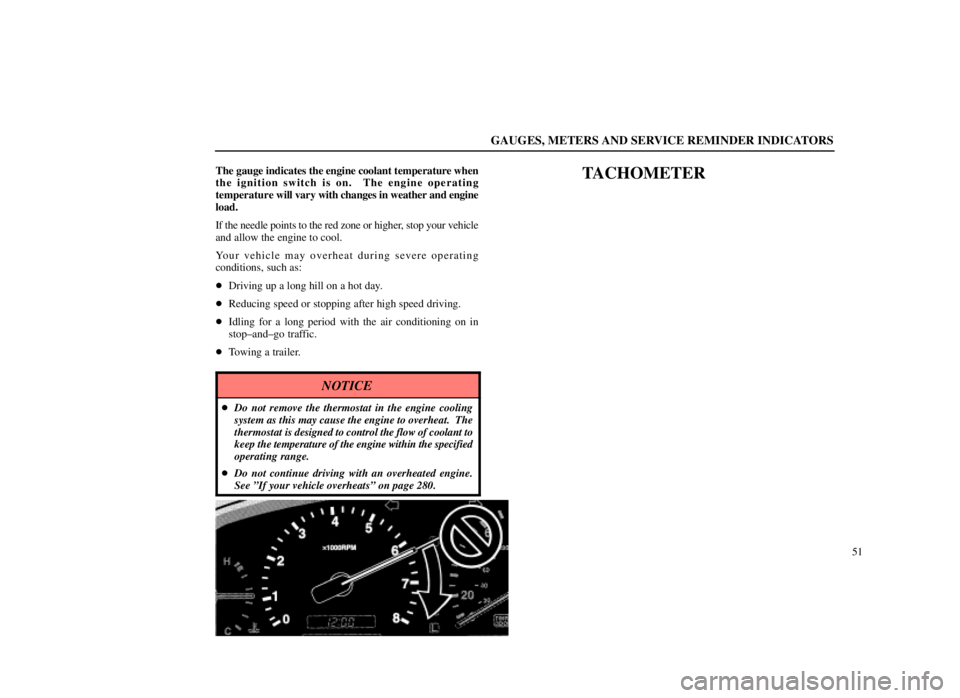
TACHOMETER
Page 245 of 432

STARTING AND DRIVING
227
(f) Good driving practice
�If the transmission repeatedly upshifts and downshifts
between the fourth and overdrive gears when climbing a
gentle slope, shift the selector lever to the º4º position. Be
sure to shift the selector lever to the ºDº position after
climbing the slope.
� When towing a trailer, in order to maintain ef ficient engine
braking and electrical charging performance, do not use
overdrive. The selector lever must be in the º4º position.
CAUTION
Always keep your foot on the brake pedal while stopped with
the engine running. This prevents the vehicle from creeping.
NOTICE
Do not hold the vehicle on an upgrade with the
accelerator pedal. This can cause the transmission to
overheat. Always use the brake pedal or parking brake.
(g) Rocking your vehicle if stuck
CAUTION
If your vehicle becomes stuck in snow, mud, sand, etc., then
you may attempt to rock the vehicle free by moving it forward
and backward. Do not attempt this procedure if people or
objects are anywhere near the vehicle. During the rocking
operation the vehicle may suddenly move forward or back as
it becomes un±stuck, causing injury or damage to nearby
people or objects.
Page 257 of 432

STARTING AND DRIVING
239
(f) Good driving practice
�If the transmission repeatedly upshifts and downshifts
between the fourth and overdrive gears when climbing a
gentle slope, shift the selector lever to the º3º position. Be
sure to shift the selector lever to the ºDº position after
climbing the slope.
� When towing a trailer, in order to maintain ef ficient engine
braking and electrical charging performance, do not use
overdrive. The selector lever must be in the º3º position.
CAUTION
Always keep your foot on the brake pedal while stopped with
the engine running. This prevents the vehicle from creeping.
NOTICE
Do not hold the vehicle on an upgrade with the
accelerator pedal. This can cause the transmission to
overheat. Always use the brake pedal or parking brake.
(g) Rocking your vehicle if stuck
CAUTION
If your vehicle becomes stuck in snow, mud, sand, etc., then
you may attempt to rock the vehicle free by moving it forward
and backward. Do not attempt this procedure if people or
objects are anywhere near the vehicle. During the rocking
operation the vehicle may suddenly move forward or back as
it becomes un±stuck, causing injury or damage to nearby
people or objects.
Page 276 of 432
SECTION 3 ± 2
258
STARTING AND DRIVING
Driving tips
Break±in period. . . . . . . . . . . . . . . . . . . . . . . . . . . . . . . . . . . . \
259
Operation in foreign countries . . . . . . . . . . . . . . . . . . . . . . . .
259
Tips for driving in various conditions s . . . . . . . . . . . . . . . . . .
259
Winter driving tips . . . . . . . . . . . . . . . . . . . . . . . . . . . . . . . . .
260
Trailer towing . . . . . . . . . . . . . . . . . . . . . . . . . . . . . . . . . . . . \
.
261
How to save fuel and make your vehicle last longer . . . . . . .
270
Page 277 of 432

DRIVING TIPS
259
BREAK±IN PERIOD
Drive gently and avoid high speeds.
You need not follow a break±in schedule with your new
Lexus. But following a few simple tips for the first 1600 km
(1000 miles) can add to the future economy and long life of
your vehicle:
�Do not drive over 88 km/h (55 mph).
� Avoid overrevving. Maintain engine speed between 2000
and 4000 rpm.
� Avoid full±throttle starts.
� Try to avoid hard stops during the first 300 km (200 miles).
� Do not drive for a long time at any single speed, either fast
or slow.
� Do not tow a trailer during the first 800 km (500 miles).
OPERATION IN FOREIGN
COUNTRIES
If you plan to drive your Lexus in another country ...
First, comply with the vehicle registration laws.
Second, confirm the availability of the correct fuel (unleaded
and minimum octane rating).
TIPS FOR DRIVING IN VARIOUS CONDITIONS
�Always slow down in gusty crosswinds. This will allow
you much better control.
� Drive slowly onto curbs and, if possible, at a right angle.
Avoid driving onto high, sharp±edged objects and other
road hazards. Failure to do so can lead to severe tire
damage resulting in tire bursts.
� When parking on a hill, turn the front wheels until they
touch the curb so that the vehicle will not roll. Apply the
parking brake, and place the transmission in ºPº. If
necessary, block the wheels.
� Washing your vehicle or driving through deep water may
get the brakes wet. To see whether they are wet, check that
there is no traffic near you and then press the pedal lightly.
If you do not feel a normal braking force, the brakes are
probably wet. To dry them, drive the vehicle cautiously
while lightly pressing the brake pedal with the parking
brake applied. If they still do not work safely, pull to the
side of the road and call a Lexus dealer for assistance.
CAUTION
�Before driving, make sure the parking brake is fully
released and that the parking brake reminder light is off.
Page 279 of 432

DRIVING TIPS
261
your Lexus dealer ± they will be pleased to help.
Check
the electronic ignition system for loose connections
or obvious damage.
Keep the door locks from freezing.
Squirt lock de±icer or glycerine into the locks to keep them
from freezing.
Use a washer fluid containing an antifreeze solution.
This product is available at your Lexus dealer and most auto
parts stores. Follow the manufacturer's directions for how
much to mix with water.
NOTICE
Do not use engine antifreeze or any other substitute
because it may damage your vehicle's paint.
Do not use your parking brake when there is a possibility
it could freeze.
When parking, put the transmission into ºPº and block the
front wheels. Do not use the parking brake, or snow or water
accumulated in and around the parking brake mechanism
may freeze the parking brake, making it hard to release.
Keep ice and snow from accumulating under the fenders.
Ice and snow built up under your fenders can make steering
difficult. During bad winter driving, stop and check under the
fenders occasionally. Depending on where you are driving, we recommend you
carry some emergency equipment.
Some of the things you might put in the vehicle are tire chains,
window scraper, bag of sand or salt, flares, small shovel,
jumper cables, etc.
TRAILER TOWING
Your vehicle is designed primarily as a passenger±carrying
vehicle. Towing a trailer will have an adverse effect on
handling, performance, braking, durability and driving
economy (fuel consumption, etc.). Your safety and
satisfaction depend on the proper use of correct equipment
and cautious driving habits. For your safety and the safety of
others, you must not overload your vehicle or trailer. Lexus
warranties do not apply to damage or malfunction caused by
towing a trailer for commercial purposes. Ask your local
Lexus dealer for further details before towing.
Page 280 of 432
DRIVING TIPS
262
Weight limits
Before towing, make sure the total trailer weight, gross
vehicle weight, gross axle weight and trailer tongue load
are all within the limits.
The total trailer weight and tongue load can be measured with
platform scales found at a highway weighing station, building
supply company, trucking company, junk yard, etc.
CAUTION
Page 281 of 432

DRIVING TIPS
263
�The total trailer weight (trailer weight plus its cargo load)
must not exceed 726 kg (1600 lb.). Exceeding this weight is
dangerous.
� Trailer hitch assemblies have different weight capacities
established by the hitch manufacturer. Even though the
vehicle may be physically capable of towing a higher
weight, the operator must determine the maximum weight
rating of the particular hitch assembly and never exceed
the maximum weight rating specified for the trailer hitch.
Exceeding the maximum weight rating set by the trailer
hitch manufacturer can cause an accident resulting in
serious personal injuries.
�The gross vehicle weight must not exceed the Gross V ehicle
Weight Rating (GVWR) indicated on the Certification
Label. The gross vehicle weight is the sum weight of the
unloaded vehicle, driver, passengers, luggage, hitch and
trailer tongue load. It also includes the weight of any
special equipment installed on your vehicle.
� The load on either the front or rear axle resulting from
distribution of the gross vehicle weight on both axles must
not exceed the Gross Axle Weight Rating (GAWR) listed on
the Certification Label.