1999 LAND ROVER DISCOVERY oil
[x] Cancel search: oilPage 1315 of 1529

BODY CONTROL UNIT
86-3-28 DESCRIPTION AND OPERATION
Courtesy headlamps
This feature activates the headlamps for 30 seconds when the lock button on the remote transmitter is held down for
longer than 1 second. The headlamps will extinguish if the BCU receives either a lock or an unlock signal from the
remote transmitter.
The BCU checks the status of the following inputs to determine the correct qualifying conditions for requesting
courtesy headlamps:
lIgnition state.
lRemote locking request.
lRemote unlocking request.
lLazy locking request.
If the ignition is off and a lazy locking request is received, the courtesy headlamps are switched on and an internal
timer is turned on in the BCU which operates for 30 seconds. If the 30 second timer expires or a request for remote
locking or remote unlocking is received, the courtesy headlamps will be turned off.
When main beam is selected, the IDM also provides a signal to the instrument pack to switch on the main beam
warning lamp. An additional signal 'main beam indicator disable' is used to prevent the daylight running lamps
illuminating the main beam indicator when the main beam is in the daylight running lamp state and the main beam
indicator disable signal is on.
Lights on alarm
The lights on alarm in the instrument pack operates when the driver's door is open and the side lamps or headlamps
are on. The system uses inputs from the driver's door switch and the lighting switch to determine the logical conditions
that need to occur for switching on the alarm. The BCU carries out the logic operation and communicates with the
instrument pack using the serial data bus; the instrument pack will be requested to sound the alarm if the logic inputs
indicate that the driver's door is open with the lights still on.
Supply voltage is provided through the lighting switch to the IDM which acts as the signal line to indicate that the lights
are on for the logic circuits in the IDM and BCU. When the driver's door is opened, a second feed is supplied to the
BCU through the driver's door switch to indicate the condition. In this logic condition (lights on and driver's door open)
the BCU signals the instrument pack to operate the audible warning. If the lights are switched off or the driver's door
is closed the logic condition will be changed and the audible warning will be switched off.
Daylight running lamps
The BCU operates the daylight running lamps (where fitted) via the IDM. The daylight running lamps option can be
programmed in one of three states dependent on market/ customer requirements, these are:
lOption 1– no daylight running lamps.
lOption 2 – on with main beam off.
lOption 3 – on with main and dipped beam off and gearbox not in Park.
The BCU will ensure the logical conditions are satisfied for the lamps to operate under the set conditions. The BCU
checks the status of the following inputs to determine the logic action for providing an output to the daylight running
lamp relay:
lMain beam state.
lEngine running (link from instrument pack).
lDipped beam.
lGearbox state.
A voltage supply is fed to the coil of the daylight running lamp relay and the IDM. When the preconditions are satisfied
for daylight running lamp operation, the BCU sends a signal for the IDM to complete the circuit to earth to switch on
the daylight running lamps. The logical inputs are checked to ensure that the engine is running before switching the
relay to turn on the daylight running lamps. The engine running signal has to be present for at least 2 seconds before
the daylight running lamp relay can be switched on.
Fog lamps
The BCU operates the rear fog lamps and the front fog lamps (where fitted) via the IDM. The BCU front fog lamp
operation can be programmed to operate under one of three set conditions. The BCU will ensure the logical conditions
are satisfied for the lamps to operate under the set conditions.
Page 1316 of 1529

BODY CONTROL UNIT
DESCRIPTION AND OPERATION 86-3-29
Front fog lamps
Front fog lamp operation is monitored by the BCU, which allows only the front fog lamps to operate when the side
lamps or headlamps are on. When the side lamps, headlamps or ignition switch is turned off, the BCU also switches
off the fog lamps. When the side or headlamps are switched on again, the front fog lamps will remain off unless the
front fog lamp switch is pressed to resume operation. If the rear fog guard lamps are selected on, switching off the
front fog lamps will also switch off the rear fog guard lamps.
When the fog lamp switch is operated, an earth path is completed and the BCU allows the fog lights to be switched
on providing the logical preconditions have been satisfied. The BCU then supplies a voltage supply to the fog lamp
relay, to illuminate the fog lamps.
The front fog lamps option can be programmed in one of three states dependent on market/ customer requirements,
these are:
lOption 1– not fitted.
lOption 2 – main beam no effect.
lOption 3 – off with main beam.
The BCU checks the status of the following inputs to determine the logic action for providing an output to the front fog
lamp relay:
lIgnition state.
lMain beam state.
lSide lamps.
lDipped beam.
lFront fogs selected (press button, not latched).
If the ignition state is crank the state of the front fog relay is memorised and the relay is switched off. Pressing the
front fog switch during cranking will not be recognised. When the ignition state returns to Ignition after cranking, the
memorised front fog relay state is restored. If the ignition is turned off, the front fog relay is turned off.
For option 3 configuration, if the main beam is turned on the state of the front fog relay is memorised and the relay is
switched off. Pressing the front fog switch while main beam is on will not be recognised. When the Main beam state
returns to OFF, the memorised front fog relay state is restored.
In the event of a communications link failure while the front fog relay is on, the front fog relay will be switched off.
Rear fog lamps
The rear fog lamps operation is monitored by the BCU, which only allows the rear fog lamps to operate when the side
lamps or the headlamps are on. When the side lamps, headlamps or ignition is switched off, the rear fog lamps are
also switched off. When the side lamps or headlamps are switched on again, the rear fog lamps will not switch on
again unless reselected by operating the rear fog lamps switch. If front fog lamps are fitted, the rear fog lamps will be
switched off if the front fog lamps are switched off.
A supply voltage to the rear fog lamps relay is provided from a fuse in the passenger compartment fuse box, then
through two electronic switches in the IDM. With the lighting switch in the side lamp or headlamp position, an earth
path from the coil of the rear fog lamps relay completes the circuit through the two switches in the IDM to switch the
rear fog lamps on when the BCU receives a request signal from the rear fog lamps switch to turn the circuit on.
The BCU checks the status of the following inputs to determine the logic action for providing an output to the rear fog
lamp relay:
lIgnition state.
lMain beam state.
lDipped beam.
lFront fogs relay.
lRear fogs selected (press button, not latched).
If the ignition state is crank the state of the rear fog relay is memorised and the relay is switched off. Pressing the front
fog switch during cranking will not be recognised. When the ignition state returns to Ignition after cranking, the
memorised rear fog relay state is restored. If the ignition is turned off, the rear fog relay is turned off.
In the event of a communications link failure occurring while the rear fog relay is on, the rear fog relay will remain on
until the ignition is turned off or the dipped/ main beam is turned off.
Page 1318 of 1529

BODY CONTROL UNIT
DESCRIPTION AND OPERATION 86-3-31
Gear position indicator illumination
On automatic gearbox models, two variations of illumination for the gear position indicators on the selector lever can
be programmed into the BCU. In option 1, illumination is provided when the ignition is on. In option 2, illumination is
enabled when the ignition is on and the side lamps are off.
Starter relay
The BCU checks the status of the following inputs and internal BCU conditions to determine whether or not to provide
an output to enable the starter relay:
lAutostart inhibit (vehicles with automatic gearbox only).
lSecurity start inhibit (immobilisation check).
lEngine running (link to instrument pack).
lEEPROM locked (internal check).
lIDM and BCU matched.
When the BCU receives a crank signal from the ignition switch, an earth path is completed to the starter relay coil,
provided that the security system has been de-activated. If the ECM has not received a valid unlock/ remobilise signal,
the starter relay will be disengaged and the engine stopped. The BCU also receives an engine running signal from
the instrument pack, so that if the ignition key is turned to the crank position while the engine is running, the starter
motor relay will not be engaged.
If the logic conditions are correct to allow starter operation, the completion of the earth path from the starter relay coil
to the BCU energises the coil and the relay contacts close to supply battery power to the starter motor.
When the ignition switch is released from the crank position, the power supply feed from the ignition switch to the
starter relay coil is interrupted and the relay contacts open to prevent further battery feed to the starter motor.
If a communications link failure is experienced, the BCU will be prevented from detecting the 'engine running'
condition and the BCU will default to assume that the engine is not running.
Cruise control
The Neutral/ Reverse/ Park/ Brake selected output is used by the cruise control system. The BCU checks for the
following inputs:
lIgnition on.
lGearbox state.
lBrake switch activated.
For vehicles with manual transmission, Neutral/ Reverse/ Park/ Brake selected output is on if the ignition is on and
brake switch activated is on. Otherwise, the Neutral/ Reverse/ Park/ Brake selected output is off.
For vehicles with automatic transmission, the Neutral/ Reverse/ Park/ Brake selected output is on if the ignition is on
and brake switch activated is on, or if the ignition is on and 'gearbox state' is in Neutral, Park or Reverse. Otherwise
Neutral/ Reverse/ Park/ Brake selected output is off.
Shift interlock (where fitted)
On automatic gearbox models, the BCU and IDM combine to operate a shift interlock solenoid, so that the gear
selector lever can only be moved when certain logical conditions have been satisfied. Operation of the interlock may
be affected, if the battery becomes discharged.
+ AUTOMATIC GEARBOX - ZF4HP22 - 24, DESCRIPTION AND OPERATION, Description.
When the gear selector lever is in the Park position and the ignition is off, an interlock solenoid is de-energised, locking
the gear selector lever in the Park position.
The gear selector lever can only be moved from the Park position when the ignition is switched on and the brake pedal
is depressed. When these conditions are satisfied, the brake pedal switch signal is received by the BCU which then
signals the IDM to energise the interlock relay. When the interlock relay is energised, the interlock solenoid is
operated, unlocking the gear selector lever.
When the brake pedal is released, the feed to the BCU is removed and the shift interlock solenoid is de-energised.
The locking mechanism controlled by the solenoid will lock the gear selector lever once it is returned to the Park
position.
Page 1319 of 1529

BODY CONTROL UNIT
86-3-32 DESCRIPTION AND OPERATION
The shift interlock option can be programmed in one of three states dependent on market/ customer requirements,
these are:
lOption 1– not fitted.
lOption 2 – normal operation.
lOption 3 – inhibit transfer box.
The BCU checks the status of the following inputs to determine the logic action for employing the shift interlock
solenoid:
lBrake switch activated.
lIgnition state.
lGearbox state.
In the event of a communications link failure, the shift interlock solenoid enable is switched on for 1 minute every time
the ignition is switched on and switched off when the ignition is turned off.
Ignition interlock (where fitted)
On automatic gearbox models, when the ignition key is inserted in the ignition switch, the ignition key-in switch
contacts close to supply a signal to the BCU to indicate the presence of the key in the switch and provide a supply
feed to the ignition interlock solenoid. If the gear selector lever is in a position other than Park, or the 'transfer box
neutral selected' is on, the BCU will supply an earth path to complete the ignition interlock circuit and cause the
interlock solenoid to be engaged. With the interlock solenoid engaged, removal of the ignition key is prevented. The
BCU will open the circuit, to allow removal of the ignition key, only when the gear selector lever is in the Park position
and the transfer box is in either high or low range.
The ignition key interlock option can be programmed in one of three states dependent on market/ customer
requirements, these are:
lOption 1– not fitted.
lOption 2 – normal operation.
lOption 3 – inhibit transfer box.
The BCU checks the status of the following inputs to determine the logic action for operating the ignition key interlock
solenoid:
lTransfer box neutral selected.
lGearbox state.
lTransit mode.
When the transit mode is on, the ignition key interlock solenoid is off.
Transfer box interlock (where fitted)
The transfer box interlock is controlled by the IDM to prevent transfer box shifter operation unless certain
preconditions have been satisfied.
The transfer box interlock prevents the transfer box being shifted from High or Low to neutral with the ignition key
removed from the ignition switch. When the BCU senses that the ignition key is removed from the ignition switch, it
signals the IDM via the serial data bus. The IDM then provides an earth path for the coil of the transfer box relay,
energising the relay coil and closing the relay contacts to provide a voltage supply to the transfer box interlock
solenoid.
A diode is included in the supply line to the solenoid to prevent residual current causing the solenoid to stick in the
energised position.
The transfer box solenoid interlock option can be programmed in one of three states dependent on market/ customer
requirements, these are:
lOption 1– not fitted.
lOption 2 – normal operation.
lOption 3 – inhibit transfer box.
The BCU checks the status of the following inputs to determine the logic action for employing the transfer box interlock
solenoid (transfer box solenoid enable):
lIgnition state.
lGearbox state.
Page 1326 of 1529

ALARM SYSTEM AND HORN
DESCRIPTION AND OPERATION 86-4-3
1Theft deterrent LED
2Receiver
3Volumetric sensors
4Central door locking switch
5Body Control Unit (BCU)
6Bonnet activated alarm switch
7Vehicle horn
8Alarm sounder
9Fuel cut off switch
10Fuel flap release switch
11Door latch switches, drivers door key lock/
unlock switches
12Battery Backed Up Sounder (BBUS)
13Passive remobilisation exciter coil
Page 1335 of 1529
ALARM SYSTEM AND HORN
86-4-12 DESCRIPTION AND OPERATION
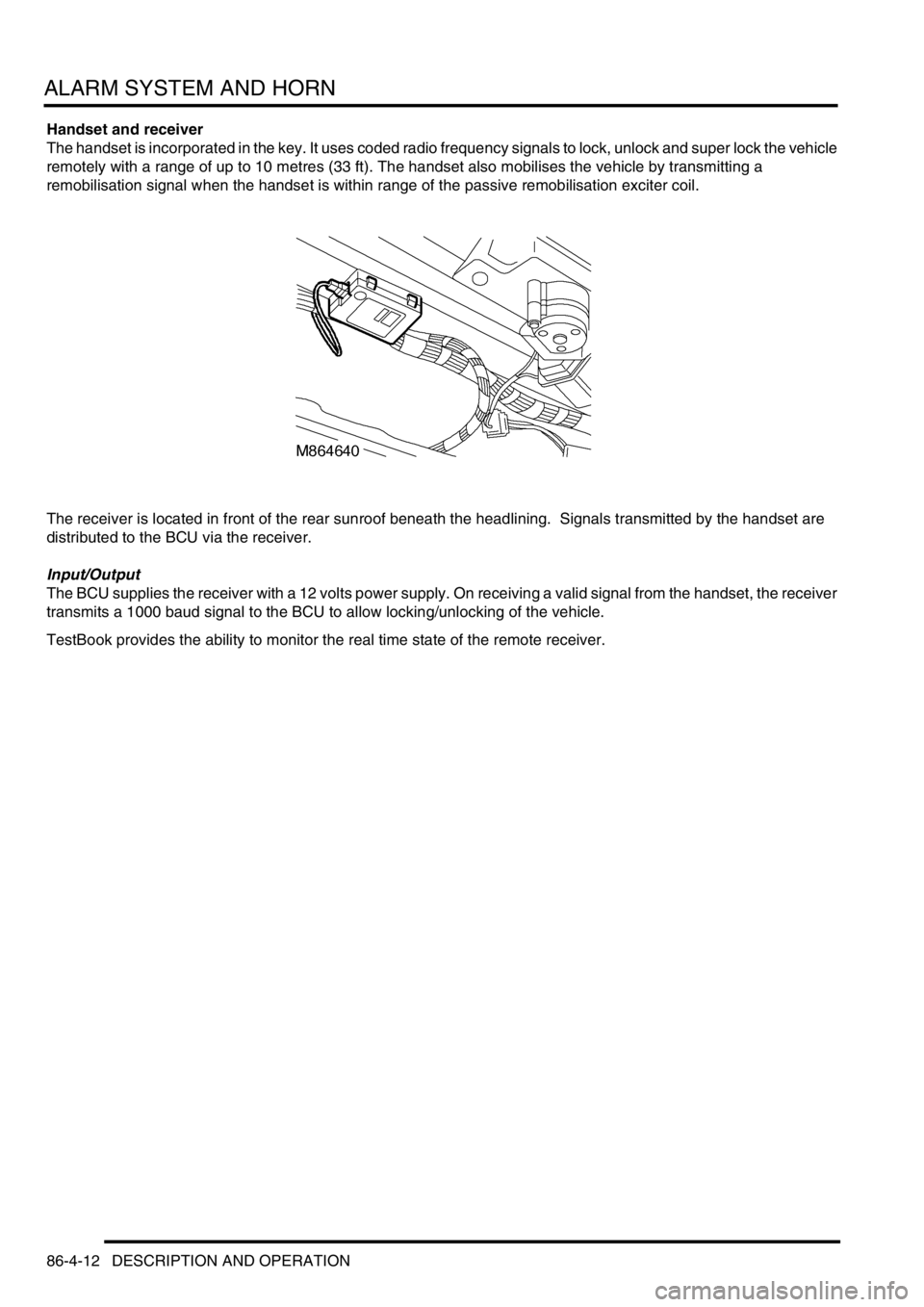
Handset and receiver
The handset is incorporated in the key. It uses coded radio frequency signals to lock, unlock and super lock the vehicle
remotely with a range of up to 10 metres (33 ft). The handset also mobilises the vehicle by transmitting a
remobilisation signal when the handset is within range of the passive remobilisation exciter coil.
The receiver is located in front of the rear sunroof beneath the headlining. Signals transmitted by the handset are
distributed to the BCU via the receiver.
Input/Output
The BCU supplies the receiver with a 12 volts power supply. On receiving a valid signal from the handset, the receiver
transmits a 1000 baud signal to the BCU to allow locking/unlocking of the vehicle.
TestBook provides the ability to monitor the real time state of the remote receiver.
Page 1336 of 1529
ALARM SYSTEM AND HORN
DESCRIPTION AND OPERATION 86-4-13
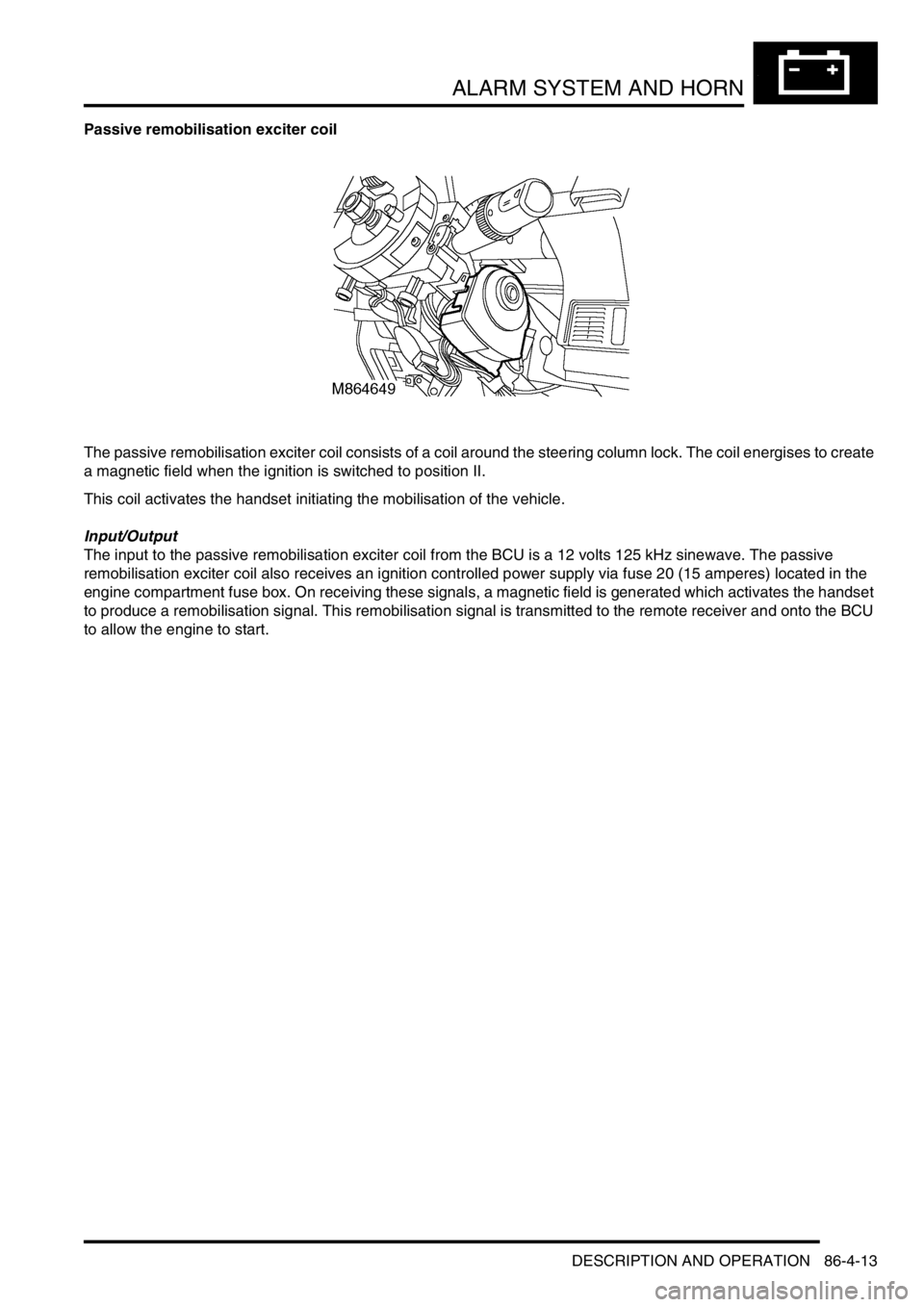
Passive remobilisation exciter coil
The passive remobilisation exciter coil consists of a coil around the steering column lock. The coil energises to create
a magnetic field when the ignition is switched to position II.
This coil activates the handset initiating the mobilisation of the vehicle.
Input/Output
The input to the passive remobilisation exciter coil from the BCU is a 12 volts 125 kHz sinewave. The passive
remobilisation exciter coil also receives an ignition controlled power supply via fuse 20 (15 amperes) located in the
engine compartment fuse box. On receiving these signals, a magnetic field is generated which activates the handset
to produce a remobilisation signal. This remobilisation signal is transmitted to the remote receiver and onto the BCU
to allow the engine to start.
Page 1344 of 1529

ALARM SYSTEM AND HORN
DESCRIPTION AND OPERATION 86-4-21
Passive immobilisation
Passive immobilisation prevents the vehicle from being started unless the authorised key is used to start the vehicle.
There are only two configurations for passive immobilisation:
lpassive immobilisation not active
lpassive immobilisation active
When the ignition is switched off, the vehicle remains mobilised for up to a maximum of 5 minutes. If however the
driver's door is opened, after 2 minutes 30 seconds, the vehicle remains in a mobilised state for a further 30 seconds.
When the timer in the BCU has expired, the vehicle is immobilised.
Once the ignition is switched on, the BCU transmits a coded signal to the ECM. If the coded signal does not
correspond to the programmed code in the ECM, the ECM is inhibited and the BCU inhibits the starting circuit.
In order for passive immobilisation to occur, the following conditions must be met:
lDriver's door closed.
lFuel cut-off switch not tripped.
lKey not inserted in ignition.
Passive remobilisation
Whenever the vehicle is immobilised, passive remobilisation of the engine occurs when the ignition is switched on,
allowing the vehicle to be started.
There are three configurations for passive remobilisation:
lPassive immobilisation not active.
lPassive immobilisation active.
lEKA with super locking on receiving good passive remobilisation exciter coil signal.
The BCU controls the passive remobilisation exciter coil (located around the ignition barrel) to generate a magnetic
field which causes the handset to transmit a remobilisation signal. The BCU receives the signal and allows the vehicle
to be started. If a valid signal from the handset is not received within one minute of the ignition being switched to
position II, the BCU stops the passive coil from generating the magnetic field.
Emergency key access
If the handset fails to operate, the engine can be remobilised by using the key to enter a unique four digit Emergency
Key Access (EKA) code.
There are three configurations for emergency key access:
lEKA not active (no immobiliser fitted).
lEKA active.
lEKA with super locking on receiving good passive remobilisation exciter coil signal.