1999 HONDA CIVIC COUPE tire pressure
[x] Cancel search: tire pressurePage 194 of 269

Tires
To safely operate your car, your tires must be the proper type and size, in
good condition with adequate tread, and correctly inflated. The following
pages give more detailed information on how and when to check air
pressure, how to inspect your tires
for damage and wear, and what to do
when your tires need to be replaced.
Inflation
Keeping the tires properly inflated
provides the best combination of
handling, tread life and riding comfort. Underinflated tires wear
unevenly, adversely affect handling and fuel economy, and are more
likely to fail from being overheated. Overinflated tires can make your car
ride more harshly, are more prone to damage from road hazards, and wear
unevenly.
We recommend that you visually check your tires every day. If you
think a tire might be low, check it immediately with a tire gauge. Use a gauge to measure the air
pressure at least once a month. Even
tires that are in good condition may
lose one to two psi (10 to 20 kPa, 0.1
to 0.2 kgf/cm2) per month. Remember to check the spare tire at
the same time you check all the other tires.
Check the pressure in the tires when
they are cold. This means the car has been parked for at least three
hours. If you have to drive the car
before checking the tire pressure, the tires can still be considered
"cold" if you drive less than 1 mile (1.6 km).
CONTINUED
Maintenance
Using tires that are excessively
worn or improperly inflated can
cause a crash in which you can
be seriously hurt or killed.
Follow all instructions in this
owner's manual regarding tire
inflation and maintenance.Main Menu Table of Contents s t
Page 195 of 269
Tires
If you check the pressure when the
tires are hot (the car has been drivenseveral miles), you will see readings
4 to
6 psi (30
to
40 kPa, 0.3
to 0.4
kgf/cm2) higher than the cold reading. This is normal. Do not letair out to match the specified cold
pressure. The tire will be
underinflated.
You should get your own tire pressure gauge and use it whenever
you check your tire pressures. This
will make it easier for you to tell if a pressure loss is due to a tire problemand not due to a variation between
gauges.
Recommended Tire Pressures for
Normal Driving
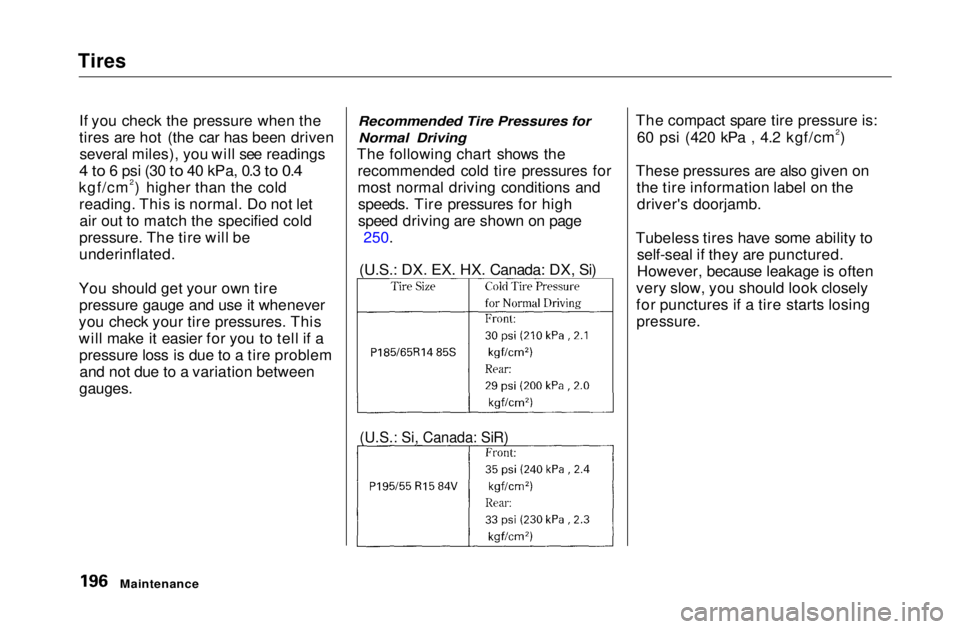
The following chart shows the recommended cold tire pressures for
most normal driving conditions andspeeds. Tire pressures for high
speed driving are shown on page
250.
(U.S.: DX. EX. HX. Canada: DX, Si)
(U.S.: Si, Canada: SiR)
The compact spare tire pressure is:
60 psi (420 kPa , 4.2 kgf/cm2)
These pressures are also given on the tire information label on thedriver's doorjamb.
Tubeless tires have some ability to self-seal if they are punctured.
However, because leakage is often
very slow, you should look closely
for punctures if a tire starts losing
pressure.
MaintenanceMain Menu Table of Contents s t
Page 198 of 269

Tires
Replacing Tires and Wheels
The tires that came with your car were selected to match the perform- ance capabilities of the car while
providing the best combination of
handling, ride comfort, and long life.
You should replace them with radial tires of the same size, load range, speed rating, and maximum cold tire
pressure rating (as shown on the
tire's sidewall). Mixing radial and
bias-ply tires on your car can reduce its braking ability, traction, andsteering accuracy. It is best to replace all four tires at
the same time. If that is not possible
or necessary, then replace the two
front tires or the two rear tires as a
pair. Replacing just one tire can seriously affect your car's handling. The ABS works by comparing the
speed of the wheels. When replacing
tires, use the same size originally supplied with the car. Tire size and
construction can affect wheel speed and may cause the system to work in-
consistently.
If you ever need to replace a wheel,
make sure the wheel's specifications
match those of the original wheel
that came on your car. Replacement
wheels are available at your Honda dealer.
Maintenance
Installing improper tires on your
car can affect handling and
stability. This can cause a crash in which you can be seriouslyhurt or killed.
Always use the size and type of
tires recommended in this owner's manual.Main Menu Table of Contents s t
Page 218 of 269

Taking Care of the Unexpected
This section covers the more- common problems that motorists
experience with their vehicles. It
gives you information about how to safely evaluate the problem and what
to do to correct it. If the problem has stranded you on the side of the road,
you may be able to get going again. If not, you will also find instructions
on getting your car towed. Compact Spare Tire....................... 220
Changing a Flat Tire..................... 221
If Your Engine Won't Start........... 226
Nothing Happens or theStarter Motor OperatesVery Slowly............................. 226
The Starter Operates Normally................................. 227
Jump Starting................................. 227 If Your Engine Overheats............. 229
Low Oil Pressure Indicator.......... 231Charging System Indicator........... 232
Malfunction Indicator Lamp ........ 233
Brake System Indicator................ 234 Closing the Moonroof................... 235
Fuses............................................... 236 Checking and Replacing........... 237
Emergency Towing....................... 241
Taking Care of the UnexpectedMain Menu s t
Page 219 of 269
Compact Spare Tire
Your car has a compact spare tire that takes up less space. Use thisspare tire as a temporary replace-
ment only. Get your regular tire
repaired or replaced and put back on
your car as soon as you can.
Check the inflation pressure of the
compact spare tire every time you
check the other tires. It should be
inflated to: 60 psi (420 kPa , 4.2 kgf/cm2)
Follow these precautions whenever
you are using the compact spare tire:
Do not exceed 50 mph (80 km/h)
under any circumstances.
This tire gives a harsher ride and
less traction on some road sur-
faces than the regular tire. Use
greater caution while driving on
this tire.
Do not mount snow chains on the
compact spare.
The wheel of the folding spare tire is designed especially to fit your
car. Do not use your spare tire on
another car unless it is the same
make and model.
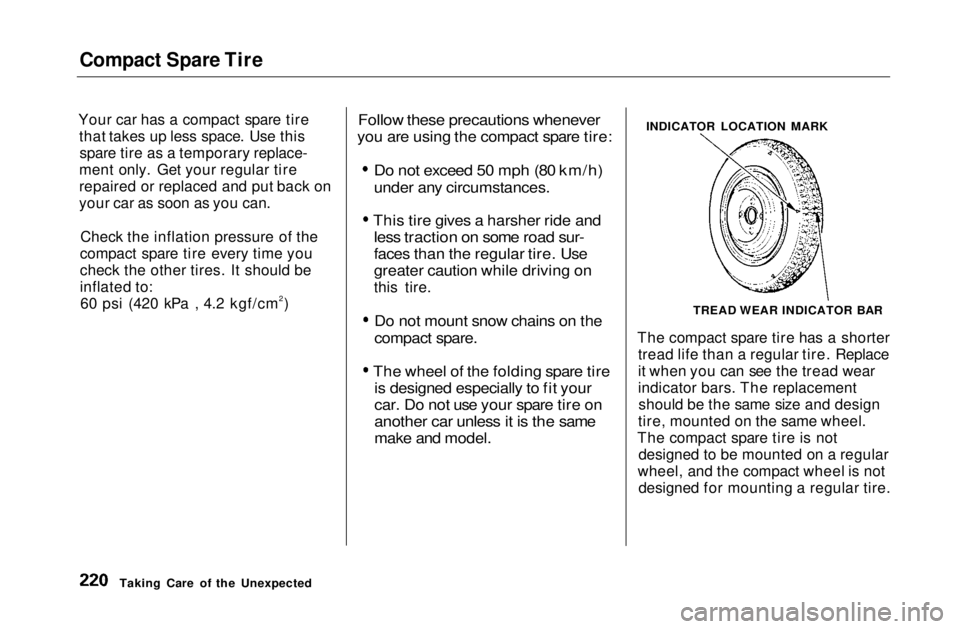
The compact spare tire has a shorter
tread life than a regular tire. Replace
it when you can see the tread wear
indicator bars. The replacementshould be the same size and design
tire, mounted on the same wheel.
The compact spare tire is not designed to be mounted on a regular
wheel, and the compact wheel is not designed for mounting a regular tire.
Taking Care of the Unexpected INDICATOR LOCATION MARK
TREAD WEAR INDICATOR BARMain Menu Table of Contents s t
Page 242 of 269

Technical Information
The diagrams in this section give you the dimensions and capacities of
your Honda, and the locations of the identification numbers. The expla-
nations of several electronic and
mechanical systems on your Honda
are for the more technically-oriented
owner. Identification Numbers................. 244
Specifications................................. 246
Tire Information............................ 249 Tire Size Designation................ 249
Wheel Size Designation............ 249
Tire Speed Ratings.................... 249
Tire Pressure Adjustment For High Speed Driving............... 250
DOT Tire Quality Grading....... 250
Treadwear.............................. 250
Traction.................................. 251Temperature.......................... 251
Oxygenated Fuels.......................... 252
Driving in Foreign Countries....... 253 Emissions Controls........................ 254
The Clean Air Act...................... 254Crankcase Emissions Control System..................................... 254
Evaporative Emissions Control System..................................... 254
Onboard Refueling Vapor Recovery................................. 254
Exhaust Emissions Controls.... 255 PGM-FI System..................... 255
Ignition Timing ControlSystem................................. 255
Exhaust Gas Recirculation (EGR) System.................... 255
Three Way Catalytic Converter............................ 255
Replacement Parts..................... 255
Three Way Catalytic Converter... 256
Technical InformationMain Menu s t
Page 249 of 269
Tire Information
Tire Pressure Adjustment For High Speed Driving
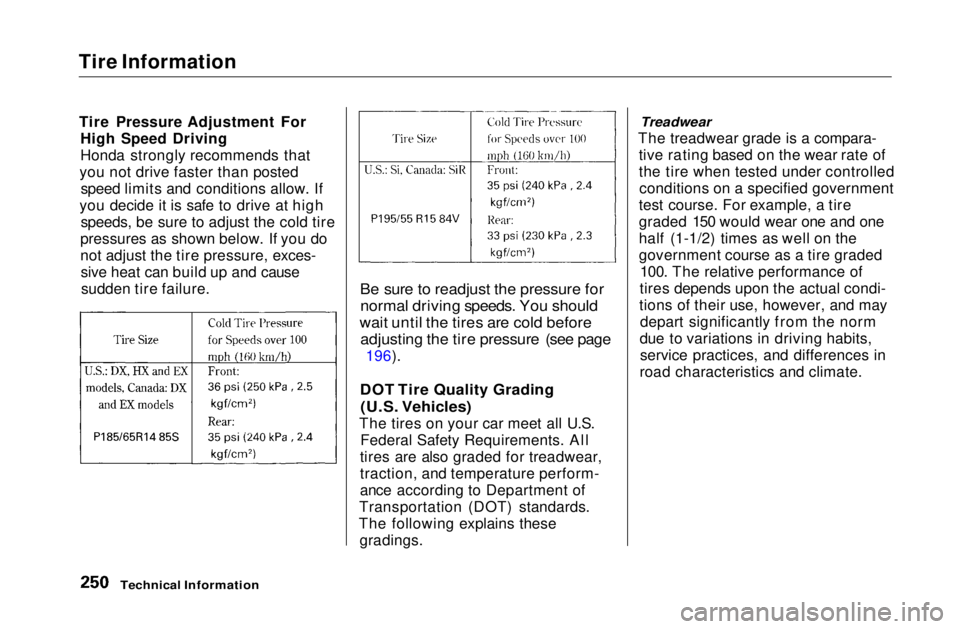
Honda strongly recommends that
you not drive faster than posted speed limits and conditions allow. If
you decide it is safe to drive at high speeds, be sure to adjust the cold tire
pressures as shown below. If you do
not adjust the tire pressure, exces- sive heat can build up and causesudden tire failure.
Be sure to readjust the pressure for
normal driving speeds. You should
wait until the tires are cold before adjusting the tire pressure (see page
196).
DOT Tire Quality Grading
(U.S. Vehicles)
The tires on your car meet all U.S. Federal Safety Requirements. All
tires are also graded for treadwear,
traction, and temperature perform-
ance according to Department of
Transportation (DOT) standards.
The following explains these gradings.
Treadwear
The treadwear grade is a compara- tive rating based on the wear rate of
the tire when tested under controlledconditions on a specified government
test course. For example, a tire
graded 150 would wear one and one
half (1-1/2) times as well on the
government course as a tire graded 100. The relative performance of
tires depends upon the actual condi-
tions of their use, however, and may depart significantly from the norm
due to variations in driving habits, service practices, and differences in
road characteristics and climate.
Technical InformationMain Menu Table of Contents s t
Page 260 of 269

Index
Accessories and Modifications.... 130 Accessories................................. 130Additional Safety Precaution.... 131 Modifications............................. 131
ACCESSORY (Ignition Key Position)........................................ 70
Accessory Power Socket................ 85
Adding Automatic Transmission
Fluid........................................ 180
Brake Fluid................................. 183 Clutch Fluid................................ 183
Engine Coolant........................... 175
Engine Oil................................... 171
Manual Transmission Fluid..... 182
Power Steering Fluid................. 184
Windshield Washer Fluid......... 180
Additional Information About Your Seat Belts........................ 42
Lap Belt......................................... 43
Lap/Shoulder Belt....................... 42
Seat Belt Maintenance................ 44
Seat Belt System Components... 42 Additional Information About
Your SRS................................... 45
Additional Safety Precautions.... 48 How Your Airbags Work............ 45
How Your SRS Indicator
Works........................................ 47
SRS Components......................... 45
Additives, Engine Oil..................... 171
Adjustments
Head Restraints........................... 77
Mirrors.......................................... 81
Seats.............................................. 76
Steering Wheel............................ 65
Airbag (SRS)...................................... 9
Air Cleaner Element...................... 185 Air Conditioning............................... 88 Maintenance............................... 193
Usage............................................. 90
Air Outlets (Vents).......................... 90
Air Pressure, Tires........................ 196 High Speed Driving................... 250
Normal Driving.......................... 196
Alcohol in Gasoline........................ 252
Antifreeze....................................... 175
Anti-lock Brakes (ABS) Indicator Light.................... 55, 153
Operation.................................... 152
Anti-theft Steering Column
Lock............................................... 70
Appearance Care........................... 213
Ashtrays (Optional)......................... 85
Audio System................................... 96
Automatic Speed Control................ 66
Automatic Transmission............... 140
Capacity, Fluid........................... 247
Checking Fluid Level................ 180
Shifting........................................ 141
Shift Lever Position Indicator.. 140
Shift Lever Positions................. 141
Shift Lock Release..................... 144
Battery Charging SystemIndicator............................ 55, 232
Jump Starting............................. 227 Maintenance............................... 189
Specifications............................. 248
CONTINUEDMain Menu s t