Page 1 of 400

yellowblue
i
The 1999 GMC Yukon Denali Owner's Manual
1-1 Seats and Restraint SystemsThis section tells you how to use your seats and safety belts properly. It also explains the air bag system.
2-1 Features and ControlsThis section explains how to start and operate your vehicle.
3-1 Comfort Controls and Audio SystemsThis section tells you how to adjust the ventilation and comfort controls and how to operate your audio system.
4-1 Your Driving and the RoadHere you'll find helpful information and tips about the road and how to drive under different conditions.
5-1 Problems on the RoadThis section tells you what to do if you have a problem while driving, such as a flat tire or overheated engine, etc.
6-1 Service and Appearance CareHere the manual tells you how to keep your vehicle running properly and looking good.
7-1 Maintenance ScheduleThis section tells you when to perform vehicle maintenance and what fluids and lubricants to use.
8-1 Customer Assistance InformationThis section tells you how to contact GMC for assistance and how to get service and owner publications.
It also gives you information on ªReporting Safety Defectsº on page 8-10.
9-1 IndexHere's an alphabetical listing of almost every subject in this manual. You can use it to quickly find
something you want to read.
Page 7 of 400
1-
yellowblue
1-1
Section 1 Seats and Restraint Systems
Here you'll find information about the seats in your vehicle and how to use your safety belts properly. You can also
learn about some things you should not do with air bags and safety belts.
1
-2 Seats and Seat Controls
1
-9 Safety Belts: They're for Everyone
1
-13 Here Are Questions Many People Ask About
Safety Belts
-- and the Answers
1
-14 How to Wear Safety Belts Properly
1
-14 Driver Position
1
-22 Safety Belt Use During Pregnancy
1
-23 Right Front Passenger Position
1
-23 Air Bag System
1
-30 Rear Seat Passengers1
-34 Rear Safety Belt Comfort Guides for Children
and Small Adults
1
-36 Center Passenger Position
1
-38 Children
1
-41 Child Restraints
1
-54 Larger Children
1
-57 Safety Belt Extender
1
-57 Checking Your Restraint Systems
1
-57 Replacing Restraint System Parts After
a Crash
Page 8 of 400

yellowblue
1-2
Seats and Seat Controls
This section tells you about the seats -- how to adjust
them and fold them up and down. It also tells you about
reclining front seatbacks and head restraints.
Power Seats
You can adjust the front seats with the controls located
on the side of the seat, next to the door.You can use the round center knob to move the seat to
where you want it. To raise the seat, move the knob up.
To lower the seat, move the knob down. To move the
seat forward, move the knob toward the front of the
vehicle. To move the seat rearward, move the knob
toward the rear of the vehicle.
You can also raise and lower the front and rear of the
seat. To raise the front of the seat, move the front lever
up. To lower the front of the seat, move the front lever
down. To raise the rear of the seat, move the rear lever
up. To lower the rear of the seat, move the rear
lever down.
The switch located at the front of this control panel
is for the power lumbar adjustment, which is
explained next.
Page 9 of 400
yellowblue
1-3 Power Lumbar Adjustment
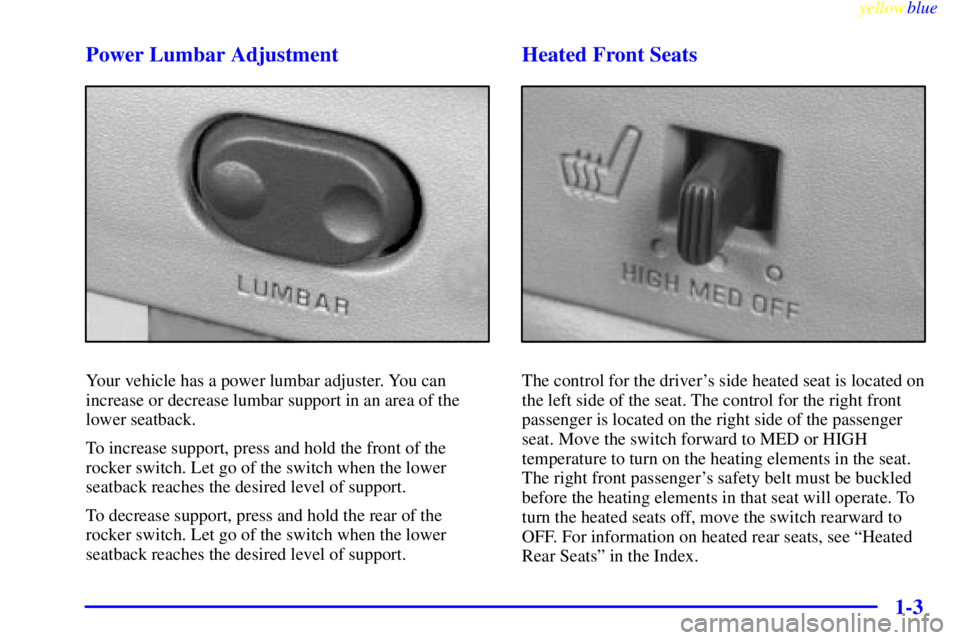
Your vehicle has a power lumbar adjuster. You can
increase or decrease lumbar support in an area of the
lower seatback.
To increase support, press and hold the front of the
rocker switch. Let go of the switch when the lower
seatback reaches the desired level of support.
To decrease support, press and hold the rear of the
rocker switch. Let go of the switch when the lower
seatback reaches the desired level of support.
Heated Front Seats
The control for the driver's side heated seat is located on
the left side of the seat. The control for the right front
passenger is located on the right side of the passenger
seat. Move the switch forward to MED or HIGH
temperature to turn on the heating elements in the seat.
The right front passenger's safety belt must be buckled
before the heating elements in that seat will operate. To
turn the heated seats off, move the switch rearward to
OFF. For information on heated rear seats, see ªHeated
Rear Seatsº in the Index.
Page 12 of 400
yellowblue
1-6 Rear Seats
CAUTION:
If a head restraint is not installed on the seatback
or stored in the vehicle properly, it could be
thrown about the vehicle in a crash or sudden
maneuver. People in the vehicle could be injured.
Remove the head restraints only when you need
to fold the seat, and be sure that the head
restraints are stored securely in the appropriate
holes at the rear of the lower seat cushion. When
the seat is returned to the passenger position, be
sure the head restraints are installed properly.
Folding the Rear Seat
Your vehicle has a 60/40 rear seat, either side may be
folded down to give you more cargo space.
Before folding, place the latch portion of the center
safety belt in the center armrest. That way, the center
safety belt will be out of the way when the seat is folded
and also will be easily available for passengers to use
when the seat is returned to the passenger position. Also,
make sure that nothing is under or in front of the seat.
When the seat is folded, it will lay flat on the floor.
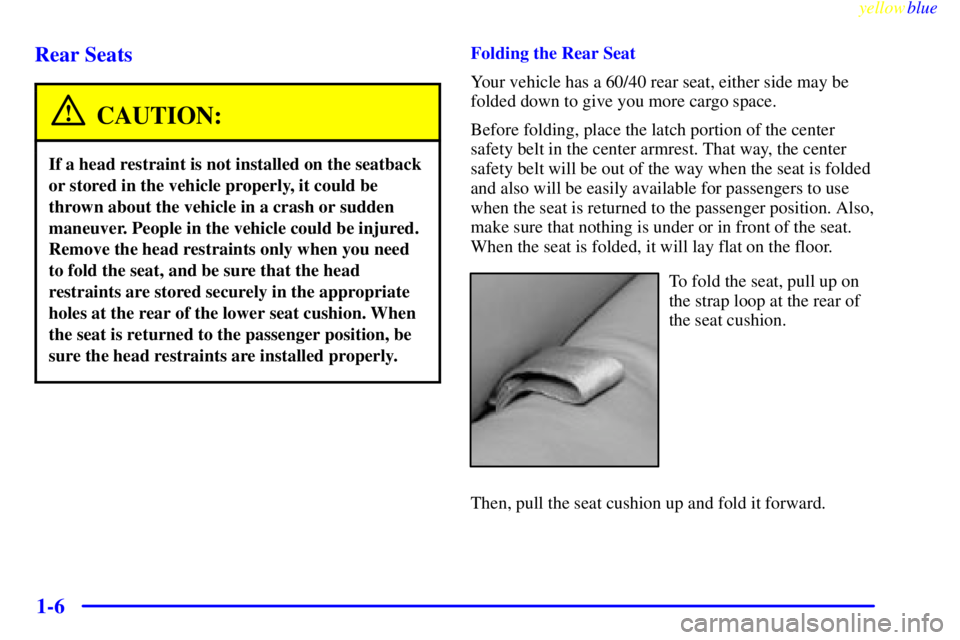
To fold the seat, pull up on
the strap loop at the rear of
the seat cushion.
Then, pull the seat cushion up and fold it forward.
Page 14 of 400
yellowblue
1-8
Heated Rear Seats
The controls for the heated
rear seats are located on the
rear of the center floor
console, below the rear seat
audio controls.Press the top of the switch to HI or the bottom of the
switch to LO to turn on the heating elements in the
outside rear seat positions. The text HI or LO on the
switch will illuminate to indicate that the heated seat
elements are operating. The switch on the left side
operates the left seat and the switch on the right side
operates the right seat. The rear seat outside passenger's
safety belt must be attached before the heating element
in that seat will operate. To turn the heated seats off,
move the switch to the center. For more information on
heated front seats, see ªHeated Front Seatsº in
the Index.
Page 15 of 400
yellowblue
1-9
Safety Belts: They're for Everyone
This part of the manual tells you how to use safety belts
properly. It also tells you some things you should not do
with safety belts.
And it explains the air bag system.
CAUTION:
Don't let anyone ride where he or she can't wear
a safety belt properly. If you are in a crash and
you're not wearing a safety belt, your injuries
can be much worse. You can hit things inside the
vehicle or be ejected from it. You can be seriously
injured or killed. In the same crash, you might
not be if you are buckled up. Always fasten your
safety belt, and check that your passengers' belts
are fastened properly too.
CAUTION:
It is extremely dangerous to ride in a cargo area,
inside or outside of a vehicle. In a collision,
people riding in these areas are more likely to be
seriously injured or killed. Do not allow people to
ride in any area of your vehicle that is not
equipped with seats and safety belts. Be sure
everyone in your vehicle is in a seat and using a
safety belt properly.
Page 20 of 400

yellowblue
1-14
Q:If I'm a good driver, and I never drive far from
home, why should I wear safety belts?
A:You may be an excellent driver, but if you're in an
accident
-- even one that isn't your fault -- you and
your passengers can be hurt. Being a good driver
doesn't protect you from things beyond your
control, such as bad drivers.
Most accidents occur within 25 miles (40 km) of
home. And the greatest number of serious injuries
and deaths occur at speeds of less than 40 mph
(65 km/h).
Safety belts are for everyone.
How to Wear Safety Belts Properly
Adults
This part is only for people of adult size.
Be aware that there are special things to know about safety
belts and children. And there are different rules for smaller
children and babies. If a child will be riding in your
vehicle, see the part of this manual called ªChildren.º
Follow those rules for everyone's protection.
First, you'll want to know which restraint systems your
vehicle has.
We'll start with the driver position.
Driver Position
This part describes the driver's restraint system.
Lap-Shoulder Belt
The driver has a lap-shoulder belt. Here's how to wear
it properly.
1. Close and lock the door.
2. Adjust the seat (to see how, see ªSeatsº in the Index)
so you can sit up straight.

