Page 21 of 224

Operating tips
²In humid weather, selectbefore driving. This
will prevent your windshield from fogging. After a
few minutes, select any desired position.
²To prevent humidity buildup inside the vehicle,
don't drive with the climate control system in the
OFF position.
²Don't put objects under the front seat that will
interfere with the airflow to the back seats.
²Remove any snow,
ice or leaves from
the air intake area
(at the bottom of
the windshield
under the hood).
²If the air conditioner works well in MAX A/C, but
not in A/C, this may indicate that the cabin air
filter (if equipped) needs to be replaced.
²If your vehicle has been parked with the windows
closed during hot weather, the air conditioner will
do a much faster job of cooling if you drive for
two or three minutes with the windows open. This
will force most of the hot, stale air out of the
vehicle. Then operate your air conditioner as you
would normally.
²When placing objects on top of your instrument
panel, be careful to not place them over the
defroster outlets. These objects can block airflow
and reduce your ability to see through your
windshield. Also, avoid placing small objects on
top of your instrument panel. These objects can
fall down into the defroster outlets and block
airflow and possibly damage your climate control
system.
Controls and features
21
Page 28 of 224

Operating tips
²In humid weather, select Fbefore driving.
This will reduce your windshield from fogging.
After a few minutes, select any desired position.
²To prevent humidity buildup inside the vehicle,
don't drive with the climate control system in the
OFF position.
²Don't put objects under the front seat that will
interfere with the airflow to the back seats.
²Remove any snow,
ice or leaves from
the air intake area
(at the bottom of
the windshield).
²If your vehicle has been parked with the windows
closed during hot weather, the air conditioner will
do a much faster job of cooling if you drive for
two or three minutes with the windows open. This
will force most of the hot, stale air out of the
vehicle. Then operate the air conditioner as you
would normally.
²If the air conditioner works well in MAX A/C but
not in normal A/C, this may indicate that the
cabin air filter (if equipped) needs to be replaced.
²When placing objects on top of your instrument
panel, be careful to not place them over the
defroster outlets. These objects can block airflow
and reduce your ability to see through your
windshield. Also, avoid placing small objects on
top of your instrument panel. These objects can
fall down into the defroster outlets and block
airflow and possibly damage your climate control
system.
Controls and features
28
Page 143 of 224
IDENTIFYING COMPONENTS IN THE ENGINE
COMPARTMENT
3.0L V6 Vulcan engine
1. Automatic transmission fluid dipstick
2. Brake fluid reservoir
3. Air filter assembly
4. Battery
5. Engine oil filler cap
6. Engine oil dipstick
7. Power steering fluid reservoir
8. Engine coolant reservoir
9. Windshield washer fluid reservoir
12
3
4567
8
9
Maintenance and care
143
Page 144 of 224
3.0L DOHC V6 Duratec engine
1. Automatic transmission fluid dipstick
2. Brake fluid reservoir
3. Air filter assembly
4. Battery
5. Engine oil filler cap
6. Engine oil dipstick
7. Engine coolant reservoir
8. Windshield washer fluid reservoir
9. Power steering fluid reservoir
8912
3
4
56
7
Maintenance and care
144
Page 145 of 224
3.4L-32V V8 SHO engine
1. Automatic transmission fluid dipstick
2. Brake fluid reservoir
3. Air filter assembly
4. Battery
5. Engine oil dipstick
6. Engine oil filler cap
7. Engine coolant reservoir
8. Windshield washer fluid reservoir
9. Power steering fluid reservoir
ENGINE OIL
Checking the engine oil
Refer to the Scheduled Maintenance Guide for the
appropriate intervals for checking the engine oil .
1. Make sure the vehicle is on level ground.
2. Turn the engine off and wait a few minutes for
the oil to drain into the oil pan.
V8 32 VALVE
8
9123
456
7
Maintenance and care
145
Page 147 of 224
Adding engine oil
1. Check the engine oil. For instructions, refer to
Checking the engine oilin this chapter.
2. If the engine oil level is not within the normal
range, add only certified engine oil of the
recommended viscosity. Remove the engine oil filler
cap and use a funnel to pour the engine oil into the
opening.
3. Recheck the engine oil level. Make sure the oil
level is not above the F in FULL mark on the engine
oil level indicator (dipstick).
4. Install the indicator and ensure it is fully seated.
5. Fully install the engine oil filler cap by turning the
filler cap clockwise until three clicks can be heard.
To avoid possible oil loss, DO NOT operate the
vehicle with the engine oil level indicator
and/or the engine oil filler cap removed.
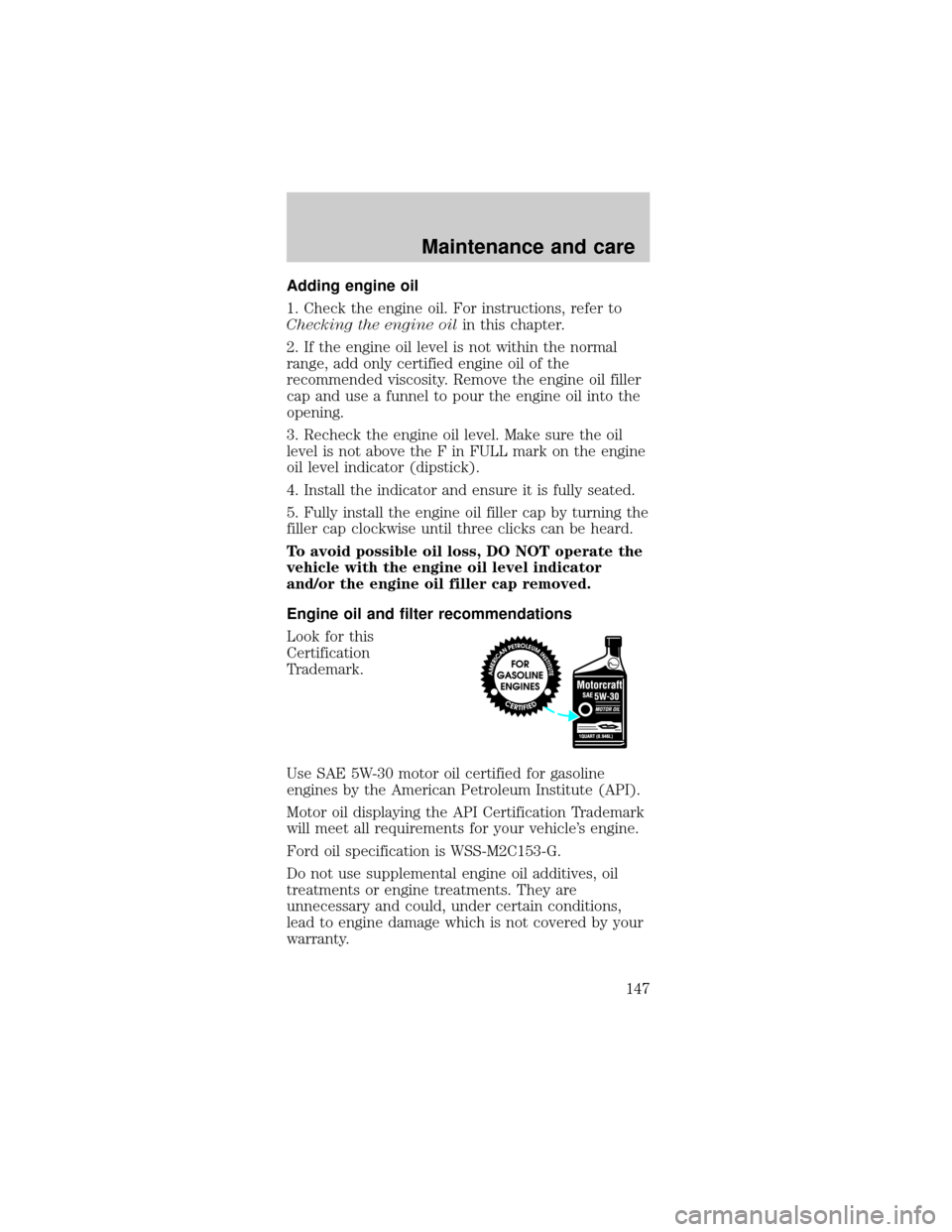
Engine oil and filter recommendations
Look for this
Certification
Trademark.
Use SAE 5W-30 motor oil certified for gasoline
engines by the American Petroleum Institute (API).
Motor oil displaying the API Certification Trademark
will meet all requirements for your vehicle's engine.
Ford oil specification is WSS-M2C153-G.
Do not use supplemental engine oil additives, oil
treatments or engine treatments. They are
unnecessary and could, under certain conditions,
lead to engine damage which is not covered by your
warranty.
Maintenance and care
147
Page 148 of 224

Change your engine oil and filter according to the
appropriate schedule listed in the Scheduled
Maintenance Guide.
Ford production and aftermarket (Motorcraft) oil
filters are designed for added engine protection and
long life. If a replacement oil filter is used that does
not meet Ford material and design specifications,
startup engine noises or knock may be experienced.
It is recommended you use the appropriate
Motorcraft oil filter (or another brand meeting Ford
specifications) for your engine application.
BRAKE FLUID
Checking and adding brake fluid
Brake fluid should be
checked and refilled as
needed. Refer to the
Scheduled
Maintenance Guide for
the service interval
schedules:
1. Clean the reservoir
cap before removal to prevent dirt or water from
entering the reservoir.
2. Visually inspect the
fluid level.
3. If necessary, add
brake fluid until the
level reaches MAX. Do
not fill above this line.
4. Use only a DOT 3 brake fluid certified to meet
Ford specifications. Refer toLubricant
specificationsin theCapacities and specifications
chapter.
Brake fluid is toxic.
MAX
Maintenance and care
148
Page 170 of 224

Fuel quality
If you are experiencing starting, rough idle or
hesitation driveability problems during a cold start, try
a different brand of gasoline. ªPremiumº unleaded
gasoline should not be used (particularly in the United
States) if ªRegularº unleaded gasoline is recommended
because it may cause these problems to become more
pronounced. If the problems persist, see your dealer or
a qualified service technician.
It should not be necessary to add any aftermarket
products to your fuel tank if you continue to use a
high quality fuel.
Cleaner air
Ford approves the use of gasolines to improve air
quality, including reformulated gasolines that contain
oxygenates up to 10% ethanol or 15% MTBE.
Running out of fuel
Avoid running out fuel because this situation may
have an adverse affect on powertrain components.
If you have run out of fuel:
²You may need to crank the engine several times
after refueling before the system starts to pump
the fuel from the tank to the engine.
²Your ªService Engine Soonº indicator may come
on. For more information on the ªService Engine
Soonº indicator, refer to theInstrumentation
chapter.
Fuel Filter
For fuel filter replacement, see your dealer or a
qualified service technician. Refer to the Scheduled
Maintenance Guide for the appropriate intervals for
changing the fuel filter.
Replace the fuel filter with an authorized
Motorcraft part. The customer warranty may
be void for any damage to the fuel system if an
authorized Motorcraft fuel filter is not used.
Maintenance and care
170


